
Where the news gets decoded.
Press releases, regulator filings, newswire items. Each looks small; each carries an architectural decision underneath. tracee briefings turn that seed into a structured explainer with a diagram and a CEO-grade bottom line.
Latest briefings.
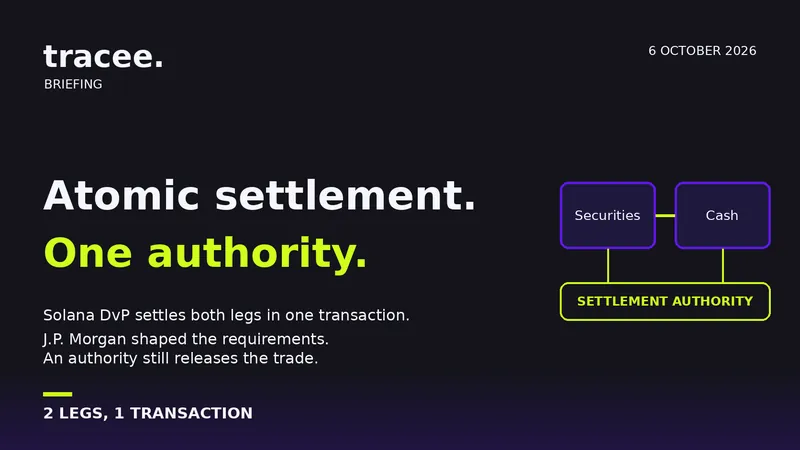
Solana DvP is an MIT-licensed, audited escrow that releases a securities leg and a cash leg in one transaction. J.P. Morgan advised on requirements, but a single settlement authority still triggers release and privacy features are not yet shipped.
Read briefingFiserv's platform is live with Roughrider Coin, a permissioned Solana token for 90+ North Dakota banks. No volume, supply or reserve figure is published.
Read briefingNeither grant buys a live payment. Both fund the governance and reconciliation systems behind pilots that were already running on Stellar.
Read briefingQuant was named vendor for the tokenized deposit network 25 US banks are building, closing the watchpoint tracee flagged in June. No blockchain has been named yet.
Read briefingThe Fed proposed GENIUS Act reserve, capital and application rules seven months after the OCC and five after the FDIC. None of the three is final yet.
Read briefingBMO, CIBC, National Bank, RBC, Scotiabank and TD signed a joint statement to explore a shared CAD tokenized deposit, with no platform, vendor or date named yet.
Read briefingThe ECB and 27 EU central banks want MiCA's 60% bank-deposit quota gone, replaced by a liquidity test, and the stablecoin yield ban widened to lending and staking.
Read briefingPontes went live with 13 banks and four DLT operators settling wholesale tokenised assets in central bank money. Trading runs 8am to 4pm CET only; round-the-clock operation waits until 2028.
Read briefing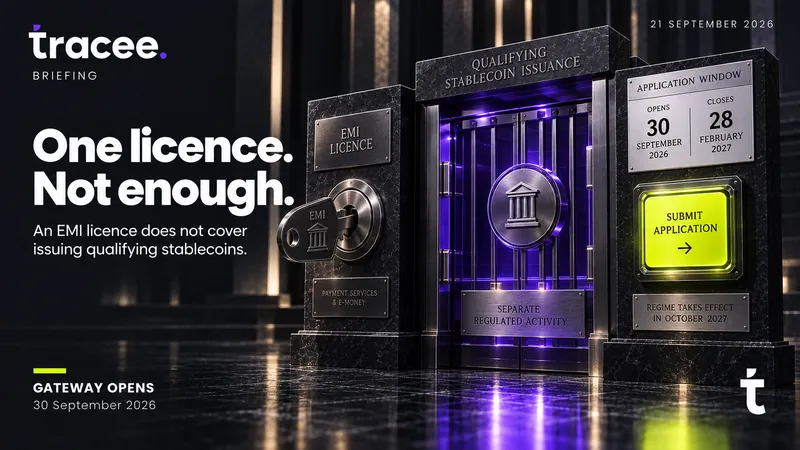
PS26/18 clarifies which of five newly regulated activities, issuing qualifying stablecoins included, an EMI licence does not cover. The application gateway opens 30 September 2026 and closes 28 February 2027, ahead of the regime taking force in October 2027.
Read briefing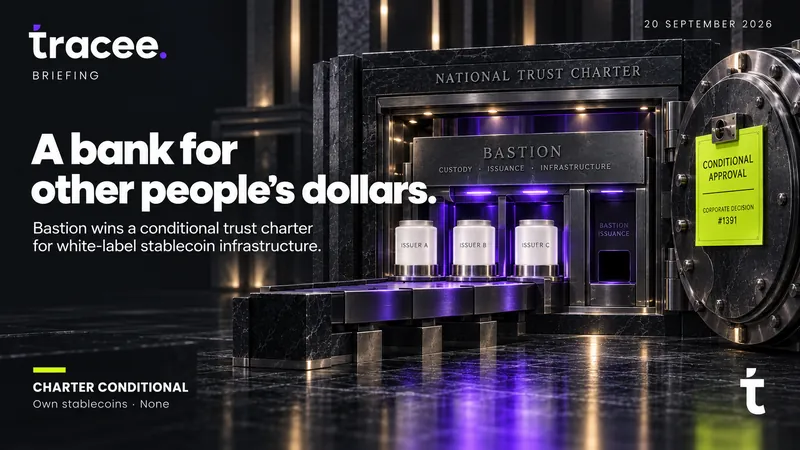
The OCC conditionally approved Bastion's national trust charter on 18 September, Corporate Decision #1391. Bastion custodies and runs white-label issuance rails for other companies' stablecoins; it issues none of its own.
Read briefing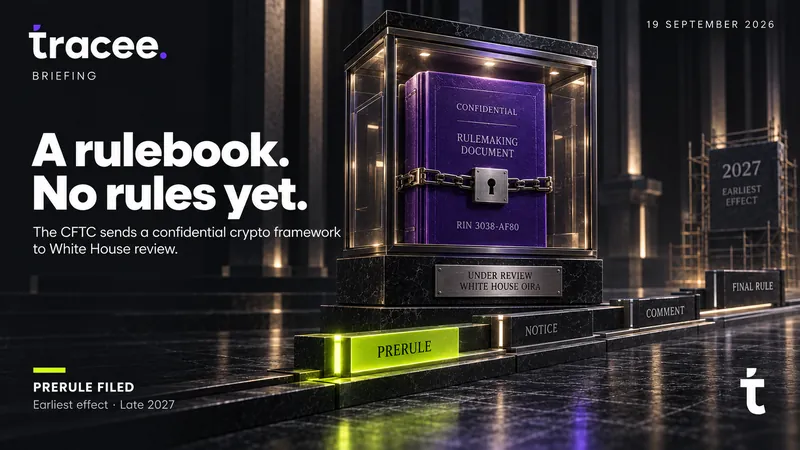
The CFTC submitted RIN 3038-AF80 to the White House OIRA on 17 September, two days after the Senate's Clarity Act cloture vote failed 49-50. The rule text is confidential, the filing sits at the earliest prerule stage, and nothing binds anyone before late 2027.
Read briefing
The SEC's Innovation Exemption lets Tokenized Securities Venues trade tokenized NMS stock on permissioned AMMs for five years, two days after the Senate's Clarity Act cloture vote failed 49-50. Only full-rights tokens qualify, issuers get a 30-day veto, and no venue is live yet.
Read briefing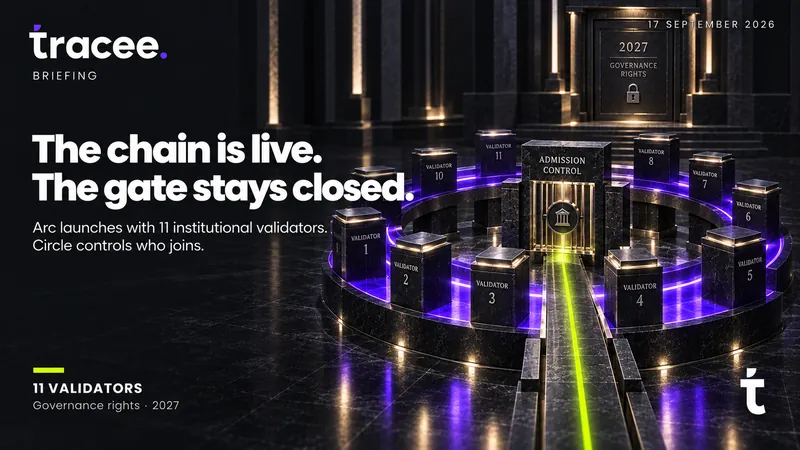
Circle's Arc mainnet went live with 11 institutional validators, BlackRock and Visa among them, USDC as gas, and sub-second finality. Circle alone still controls validator admission, and ARC carries no governance rights until a 2027 Proof-of-Stake transition.
Read briefing
123 industry responses later, FCA and Bank of England back tokenised collateral first and let stablecoins settle trades only inside a supervised sandbox, ahead of a roadmap due later in 2026.
Read briefing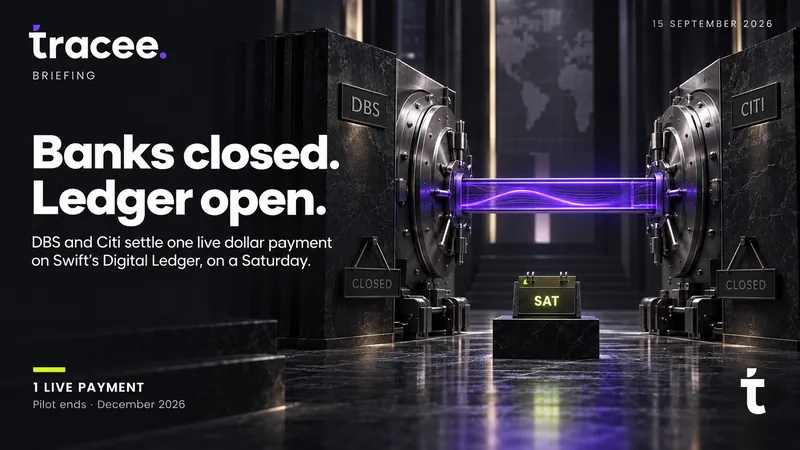
DBS and Citi settled a live USD payment via tokenized deposits on Swift's Digital Ledger in minutes on a Saturday. The pilot carrying it is scoped to end in December 2026, with no size disclosed and no graduation date announced.
Read briefing
Canada's OSFI ruled tokenized deposits aren't legally distinct from ordinary ones, no new license, no new legal wrapper, while the FDIC still relies on a proposed rule and the US bank consortium targets 2027.
Read briefing
SEBI and RBI settled three corporate bond issuances, REC, Larsen & Toubro and IIFL Finance, worth ₹1,025 crore, atomically against India's wholesale digital rupee. No secondary market exists yet, and investors don't hold their own keys.
Read briefing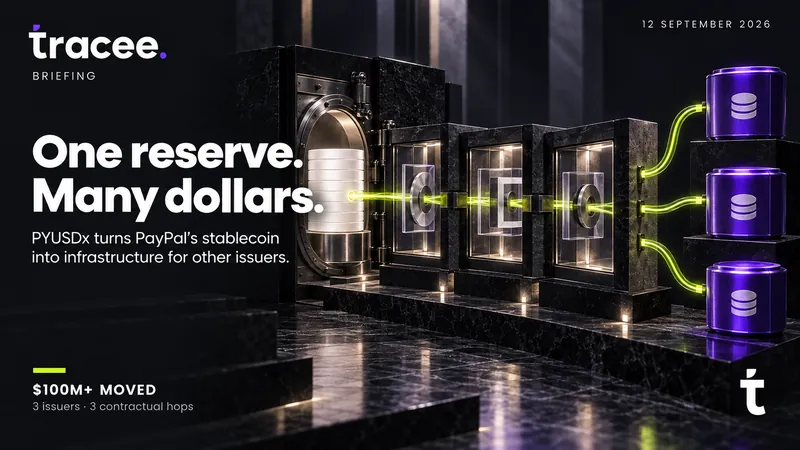
PayPal, M0 and MoonPay took PYUSDx public: an infrastructure platform that wraps PYUSD into branded, company-issued stablecoins. Three issuers, Saturn, Concrete and Cap, already moved over $100M through it, three contractual hops from the Paxos reserve behind it.
Read briefing
Coinbase and Moov gave 1,000-plus community banks and credit unions stablecoin payment infrastructure five days before the Senate's Clarity Act cloture vote. No bank is named, no corridor is disclosed, and no customer is live yet.
Read briefing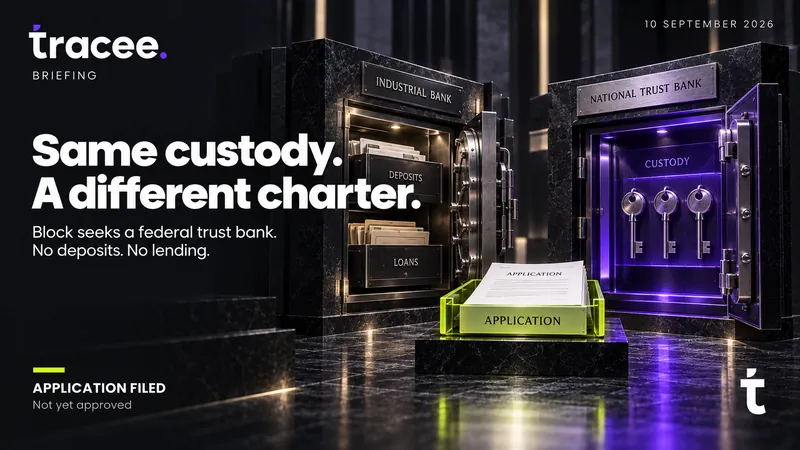
Block filed 4 September for a second bank charter, Builders Bank, an uninsured trust bank barred from taking deposits or making loans. It would be the seventh OCC-chartered crypto custody bank, filed months ahead of the SEC's pending "qualified custodian" rule.
Read briefing
Broadridge's Distributed Ledger Repo platform, already moving $351 billion a day, added G7 government securities to a collateral list that had been US Treasuries only. The scale was never the open question; what it can hold is.
Read briefing
ECB Executive Board member Isabel Schnabel told Jackson Hole that central banks must put their own money on-chain or lose the settlement layer to dollar stablecoins. Three weeks later, Project Pontes dropped its pilot label and set a 21 September go-live, with Clearstream and Axiology among the first outside platforms connecting.
Read briefing
South Korea's FSC unveiled a three-phase roadmap for tokenized securities, with legal recognition for institutional funds, bonds and unlisted shares effective 4 February 2027 and no new license required. Phase three, stablecoin settlement, waits on a law Korea hasn't passed.
Read briefing
21 banks, from Bank of America to MUFG, committed to build a jointly owned dollar stablecoin company, three days after the BIS told Jackson Hole that tokenized deposits should carry payments instead. No name, governance, or licence yet, and two of the European members already back a rival euro consortium.
Read briefing
Japan's FSA filed a formal tax reform request to exempt trust-type stablecoins from filing a tax report every time a beneficiary changes, a rule built for family trusts that breaks down for a token that moves all day. The fix, subject to Diet approval, takes effect 1 April 2027 at the earliest and today applies to exactly one issuer, JPYSC.
Read briefing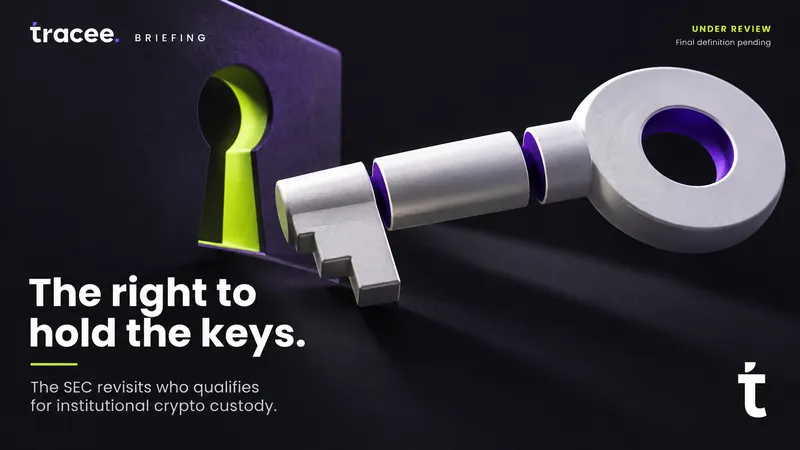
The SEC sent "Amendments to the Custody Rules" to the White House on 25 August, reviving a crypto custody rewrite that died under Gensler in 2025. The narrower version blesses multi-sig and MPC custody and will decide which providers count as a qualified custodian for institutional crypto.
Read briefing
BIS General Manager Pablo Hernandez de Cos told the Fed's Jackson Hole symposium that stablecoins aren't credible as payment at scale, restating the BIS's own June and July research in his own voice. The same week, Revolut and Standard Chartered both shipped stablecoin distribution instead of tokenized deposits.
Read briefing
Standard Chartered announced it is the first bank distributor of HKDAP, Hong Kong's first regulated HKD stablecoin. The Hong Kong Monetary Authority licensed only 2 of 36 applicants, and Standard Chartered is the largest shareholder of Anchorpoint, HKDAP's issuer, so the "first" claim rests on a field of one possible competitor.
Read briefing
Revolut began rolling out EURR to customers in Denmark, Poland and Portugal while delisting Tether's USDT across the EEA under MiCA. Bridge, the Stripe-owned infrastructure firm, issues the token and holds the reserves; Revolut only distributes, a split every other neobank can now copy.
Read briefing
A Dallas Fed research note estimates tokenized deposits could cut US banks' interest-rate-risk absorption capacity by up to $700 billion and maturity-transformation capacity by $580 billion, landing the same week Wells Fargo, the 39-association BankChain Alliance, and JPMorgan's JPM Coin turned the underlying behavior from research assumption into shipping product.
Read briefing
FASB's 18 August 2026 proposal would let stablecoins meeting a three-part redemption and reserve test sit on the cash-equivalents line, with comments due 19 November and no effective date set. The GENIUS Act's Section 3(g) already bars any stablecoin from a non-permitted issuer from that treatment, and the regulators deciding who becomes a permitted issuer are themselves still working from proposals.
Read briefing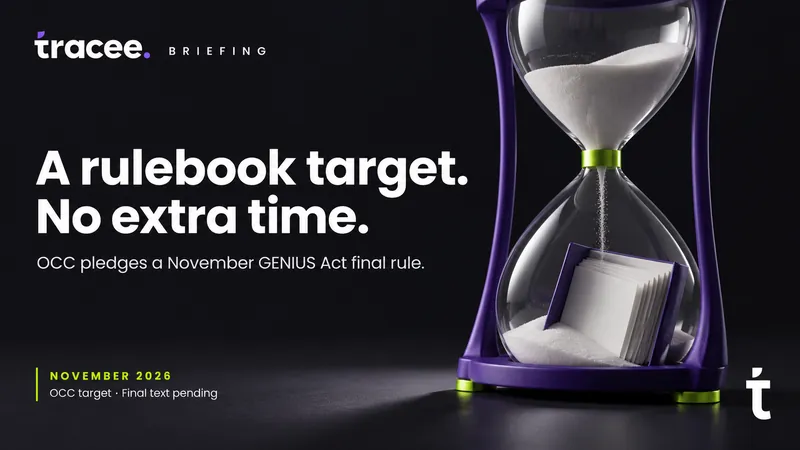
OCC Comptroller Jonathan Gould pledged a final GENIUS Act rule by November, the first of five required regulators to name a date. Because the statute's effective date is the earlier of 120 days after a final rule or January 18, 2027, the pledge does not move the compliance runway, it only determines whether issuers have a finished rulebook before it ends.
Read briefing
Treasury proposed a rule defining when a stablecoin is "issued in the United States" and "offered or sold" to a US person, borrowing from Regulation S and extending potential liability to exchanges. It is a 60-day comment period NPRM, not a final rule, and outside analysts have used Tether's own reserve attestation to size a roughly $47 billion compliance gap.
Read briefingDeel expanded DLUSD, its dollar-denominated payroll balance issued through Stripe-owned Bridge and settled on Tempo, from Argentina to over 80 countries in eleven weeks. Because DLUSD is closed-loop and can never leave Deel's platform, it avoids most of the licensing and reserve-disclosure obligations that apply to transferable stablecoins.
Read briefing
KPMG issued an unqualified opinion on Tether International's FY2025 financial statements, its first full audit after two years of quarterly attestations, confirming roughly $141 billion in US Treasury holdings, physically verified gold reserves, and a $6.814 billion surplus of assets over liabilities. The audit report itself has not been made public.
Read briefing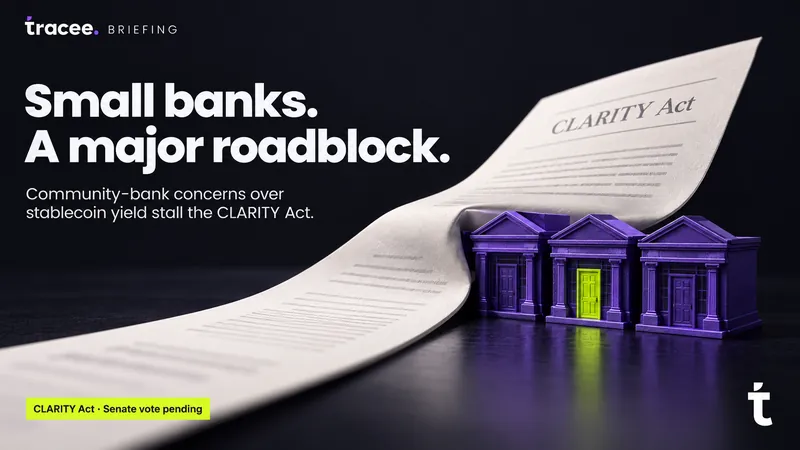
The Senate recessed on 10 August without a floor vote on the CLARITY Act after Senators Josh Hawley and Jerry Moran broke ranks over a stablecoin yield provision community banks say still lets issuers pull deposits from local lenders. The next vote is targeted for 15 September.
Read briefing
The Central Bank of Ireland approved Schroders' SOAR share class, a tokenised money market fund built on J.P. Morgan's Kinexys platform. It is the first time Kinexys has carried a third-party active manager's fund rather than a J.P. Morgan product, cleared through an EU regulator instead of the SEC or OCC.
Read briefing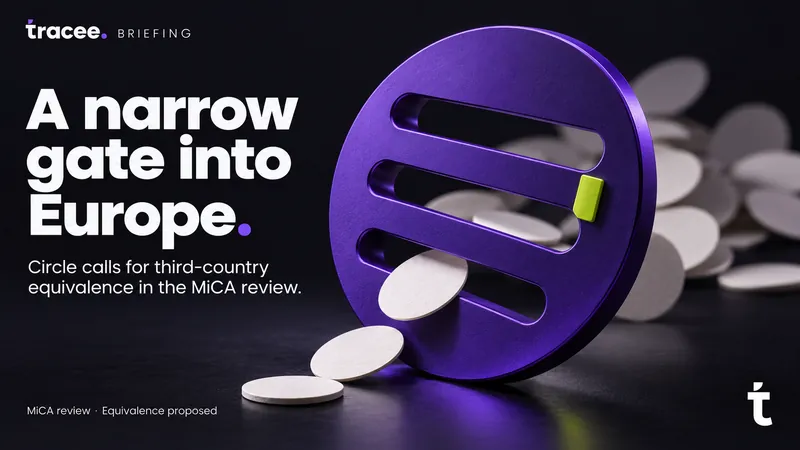
On the second anniversary of its own MiCA authorization, Circle disclosed that only 3 of the world's top 50 stablecoins are MiCA-compliant, and publicly pushed the European Commission's live review toward a third-country equivalence mechanism that would ease its own competitors into the EU market.
Read briefing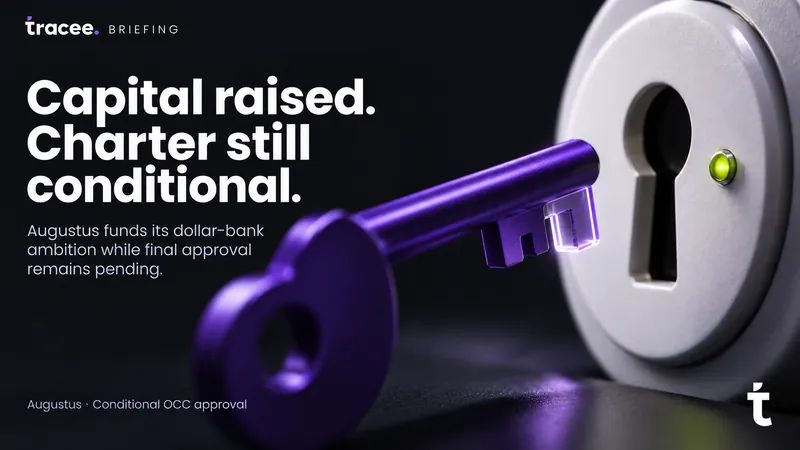
The Finland-based euro clearing business behind the raise is real and revenue-generating. The dollar clearing business the valuation is priced on is not: the OCC charter is conditional, not final, there is no disclosed Federal Reserve master account, and this is the eighth such conditional approval since 2010, not a first.
Read briefingBNY moved Treasury-backed reserves tied to Ripple's RLUSD and OpenEden's USDO after Fedwire Securities Service's daily close. Both issuers already custody with BNY, which is why the test worked without a third bank involved, and BNY is targeting always-on Treasury settlement in 2027.
Read briefing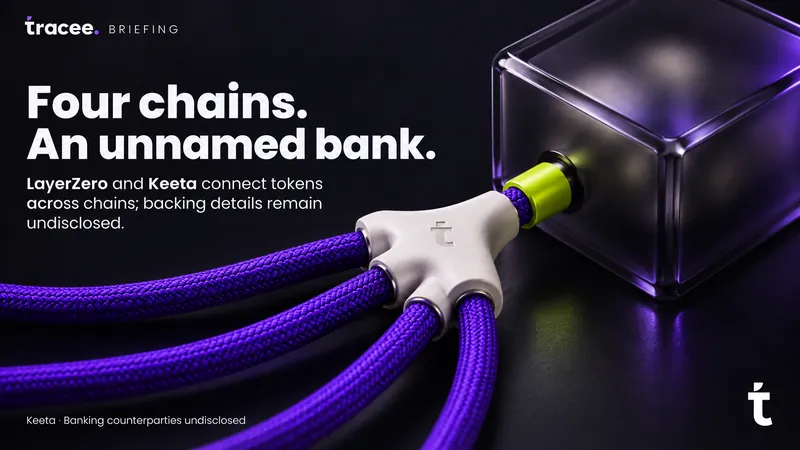
Keeta Stablecoins move natively across Keeta Network, Ethereum, Solana and Base via LayerZero's Omnichain Fungible Token standard. The backing runs through Bivo, a money transmitter, not a chartered bank, and no partner bank, deposit insurance status, or redemption terms are disclosed.
Read briefing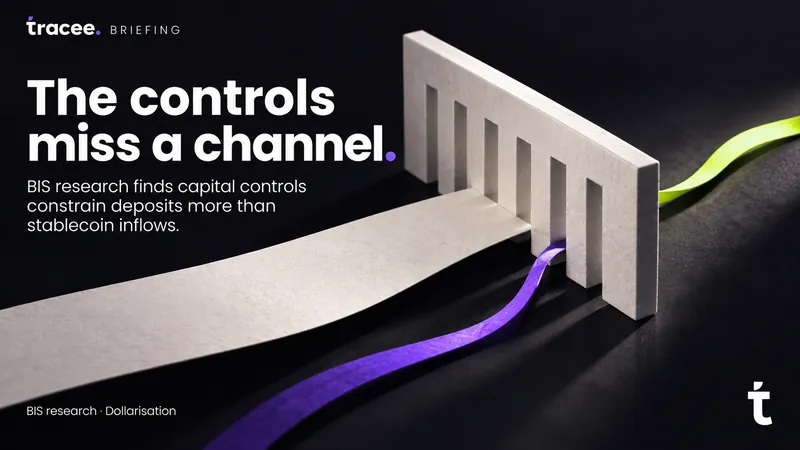
Countries requiring approval for residents to hold foreign-currency bank accounts show dollarization ratios 25 to 32 percentage points lower than countries without that rule. Dollar-stablecoin inflows across the same 184 countries show no comparable gap, the capital-control lever that restrains deposit dollarization does not reach the stablecoin channel.
Read briefing
Section 20's effective date, the earlier of 18 January 2027 or 120 days after final rules issue, is untouched by the miss. Two of the five comment periods do not close until August, leaving roughly nine weeks for the early-trigger path to still matter before the statutory backstop takes over.
Read briefing
None of the ten recommendations is binding, and the roadmap creates no mutual recognition between the two regimes: a stablecoin issuer licensed in one country still needs separate authorization in the other. The reserve-standard convergence follows directly from tracee's own July 4 briefing on the IMF's fragmentation warning, narrowing the gap between exactly two of the three regimes it named.
Read briefing
Open USD is not yet live; Open Standard has said its native Solana launch comes later in 2026. Circle shares fell roughly 5% on the news anyway, compounding a roughly 15% drop after Open Standard's June 30 launch, and Mizuho downgraded Circle to Underperform on July 14 citing the reserve-income threat directly.
Read briefing
JPYSC's own issuer and co-developer had already committed the token to Startale's Strium L1 in June, and Progmat already moved more than ¥439.6B in tokenized assets onto Avalanche the same month. The megabank consortium's October 2026 blockchain decision now has three Japanese chain bets to weigh instead of one.
Read briefing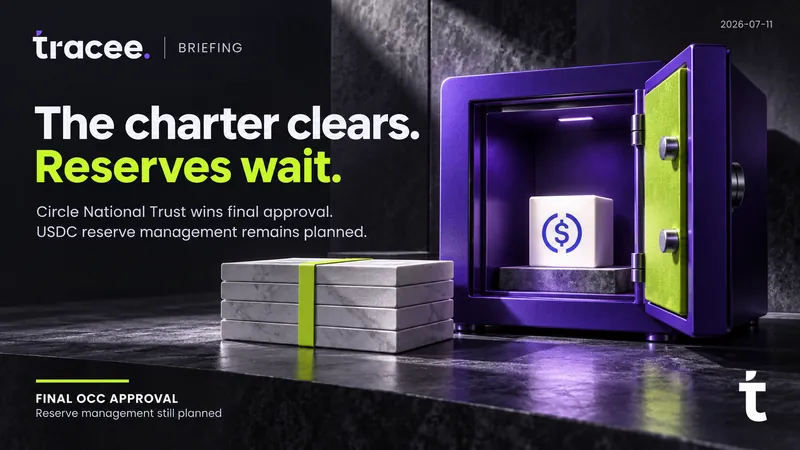
The new bank custodies digital assets for Circle and its own affiliates under direct federal supervision. USDC reserve management stays with BNY Mellon and is described only as a planned future capability, and the charter does nothing to answer Open USD, the fee-free, yield-sharing stablecoin backed by Stripe, Visa, and over 140 other firms targeting a Solana launch later in 2026.
Read briefing
The ledger moves tokenized deposits 24/7, including weekends and overnight, running on a permissioned Linea-style network with Chainlink CCIP as its interoperability layer. Final settlement still clears through SWIFT's existing correspondent banking rails, and no live transaction has been disclosed. The pilot shares several banks with The Clearing House's competing tokenized deposit network, targeting a first-half 2027 launch.
Read briefing
tracee's July 7 Bridge briefing flagged whether Circle, Ripple, or Paxos would pursue the same CASP-plus-EMI structure in Luxembourg. Four days later, Ripple did, though it built the pair sequentially over six months rather than in one filing, and its passport reaches three more markets than Bridge's. RLUSD, Ripple's $1.7B stablecoin, is not listed in ESMA's e-money token register, so it still cannot trade on regulated EU venues despite the completed license stack.
Read briefing
MiCA's transitional period closed June 30; two days later, Bridge became the entity holding both a CASP authorization and an EMI license from the same Luxembourg regulator. Most stablecoin platforms still split those two relationships across a crypto license and a separate banking partner. Bridge collapsed them into one filing covering all 27 EU states, nine days after Ripple's own preliminary CASP grant from the same regulator. No branded stablecoin has shipped on Bridge's rails yet, and whether Bridge is genuinely the first non-bank platform to combine both licenses in one entity remains unconfirmed.
Read briefing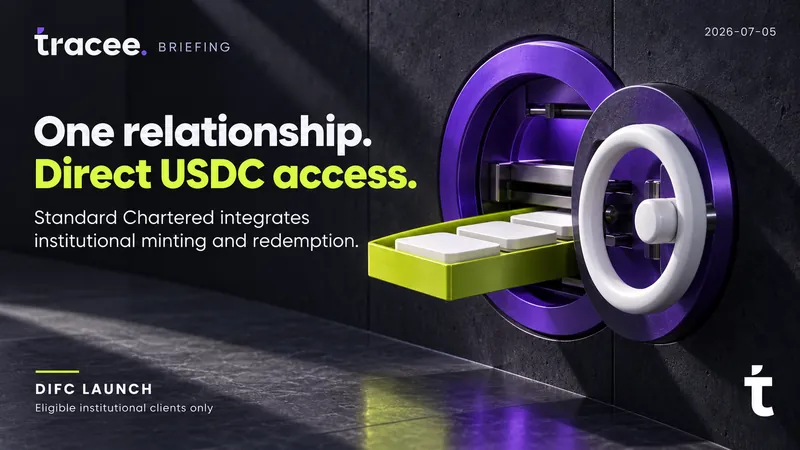
Standard Chartered did not build a stablecoin. It built the first G-SIB-grade door into one, folding the second account institutional clients used to need with Circle into their existing banking relationship. Zodia Markets, the bank's existing digital asset venue, already cleared $4B in net USDC minting volume in 2024, so the launch formalizes a channel more than it opens one. For now it is a single-jurisdiction pilot: DIFC-eligible clients only, with an expansion promise and no date attached.
Read briefing
The IMF's contribution isn't new data. It is the first time a multilateral institution has placed tokenized deposits, stablecoins, and wholesale CBDC on equal footing as rival settlement assets, and admitted the fragmentation risk it warns about is already live: the GENIUS Act's 100% T-bill reserve rule and MiCA's 60% EU bank deposit floor already force Circle to run two separate reserve pools. No standard-setter, working group, or timeline has been named to prevent it.
Read briefing
EURXT is not built to trade. It is built to settle CACEIS's own tokenised fund subscriptions, giving it captive volume from day one that SG-FORGE's EURCV and Circle's EURC still have to build through FX desks and exchange listings. Crédit Agricole becomes the second major French bank, after Société Générale, to issue its own MiCA euro token rather than wait on the 37-bank Qivalis consortium, still without a De Nederlandsche Bank licence. Euro stablecoins remain roughly 0.3% of the global stablecoin market; EURXT does not move that share, but it adds a second large bank betting on its own balance sheet over a shared utility coin.
Read briefing
The FCA's 30 June rules and the Bank of England's 22 June rules are two tiers of one UK stablecoin regime, not two separate regimes. Qualifying (non-systemic) issuers get 1% capital, a 10% core-asset floor, and next-business-day redemption. Systemic issuers, once HM Treasury designates them under the Banking Act 2009, face 70% gilts, 30% unremunerated Bank of England deposits, a £40B issuance cap, and 24-hour redemption. HM Treasury's systemic test has no published quantitative threshold, so issuers cannot underwrite the crossover between the two tiers.
Read briefing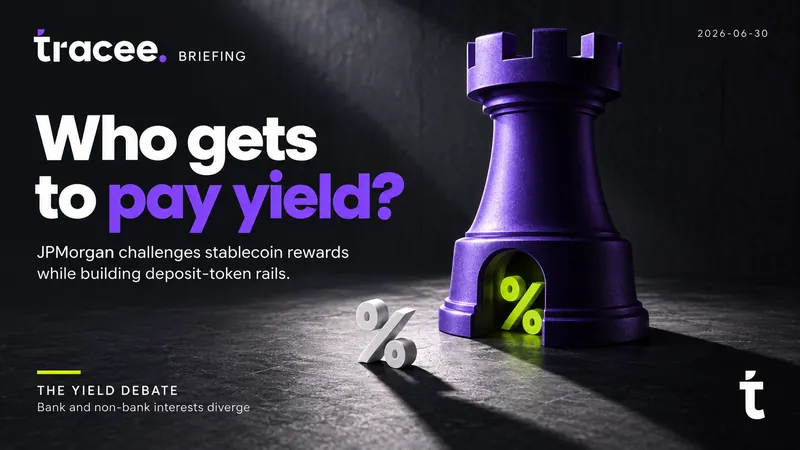
JPMorgan is not neutral on Clarity Act yield provisions: it operates Kinexys, is building JPMD (a deposit token that can pay yield), and anchors the TCH tokenized deposit network targeting 18 banks and H1 2027. Galaxy Research cut Clarity Act passage odds to 50% citing Senate calendar constraints. The GENIUS Act has already settled the bank track: no licensed Payment Stablecoin Issuer can pay yield. JPMorgan's shadow banking label targets the non-bank Clarity Act track. The TCH network, if it clears H1 2027, provides the yield-bearing alternative inside the regulated perimeter.
Read briefing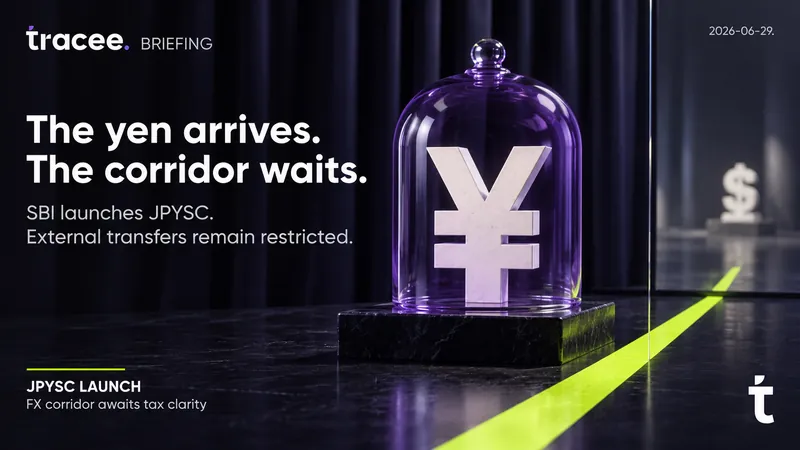
Japan's June 1 Payment Services Act amendment created two trust-type stablecoin categories: the foreign pathway (USDC, RLUSD) and the domestic Type III (JPYSC). Before June 24, the yen slot was empty. JPYSC fills it: no transaction cap, trust law asset segregation, up to 50% JGB reserves. SBI VC Trade is Japan's sole EPSP for trust-type distribution, making SBI the only group sitting on both the dollar leg (USDC distribution, RLUSD listing) and the yen leg (JPYSC issuance). Japan's NTA has not published guidance on stablecoin-to-stablecoin conversion taxation. Until it does, no yen-dollar liquidity pool can trade.
Read briefing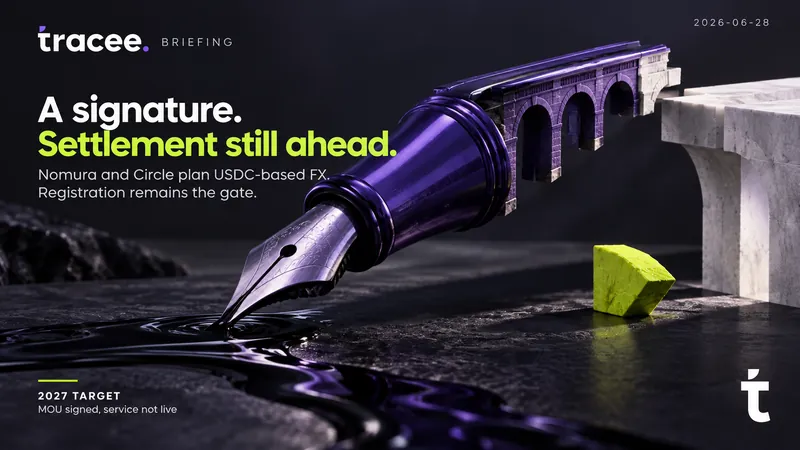
The Circle-Nomura MOU is the first institutional-grade commitment to use USDC as an FX settlement instrument in Japan, not as a retail payment token. Nomura, Japan's largest brokerage with 80,000-plus institutional clients, supplies the compliance infrastructure, Bank of Japan settlement connectivity, and regulatory relationships that Japanese corporations require. Japan's June 1 PSA amendment created the trust-type stablecoin framework; Nomura's pending EPSP registration is the single gate between this announcement and any live FX transaction. The yen-to-dollar correspondent banking chain has seven hops; the USDC chain has one.
Read briefing
Euroclear, which settles more than $37 trillion in securities annually across 90+ markets, has designated SG-FORGE's USDCV as the candidate cash leg for USD-denominated NEU CP settlement on DLT. This is the first time a global central securities depository has formally designated a bank-issued, MiCA-regulated stablecoin as the settlement cash for a fixed-income instrument class. The structural opening was created by the Federal Reserve's absence from wholesale CBDC infrastructure, a gap that will remain after Congress banned any Fed CBDC through 2030. USDCV's MiCA authorization makes it the only dollar stablecoin with a fully EU-regulatory basis for institutional use inside European financial market infrastructure, particularly after MiCA's July 1 transitional period closure removes Tether USDT from EU licensed markets.
Read briefing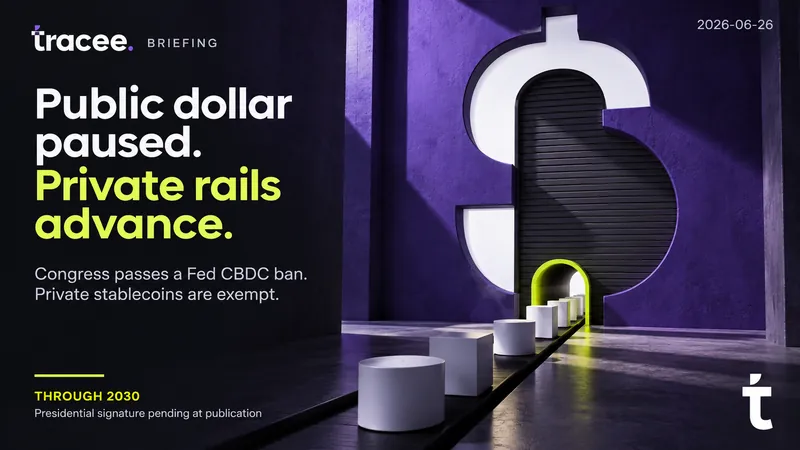
On June 22, 2026, the US Senate passed the 21st Century ROAD to Housing Act 85-5, with the House having cleared it 358-32. Buried in Section 1001: a four-year prohibition on any Federal Reserve CBDC. The Fed cannot issue, develop, or pilot a retail or wholesale digital dollar until at least 2030. Private stablecoins are explicitly exempt. The GENIUS Act, signed in July 2025, had already created a licensing framework for private stablecoin issuers. The CBDC ban makes that framework the only path for a regulated digital dollar in the United States. What had been a regulatory choice is now a statutory mandate. The architecture decision for the US dollar has been made by Congress, not by the Fed, and not by the market.
Read briefing
On June 23, the BIS published Chapter III of its Annual Economic Report, the most authoritative annual statement on global monetary architecture. The chapter diagnoses three structural failures in current stablecoins: singleness (par redemption is not contractually guaranteed at scale), elasticity (supply cannot respond to monetary policy), and integrity (secondary-market AML/CFT coverage is structurally absent). The BIS proposes a two-layer answer: wholesale CBDC ledgers for interbank settlement, layered with tokenized commercial bank deposits for retail transactions, integrated through a shared unified ledger. This is not a discussion paper. Annual Economic Report chapters represent multilateral central bank consensus. Any regulator citing singleness, elasticity, and integrity as design requirements is operationalizing the BIS framework.
Read briefing
On April 17, ESMA confirmed: MiCA's transitional period closes July 1, 2026 with no extension. The result is a bifurcated market. Tether, the global dollar stablecoin leader, exits EU licensed spot platforms rather than comply with the 60% EU bank deposit reserve requirement. Circle, which spent two years securing dual authorization (ACPR EMT issuance plus AMF CASP distribution), becomes the sole top-10 licensed dollar stablecoin issuer in the EU. Over 80% of CASPs remain unlicensed entering the deadline. The architecture is narrow, and its durability depends on NCA enforcement velocity now that NCAs can no longer defer.
Read briefing
On 22 June, the Bank of England published its Policy Statement and draft Code of Practice for sterling systemic stablecoins, completing the reserve architecture the November 2025 consultation left open. Per-user holding limits are dropped. In their place, a £40 billion temporary issuer guardrail per systemic coin. The defining rule is 70% short-dated UK gilts, 30% unremunerated overnight deposits at the BoE: the 30% earns nothing, anchoring redemption certainty at the cost of yield. The GENIUS Act has no equivalent: US issuers earn T-bill yield on 100% of reserves. The yield gap is approximately 130 basis points per year. Final Code at year-end 2026; FCA authorization opens September 2026; full regime live October 2027.
Read briefing
Five US agencies jointly published the GENIUS Act's CIP rule on June 22, completing the stablecoin supervisory architecture in draft form alongside the FDIC's June 9 deposit insurance line and the OCC's June 12 reserve reporting forms. The rule requires all PPSIs to verify the identity of every direct account holder at issuance. Secondary-market flows, the majority of stablecoin transaction volume by count, sit outside the CIP perimeter by design. Fed Chair Warsh abstained from the five-to-one vote; Gov. Barr entered a written concern about illicit finance in secondary markets into the official record. Comment period closes August 21; OCC final rules are due July 18.
Read briefingHKEX and HKMA ran a real-value pilot on 19 June using wholesale e-HKD to settle advance margin at the HKFE Clearing Corporation Limited, with HSBC and Bank of China (HK) as pilot banks. The 3pm HKT interbank deadline that blocked same-day margin funding for the After-Hours Trading session no longer applies to e-HKD, which runs continuously. HKCC clears 1.78 million derivative contracts per day. Broader Clearing Participant adoption requires SFC and HKMA regulatory approval; no timeline has been given. The DLT architecture and margin volumes are undisclosed.
Read briefingHIFI, DRW, and Marex completed the first competitive onchain repo on Canton on 17 June, settling U.S. Treasuries against USDCx in seconds with Tradeweb RFQ pricing and a prime broker in the structure. The cash leg runs fiat through RTP to USDC to USDCx, reversing automatically at maturity. Before this trade, onchain repo was theoretical. After it, the $12.6 trillion daily U.S. repo market has a live commercial answer with market-standard pricing and atomic settlement. DTCC's October 2026 Canton go-live and its cash-leg decision are the next gates.
Read briefingOn June 16, China's e-CNY Centre International signed 26 institutions as CBETS direct participants for live cross-border digital yuan settlement in eight corridors. Standard Chartered Bank (China) is the only non-Chinese institution in cohort one. CBETS fills the commercial bank layer that mBridge, China's central bank multi-CBDC platform with $55B in annual volume, was not designed to cover. Together they form a two-layer CNY settlement architecture that now reaches the same corridors where USD-denominated stablecoins are scaling: UAE, Brazil, Singapore, Thailand, Qatar. No FX conversion layer was announced. No volume data published. The rails are live; adoption is the open question.
Read briefingTrace Finance raised $32M to scale the regulated bank infrastructure layer that connects stablecoins to local payment rails in emerging markets. In Brazil, that means a BCB FX license, Pix connectivity, and a compliance stack already processing $10B+ for the top four global payment platforms in Latin America, including dLocal. The Paxos investment and Itaú Vice Chairman's angel participation both signal the same thing: neither the stablecoin issuer nor the incumbent bank will build this bridge themselves. BCB reclassification of crypto cross-border flows as FX operations is the structural moat. APAC expansion (Philippines, Indonesia) is roadmap, not product.
Read briefingOn June 16, 2026, State Street Investment Management launched SSCXX, a Rule 2a-7 government money market fund built explicitly as a GENIUS Act reserve management vehicle. Anchorage Digital Bank N.A., the sole federally chartered crypto bank, anchored the fund at launch and opens a pipeline to up to 20 stablecoin issuers. Five major custodians (BlackRock, Goldman Sachs, BNY, JPMorgan, State Street) have now converged on an identical reserve product design before the stablecoin market has materially scaled. Distribution, not product design, is the differentiator. The OCC final rule due July 18 sets the number of licensed stablecoin issuers and thus the total addressable reserve management market.
Read briefingOn June 10, 2026, Mastercard launched AP4M and Visa disclosed $70B annualized stablecoin settlement on the same day. Both card networks crossed from passive stablecoin settlement to active agentic identity and permissioning infrastructure in a single news cycle. AP4M issues machine-grade payment credentials anchored on Polygon, Solana, and Base, with USDC and RLUSD as the settlement stablecoins. The OCC final rule due July 18 determines whether USDC and RLUSD can operate as fully licensed PPSIs, making it the single gate for the commercial rollout.
Read briefingThe OCC published draft PS-01 weekly reserve forms and PS-02 quarterly financial condition forms for all Permitted Payment Stablecoin Issuers on June 12, 2026. The weekly cadence positions PPSI supervision closer to bank liquidity reporting than to investment fund disclosure. The 6,308-hour annual burden estimate is the first published measure of what federal stablecoin compliance costs to operate: a rounding error for Circle at $75.5B, a real barrier for sub-$500M entrants. The forms are drafts; "trading volume" is undefined. Five conditional OCC charter holders (Circle, Paxos, Ripple, BitGo, Fidelity) remain pre-approval until July 18.
Read briefingDigital Asset raised $355M led by a16z on June 11, with ADIA, Apollo, BNP Paribas, HSBC, Citadel Securities, and Tradeweb among 25-plus institutional investors. Canton processes $4T monthly volume. DTCC's Treasury tokenization on Canton targets October 2026 for expanded go-live. The investor list is also the participant list: every named institution has operational exposure to Canton already. The cash leg for DvP on Canton is unresolved; OCC GENIUS Act final rules on July 18 set the competitive perimeter. CEO Yuval Rooz confirmed acquisitions as a use of proceeds, with Fnality and Partior as the most structurally proximate targets.
Read briefingKfW issued its third eWpG blockchain bond on June 9, EUR 100M, with three experiments scheduled during the bond term: a chain migration from Polygon to SWIAT/RL1 (autumn 2026), a registrar change from Cashlink to DekaBank, and coupon and repayment cash flows via ECB Pontes before its Q3 2026 official launch. KfW also independently managed its own DvP blockchain address for the first time, removing a custodian dependency. The Pontes commitment is the structural move: it creates a real-money deadline for ECB infrastructure that no policy schedule can reschedule. Three experiments planned; none complete yet.
Read briefingThe FDIC's comment period on its GENIUS Act proposed rule closed June 9 with 338 submissions. The ruling confirms two legal classes of digital dollar: bank deposit tokens issued by chartered, FDIC-insured banks remain insured deposits regardless of the technology used to record them; stablecoin holders receive no pass-through FDIC coverage. The Bank Policy Institute, The Clearing House Association, and the Consumer Bankers Association filed jointly welcoming this technology-neutral framing. For institutional fiduciaries who require FDIC coverage, the TCH tokenized deposit network has a structural pitch that no non-bank stablecoin issuer can match. For payment corridors and humanitarian rails, FDIC insurance is irrelevant and stablecoins retain all their advantages. The architecture has split cleanly. OCC final rules due July 18 complete the framework.
Read briefingRipple's RLUSD expanded to 40+ blockchains on June 4 via Wormhole's Native Token Transfers (NTT) standard, reaching a $1.72B market cap as the 8th-largest stablecoin globally. The NTT architecture is the structural event: unlike bridge deployments where a third party controls the synthetic token on destination chains, NTT lets Ripple deploy its own canonical RLUSD contracts everywhere and retain pause, freeze, and whitelist rights across all 40+ chains. This arrived one day after Mastercard added RLUSD to its 24/7 card settlement network and three days after Japan's FSA opened its payment perimeter to GENIUS Act-eligible stablecoins. The three moves together give RLUSD card-rail reach, G7 payment-law eligibility, and multichain DeFi presence under a single compliance framework. Volume has not matched the infrastructure. Bottom line inside.
Read briefingJapan's amended Payment Services Act creates the most portable regulatory framework for foreign stablecoins yet built in the G7: no domestic entity, no domestic reserves, only regulatory equivalence between the FSA and the issuer's home supervisor. Circle already clears the bar via its OCC conditional charter. Tether cannot, without restructuring its legal architecture from the ground up. SBI VC Trade is the sole registered Electronic Payment Service Provider for USDC as of June 1, with a live QR-code payment pilot via APLUS that converts USDC to JPY before merchants settle. The framework is open; the commercial rollout is thin until a second EPSP registers. Bottom line inside.
Read briefing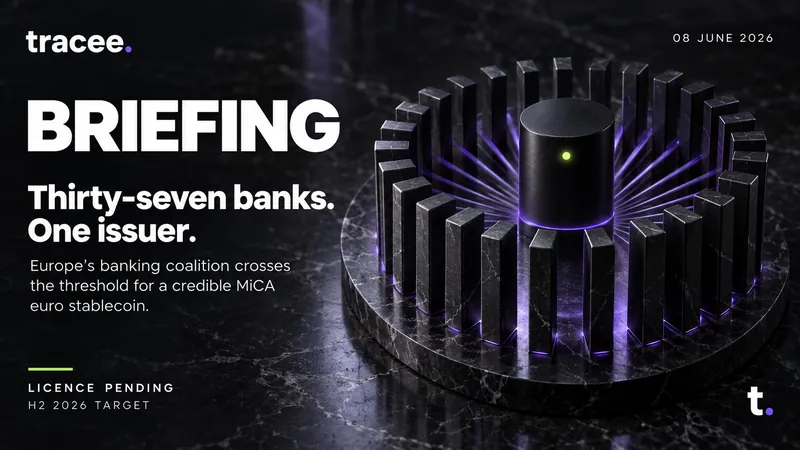
Qivalis crossed a threshold on 20 May that Circle EURC has never crossed: 37 supervised European banks signed as equity shareholders, creating a distribution network before the product exists. New members include ABN AMRO, Rabobank, Nordea, Intesa Sanpaolo, and BNP Paribas. Fireblocks handles tokenisation, wallet, and custody. The DNB EMI licence is the single remaining gate before issuance. Euro stablecoins remain below 0.2% of a $310B market; the ECB digital euro is three years out. The blockchain has not been announced. Bottom line inside.
Read briefing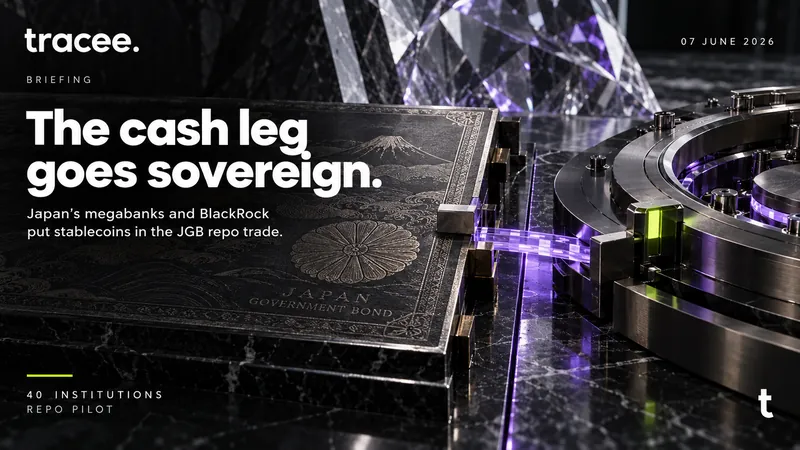
Japan's dominant tokenized securities platform exits R3 Corda and lands on Avalanche L1 in June 2026, making ¥439.6B in tokenized real estate and corporate bonds EVM-compatible for the first time. Simultaneously, Progmat's Digital Asset Co-Creation Consortium has assembled BlackRock Japan, all three Japanese megabanks, Daiwa, SBI, Nomura, State Street, and Tokio Marine in a 40-institution working group targeting stablecoin-settled T+0 repo for Japan's $1.6T JGB market. The WG report is due October 2026; commercial issuance is a year-end 2026 target. The critical unresolved decision: which stablecoin carries the cash leg. Bottom line inside.
Read briefing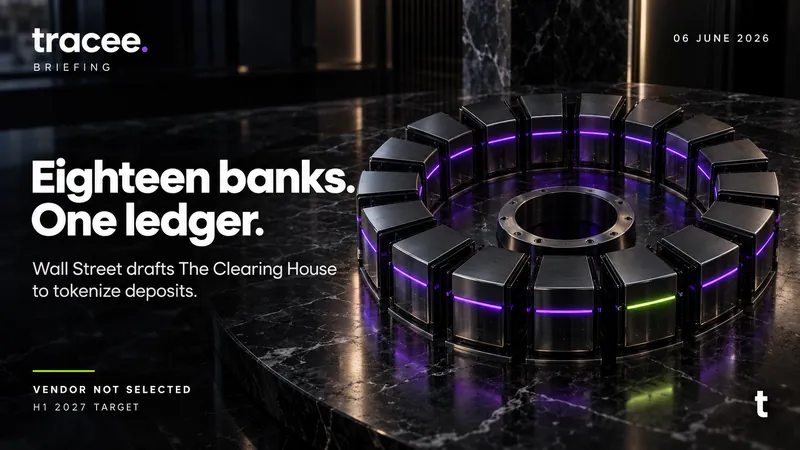
Eighteen US banks, including all four systemic institutions, have committed to a shared tokenized deposit network operated by The Clearing House, targeting a first-half 2027 launch. TCH already runs RTP® and CHIPS®, clearing $2 trillion-plus daily. No blockchain vendor has been selected. The network would keep every dollar inside the regulated banking system while adding programmability and 24/7 settlement. The GENIUS Act's final rules, due July 18, are the gating event that determines whether the regulatory moat this initiative is counting on actually holds. Parallel: Cari Network (five regional banks, ZKsync/Prividium, Q4 2026) is racing ahead on the retail side. Bottom line inside.
Read briefing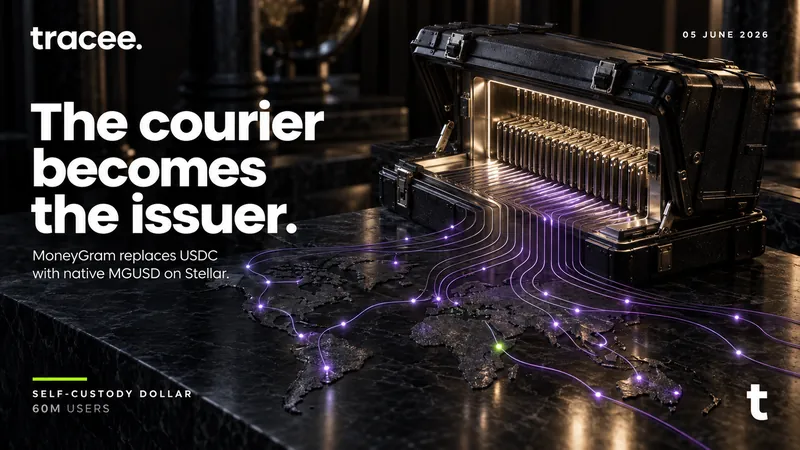
MoneyGram launched MGUSD on Stellar on 2 June 2026, replacing five years of third-party USDC distribution with a native branded stablecoin issued by Bridge, a Stripe company. Twenty-nine days after Western Union launched USDPT on Solana, the remittance duopoly's on-chain migration is complete. The structural move: self-custodial wallets embedded in the MoneyGram app turn a point-to-point transfer network into a persistent dollar savings infrastructure for users in high-inflation corridors. US-only at launch; 200 countries and 500,000 agents are the stated destination. Bottom line inside.
Read briefing
Three weeks after Visa published a $7B annualized run rate on nine blockchains, Mastercard opened its Multi-Token Network to six regulated stablecoins across eight chains and added intraday, weekend, and holiday settlement cycles. The card duopoly is now both legs committed. The T+1 batch window that has governed card settlement since the 1970s is structurally optional for MTN participants. USDT's absence from the roster reflects the GENIUS Act perimeter. The OCC final rule, due July 18, is the next gate. Bottom line inside.
Read briefing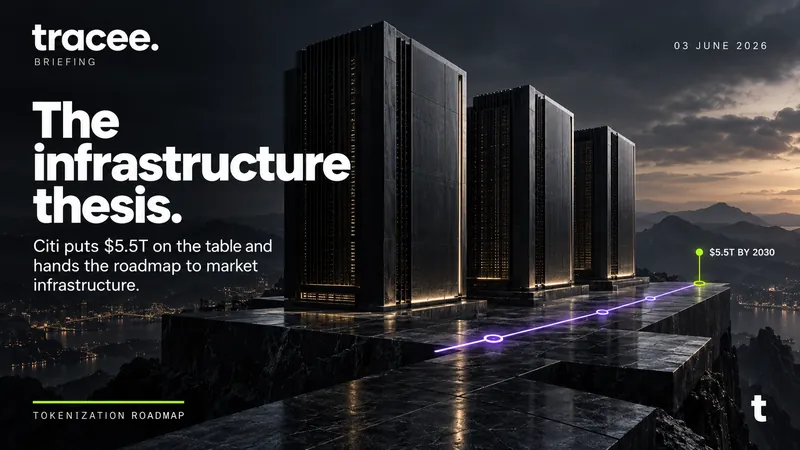
Citi's Tokenization 2030 report projects a $17B-to-$5.5T market by 2030, with DTCC (October 2026), Nasdaq, and ICE named as the infrastructure carriers. The structural engine is a stablecoin-to-Treasury feedback loop: $1.9T in stablecoins by 2030 drives up to $1T in on-chain Treasury reserve demand. Private credit and private equity are honestly capped at $100B each: legal barriers survive tokenization. Every load-bearing assumption is a gating event with a scheduled date in the next twelve months. Bottom line inside.
Read briefing
ECB Executive Board member Isabel Schnabel drew a direct structural parallel between stablecoins and money market funds at the 2026 Bank of Korea International Conference, pointing to the 2008 and 2020 MMF runs as the empirical template. Global stablecoins: $300B, ~99% dollar-denominated, euro stablecoins: 0.3%. She confirmed ECB Pontes for Q3 2026 as the wholesale settlement bridge, endorsed the digital euro as Europe's only legitimate retail response, and implicitly overruled the Banque de France's dissent on euro stablecoins. Bottom line inside.
Read briefing
Eight central banks (Bank of England, FRBNY, Banque de France, Bank of Japan, Bank of Korea, Bank of Mexico, Swiss National Bank, Bank of Canada) and 40+ private banks proved atomic multi-currency cross-border settlement works in simulation. Shared sanctions screening across all participants eliminates the redundant checks that cause most correspondent banking delays. Project Agorá moves to real-value testing with no date or currency pair announced. The cash leg that every tokenized asset pilot has been missing now has a working prototype. DTCC goes live for the asset leg in October 2026. Bottom line inside.
Read briefing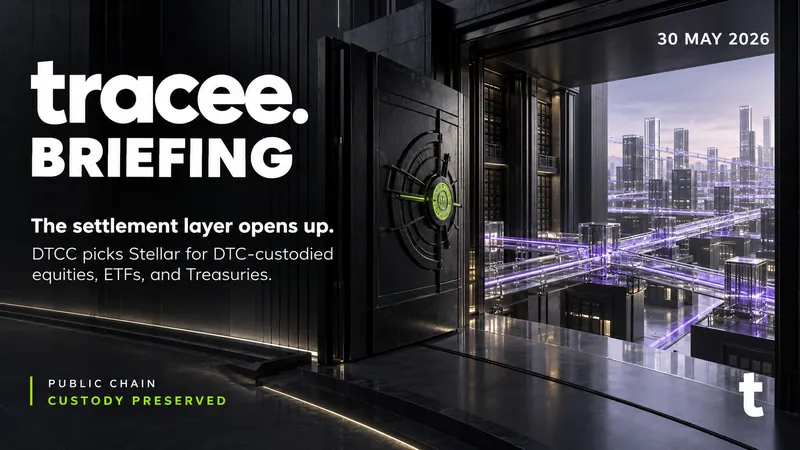
DTCC named Stellar as the first public, permissionless blockchain for DTC-custodied securities on 27 May 2026, with availability targeted for H1 2027. Canton Network (permissioned) goes live in July and October 2026. More than 50 firms including BlackRock, Goldman Sachs, JPMorgan, Ondo Finance, Kraken, and Anchorage Digital are building on the same service. DTC custody is unchanged: every token on every chain is a digital twin of an asset that never leaves DTC's system. The chain choice is a distribution decision. The H1 2027 Stellar integration is the first proof that DTC-custodied assets can live on a genuinely open blockchain. Bottom line inside.
Read briefing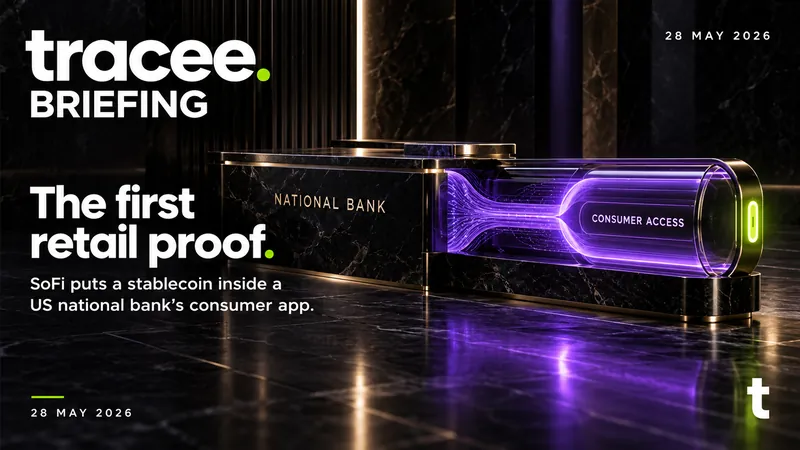
SoFi Bank, N.A. made SoFiUSD available to its 14.7 million consumer members on 27 May 2026, the first stablecoin issued by a federally chartered national bank inside a retail banking app. Reserves sit in a Federal Reserve master account, not a trust company or offshore custodian. The GENIUS Act signed in July 2025 is the regulatory enabler. Mastercard settlement integration means SoFi Bank plans to settle its own card transactions in SoFiUSD; FDIC-insurable tokenized deposits are the yield-bearing roadmap layer. Three questions remain open: will 14.7 million members actually use it, when does Mastercard settlement go live, and who copies the architecture next. Bottom line inside.
Read briefing
At the Nicosia informal ECOFIN on 22 May, the ECB rejected all three Bruegel proposals that could have made euro stablecoin issuance commercially viable: lowering MiCA's 30/60% bank reserve floors, granting access to ECB funding windows, and designating the ECB as lender of last resort. Euro tokens remain 0.3% of a $323B global market. MiCA's reserve drag is confirmed policy; the digital euro (2029) is the ECB's only answer to USD-token dominance in European cross-border flows. The Banque de France broke with Lagarde on 12 May, naming EURCV as a model. Bottom line inside.
Read briefing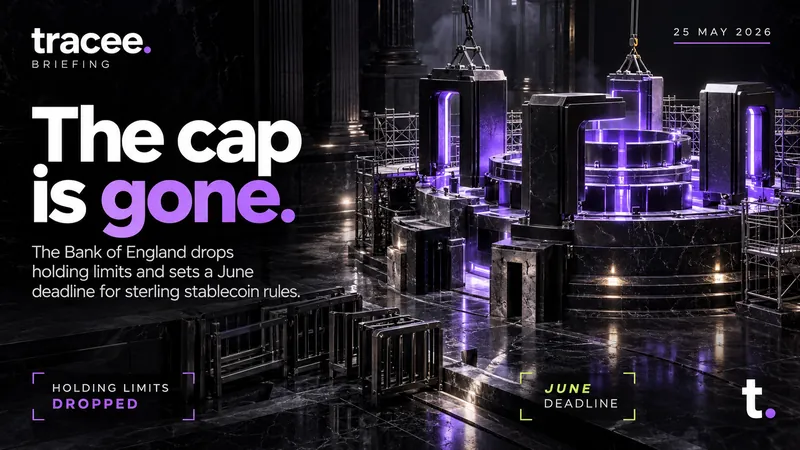
The BoE drops individual stablecoin holding limits in favour of aggregate caps and sets June 2026 for draft rules, with 16 Digital Securities Sandbox firms preparing to go live late in the year. The announcement contains five distinct moves: two close the November consultation's worst provisions outright, three are gated on what the June draft actually says.
Read briefing37 banks across 15 EU countries back Qivalis ahead of a second-half 2026 launch, with a DNB e-money licence still pending and Fireblocks as the infrastructure layer. The coalition is real and the product is not yet: Circle's EURC already holds 41 percent of the euro stablecoin market while Qivalis has issued nothing.
Read briefing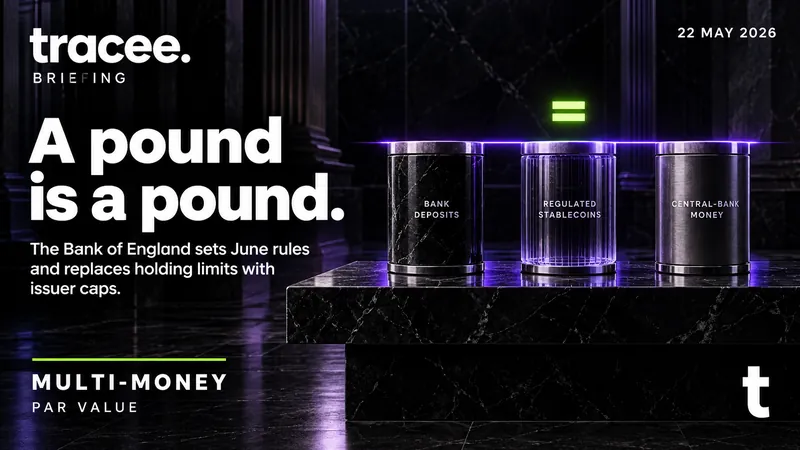
The Bank of England drops the £20,000 individual stablecoin holding limit in favour of aggregate issuance caps on providers, sets June 2026 for draft rules and year-end for final rules, and explicitly aligns its timeline with the GENIUS Act. The PRA reaffirms the same prudential treatment for tokenised deposits as for traditional bank liabilities. Three frameworks (MiCA, GENIUS Act, and now the BoE) converge on the same design: cap the issuer, not the user. The variable is the June cap number: too low and the UK framework becomes a positioning move rather than a commercial environment. Bottom line inside.
Read briefing
Zerohash Europe received an EMI license from DNB on 18 May 2026, the first firm licensed under MiCAR to also hold full EMI status. The EBA's June 2025 no-action letter established that routing stablecoin payment flows for institutional clients is a payment service under PSD2 requiring a PI or EMI license, not just a MiCA CASP authorization. The March 2, 2026 compliance deadline has passed. Any B2B stablecoin infrastructure provider in the EEA routing payment flows without both a MiCA CASP and an EMI or PI license is now operating in a gap the regulator explicitly closed. Zerohash crossed the line first. Interactive Brokers Europe is already live as a client. Bottom line inside.
Read briefing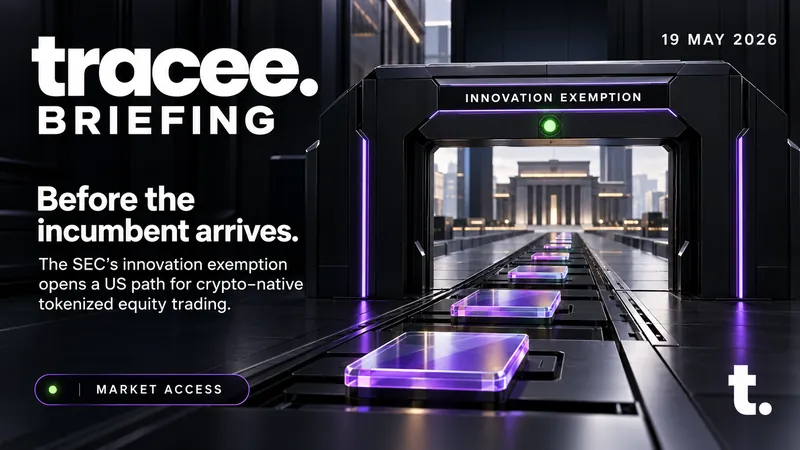
The SEC releases a conditional exemption for crypto-native platforms to offer tokenized US equities outside full broker-dealer registration. Kraken xStocks has $25B in prior volume; the exemption gives it a formal US home. DTCC goes live in October with the permanent infrastructure. The two-track market structure, crypto-native vs. TradFi, is what NYSE, Nasdaq and CME Group objected to in December 2025. Whether the exemption survives October depends on whether the SEC converts it to permanent rules before DTCC's institutional rails make the question irrelevant. Bottom line inside.
Read briefing
Western Union launched USDPT on May 4, the first major money services business to deploy a GENIUS Act-compliant stablecoin issued by a federally chartered bank. The architecture: Anchorage Digital Bank issues USDPT, Fireblocks provides settlement infrastructure, Solana settles, and Western Union's 600,000 agents in 200 countries cash out. The Digital Asset Network turns that agent footprint into an API any compliant wallet can call. At $36B in annual Philippines remittances, the pilot corridor is among the world's largest volume tests for regulated stablecoin-to-cash settlement. Bottom line inside.
Read briefing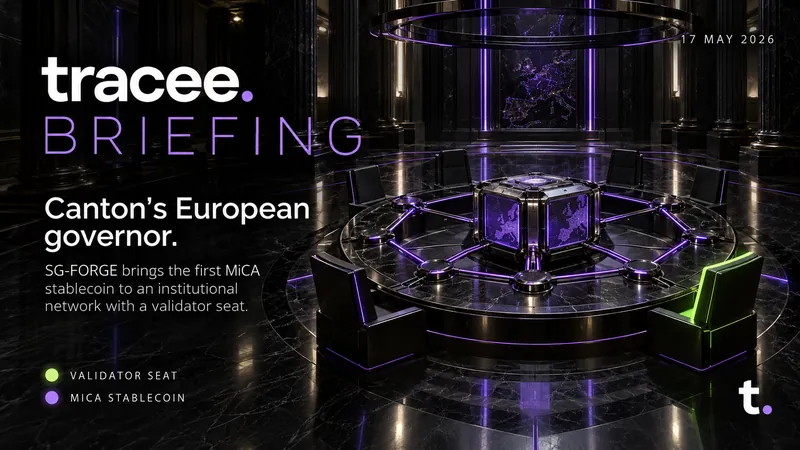
SG-FORGE deployed EURCV ($97M) and USDCV ($20M) on Canton Network and joined as an Ecosystem Super Validator on 12 May 2026, the first MiCA-authorized e-money token issuer to hold a governance role on the network. The Super Validator seat gives SG-FORGE influence over Canton's collateral eligibility framework, before those rules crystallize at institutional scale. Canton is already inside Visa's nine-chain stablecoin settlement layer. At $117M combined AUM this is not a market event; it is a governance claim on the settlement infrastructure that will matter when European institutional euro stablecoin volumes are twenty times larger. Bottom line inside.
Read briefing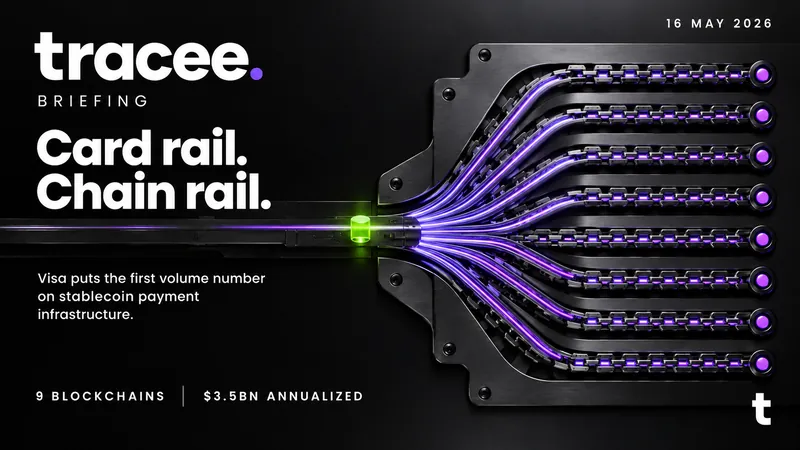
Visa has reached a $7 billion annualized stablecoin settlement run rate, up 50% quarter over quarter, across nine blockchains including Canton (JPMorgan Kinexys) and Arc (Circle's institutional chain). Canton's entry puts JPMorgan's bank-issued deposit token inside the same settlement layer as public-chain stablecoins. The legal distinction between deposit tokens and payment stablecoins survives; the settlement distinction is collapsing. The GENIUS Act final rule (due July 18) is the next binding gate. Bottom line inside.
Read briefingA hundred questions across basics, regulation, technology, issuers and models, use cases, risks, geography, and the 2026 outlook. Each answer is two to four sentences, operationally grounded, and written from first principles. The same evidence base we use in client engagements, in a format you can scan in five minutes or read end to end in twenty-five. Bottom line: the segment has reached a state where the easy questions are largely settled and the hard ones are operational.
Read briefing
GENIUS (signed July 2025) handled the stablecoin layer. CLARITY now draws the perimeter around everything it settles against: digital commodities to the CFTC, digital securities to the SEC. Together the two bills cover the same scope as MiCA. The binding constraint on passage is not vote arithmetic but ethics: both Democratic crossover votes are conditioned on language barring sitting officials from holding crypto assets. The infrastructure players did not wait for the vote; JPMorgan filed JLTXX the day before the committee hearing. Bottom line inside.
Read briefing
Bermuda is the first OECD-grade live deployment of a national payment system onto a public chain. The wholesale tokenization stack (JLTXX, BUIDL, BENJI, $13.5B AUM) has no comparable client. Stellar now has two, after Marshall Islands ENRA in November 2025. Different problem, different rail, different unit size: $1M-minimum institutional reserves on Ethereum versus consumer wallets on Stellar at sub-cent settlement, against 3 to 5% card fees. The wholesale stack will not win this tier as currently designed: wrong rail, wrong unit, wrong custodian model. Bottom line inside.
Read briefingJLTXX, filed 12 May and effective 13 May, is J.P. Morgan's second tokenized MMF on Ethereum after MONY. The bank that argued in public for two years that deposits should beat stablecoins has just filed the reserve substrate for everyone else's stablecoin. JPMD on the liability side, JLTXX on the asset side, Kinexys running both. Five days, four firms (JPMorgan, BlackRock, DTCC, Anchorage), one stack: the next twelve months of stablecoin and tokenized-fund infrastructure are being decided right now. Bottom line inside.
Read briefingThe third public NCB-level break with Lagarde in three months, after Nagel at the Bundesbank (16 Feb) and Villeroy at the Banque de France. The biggest euro stablecoin in 2026 is Circle's EURC, issued from the US, holding 41–50% of an $887M market. Lagarde's monetary policy concerns survive on principle; her policy line does not. Beau wins by default, and the next fight is product, between Qivalis and Circle. Bottom line inside.
Read briefingSeven axes where the two paths diverge: issuer license, backing, regulation, insurance, network, yield, and example issuers. The legal line is sharp on resolution (yield ban, FDIC eligibility, bankruptcy character) and blurring on product (same chains, same wallet UX, same retail surface). Same digital dollar, two completely different bodies of law underneath. Bottom line inside.
Read briefingFour moves stacked under one headline: two shipped (multichain expansion, DeFi composability via Uniswap and Euler), two exploratory (tokenized ETFs, staked ETH ETF pending SEC). The wedge is Euler: first major TradFi money market fund used as DeFi collateral at this scale. Macro frame: BlackRock locking in Securitize as preferred rail before DTCC's October tokenization go-live. $2.4B AUM is a rounding error against $13T; the integrations are not. Bottom line inside.
Read briefingSix actors decomposed: Ondo (issuer), Ripple (holder), XRP Ledger (venue), Mastercard MTN (orchestrator), Kinexys (cross-border cash rail), and two correspondent banks. The headline stacks four qualifiers ("first near real time, cross border, cross bank") but only one earns its keep. The honest limit: the asset and cash legs never met atomically. The macro frame: this is positioning ahead of DTCC's October tokenization go-live, not the breakthrough the press release suggests. Bottom line inside.
Read briefingBriefings publish on no fixed cadence | we wait until a news item rewards the six-move treatment. To be notified when a new briefing lands, write to hello@traceeapp.com.
Common questions about tracee briefings
What is a tracee briefing?
How often does tracee publish briefings?
What do briefings cover?
Are briefings available in French?
Can I cite a tracee briefing?
Have a news item that deserves the six moves?
Send it to us. If it rewards the treatment, we publish a briefing within the week. If you want a private briefing instead of a public one, that is what the consulting engagement formats are for.