
Before DTCC arrives: the SEC hands crypto platforms a conditional permit for tokenized US equity trading.
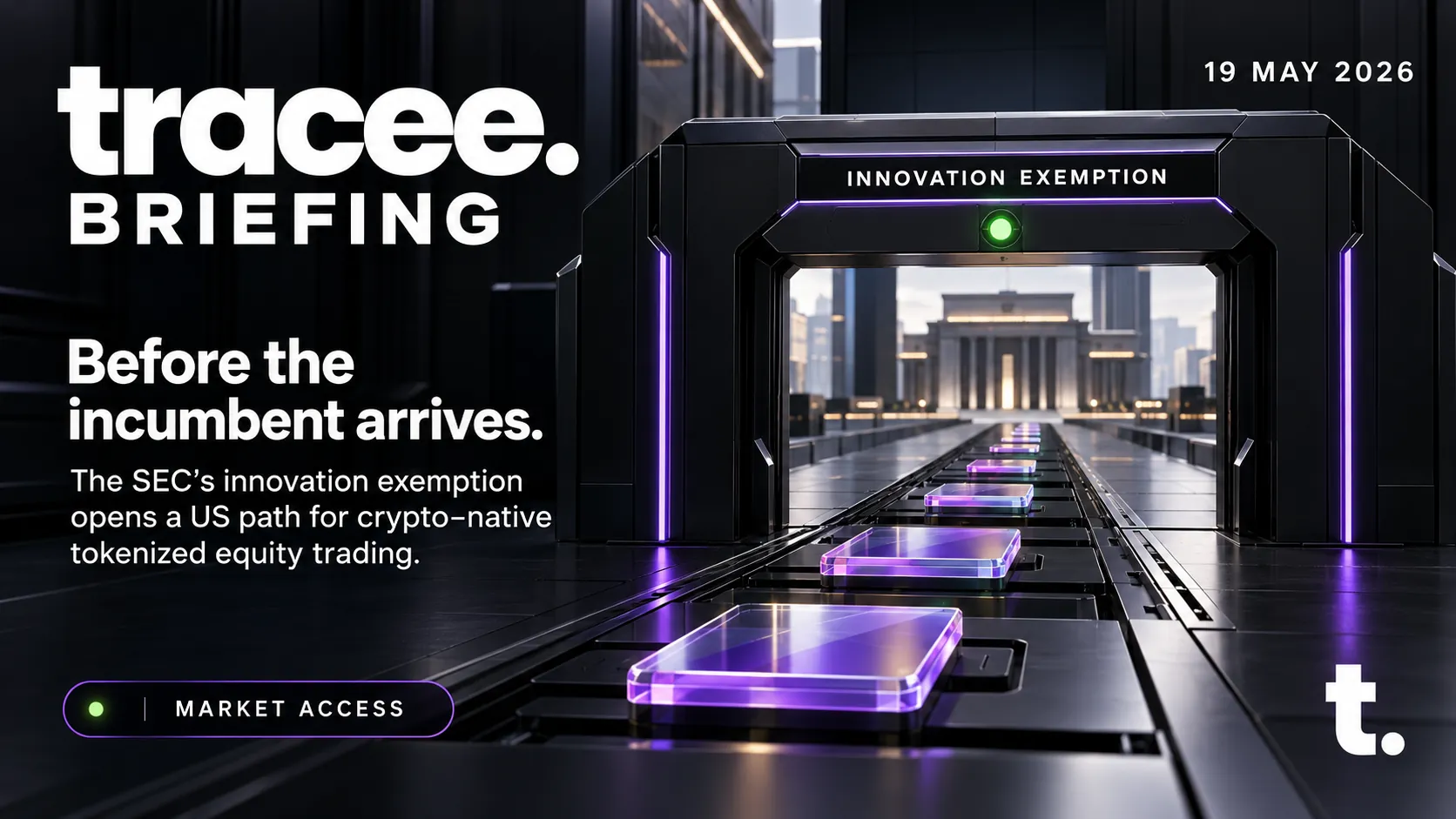
One exemption. Three platforms, two tracks, one clock.
That paragraph contains three separate regulatory facts. The exemption is new. The DTCC parallel track, a no-action letter issued in December 2025 for the same asset class, is not. The clock running between the two is the structural variable that matters.
Two moves are operational today. Two are in progress. One is unresolved.
This is not one announcement. Five separate facts are compressed into a single news cycle, each with a different status and a different deadline.
Status matters here. The Shipped items are operational facts. The Exploring item now has a formal US path. The Pending item is the binding constraint: without permanent rules, DTCC's October launch decides the market structure by default.
Two regulatory routes to the same underlying US equities.
Both tracks cover the same assets. They operate under different legal instruments, on different infrastructure, and with different settlement finality.
- The exemption track is where the market is now. Kraken xStocks has $25B in trading volume without US regulatory clarity. The exemption does not create demand; it legitimizes demand that already exists.
- Settlement is the structural asymmetry. The crypto-native track settles on-chain in seconds, around the clock. DTCC settles T+1 during business hours. Same equity, two clearing realities: that gap is where arbitrage risk accumulates once both tracks are live.
The exemption is a bridge, not an arrival.
The exemption makes the US the second major market, after the EU, where tokenized equities have a formal regulatory container. Kraken and Robinhood launched European tokenized equity products in 2025 and accumulated $25B in volume before any US framework existed. The exemption closes a twelve-month gap with Europe. It is catch-up regulation, not first-mover positioning.
The two-track market structure is what the traditional exchanges actually objected to. NYSE, Nasdaq, and CME Group did not oppose tokenization in their December 2025 letter. They opposed a competing equities market that operates outside exchange hours, on different infrastructure, with different compliance requirements. The innovation exemption makes that competition formal and gives it a federal regulatory stamp. That is why the opposition is structural, not technical.
The CLARITY Act is the companion piece. The Senate Banking Committee voted 15-9 on 14 May to advance the Digital Asset Market Clarity Act, which places digital securities permanently under SEC jurisdiction. Tokenized stocks are digital securities. CLARITY defines who regulates; the innovation exemption defines what the rules are during the transition. The two instruments together are the US answer to MiCA's scope: one statute for stablecoins (GENIUS Act), one for market structure (CLARITY), one bridge rule for the infrastructure gap (this exemption).
Five elements in this week's news. Two are genuinely new.
Rate each element against the headline's implicit claims.
| Element | Status | Verdict |
|---|---|---|
| Innovation exemption mechanism | Shipped | New. First formal US regulatory accommodation for crypto-native tokenized equity platforms. No prior instrument covered this. |
| 24/7 US equity trading | Shipped | New under US regulatory umbrella. Traditional equity markets close nights and weekends. This capability now has a domestic legal container for the first time. |
| Two-track market structure | Shipped | New. TradFi infrastructure (DTCC/NYSE) and crypto-native platforms (Kraken/Coinbase/Robinhood) now operate under different regulatory instruments on the same asset class simultaneously. |
| Kraken xStocks $25B volume | Shipped | Incremental. The product and the volume predate the exemption. The number confirms demand; the exemption validates it. Different claims. |
| TradFi opposition (SIFMA, exchanges) | Pending resolution | Incremental. The December 2025 objections are restated, not escalated. Opposition is on the record; litigation has not started. |
The exemption mechanism, the 24/7 trading capability, and the formal two-track structure are the three elements that did not exist last week. Everything else is confirmation of prior positions.
Five questions the exemption does not answer.
The exemption is a bridge rule. Here is what it leaves open:
- Temporary, not permanent. The exemption confers no perpetual rights. Permanent rulemaking has not begun, and all of SIFMA's KYC/AML objections remain on the table for that process.
- Lighter compliance controls. SIFMA and Citadel Securities flagged that platforms operating under the exemption carry lighter know-your-customer and anti-money-laundering requirements than licensed broker-dealers. That gap is not theoretical; it is the central opposition argument.
- DTCC defines the end state. October 2026 is when the permanent US market structure for tokenized equities is set. The exemption is a bridge across a six-month gap; what it bridges to has not been decided.
- Non-US securities scope is unclear. Robinhood's European product used offshore issuers. The exemption's explicit coverage of non-US-listed equities is not confirmed in public reporting.
- No institutional liquidity proof yet. $25B in Kraken xStocks volume is real trading activity. It is not proof of institutional-grade continuous order-book depth on the regulated US side of the product.
CLARITY Act on the left, DTCC clock on the right.
The CLARITY Act's 15-9 committee vote on 14 May assigned digital securities permanently to SEC jurisdiction. Tokenized stocks are digital securities under that perimeter. The innovation exemption now covers the transition period; CLARITY provides the permanent statutory authority. Together, GENIUS Act (stablecoins), CLARITY (market structure), and the innovation exemption (the gap rule) map onto the same scope as MiCA. The US regulatory architecture for digital assets is no longer fragmented in principle; it is fragmented in timing.
The DTCC clock runs regardless of the exemption. DTCC's October 2026 launch covers the same Russell 1000 stocks, ETFs, and Treasuries that the innovation exemption covers. When DTCC goes live, with more than 50 institutional participants and a central-counterparty clearing guarantee, the question shifts from "can crypto platforms offer tokenized equities" to "why should institutions use the crypto-native track when DTCC's rails are operational." The exemption must either evolve into permanent rules before October or face a structural disadvantage at the moment the institutional market takes the decision seriously.
The BUIDL multichain expansion and the JLTXX filing are the parallel infrastructure moves: the same DTCC October gate shapes every decision in the tokenized-asset market right now. The innovation exemption is the equities-side instrument; BUIDL and JLTXX are the money-market-fund and reserve-substrate sides. All three are positioning moves ahead of the same October reference clock.
The bridge stays open until October 2026.
The SEC's innovation exemption is not a market event; it is a bridge rule. It gives Kraken, Coinbase, and Robinhood a formal US path to offer tokenized equities for the six months until DTCC's October launch defines the permanent infrastructure. The exemption validates $25B in existing Kraken xStocks demand, opens the US market for Robinhood's domestic expansion, and formalizes the two-track market structure that traditional exchanges objected to in December. Whether that two-track structure survives October depends on one thing: whether the SEC converts the temporary exemption into permanent rules before DTCC's institutional rails make the question irrelevant.
Three things to watch:
- DTCC's July 2026 limited production trades. A clean pilot strengthens SIFMA's position and increases pressure on the exemption before any permanent rulemaking begins.
- SEC permanent rulemaking timeline. If formal rules land before October, the crypto-native track becomes durable. If not, the DTCC launch sets the market structure by default and the exemption becomes a legacy instrument.
- SIFMA's response to the exemption text. December's letter was objection. If SIFMA or the exchanges escalate to legal challenge before permanent rulemaking, the exemption's practical scope narrows immediately and Robinhood's US expansion stalls.
Common questions about the SEC's innovation exemption for tokenized stocks.
What is the SEC's innovation exemption for tokenized stocks?
How does the crypto-native track differ from DTCC's tokenization infrastructure?
Why did SIFMA, Nasdaq, NYSE and CME Group oppose the exemption?
What is DTCC's tokenization service and when does it launch?
What happens to crypto platforms after DTCC launches in October?
Related briefings on the same rails.
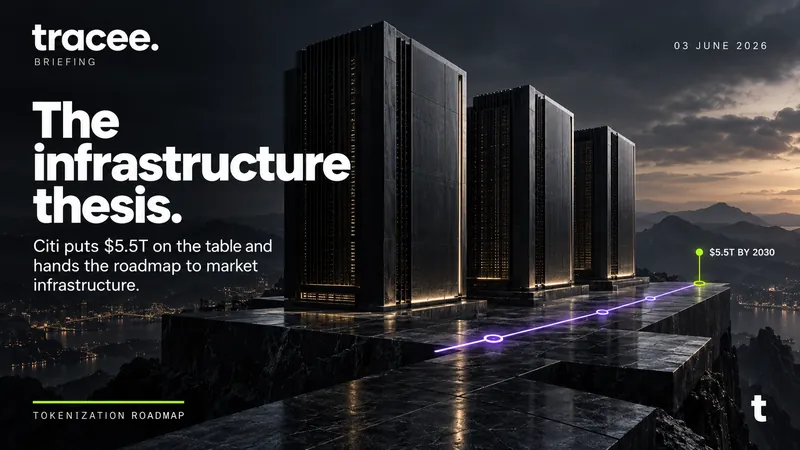
Citi's Tokenization 2030 report projects a $17B-to-$5.5T market by 2030, with DTCC (October 2026), Nasdaq, and ICE named as the infrastructure carriers.
Read briefing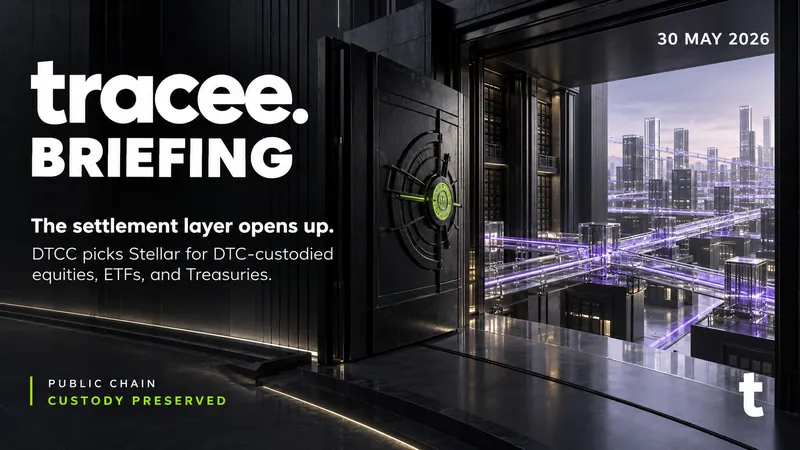
DTCC named Stellar as the first public, permissionless blockchain for DTC-custodied securities on 27 May 2026, with availability targeted for H1 2027.
Read briefingBMO, CIBC, National Bank, RBC, Scotiabank and TD signed a joint statement to explore a shared CAD tokenized deposit, with no platform, vendor or date named yet.
Read briefing
21 banks, from Bank of America to MUFG, committed to build a jointly owned dollar stablecoin company, three days after the BIS told Jackson Hole that tokenized…
Read briefing
The SEC's Innovation Exemption lets Tokenized Securities Venues trade tokenized NMS stock on permissioned AMMs for five years, two days after the Senate's Clarity…
Read briefingFour moves stacked under one headline: two shipped (multichain expansion, DeFi composability via Uniswap and Euler), two exploratory (tokenized ETFs, staked ETH ETF…
Read briefingSuggest a news item or request a private briefing.
Public briefings publish on no fixed cadence. Private briefings, written for one institution and one decision, are part of the consulting engagement formats.
Book a discovery call