
21 banks commit to a joint dollar stablecoin: the industry the BIS just told to build tokenized deposits chose to build a stablecoin instead.
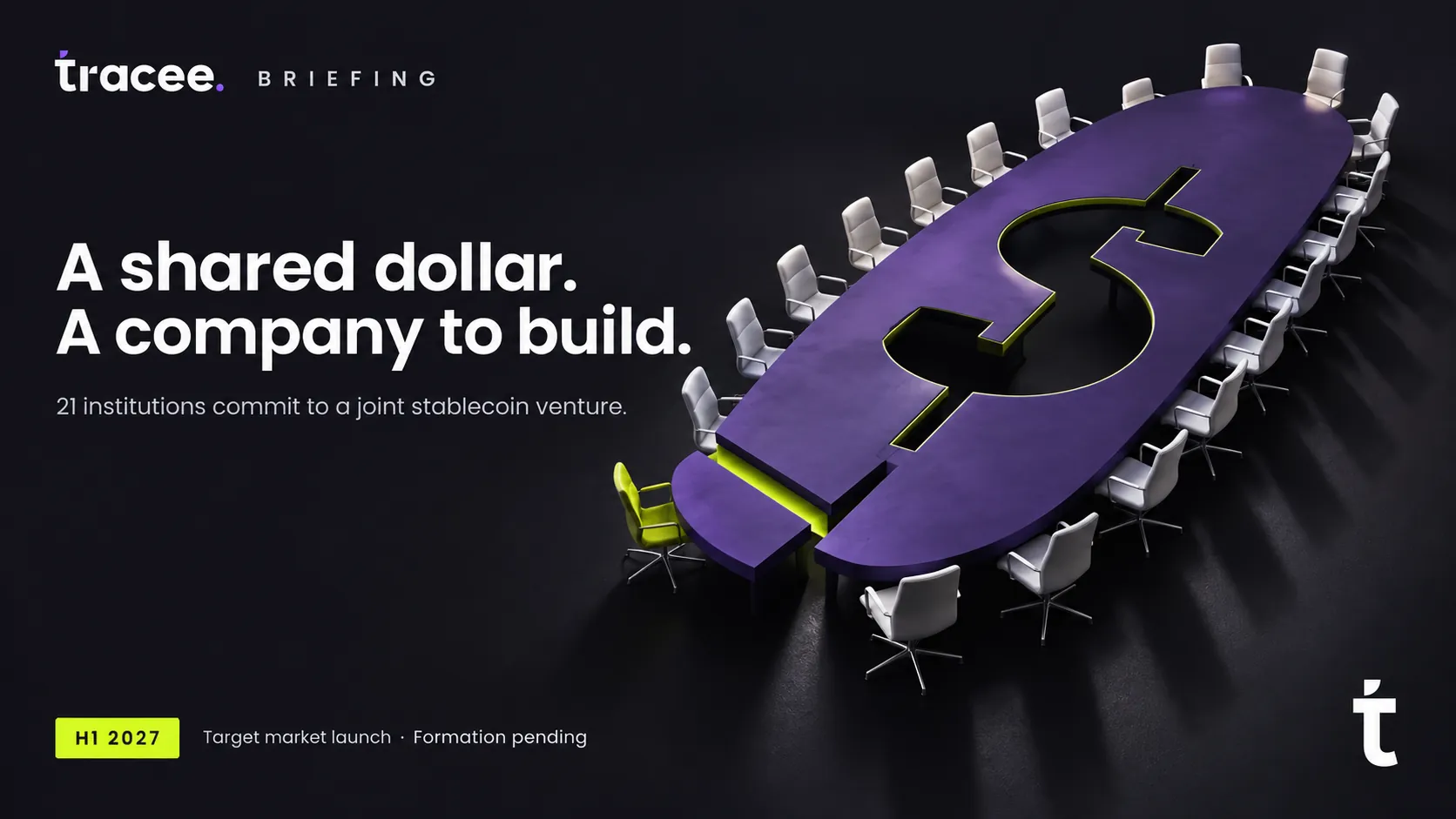
One paragraph, and a verb that just changed.
Eleven months ago, ten of these institutions said they were only exploring this idea. What changed on 1 September is the verb: from exploring to establishing.
Four claims sit inside the release. One is genuinely new.
Rated on what has actually happened against what has only been promised.
| Claim | Status | Verdict |
|---|---|---|
| 21 institutions commit to a jointly owned stablecoin company | Shipped | Genuinely new. A stablecoin issuer with this many G-SIB shareholders has never existed. Eleven institutions joined the original ten in eleven months. |
| US dollar stablecoin, market launch targeted H1 2027 | Targeted | Not built. Even the company itself is "subject to closing conditions." Sixteen months of runway sits between the commitment and the token. |
| Euro token flagged as the priority next currency | Exploring | Intent only. No filing, no licence application, no date attached to it anywhere in the release. |
| Company name, governance, blockchain, custodian, per-bank stake | Undisclosed | The gap that matters. The details that would let anyone assess this venture are exactly the details withheld. |
One fact here is new: a stablecoin issuer owned by this many of the world's largest banks has never existed. How it will actually work is still unwritten.
A shareholder register, not yet a company.
Strip the release down to what actually exists today, and what is still a commitment on paper.
- Everything above the two lime cards is a governance decision still to be made. No entity, no chain assignment, and no custodian sits behind the shareholder list yet.
- The regional spread is deliberate. Ten shareholders in North America, eight in Europe, three spanning Asia, the Middle East and Africa. A single-jurisdiction issuer fights a separate licensing battle in every market it wants to serve; a shared entity fights once, wherever it ultimately domiciles.
Three reasons this is bigger than a press release about intent.
This is an issuance bet, not a distribution deal. Every recent bank stablecoin move has been a bank distributing someone else's token. Standard Chartered distributes HKDAP through a joint venture it partly owns. Revolut rents Bridge's stablecoin rails for EURR. Here, 21 of the world's largest banks are trying to own the issuer itself, the position Circle and Tether currently hold alone among scaled players in a stablecoin market north of $300B.
It lands three days after the BIS told these same balance sheets to build the other instrument. On 28 August, BIS General Manager Pablo Hernandez de Cos told the Federal Reserve's Jackson Hole Economic Policy Symposium that tokenized deposits, not stablecoins, should carry routine payments. On 1 September, a roster that includes several of the same globally systemic banks committed capital to a stablecoin company instead.
The GENIUS Act built the shelf they are now stocking. The US federal stablecoin framework creates a Permitted Payment Stablecoin Issuer status that a bank-owned consortium can credibly obtain, unlike Tether today. OCC Comptroller Jonathan Gould has committed to a final implementing rule by November 2026. Owning the issuer only became a rational bet once the compliance shelf existed to put it on.
A commitment is not a company. Five reasons to read this as a start, not a launch.
- No name attaches to any of it. Not the company, not the token, not the blockchain it will settle on.
- Governance and ownership are undisclosed. No per-bank stake, no control mechanism, no statement of who holds a board seat versus who is a passive shareholder.
- "Committed to establish" is not "established." Formation itself is explicitly subject to closing conditions that have not been detailed.
- H1 2027 is sixteen months out. Enough runway for the venture to shrink, delay, or quietly fold into a rival before a single token exists.
- The regulatory shelf is not finished either. The OCC's own final GENIUS Act rule is not due until November 2026, and MiCA compliance for the euro leg is a separate process that has not started.
The same banks are hedging every instrument on the table at once.
Two of the European members are already funding a rival coalition. Rabobank and BBVA back this 21-bank, dollar-first venture and also back Qivalis, the 37-bank consortium tracee profiled in May 2026 that is pursuing a euro stablecoin under a pending Dutch e-money institution licence. Neither announcement mentions the other. The same balance sheets are currently funding two parallel, uncoordinated paths to the same instrument, one euro-first with a licence application already filed, one dollar-first with nothing filed yet.
Wells Fargo is doing something similar on the deposit side. The Dallas Fed briefing tracee published in August covered Wells Fargo's own tokenized-deposit launch, the instrument the BIS argues banks should build instead of stablecoins. Wells Fargo is now committed to both: tokenized deposits on its own balance sheet, and a shared stablecoin company alongside 20 competitors.
A positioning move, funded with real capital and a real roster.
21 of the world's largest banks answered the tokenized-deposit-versus-stablecoin argument with a capital commitment rather than a counter-argument. It is not a shipped product: no name, no governance, no licence, sixteen months of runway before the H1 2027 target. But the roster, spanning five regions and already overlapping with a rival European coalition, is the real signal. Banks are not choosing an instrument. They are funding every instrument at once.
Watch three things:
- Whether the company actually forms in H2 2026, with a name attached. The first proof this moves past a shareholder commitment.
- Whether the OCC's November GENIUS Act rule accommodates a 21-bank-owned issuer cleanly, or forces restructuring. The compliance shelf this venture is being built to sit on is not finished yet.
- Whether Qivalis and this venture converge, compete, or coexist once either has a live token. Rabobank and BBVA cannot indefinitely fund two horses in the same race.
Common questions about the 21-bank G7 stablecoin venture.
What did the 21 banks announce about a joint stablecoin?
Which banks are involved in the joint stablecoin venture?
Is this a real product yet, or just an announcement?
How does this relate to the BIS's push for tokenized deposits over stablecoins?
Does this compete with Qivalis, the European 37-bank euro stablecoin consortium?
Where can I read the original announcement?
Related briefings on the same rails.
BMO, CIBC, National Bank, RBC, Scotiabank and TD signed a joint statement to explore a shared CAD tokenized deposit, with no platform, vendor or date named yet.
Read briefing
BIS General Manager Pablo Hernandez de Cos told the Fed's Jackson Hole symposium that stablecoins aren't credible as payment at scale, restating the BIS's own June…
Read briefing
The SEC releases a conditional exemption for crypto-native platforms to offer tokenized US equities outside full broker-dealer registration.
Read briefing
Citi's Tokenization 2030 report projects a $17B-to-$5.5T market by 2030, with DTCC (October 2026), Nasdaq, and ICE named as the infrastructure carriers.
Read briefing
DTCC named Stellar as the first public, permissionless blockchain for DTC-custodied securities on 27 May 2026, with availability targeted for H1 2027.
Read briefing
ECB Executive Board member Isabel Schnabel told Jackson Hole that central banks must put their own money on-chain or lose the settlement layer to dollar stablecoins.
Read briefingSuggest a news item or request a private briefing.
Public briefings publish on no fixed cadence. Private briefings, written for one institution and one decision, are part of the consulting engagement formats.
Book a discovery call