
The cap is gone: Bank of England drops holding limits and sets a June deadline for sterling stablecoin rules.

One speech, one consultation paper. Five architectural decisions inside them.
That paragraph, taken together with the joint BoE/FCA Call for Input published the day before, contains five distinct moves that each carry a different commercial and regulatory weight.
Five moves in two days. Two are done. Three are gated on the June draft.
The Bank of England and the FCA made these moves on 18 and 19 May 2026. Their weight is not equal.
| Move | Status | Verdict |
|---|---|---|
| Individual holding limits dropped (£20k per person / £10M per business from Nov 2025 consultation) | Confirmed | Real shift. Six months of industry feedback reverses the most commercially disqualifying element of the November consultation. |
| Aggregate issuance caps proposed as replacement guardrail | Exploring | New chokepoint. Shifts constraint from the wallet to the issuer. Level unspecified until June draft rules. |
| Draft systemic stablecoin rules: June 2026. Final Codes of Practice: year-end 2026 | Pending · June 2026 | Binding gate. The first published number any sterling stablecoin issuer can build a business case against. |
| BoE + FCA joint Call for Input: tokenization vision for UK wholesale markets. Feedback deadline: 3 July 2026 | Published | First joint frame. Conduct and prudential regulators align on tokenized securities, collateral, and settlement for the first time. |
| 16 Digital Securities Sandbox firms (Euroclear, HSBC, London Stock Exchange Group) moving to live production, late 2026 | Pending · late 2026 | Sandbox to live. Tokenized gilts and corporate bonds on a regulated UK venue by year-end. |
The two confirmed moves close the November consultation's worst provisions. The three gated moves depend on what the June draft says.
Three forms of digital sterling, one Bank of England sitting above all of them.
Breeden's speech names four forms of UK digital money. The BoE is building the oversight and settlement layer that must support all of them, with different rules for each.
- The stablecoin sits between two known layers. Tokenized bank deposits have an established regulatory home (PRA). The DSS has an established technical home (sandbox-to-live). The regulated stablecoin layer is the one whose rules are still being written. Everything in this announcement is about closing that gap.
- The corporate subsidiary path is the bank-issuer unlock. Banks are permitted to issue stablecoins through a separate non-deposit-taking entity. That entity's liabilities are distinct from the deposit book. The parent's capital adequacy and FSCS obligations are preserved. This resolves the structural question that prevented UK banks from moving earlier.
The November consultation closed the commercial door. This one reopens it.
Individual holding limits at £20,000 made a sterling stablecoin commercially incoherent. Corporate treasury holds balances that routinely run into hundreds of millions. B2B settlement requires balances at institutional scale. A £10 million business ceiling would have excluded every institutional use case that makes a payment stablecoin worth building. Aggregate issuance caps do not have this problem. The ceiling is on the issuer's total supply, not on the wallet balance. A business can hold as much as it needs, provided the issuer's aggregate cap covers it. That is the difference between a commercial product and a regulatory curiosity.
The BoE/FCA joint Call for Input is structurally significant beyond the stablecoin rules. UK financial regulation has historically separated conduct (FCA) from prudential (PRA/BoE). Digital money and tokenized securities sit across that boundary. A joint consultation covering tokenized securities, collateral treatment, settlement infrastructure, and stablecoin rules means the two regulators are designing the digital money architecture together. The risk of regulatory gaps or contradictions between conduct and prudential frameworks, which has slowed institutional adoption in other jurisdictions, is lower here because both regulators are in the room at the same time.
Breeden's explicit reference to the US timeline is a deliberate signal. The GENIUS Act final rules are due July 18, 2026. The UK's Codes of Practice are targeting the same window. Two of the three major stablecoin regulatory frameworks, the US and the UK, are synchronized. That means a stablecoin issuer planning a simultaneous dollar and sterling launch will have both rulebooks available within the same quarter. The EU MiCA framework is already in effect. The three-regulator frame is closing, and the gaps between them are the next compliance problem for any issuer with cross-border ambitions.
Five things this announcement does not resolve.
- Systemic threshold undefined. At what total issuance volume does a sterling stablecoin become systemic and trigger the new rules? The BoE has not specified the number. Pre-systemic issuers have no clear regulatory path and no confirmed light-touch regime.
- 40% non-remunerated deposit floor is under review, not eliminated. The November consultation required issuers of systemic stablecoins to hold 40% of backing assets as non-interest-bearing deposits at the Bank of England. Reducing it to 20% halves the profitability drag; it does not remove the structural cost. The June draft will say how far the floor moves.
- Aggregate cap level is unspecified. The June draft needs to publish a number. Until it does, any commercial modelling for a sterling stablecoin launch is speculative. A cap set too low (say, £5 billion) would still exclude institutional use at scale.
- UK framework is sterling-denominated only. USDC, EURC, and USDT are not regulated by these rules. They continue to circulate in the UK outside this framework. The new rules build sovereign digital money infrastructure; they do not level the playing field between sterling and foreign-currency stablecoins.
- RTGS near-24/7 extension is under consultation, not confirmed. The settlement infrastructure that would make a sterling stablecoin commercially competitive with Faster Payments and SEPA Instant depends on BoE confirming the extended RTGS hours. That outcome is not committed.
Three major frameworks closing. Sterling is still the laggard currency.
The US/EU/UK regulatory triangle is converging on the same H2 2026 window. The GENIUS Act final rules are due 18 July 2026. MiCA is in effect across the EEA. UK Codes of Practice target year-end 2026. A stablecoin issuer with cross-border ambitions will have all three frameworks available within roughly a six-month window. What remains unanswered is how those frameworks interact at the points where a stablecoin moves between jurisdictions, which is the next compliance architecture problem for any issuer building for scale.
The competitive pressure on the UK to ship is real. Qivalis, the 37-bank European consortium pursuing a DNB EMI licence for a MiCA-compliant euro stablecoin, targets a launch in the second half of 2026. If Qivalis reaches market before the UK Codes of Practice finalize, the cross-border institutional B2B tier defaults to euros. Circle's EURC already holds $887 million and a live MiCA EMT authorization. Sterling enters this race as the third-placed currency, after the dollar and the euro, and the gap widens with every month the rules remain in draft. The BoE knows this. Breeden's June commitment is, in part, a response to that competitive timeline.
The HKMA granted its first stablecoin issuer licences to HSBC and Anchorpoint Financial (Standard Chartered, PCCW, Animoca Brands) on 10 April 2026 for HKD-denominated products. Both institutions have deep UK operations and a proven willingness to structure non-deposit-taking stablecoin subsidiaries. The BoE's confirmed corporate subsidiary path maps directly to the structure they already operate. If the June draft rules confirm commercially workable terms, HSBC or Standard Chartered are the most likely first movers for a regulated sterling product, not a fintech starting from scratch.
The November consultation closed two commercial doors. June tells us how wide they reopen.
The November 2025 consultation had two industry-blocking provisions: individual holding limits and a 40% non-remunerated reserve floor at the Bank of England. Both are now under active revision. The June draft rules will set the aggregate cap level and the revised reserve floor. Those two numbers determine whether a sterling stablecoin is commercially viable for institutional use. A cap high enough for corporate treasury and a reserve floor below 30% makes the product buildable. Anything tighter and the UK framework produces regulated stablecoins that no institutional operator will issue at scale. The test the June document needs to pass is a commercial one, not a technical one.
Watch three things over the next six months:
- June draft rules: aggregate cap level and reserve floor. These two numbers determine whether a UK sterling stablecoin is buildable at institutional scale or is a regulatory product with no commercial issuer.
- DSS first live assets: gilts or corporate bonds? Which 16 firms reach production by year-end, and which asset class goes on-chain first, sets the precedent for tokenized securities settlement in the UK.
- HSBC or Standard Chartered sterling filing. Whether either bank applies for a UK stablecoin authorization using the confirmed corporate subsidiary path, building on their existing HKD licences, is the signal that UK sterling stablecoins are moving from framework to product.
Common questions about UK stablecoin regulation and digital money.
What are systemic stablecoins under UK regulation?
What were the individual holding limits the BoE proposed, and why are they gone?
What are aggregate issuance caps, and how are they different?
What is the Digital Securities Sandbox?
How does the UK framework compare to MiCA and the GENIUS Act?
Can UK banks issue stablecoins?
Related briefings on the same rails.
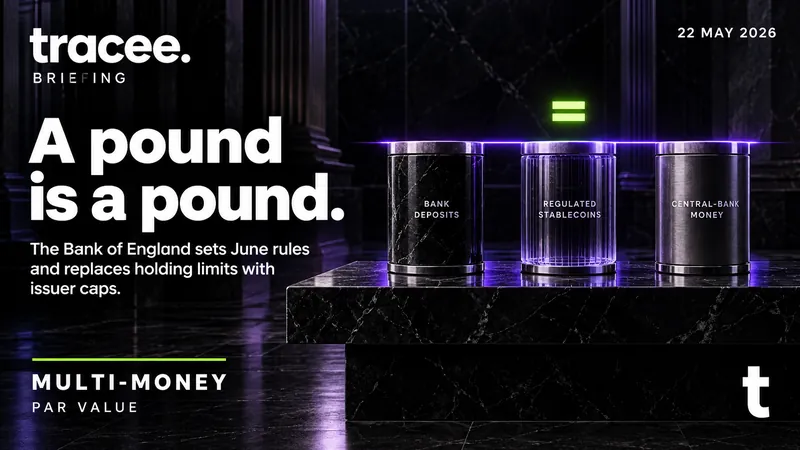
The Bank of England drops the £20,000 individual stablecoin holding limit in favour of aggregate issuance caps on providers, sets June 2026 for draft rules and…
Read briefing
On 22 June, the Bank of England published its Policy Statement and draft Code of Practice for sterling systemic stablecoins, completing the reserve architecture the…
Read briefing
Section 20's effective date, the earlier of 18 January 2027 or 120 days after final rules issue, is untouched by the miss.
Read briefingThe Fed proposed GENIUS Act reserve, capital and application rules seven months after the OCC and five after the FDIC. None of the three is final yet.
Read briefing
GENIUS (signed July 2025) handled the stablecoin layer. CLARITY now draws the perimeter around everything it settles against: digital commodities to the CFTC…
Read briefingThe OCC published draft PS-01 weekly reserve forms and PS-02 quarterly financial condition forms for all Permitted Payment Stablecoin Issuers on June 12, 2026.
Read briefingSuggest a news item or request a private briefing.
Public briefings publish on no fixed cadence. Private briefings, written for one institution and one decision, are part of the consulting engagement formats. Read more on the consulting page.
Book a discovery call