
Circle's OCC trust bank charter clears final approval: the new bank custodies USDC's own reserves in place of third parties, and does nothing yet to blunt the rival stablecoin racing to undercut its fees.
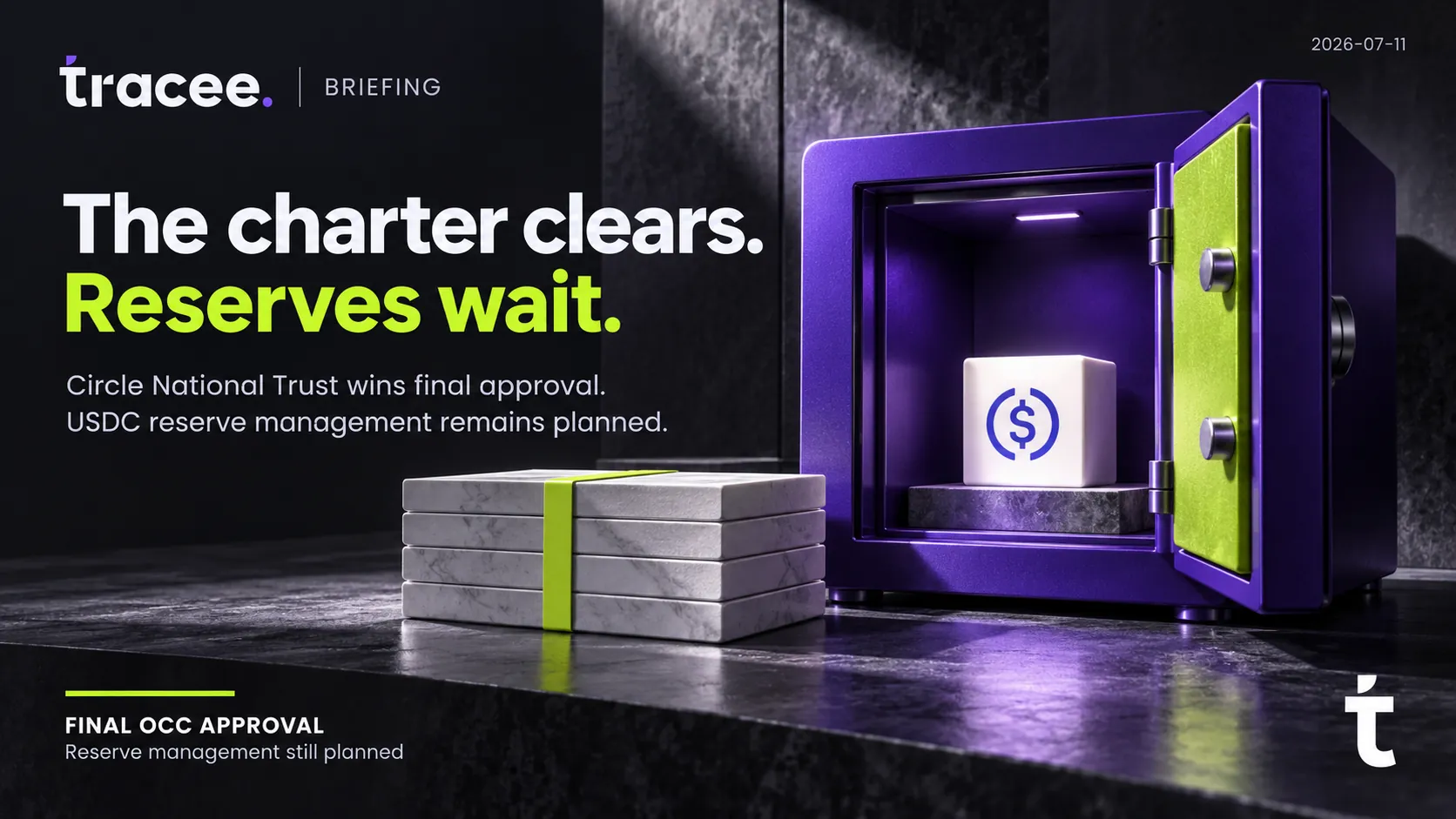
A year after filing, the OCC signs off and Circle gets to open a bank.
The word doing the most work in that paragraph is "planned."
Five moves, and the one investors priced in overnight is not the one that shipped.
Rated against what each piece actually delivers:
| Move | Status | Verdict |
|---|---|---|
| Final OCC approval, First National Digital Currency Bank | Shipped | Real, and first of five. Circle converts December's conditional charter to a final one before Ripple, Paxos, BitGo, or Fidelity Digital Assets, the four firms approved alongside it. |
| Circle National Trust, fiduciary custody | Shipped | Custody only. The bank opens to hold digital assets for Circle and its affiliates under direct OCC supervision, replacing no existing relationship on day one. |
| USDC reserve management inside the new bank | Pending | Not yet. Circle's own materials describe reserve management as a planned future capability. BNY Mellon remains USDC's reserve custodian today. |
| Third-party institutional custody clients | Exploring | Demand-dependent. Circle says the bank may eventually serve banks and regulated derivatives organizations directly, with no date attached. |
| CRCL stock reaction | Shipped | Real, then faded. Shares jumped as much as 16% intraday before trimming the rally; Mizuho called the move overly optimistic, Clear Street called it underpriced. |
The charter is real and the sequencing is genuinely new. What it lets Circle do differently starting today is narrower than the headline number.
One custody leg moves in-house. The reserve-management leg, and the rest of the balance sheet, stay exactly where they are.
The new bank slots in beside Circle's existing custodian, not underneath it.
- The charter adds a supervisor, not a new balance sheet. Circle now answers to the OCC directly for the custody leg it controls; the reserves themselves have not moved.
- One federal charter replaces a patchwork of state ones. A single OCC license lets Circle custody digital assets under uniform federal rules instead of state-by-state trust registrations.
Three reasons this is a defensive move against Circle's own vendors, not just its stablecoin rivals.
Circle spent four years paying a bank to hold the reserves behind its own product. BNY Mellon has custodied USDC's reserve assets since 2022 and only began letting institutions mint and redeem USDC directly in June 2026. A national trust charter lets Circle bring the custody leg of that relationship in-house, under its own federal license instead of a vendor's.
It is also a queue position, not a differentiator. Ripple, Paxos, BitGo, and Fidelity Digital Assets all received the identical conditional approval in December 2025. Circle converting first buys a headline; it does not change what any of the five charters actually permits.
The timing also lands eight days before the OCC's GENIUS Act final rules are due, so Circle is visibly building the supervised infrastructure the rulebook is about to require in writing, ahead of competitors still sitting on conditional approval.
The bank is chartered. Four things it does not yet do.
- It doesn't manage USDC's reserves yet. Reserve management sits inside the charter as a stated future capability with no committed date; BNY Mellon keeps that job today.
- It doesn't open to outside clients yet. Custody is scoped to Circle and its own affiliates; extending the service to banks and regulated derivatives organizations is explicitly demand-dependent, with no announced customer.
- It doesn't touch USDC's real competitive threat. USDC's market cap has declined since March 2026 per Mizuho, and Open USD, backed by Stripe, Visa, Mastercard, BlackRock, and Coinbase among more than 140 firms, is preparing a fee-free, yield-sharing rival aimed at a Solana launch later in 2026. A custody charter does not touch mint and redeem economics.
- Wall Street isn't reading it as one clean win. Mizuho held its Neutral rating and $85 price target, calling the intraday pop overly optimistic; Clear Street's $157 target, the Street's highest, reads the same charter as a genuine long-term moat. Both used the identical filing to reach opposite conclusions.
Five conditional charters from one December, and Circle is the only one the OCC has actually finished.
tracee's June briefing on the OCC's draft PS-01 and PS-02 stablecoin reporting forms named the same five-firm cohort, Circle, Paxos, Ripple, BitGo, and Fidelity Digital Assets, as the first Permitted Payment Stablecoin Issuers building toward OCC-supervised operation under the GENIUS Act. Circle finishing first sets the template the other four now have to match or explain away.
It also lands five days after tracee's briefing on Standard Chartered's integrated USDC minting access, and eleven days after BNY expanded its own USDC mint-and-redeem service, so three separate institutions moved on Circle's reserve and distribution rails inside two weeks. None of them, including Circle's own charter, has published a live reserve-management transaction yet.
The GENIUS Act's OCC final rules land July 18, eight days after this approval, and will set the reporting and reserve standards every one of the five charters has to operate under, Circle's included, once its bank actually opens for business.
Circle won a queue position, not a moat. The rival that can actually pressure USDC's fees is still months from a live token.
Circle is first of five December 2025 charters to clear final OCC approval, and the bank it opens can custody Circle's own digital assets under direct federal supervision starting now. What it cannot yet do is manage USDC's reserves, serve an outside client, or answer the fee-free, yield-sharing stablecoin that Stripe, Visa, and more than 140 other firms are building to compete with it. The charter fortifies the plumbing Circle already controlled. It says nothing about the plumbing Circle is about to have to defend.
Watch three things:
- Whether Circle National Trust actually opens and takes over reserve management from BNY Mellon. A charter is not an operating bank until deposits move.
- Which of Ripple, Paxos, BitGo, or Fidelity Digital Assets converts its conditional charter next. Circle's lead shrinks fast if the OCC clears the rest of the December cohort on a similar schedule.
- Whether Open USD ships its Solana launch on schedule later in 2026. A fee-free, yield-sharing rival stablecoin is the more consequential threat to USDC's economics than any custody charter addresses.
Common questions about Circle's OCC trust bank charter.
What did Circle just receive from the OCC?
What can Circle National Trust actually do at launch?
Is Circle the first stablecoin issuer to get a national trust bank charter?
What does this not change about USDC?
Where can I read the original source?
Related briefings on the same rails.

Open USD is not yet live; Open Standard has said its native Solana launch comes later in 2026.
Read briefing
The Finland-based euro clearing business behind the raise is real and revenue-generating.
Read briefingOn June 16, 2026, State Street Investment Management launched SSCXX, a Rule 2a-7 government money market fund built explicitly as a GENIUS Act reserve management…
Read briefing37 banks across 15 EU countries back Qivalis ahead of a second-half 2026 launch, with a DNB e-money licence still pending and Fireblocks as the infrastructure layer.
Read briefing
tracee's July 7 Bridge briefing flagged whether Circle, Ripple, or Paxos would pursue the same CASP-plus-EMI structure in Luxembourg.
Read briefing
MiCA's transitional period closed June 30; two days later, Bridge became the entity holding both a CASP authorization and an EMI license from the same Luxembourg…
Read briefingSuggest a news item or request a private briefing.
Public briefings publish on no fixed cadence. Private briefings, written for one institution and one decision, are part of the consulting engagement formats.
Book a discovery call