
The settlement layer opens up: DTCC picks Stellar as the first public blockchain for DTC-custodied equities, ETFs, and Treasuries.
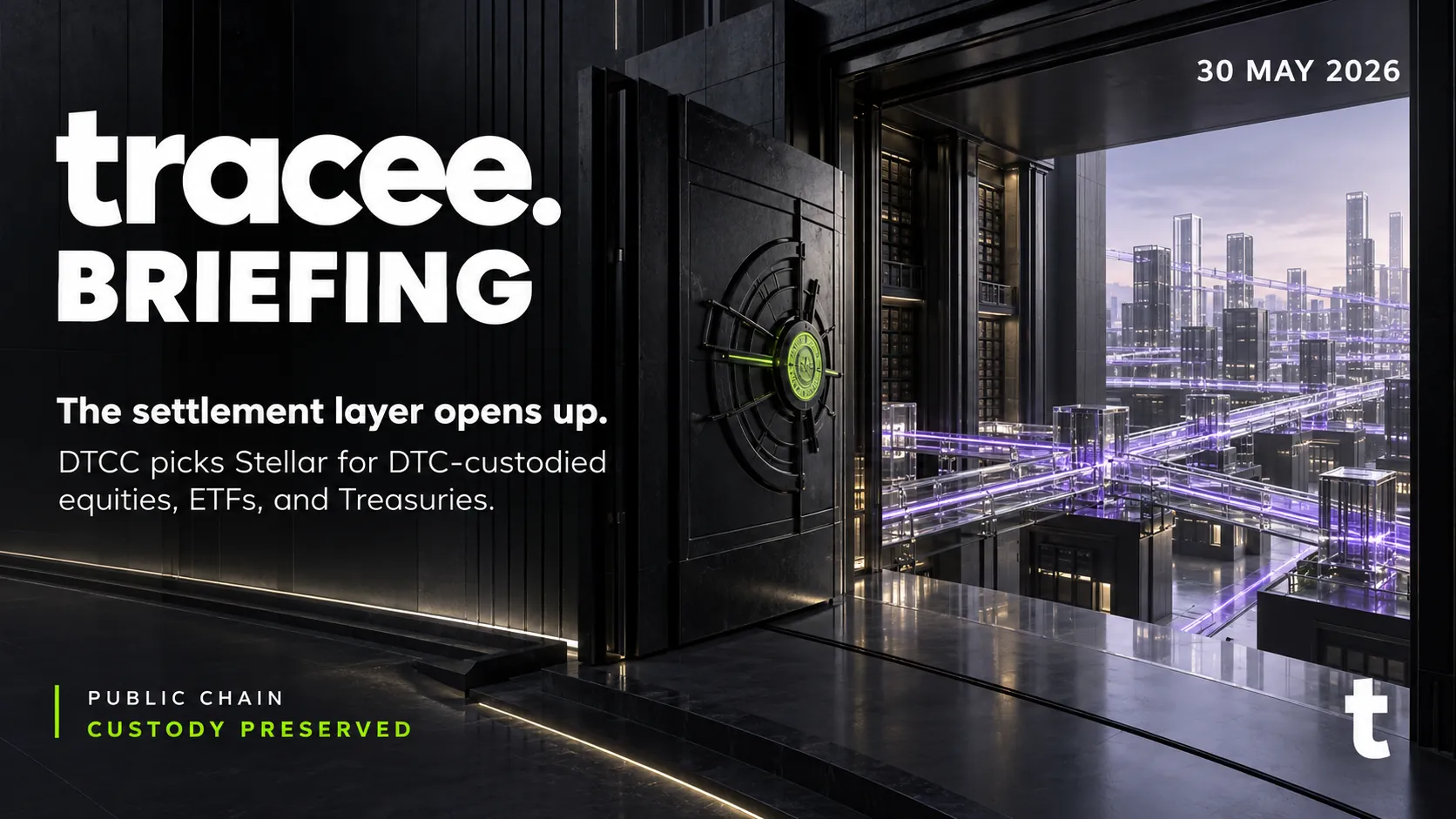
One announcement. The custodian of $114 trillion goes public.
Four things are packed into that paragraph with different implications. Two are already delivered. One is the structurally new claim. One is a direction without a deadline.
Four moves, one announcement. Only one is genuinely new.
| Move | Status | Verdict |
|---|---|---|
| SEC no-action letter for DTC tokenization service | Shipped | Foundation layer. Issued December 2025 by the Division of Trading and Markets. Authorizes DTC to operate a tokenization service for Russell 1000 stocks, major ETFs, and Treasuries. Three-year permission window. The legal gateway that makes every subsequent move possible. |
| Canton Network as first blockchain partner, July / October 2026 | Shipped | Enterprise first. Limited production in July, broader launch in October. Canton is a permissioned network: access is controlled by its Ecosystem Super Validators, not by the public. Institutional grade, not open grade. |
| Stellar selected as first open blockchain, H1 2027 | Shipped | The new move. Stellar is permissionless at the network layer. Any wallet meeting the compliance requirements of the issuing institution can, in principle, hold a DTC-custodied security token. This is the first time DTC custody reaches a genuinely public chain. |
| Multi-chain expansion to additional L1 and L2 networks | Exploring | Direction, not a commitment. Nadine Chakar (DTCC Global Head of Digital Assets) stated intent for "multiple layer-1 and layer-2 networks." No chain named, no date set. |
The October 2026 launch is Canton. The H1 2027 integration is Stellar. They are separate milestones on a single service.
Custody stays at DTC. The digital twin travels to two chains.
DTC retains legal custody throughout. The tokenization service mints a digital representation of a DTC-custodied security and places it on a connected chain. The underlying asset never leaves DTC's system; investor protections, ownership rights, and corporate action mechanics remain intact. The chain holds the token, not the security.
The Canton and Stellar layers are operationally distinct. Canton restricts network participation to authorized operators. Stellar restricts token-level access through the issuing institution's compliance layer, but the underlying network is open. The same digital twin travels through two very different access control regimes.
Three structural shifts, not one announcement.
The public chain distinction is structural, not cosmetic. On Canton, DTCC and its Super Validators control who can transact. On Stellar, the network is permissionless at the protocol level; the issuing institution controls token-level eligibility through its own compliance layer. The difference is where the access policy sits. Canton's model is closed infrastructure with institutional participants. Stellar's model is open infrastructure with institution-level access gates on the token itself. That gap matters for how secondary markets develop, how DeFi protocols can eventually interact with DTC-custodied tokens, and how many distribution venues can reach the same security.
The 50+ Industry Working Group spans both sides of the institutional divide. Traditional custodians (BlackRock, Goldman Sachs, JPMorgan, Morgan Stanley, Bank of America, Charles Schwab) and crypto-native distributors (Ondo Finance, Kraken, Anchorage Digital, Fireblocks) are building on the same tokenization service. A DTC-custodied Russell 1000 token can now travel from a Goldman Sachs bond desk to an Ondo Finance smart contract within the same settlement architecture, without leaving DTC custody.
The Stellar choice is not arbitrary. Stellar is the same chain that the Stellar Development Foundation deployed for Bermuda's national on-chain economy in May 2026 and for the Marshall Islands ENRA citizen payment program in November 2025. DTC's tokenization service on Stellar will be the third large-scale public institution to commit to the network within twelve months. The wholesale institutional tier (Russell 1000 stocks) and the retail sovereign tier (Bermuda citizens) now share the same public settlement rail. No other chain carries both mandates at this scale.
Five things the announcement quietly does not solve.
- Stellar does not go live until H1 2027. The October 2026 launch is Canton-only. The Stellar integration is 12 to 18 months away from the announcement date. Everything the announcement promises about open-chain access is a commitment, not a delivery.
- "Public chain" with a compliance layer is still access-controlled. The press release explicitly states that investor protections are maintained on Stellar. In practice this means tokenized DTC securities will carry transfer restrictions enforced at the token level. Any wallet can hold the Stellar network address; not any wallet can receive the token. The open chain carries a closed transfer register.
- No on-chain cash leg. Settlement cash remains fiat. The tokenized asset moves on Stellar or Canton; the dollar payment moves through wire or ACH. Without a regulated dollar instrument on the same chain, this is not atomic delivery-versus-payment. The DvP gap is the same problem the Kinexys Treasury pilot (May 2026) exposed on the XRP Ledger.
- Multi-chain creates fragmentation risk. Canton, Stellar, and future L1/L2 networks will each hold separate pools of DTC-custodied tokens. Secondary market liquidity fractures across chains. Cross-chain bridges would reintroduce the smart-contract risk that DTC custody was designed to eliminate.
- The Industry Working Group has competing interests. Wall Street firms want controlled permissioned settlement. Crypto-native firms want open composability. The 50+ IWG is a coalition building a shared rail for different end goals. Whose design language dominates will determine how open this infrastructure actually becomes in production.
Two settlement layers go live before either has an on-chain cash leg.
DTCC's October 2026 Canton launch and the ECB's Project Pontes (Q3 2026) create a window in which both the US and EU wholesale settlement layers simultaneously move onto distributed ledger infrastructure. Pontes connects Eurosystem DLT platforms to T2 and TARGET Instant Payment Settlement, providing tokenized central bank money as the settlement asset for European commercial bank tokenized asset transactions. DTCC provides the tokenized asset side; neither side yet provides a public CBDC cash leg. The structural gap is identical on both sides of the Atlantic: the asset goes on-chain, the dollar or euro payment does not.
The SEC's innovation exemption briefing (19 May 2026) noted that Kraken, Coinbase, and Robinhood have a six-month window to operate tokenized equity platforms outside full broker-dealer registration. That window closes as DTCC's October 2026 institutional rails go live for the same asset class.
The SG-FORGE + Canton Network briefing (17 May 2026) noted that Canton is already inside Visa's nine-chain stablecoin settlement layer and that SG-FORGE holds a Super Validator governance seat on Canton. DTCC's October Canton launch adds another institutional anchor to a network that is quietly accumulating governance claims from both TradFi and DeFi-adjacent institutions. Stellar's arrival in H1 2027 extends that architecture to the first genuinely open layer.
DTC custody is the anchor. The chain is a distribution question, not a safety question.
DTCC naming Stellar as its first open-blockchain partner confirms that US capital market settlement will be multi-chain and that no single L1 captures the settlement layer. DTC custody is the stabilizing constant: every token, on every chain, is a digital twin of an asset that never leaves DTC's system. The chain choice is a distribution decision, determining who can reach the token and through what wallet. The October 2026 Canton launch proves the service is operational. The H1 2027 Stellar integration proves it is open. Both milestones matter; they answer different questions.
Watch three things:
- July 2026 volume on Canton. How many of the 50+ IWG firms execute limited production trades, and at what ticket size? Volume here is the first real signal of institutional commitment rather than institutional attendance.
- The H1 2027 Stellar deadline. Any delay extends the Canton-only phase and hands the public-chain settlement narrative to alternative venues that do not carry DTC custody backing.
- The cash leg. Which regulated dollar instrument (GENIUS Act stablecoin, tokenized deposit, or CBDC pilot) first occupies the settlement cash leg on Stellar or Canton? That entity, not the chain choice, determines who owns the settlement economics.
Related briefings on the same rails.
The SEC releases a conditional exemption for crypto-native platforms to offer tokenized US equities outside full broker-dealer registration.
Read briefing
Citi's Tokenization 2030 report projects a $17B-to-$5.5T market by 2030, with DTCC (October 2026), Nasdaq, and ICE named as the infrastructure carriers.
Read briefingBMO, CIBC, National Bank, RBC, Scotiabank and TD signed a joint statement to explore a shared CAD tokenized deposit, with no platform, vendor or date named yet.
Read briefing
21 banks, from Bank of America to MUFG, committed to build a jointly owned dollar stablecoin company, three days after the BIS told Jackson Hole that tokenized…
Read briefingJLTXX, filed 12 May and effective 13 May, is J.P. Morgan's second tokenized MMF on Ethereum after MONY. The bank that argued in public for two years that deposits…
Read briefingQuant was named vendor for the tokenized deposit network 25 US banks are building, closing the watchpoint tracee flagged in June. No blockchain has been named yet.
Read briefingSuggest a news item or request a private briefing.
Public briefings publish on no fixed cadence. Private briefings, written for one institution and one decision, are part of the consulting engagement formats.
Book a discovery call