
The Fed is out of the digital dollar business: Congress has chosen private stablecoin rails as America's monetary infrastructure through 2030.
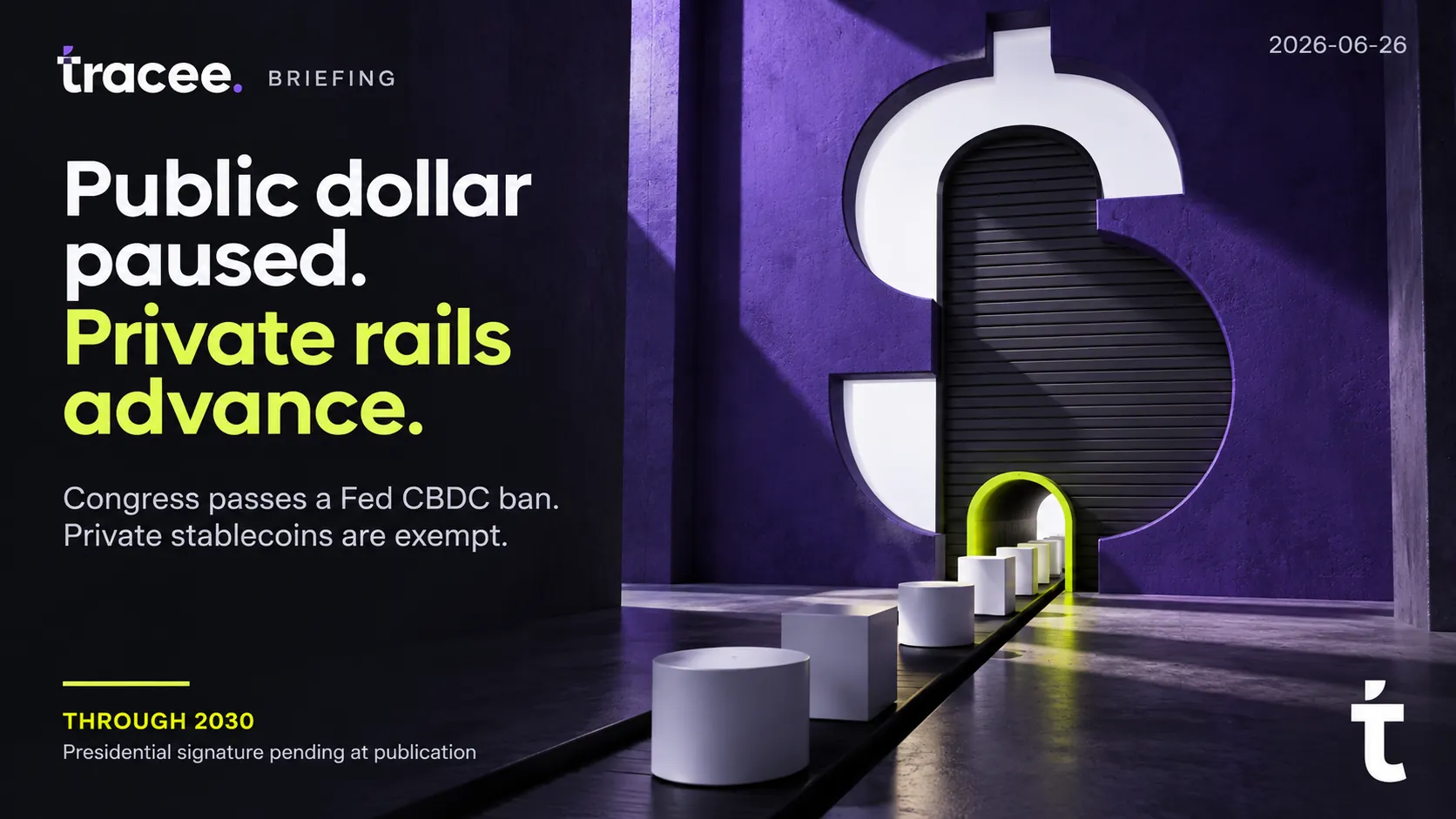
Two votes. One structural decision.
The housing headline buried the most consequential digital asset legislation the US Congress has ever passed. The CBDC prohibition is Section 1001, not a rider.
Five moves inside one bill. Not all five carry equal weight.
The legislation bundles a statutory CBDC prohibition into a housing affordability bill. Separated by structural significance:
| Move | Status | Verdict |
|---|---|---|
| Senate vote, 85-5 | Enacted | Supermajority. Two-thirds of those voting is the veto-override threshold. 85 votes against 5 clears it by a wide margin. No president can block this alone. |
| House vote, 358-32 | Enacted | Veto-proof. Both chambers cleared the two-thirds override threshold independently. The bill passes over any presidential veto. |
| CBDC prohibition, Section 1001 | Enacted | Statutory, not executive. The January 2025 executive order prohibited CBDC development administratively. This requires an act of Congress to reverse. |
| Private stablecoins explicitly exempt | Confirmed | GENIUS Act mandate. Licensed private issuers under the Guiding and Establishing National Innovation for US Stablecoins Act are now the only federal path to a regulated digital dollar. |
| Presidential signature withheld | Pending | Leverage, not a veto. Trump conditioned the signature on the SAVE America Act. Auto-enactment runs until approximately 3 July under the ten-day constitutional rule. |
The veto-proof margins make the signature question procedural. The legislative outcome does not change.
One path blocked, one path mandated.
The US digital money landscape now has two lanes: one prohibited, one active. The wiring from issuer to end user runs entirely through the private layer through 2030.
The muted card is not empty: the Fed still runs Fedwire and FedNow and can hold reserves for GENIUS Act issuers. What it cannot do is put its name on the token.
Three consequences the housing headline did not surface.
The GENIUS Act is no longer one option. It is the architecture. Licensed private issuers under the GENIUS Act's 1:1 reserve, OCC licensing, and FinCEN customer identification requirements are now the only federally regulated path to digital dollars in the United States. Circle and Paxos did not win this market. Congress assigned it to them.
The US has exited the CBDC race, officially, for four years. The ECB's Pontes initiative targets live DLT settlement in central bank money by Q3 2026. China's CBETS program signed 26 banks into live e-CNY cross-border corridors in June 2026. The US is now the only G7 economy with a statutory prohibition on central bank digital issuance. Whether dollar stablecoins can sustain the dollar's global role without a sovereign anchor to backstop confidence in a stress event is the question the ban leaves open.
The 2030 sunset is the price of 85 Senate votes. An executive order lasts one term; this legislation requires a congressional vote to undo. The ban is durable in a way the January 2025 order was not. But the 2030 expiry means the next Congress inherits a clean question: extend the ban, make it permanent, or let the Fed back in. The durability of the stablecoin-as-digital-dollar model runs through 2028, not through this bill.
What the vote does not resolve. Five open questions.
Five caveats the veto-proof margin does not close.
- The signature is still pending. Trump conditioned it on the SAVE America Act. Auto-enactment closes around July 3. A veto before then would trigger an override vote; the margins support override.
- The 2030 sunset is a policy cliff. The prohibition lapses without congressional action. A new administration that favors public digital money can simply let it expire and restart Fed CBDC work on 1 January 2031.
- The line between a CBDC and a tokenized deposit is not drawn. The ban prohibits direct Fed issuance. A bank-issued digital dollar mirroring Fed monetary policy is not covered. The boundary between synthetic CBDC and regulated bank token remains undefined in statute.
- GENIUS Act implementation is still incomplete. The OCC licensing queue, interoperability standards, and cross-border Travel Rule mechanics are months from final form. The ban creates demand for licensed issuers faster than the licensing process can supply them.
- International holders are outside the scope. The legislation governs US issuance. It cannot prohibit foreign CBDCs from serving dollar-substitute functions. The ECB digital euro and China's e-CNY programs continue unaffected.
A three-model race: the US just picked its lane.
The global digital money landscape now runs three distinct architectures in parallel. The EU and China are building sovereign digital currencies on public-money rails: the ECB's Pontes initiative targets live DLT settlement in central bank money by Q3 2026, and the People's Bank of China's CBETS program moved e-CNY into commercial cross-border operations with 26 banks across eight corridors in June 2026. Both programs advance while the US exits the public-money model for four years.
The US is betting on private rails. Its dollar-denominated stablecoin market sits at over $296 billion, more than 95% of outstanding global stablecoin supply. The dollar dominates the stablecoin economy already. The question the ban forces is whether Circle, Paxos, and their GENIUS Act successors can sustain that dominance and reserve credibility at scale without a government-issued anchor.
The OCC reporting forms published in June 2026 and the FinCEN CIP rule finalized the same week as the Senate vote were already building toward a private digital dollar architecture. The CBDC ban removes the last structural ambiguity: the US has chosen its path, at least until 2030.
The vote was not close. The choice is structural.
Congress has made a structural choice that lasts at least until 2030: the US digital dollar travels on private rails. The GENIUS Act is the container, the OCC and FinCEN are the oversight layer, and licensed stablecoin issuers are the issuers of record. The 85-5 Senate margin tells you the choice was not contested at the legislative level. What remains contested is whether the private architecture can hold.
Watch three things:
- Auto-enactment by approximately 3 July. If Trump signs or the ten-day window passes without a veto, the bill becomes law. A veto triggers an override vote; the margins in both chambers support it.
- GENIUS Act licensed issuer count through Q3 2026. The ban creates demand for regulated stablecoin infrastructure. The OCC pipeline tells you whether supply can match it before the market builds on unlicensed issuers by default.
- ECB Pontes Q3 2026 live date. The first public-money DLT settlement in production will test whether sovereign digital rails can serve the use cases the US has just ceded to the private sector.
Common questions about the US CBDC ban and stablecoin rails.
What is the 21st Century ROAD to Housing Act?
What exactly does the CBDC prohibition cover?
Does this affect USDC, USDT, or other private stablecoins?
Why has Trump not signed the bill?
What is the GENIUS Act and why does it matter here?
How does the US CBDC ban affect Europe and China?
Related briefings on the same rails.
The Fed proposed GENIUS Act reserve, capital and application rules seven months after the OCC and five after the FDIC. None of the three is final yet.
Read briefing
Euroclear, which settles more than $37 trillion in securities annually across 90+ markets, has designated SG-FORGE's USDCV as the candidate cash leg for…
Read briefing
Section 20's effective date, the earlier of 18 January 2027 or 120 days after final rules issue, is untouched by the miss.
Read briefing
On June 23, the BIS published Chapter III of its Annual Economic Report, the most authoritative annual statement on global monetary architecture.
Read briefingOn June 16, 2026, State Street Investment Management launched SSCXX, a Rule 2a-7 government money market fund built explicitly as a GENIUS Act reserve management…
Read briefingSeven axes where the two paths diverge: issuer license, backing, regulation, insurance, network, yield, and example issuers.
Read briefingSuggest a news item or request a private briefing.
Public briefings publish on no fixed cadence. Private briefings, written for one institution and one decision, are part of the consulting engagement formats.
Book a discovery call