
The card grid closes: Mastercard opens global settlement to regulated stablecoins and ends the batch window.

One press release. Three structural claims embedded in a chain count.
The chain count is the surface. Underneath: the card duopoly completes its on-chain commitment three weeks after Visa published a $7 billion annualized run rate, a new settlement-cycle model that removes the batch window as a structural constraint, and a Latin America launch sequence that connects the infrastructure to the remittance corridor.
Five moves shipped today. One of them ends a fifty-year settlement convention.
| Move | Status | Verdict |
|---|---|---|
| Stablecoin settlement live on MTN | Shipped | Six regulated stablecoins. USDC (Circle), PYUSD, USDG, and USDP (Paxos), RLUSD (Ripple), and SoFiUSD (SoFi Bank N.A.) available for institutional card settlement on the Mastercard Multi-Token Network. |
| Eight-chain settlement support | Shipped | Full chain roster. Ethereum, Solana, Polygon, Base, Arbitrum, XRP Ledger, Canton, and Tempo. Canton entry places JPMD alongside public-chain stablecoins in the same settlement layer, mirroring the Visa architecture. |
| Always-on settlement cycles | Shipped | Structural change. Intraday, weekend, and holiday settlement added. The T+1 batch window that has governed card settlement since the 1970s is now structurally optional for MTN participants. |
| US and Latin America launch partners | Shipped | Five institutions live. ARQ (formerly DolarApp), CBW Bank, Cross River, Lead Bank, and Nuvei. Emerging-market remittance corridor first in line; global expansion follows through 2026. |
| Consumer payment experience | Not yet | Back-office only. The card swipe, the merchant receipt, and the cardholder statement are unchanged. Settlement is interbank; the stablecoin is invisible to the consumer. |
The first four rows are structural facts. The fifth sets the boundary of what this announcement is not.
Card issuers, acquirers, eight chains: the MTN is the routing layer consumers will never see.
Settlement flows from issuers and acquirers through the MTN routing engine, then out to the agreed chain as a regulated stablecoin. The chain is the rail; the stablecoin is the settlement medium; the MTN is the dispatch layer connecting card-network obligations to on-chain finality.
Canton sits in the same settlement row as Ethereum and Solana. The legal distinction between JPMorgan's JPMD deposit token and Circle's USDC stablecoin survives; the settlement one does not.
Volume will follow. The always-on claim is the structural fact.
The duopoly is now both legs committed. Visa published its stablecoin settlement expansion in April 2026, naming nine blockchains and a $7 billion annualized run rate. Mastercard followed on June 3, seven weeks later. Together, Visa and Mastercard clear more than 90% of global card-network settlement volume. Both networks are now live with regulated stablecoin settlement. That removes the hypothesis question. It does not answer the scale question: Mastercard has not published a volume figure equivalent to Visa's $7 billion. The competitive metric is now who publishes first and at what level.
The settlement cycle is the structural change, not the chain count. Card-network settlement has operated in batch cycles since the 1970s: net positions calculated overnight, settled the next business day. Intraday, weekend, and holiday cycles break that rhythm entirely. A participating institution can now close settlement positions at any hour, any day, with on-chain finality. For treasury operations, this eliminates overnight float risk on card-settlement receivables. For ARQ, which serves the US-to-Latin-America remittance corridor and operates across time zones and weekends, the always-on cycle removes the last batch-driven friction point in the card chain.
The stablecoin roster reflects the regulatory line. Six stablecoins are named. USDT is absent. The GENIUS Act restricts card settlement to permitted payment stablecoins issued by regulated entities under US banking supervision. Tether does not meet that standard. The six that do represent the GENIUS Act-compliant tier as of June 2026: USDC and EURC (Circle), PYUSD, USDG, and USDP (Paxos), RLUSD (Ripple), and SoFiUSD (SoFi Bank N.A.). SoFiUSD's inclusion confirms the first watchpoint from the SoFi briefing of May 28: the Mastercard settlement integration announced then is now live.
The scope is clear. The missing numbers are the ones to watch.
- No volume figure published. Visa put $7 billion annualized on the record in April. Mastercard has not published an equivalent metric at launch. Without it, competitive assessment between the two networks is conjecture.
- Consumer experience is unchanged. The stablecoin runs only in the back-office settlement layer between financial institutions and Mastercard. Consumers swipe the same card on the same terminal. Nothing about the point-of-sale changes.
- GENIUS Act final rule is pending. The OCC must publish implementing regulations by July 18, 2026. Until it does, the permissibility of each named stablecoin for regulated institutions is technically unconfirmed. All six are operating ahead of the rule, not after it.
- Global expansion is undated. US and Latin America is the initial tranche. No timeline is committed for Europe, Asia, or MENA. MiCA-authorized stablecoins (USDC and EURC) could extend the roster to EU institutions; the path is undefined.
- Canton concentration risk applies. JPMD on Canton introduces counterparty concentration on the institutional chain. If JPMorgan's Kinexys infrastructure experiences an outage or eligibility change, the Canton leg of MTN settlement is affected. This is a single-point dependency that no public-chain leg carries.
Visa in April, Mastercard in June: the duopoly is committed in seven weeks.
The tracee briefing on Visa's stablecoin settlement (16 May 2026) called the last watchpoint the "decisive contest": which network first enrolls a consumer-facing stablecoin issuer at scale. Mastercard's announcement does not answer that question; it eliminates the prior one. Before April 2026, it was possible to argue that stablecoin card-settlement was a single-vendor experiment. Visa's $7 billion run rate made it a market signal. Mastercard's follow-on, seven weeks later, makes it a structural commitment by the two institutions that govern global card infrastructure. The on-chain migration of card-network settlement is no longer a question of if.
The ARQ connection is worth reading in the Tracee context. ARQ, formerly DolarApp, is a US-domiciled fintech serving the remittance corridor from the United States to Mexico and Latin America, where card fees run 3 to 5 percent and settlement delays compound FX exposure. Mastercard's always-on stablecoin settlement gives ARQ a path to offer card-grade merchant acceptance at corridor-settlement cost. That is the Tracee thesis on stablecoin payment rails made operational: a regulated stablecoin, a 24/7 settlement cycle, and an emerging-market institution that could not previously access the Mastercard infrastructure on competitive terms.
The GENIUS Act OCC final rule, due July 18, is the next binding gate for both the Visa and Mastercard pilots. The rule will confirm the eligible-reserve list for permitted payment stablecoin issuers and determine whether all six stablecoins in Mastercard's roster retain their compliance status at production scale. The briefing on Citi's Tokenization 2030 report (3 June 2026) identified that same date as one of three gating events for the $5.5 trillion projection. From three separate vantage points, July 18 is the same gate.
The on-chain settlement question is settled. The stablecoin eligibility question is not.
The global card payment infrastructure is now stablecoin-compatible on both legs of the duopoly. Visa at $7 billion annualized and Mastercard live on eight chains and five launch partners is not a pilot story anymore. The remaining contest is not whether on-chain card settlement is coming: it is which stablecoins win the eligible-reserve race under the GENIUS Act OCC rule due July 18, and which network publishes the higher volume number first. The six stablecoins in Mastercard's launch roster are the regulated dollar tier as of June 2026. The always-on settlement cycles they now carry are the structural upgrade that makes the batch window an artefact of the prior era.
Watch three things over the next ninety days:
- Mastercard volume disclosure. No equivalent to Visa's $7 billion annualized figure has been published. The first Mastercard volume metric will set the competitive benchmark and confirm whether the always-on cycles accelerate settlement throughput above what batch-window infrastructure produces.
- OCC GENIUS Act final rule (July 18). The rule defines which stablecoins qualify as permitted payment stablecoins for regulated institutions. Whether RLUSD, USDG, USDP, and SoFiUSD survive the final eligibility test determines Mastercard's full compliance-confirmed settlement roster.
- First EU or Asia settlement partner. US and Latin America is the first tranche. The next geographic expansion will reveal whether Mastercard's MTN can handle MiCA-authorized stablecoins alongside GENIUS Act-compliant ones, and whether a non-US bank joins the always-on settlement layer before year-end.
Common questions about Mastercard's stablecoin settlement expansion.
What did Mastercard announce on June 3, 2026?
What is the Mastercard MTN?
Why does the Mastercard announcement matter alongside Visa's?
What is the significance of always-on settlement cycles?
Why is USDT absent from Mastercard's stablecoin roster?
Related briefings on the same rails.
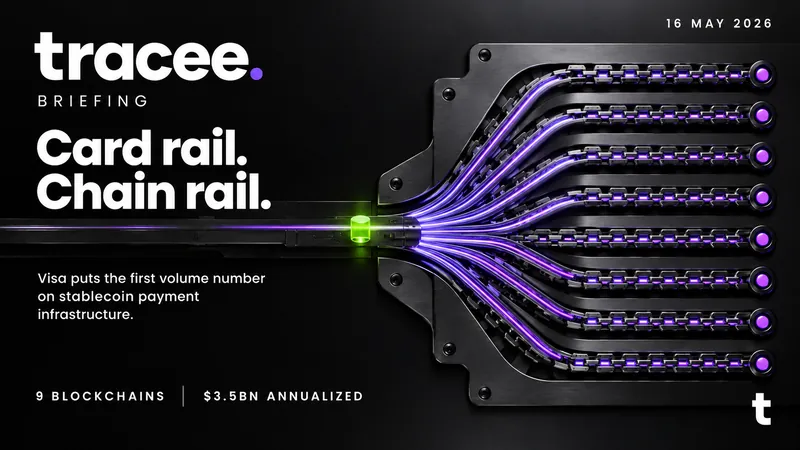
Visa has reached a $7 billion annualized stablecoin settlement run rate, up 50% quarter over quarter, across nine blockchains including Canton (JPMorgan Kinexys)…
Read briefingRipple's RLUSD expanded to 40+ blockchains on June 4 via Wormhole's Native Token Transfers (NTT) standard, reaching a $1.72B market cap as the 8th-largest…
Read briefing
Western Union launched USDPT on May 4, the first major money services business to deploy a GENIUS Act-compliant stablecoin issued by a federally chartered bank.
Read briefingDeel expanded DLUSD, its dollar-denominated payroll balance issued through Stripe-owned Bridge and settled on Tempo, from Argentina to over 80 countries in eleven…
Read briefingOn June 10, 2026, Mastercard launched AP4M and Visa disclosed $70B annualized stablecoin settlement on the same day.
Read briefing
SoFi Bank, N.A. made SoFiUSD available to its 14.7 million consumer members on 27 May 2026, the first stablecoin issued by a federally chartered national bank…
Read briefingSuggest a news item or request a private briefing.
Public briefings publish on no fixed cadence. Private briefings, written for one institution and one decision, are part of the consulting engagement formats.