
The courier becomes the issuer: MoneyGram replaces USDC with native MGUSD on Stellar and puts 60 million users on a self-custodial dollar.
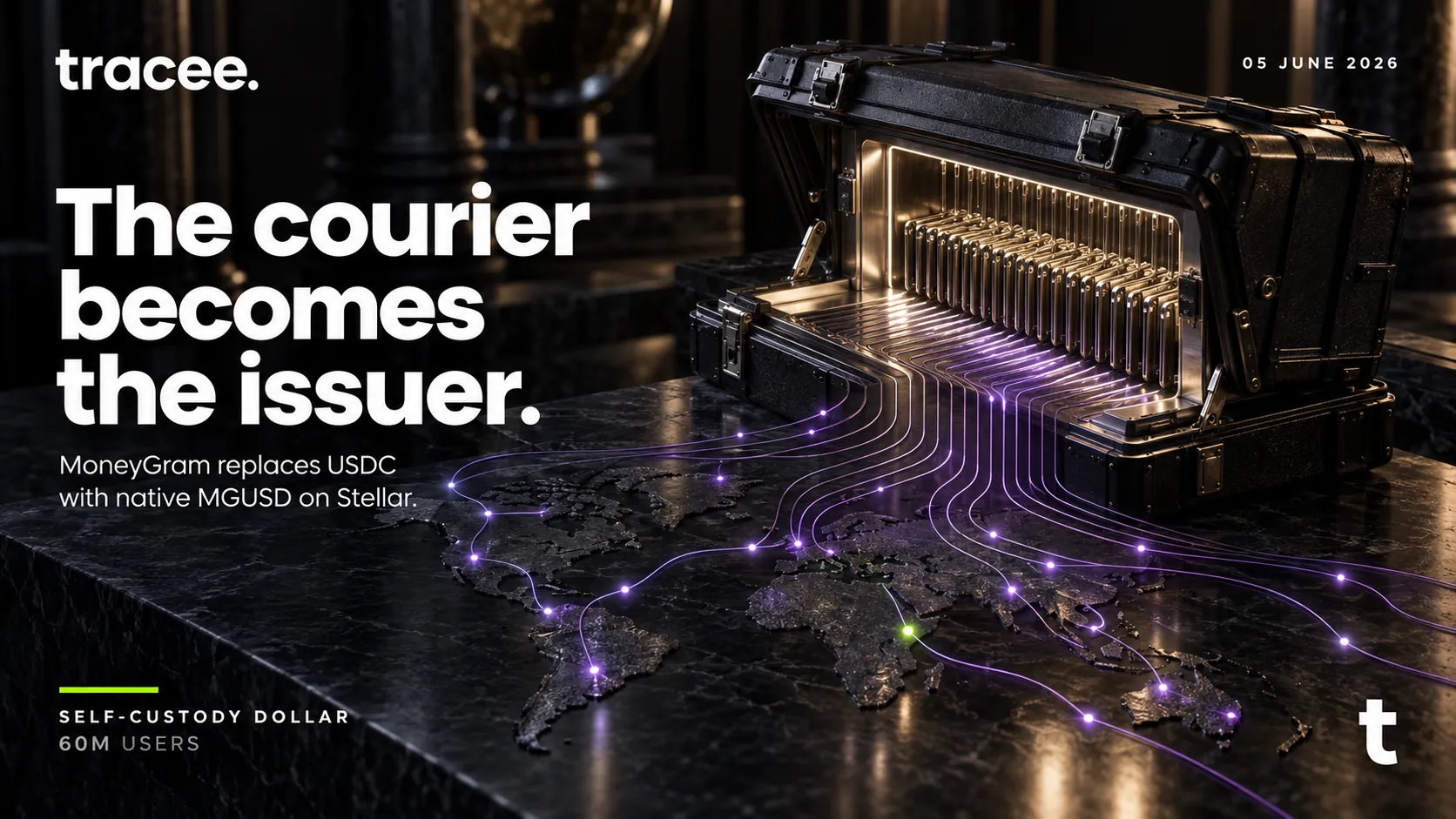
One press release. Five years of third-party USDC distribution, retired.
The architecture inside this sentence is more significant than the headline implies. MoneyGram is not adding a stablecoin feature. It is replacing its entire on-chain dollar model, and handing the issuer role to Stripe's infrastructure arm.
Five moves embedded in the press release. One of them changes the economic model entirely.
| Move | Status | Verdict |
|---|---|---|
| MGUSD live on Stellar | Shipped | Native issuance, day one. Minted and burned via M0 smart contracts on Stellar. MoneyGram's first branded stablecoin; the five-year USDC distribution arrangement is the model it replaces. |
| Bridge (Stripe) as regulated issuer | Shipped | GENIUS Act-ready by design. Bridge absorbs the compliance liability. Reserve yield and the issuer relationship move from Circle's balance sheet to Stripe's licensed subsidiary. |
| Self-custodial wallets in the MoneyGram app | Shipped | Persistent balance, not a transfer. Users hold MGUSD directly. Not a custodial float: the token sits in the customer's wallet, convertible to local currency at any of the 500,000 agents. |
| Global rollout across 200 countries | Deploying | US-only at launch. The 200-country, 500,000-agent footprint is the stated destination. No non-US corridor is live on day one; expansion timeline has not been committed. |
| Prior Stellar/USDC partnership | Retired | Five years, ~$30M cumulative. The 2021 SDF-Circle-MoneyGram arrangement that generated an estimated $30 million in transactions by 2024 is the architecture MGUSD supersedes. |
The first three rows are operational facts. Row four is the destination. Row five is the context that makes row one structurally significant.
Four layers between cash deposit and self-custodial dollar wallet.
The stack is vertical: cash or digital onboarding at the top, self-custodial wallet at the middle, cash-out agent at the bottom. Three specialized infrastructure firms sit between MoneyGram's brand and the customer's wallet.
The self-custodial wallet is the architectural shift. Prior MoneyGram Stellar service routed USDC through Fireblocks to cash-out; users never held a balance. MGUSD reverses that: the wallet is the product, the cash-out agent is the optional exit.
Three structural upgrades, only one of which is about the stablecoin.
The economic model flipped. From 2021 to 2025, MoneyGram distributed Circle's USDC on Stellar as a transfer layer: the stablecoin float was Circle's asset, the reserve yield was Circle's revenue, and MoneyGram earned fee income at the agent layer. MGUSD changes all three. The stablecoin float is now anchored to Bridge's reserve management under MoneyGram's brand. Reserve yield flows to Bridge and, through commercial arrangement, back to MoneyGram. The five-year partnership was a distribution experiment. This is the owned-product pivot that follows when a distribution experiment reaches commercial viability but economic terms remain unfavorable.
Self-custody is a different product category. A transfer network solves the point-to-point problem: money moves from person A to person B. A self-custodial wallet solves the store-of-value problem: person A holds a stable dollar balance until they choose to spend or convert it. For a MoneyGram customer in a high-inflation corridor, the Philippines, Bolivia, sub-Saharan Africa, a persistent dollar wallet inside a familiar app is a savings instrument, not a transfer mechanism. The $30M cumulative volume from four years of the USDC service likely reflects that the prior product solved only the transfer problem. MGUSD attempts to solve both.
Bridge/Stripe as issuer is a template, not a one-off. Stripe acquired Bridge in 2024 for approximately $1.1 billion. MGUSD is the first large-scale consumer deployment of Bridge's issuance infrastructure at remittance scale. The same architecture, regulated issuer plus M0 minting plus Fireblocks custody, can be replicated by any large payment or remittance network that wants a GENIUS Act-compliant stablecoin without building the regulatory stack in-house. Western Union used Anchorage Digital Bank for the same structural reason. The race is now which licensed infrastructure provider captures the second, third, and fourth large remittance network.
The architecture is sound. Four open questions that the press release does not answer.
- US-only at launch, no corridor committed. The 200-country, 500,000-agent footprint is the destination, not the starting point. No corridor outside the United States is live. Philippines, Mexico, and sub-Saharan Africa are the obvious next targets given MoneyGram's agent density; none has been named.
- Prior traction was modest. The 2021-2025 Stellar/USDC service generated approximately $30 million in cumulative transactions from a declared base of 60 million users. That is a low conversion rate. MGUSD changes the product design, but the baseline adoption question is unresolved until corridor-level volume figures appear.
- Reserve attestation schedule is unpublished. MGUSD is GENIUS Act-ready in issuer structure. Bridge's reserve composition, auditor identity, and monthly attestation cadence have not been announced. Without published attestations, the 1:1 backing claim is unverified at the institutional standard the GENIUS Act will require from July 2027.
- Self-custody cannibalizes agent fee revenue. If users hold MGUSD in wallets rather than converting immediately at agents, MoneyGram earns fewer agent transaction fees. The self-custodial model is better for users in high-inflation corridors but structurally competes with MoneyGram's existing fee structure. No disclosure addresses this tension.
- GENIUS Act OCC final rule applies on July 18. Bridge must qualify as a permitted payment stablecoin issuer under the OCC's implementing regulations. The interim period ahead of that rule is operating on the assumption of compliance, not confirmed compliance.
Western Union on May 4, MoneyGram on June 2: the remittance duopoly's on-chain migration closed in twenty-nine days.
The tracee briefing on Western Union USDPT (18 May 2026) called USDPT "Western Union's settlement layer rebuilt on a public chain." MoneyGram's MGUSD is a different architectural answer to the same question. Western Union used Anchorage Digital Bank N.A. as its regulated issuer and Solana as its chain, targeting the Philippines and Bolivia with a back-end API connecting crypto wallets to its 600,000 cash-out agents. MoneyGram used Bridge (Stripe) as its regulated issuer and Stellar as its chain, targeting all corridors via a self-custodial consumer wallet. Two different product designs, two different chain choices, both issued within twenty-nine days by the two institutions that collectively handled roughly $1.4 trillion in remittance flows annually before the on-chain migration began.
Stellar's footprint deserves a note. The DTCC chose Stellar as its first permissionless blockchain for DTC-custodied equities and Treasuries, announced 27 May 2026. Bermuda chose Stellar to become the world's first fully on-chain national economy, announced 12 May 2026. MoneyGram re-anchors its consumer dollar product to Stellar on 2 June 2026. Three announcements, three different institutional problems, the same chain, within three weeks. That is a network-effect signal for Stellar's position in the emerging dollar-stablecoin layer, distinct from its role in institutional settlement.
The GENIUS Act is the enabling condition for all of this. Both USDPT and MGUSD are specifically structured to qualify as permitted payment stablecoins under a framework signed into law in July 2025. The OCC final rule due July 18 will confirm or complicate the compliance status of both. From the Citi Tokenization 2030 briefing (3 June 2026) to the Mastercard settlement expansion, July 18 is the same gate for the stablecoin layer across every segment of the market, retail, institutional, and remittance.
The duopoly is on-chain. The adoption question is still open.
Both legs of the global remittance duopoly have issued native dollar stablecoins within a month of each other. The infrastructure architecture is credible: Bridge and Anchorage are licensed issuers, Stellar and Solana are established chains, Fireblocks and M0 are proven infrastructure. What the prior Stellar/USDC service produced, roughly $30 million over four years from 60 million declared users, sets a baseline that MGUSD's self-custodial wallet design must exceed to validate the thesis that the product upgrade drives adoption, not just the regulatory framework. The July 18 OCC rule and the first non-US corridor activation are the two events that will determine whether MGUSD is a structural deployment or a well-structured announcement.
Watch three things over the next ninety days:
- MGUSD circulating supply at 90 days. If MGUSD supply exceeds the $30 million cumulative figure the prior USDC service took four years to reach, the self-custodial wallet changed the adoption dynamic. If it does not, the upgrade was architectural, not commercial.
- First non-US corridor activation. Philippines, Mexico, or sub-Saharan Africa would each represent a different corridor thesis. Whichever goes live first, and on what timeline after July 18, defines MGUSD's emerging-market claim.
- Bridge/Stripe GENIUS Act status under the OCC final rule. If Bridge qualifies as a permitted payment stablecoin issuer under the July 18 rule, expect Stripe to offer the same white-labelled architecture to other remittance and payments networks. If it requires restructuring, the MGUSD timeline shifts accordingly.
Common questions about MoneyGram MGUSD and the remittance stablecoin race.
What is MGUSD?
How does MGUSD differ from MoneyGram's previous Stellar and USDC service?
Who is Bridge, and why does it matter?
How does MoneyGram MGUSD compare to Western Union USDPT?
What is the significance of Stellar as the chosen chain?
Related briefings on the same rails.

Western Union launched USDPT on May 4, the first major money services business to deploy a GENIUS Act-compliant stablecoin issued by a federally chartered bank.
Read briefing
SoFi Bank, N.A. made SoFiUSD available to its 14.7 million consumer members on 27 May 2026, the first stablecoin issued by a federally chartered national bank…
Read briefingRipple's RLUSD expanded to 40+ blockchains on June 4 via Wormhole's Native Token Transfers (NTT) standard, reaching a $1.72B market cap as the 8th-largest…
Read briefing
MiCA's transitional period closed June 30; two days later, Bridge became the entity holding both a CASP authorization and an EMI license from the same Luxembourg…
Read briefing
DTCC named Stellar as the first public, permissionless blockchain for DTC-custodied securities on 27 May 2026, with availability targeted for H1 2027.
Read briefing
Japan's June 1 Payment Services Act amendment created two trust-type stablecoin categories: the foreign pathway (USDC, RLUSD) and the domestic Type III (JPYSC)…
Read briefingSuggest a news item or request a private briefing.
Public briefings publish on no fixed cadence. Private briefings, written for one institution and one decision, are part of the consulting engagement formats.
Book a discovery call