
The GENIUS Act's first retail proof: SoFi becomes the first US national bank to put a stablecoin in a consumer banking app.
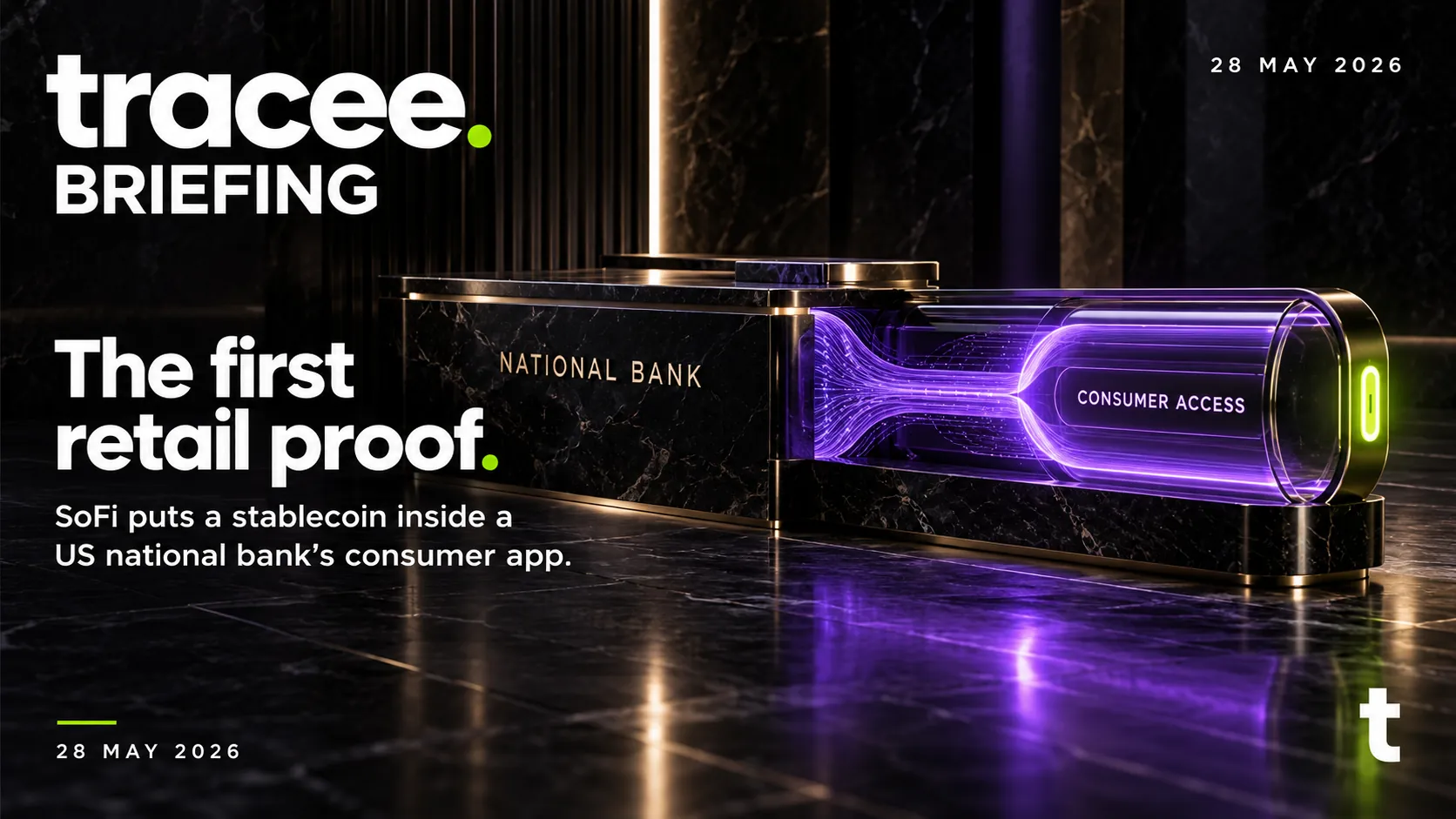
One press release. Five words that separate it from every other stablecoin announcement.
Those five words are "issued by a US national bank." SoFiUSD is not a non-bank stablecoin sitting in a bank-branded wrapper. The issuer is SoFi Bank, N.A., an OCC-regulated insured depository institution with a Federal Reserve master account.
Five moves in the announcement. Two are on the ground. Three are calendar entries.
SoFi stacked five distinct claims into one press release. They do not all carry the same weight.
| Move | Status | Verdict |
|---|---|---|
| SoFiUSD enterprise launch, December 2025 | Shipped | Incremental. The token has been live for institutional clients since 18 December 2025 and crossed $100M in circulating supply on Ethereum before the retail launch. |
| Consumer app availability for 14.7M members | Shipped | The genuine first. No OCC-chartered insured depository institution had previously made a self-issued stablecoin available inside a retail banking app. This is the event that earns the headline. |
| Mastercard settlement integration | Announced | Infrastructure signal. SoFi Bank plans to settle its own Mastercard card transactions in SoFiUSD. Partnership announced March 2026. Live date for the retail launch is unconfirmed. |
| FDIC-insurable tokenized deposits | Roadmap | Structural next step. A yield-bearing deposit token on the same issuer balance sheet as SoFiUSD. Not yet built. The GENIUS Act prohibition on stablecoin interest makes this the only path to yield for SoFiUSD holders. |
| Bullish institutional trading access | Roadmap | Incremental. Institutional stablecoin trading venues already exist. Bullish extends distribution; it adds no new architecture to the SoFiUSD stack. |
The two shipped rows are real events. The three roadmap rows are public commitments on an undisclosed timeline.
The reserve sits at the Federal Reserve, not at a trust company or offshore custodian.
The stack reads differently from non-bank stablecoin architectures because the issuer sits inside the regulated banking system, not outside it.
The Federal Reserve account as the reserve layer is what Circle, Tether, and every non-bank stablecoin issuer cannot replicate without a national bank charter or an equivalent central bank relationship.
Three architectural moves, each one larger than the press release made them sound.
The GENIUS Act produced a bank-grade issuer at consumer scale. SoFi Bank, N.A. is not a fintech with a trust charter. It is an OCC-chartered, FDIC-insured depository institution whose reserves sit in a Federal Reserve master account. The GENIUS Act signed in July 2025 established the federal framework that lets a national bank issue a payment stablecoin without the state-by-state licensing patchwork that previously made this commercially unworkable. Ten months after enactment, the framework has its first consumer-facing result. Circle (USDC) and Tether (USDT) remain the structural incumbents in global stablecoin supply. Both are non-bank entities. SoFiUSD introduces a third issuer architecture: the commercial bank as stablecoin issuer, with the full weight of federal banking regulation behind every token.
The Mastercard integration turns stablecoin into settlement infrastructure. A stablecoin available to purchase and hold is a payment product. A stablecoin used to settle the bank's own card transactions is infrastructure placed inside the existing payment system through one of its two dominant card rails. When SoFi Bank begins settling Mastercard transactions in SoFiUSD rather than through correspondent banking, the token stops being an optional feature and enters the bank's operational plumbing. Visa's $7B annualized stablecoin settlement run rate, announced in May 2026 across nine blockchains, has now been matched on the Mastercard side by a bank-issued instrument rather than a third-party stablecoin.
SoFiUSD is designed with a two-instrument arc. The payment stablecoin (no yield, public chain, GENIUS Act-compliant) and the tokenized deposit (yield-bearing, FDIC-insurable, interest-permitted) are planned as two faces of the same issuer balance sheet. A user holds SoFiUSD for payments and cross-border transfers; the deposit token is the earnings layer on top. This architecture, stablecoin as payment rail and deposit token as yield vehicle, mirrors what J.P. Morgan built with JPMD on the institutional side, applied here to retail banking accounts. The tokenized deposits versus stablecoins briefing sets out why the legal distinction between the two instruments matters to the depositor.
The first is genuine. Four qualifiers the announcement buries.
- SoFiUSD pays no yield. The GENIUS Act prohibits payment stablecoins from paying interest to holders. Any user who mints SoFiUSD today holds a non-interest-bearing dollar in a public blockchain wrapper. The tokenized deposit product, which can earn yield, is on the roadmap only.
- "First national bank" needs its qualifier. SoFi obtained its national bank charter via acquisition of Golden Pacific Bancorp in 2022, not an original OCC grant. JPMorgan, Citibank, and Bank of America, all OCC-chartered national banks with decades of history, have not issued retail stablecoins. SoFi drew first, but it is a roughly $25B bank, not a systemically important one.
- Mastercard settlement timing is unconfirmed. The partnership was announced in March 2026; the May 27 press release does not confirm card settlement is live at the consumer app launch. The Mastercard integration is the operationally significant move; its delivery date is not yet public.
- 14.7 million members is distribution potential, not volume. The announcement does not disclose how many members minted or held SoFiUSD in the five months since the December 2025 enterprise launch. The $100M circulating supply figure predates the retail launch and reflects institutional demand, not retail uptake.
- Chain risk is not FDIC-insured. The bank's guarantee covers redemption from SoFi Bank, N.A. A smart contract exploit or network failure on Ethereum or Solana is not covered by deposit insurance. The OCC charter does not extend to on-chain operational risk.
The GENIUS Act now has a consumer banking face. The competitive frame shifts from non-bank issuers to chartered institutions.
The OCC conditionally approved national trust bank charters for Circle, Ripple, Paxos, BitGo, and Fidelity Digital Assets in December 2025, converting non-bank stablecoin firms into regulated entities. Those conversions are inbound. SoFi already holds a full national bank charter with FDIC deposit insurance and Federal Reserve account access: a structurally more conservative issuer than a trust company, and a more credible one for a retail depositor. The December 2025 OCC approvals and the SoFiUSD retail launch are two faces of the same GENIUS Act buildout, converging from opposite directions on the same federally supervised stablecoin market.
The Western Union USDPT briefing from 18 May showed the GENIUS Act applied to remittance rails: a GENIUS Act stablecoin on the world's largest remittance network. SoFiUSD is the same framework applied to the everyday banking account. Both tokens are GENIUS Act payment stablecoins with 1:1 USD backing and public blockchain deployment. The distinction is the distribution channel: Western Union reaches the cross-border remittance corridor; SoFi reaches the domestic bank account of 14.7 million members.
The Visa stablecoin settlement briefing recorded a $7B annualized settlement run rate across nine blockchains in May 2026, with USDC and USDT as the dominant instruments. SoFiUSD changes the Mastercard side of that picture: the settlement token on Mastercard's rail will be issued by the bank itself, not by a third-party stablecoin provider. Whether that model, bank-issued settlement token on a card network rail, scales faster than the Visa model of third-party stablecoin integration is the market structure question the next twelve months will answer.
Distribution is confirmed. Adoption and infrastructure delivery are the open tests.
SoFi Bank, N.A. put a stablecoin it issued, under a federal framework, in front of the largest retail distribution base any bank-grade payment stablecoin has reached. The product is real, the issuer is federally chartered, the regulatory framework is in place, and the GENIUS Act's consumer thesis now has a live proof. The immediate question is adoption: whether 14.7 million members treat SoFiUSD as a payment instrument or ignore it. The structural question is whether Mastercard settlement and the tokenized deposit product arrive on the announced timeline, and whether a larger OCC-chartered bank follows the architecture SoFi just drew.
Watch three things over the next twelve months:
- SoFiUSD circulating supply on Ethereum and Solana. Crossing $1B in the next twelve months would confirm retail demand for bank-issued payment stablecoins at scale. Staying near $100M would confirm the enterprise-to-retail transfer has not yet happened, and that distribution does not equal adoption.
- Mastercard settlement live date. Card settlement in SoFiUSD is the event that turns the token from a product feature into payment infrastructure. That date is the single most important operational signal the SoFiUSD story carries.
- The next national bank to file. SoFi drew the architecture: national bank charter, GENIUS Act framework, public blockchain, card network settlement. Whether JPMorgan, a mid-size regional, or a credit union follows the template under the GENIUS Act is the industry adoption question that this launch put on the clock.
Related briefings on the same rails.

Eighteen US banks, including all four systemic institutions, have committed to a shared tokenized deposit network operated by The Clearing House, targeting a…
Read briefing
Three weeks after Visa published a $7B annualized run rate on nine blockchains, Mastercard opened its Multi-Token Network to six regulated stablecoins across eight…
Read briefing
Bermuda is the first OECD-grade live deployment of a national payment system onto a public chain.
Read briefing
Western Union launched USDPT on May 4, the first major money services business to deploy a GENIUS Act-compliant stablecoin issued by a federally chartered bank.
Read briefing
On June 22, 2026, the US Senate passed the 21st Century ROAD to Housing Act 85-5, with the House having cleared it 358-32. Buried in Section 1001: a four-year…
Read briefingThe FDIC's comment period on its GENIUS Act proposed rule closed June 9 with 338 submissions.
Read briefingSuggest a news item or request a private briefing.
Public briefings publish on no fixed cadence. Private briefings, written for one institution and one decision, are part of the consulting engagement formats.
Book a discovery call