
South Korea puts a date on tokenized securities: the legal recognition is real, the stablecoin settlement layer waits on a law Seoul hasn't passed.
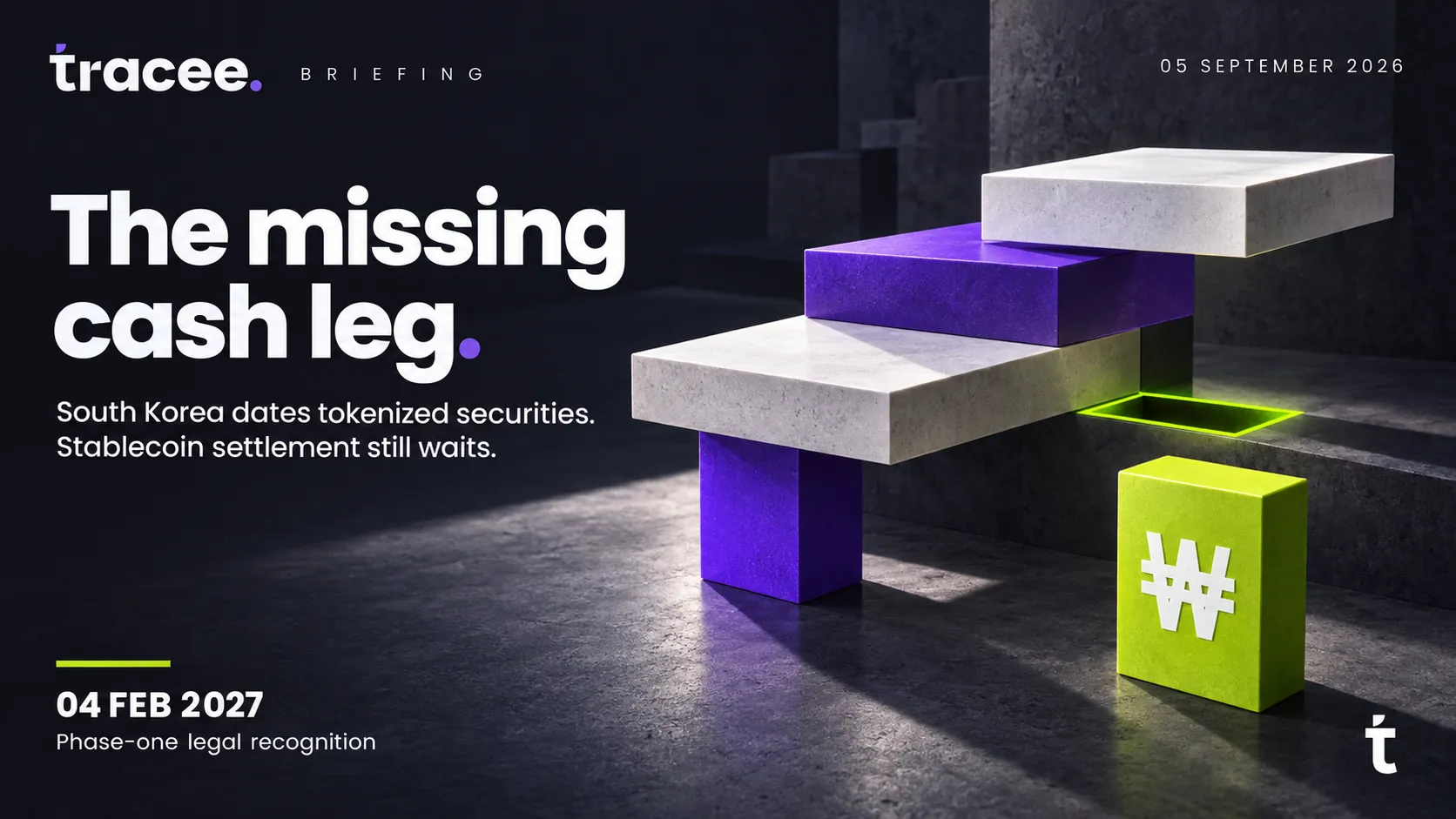
One quote from Seoul, and a three-phase plan built to end where it can't yet start.
Kwon named three phases in that meeting. Only the first one has a law attached to it.
Five moves inside the FSC's own roadmap, rated on what is locked in against what is still a hope.
Strip the "all types of securities" framing and rate each piece of the announcement on its own merits.
| Move | Status | Verdict |
|---|---|---|
| Legal recognition of security tokens (institutional money-market funds, bonds, unlisted shares), effective 4 February 2027 | Law amended | Real, but narrow. Phase one covers institutional products, not the public market retail investors actually trade. |
| No separate license regime for tokenized securities | Decided | Genuine simplification. Existing licensed securities firms handle issuance without a new charter or exam. |
| Phase two: expand tokenization to all publicly offered securities | No date set | Conditional, not committed. Timing depends on how phase one performs, a bar the FSC has not defined. |
| Phase three: on-chain settlement linked to a won stablecoin | Law doesn't exist | The actual gate. No GENIUS Act or MiCA equivalent exists in Korea, and no licensed won stablecoin can plug into it. |
| Korea Securities Depository directed to build the tokenized registry | Directive issued | Execution risk. No published technical spec, budget or delivery date attaches to the mandate. |
One phase has a law and a date attached. The other two share a sequence and no law behind the one that matters most.
Three layers, one of them working and two of them placeholders.
Strip the press release framing and the roadmap is a three-layer stack with one operating layer and two layers still waiting on something else to exist first.
- The bottleneck the FSC removed is licensing, not technology. Firms that already hold a financial investment business license can move first.
- The bottleneck the FSC left standing is the layer it actually wants. Phase three's settlement rail depends on a stablecoin law that has not reached the National Assembly.
The interesting number in this roadmap is zero, not 2027.
Zero is the count of new licenses the FSC just created. Existing licensed securities firms can issue and trade tokenized instruments under the charter they already hold. That is the opposite of the European path, where a stablecoin issuer needs both a MiCA authorization and a separate EMI license to touch the same instrument, a dual-licensing gap that has kept all but a handful of issuers out of full compliance. Korea chose not to build that gate.
The FSC named its own references: BlackRock's BUIDL and Hong Kong's tokenized green bonds. Neither is a Korean invention. The roadmap imports a model two other jurisdictions have already put capital through rather than specifying a new one from scratch, the same posture tracee flagged when Schroders tokenized a money-market fund onto JPMorgan's Kinexys rails in August.
Handing the Korea Securities Depository the infrastructure mandate turns a legal change into a systems build. KSD, not the FSC, now owns the question every tokenized money-market fund program eventually answers: who operates the ledger. BUIDL answers it with Securitize. Kinexys answers it with JPMorgan. Korea has assigned the role but has not yet published how KSD will fill it.
Three phases, one law. Read the other two as intentions.
- Phase three depends on a law that does not exist. Korea has no GENIUS Act or MiCA equivalent for stablecoins, and no licensed won stablecoin issuer to plug into the settlement layer the roadmap ends on.
- Phase two has no bar to clear. The FSC says expansion to public securities depends on phase one "proving stable," without defining what stable means or who judges it.
- KSD's mandate is a directive, not a build. No technical specification, budget or delivery date has been published for the tokenized registry it was told to construct.
- "All types of securities" is the pitch, not phase one's scope. The February 2027 law covers institutional money-market funds, corporate bonds and unlisted shares. Publicly traded stocks stay outside it.
- The $3M capital threshold is narrow, not comprehensive. It applies only to firms that self-custody tokenized issuance on their own books. Custody and secondary-trading rules for everyone else are still due by the end of September.
Korea sequenced this backwards from Hong Kong, and that might be the smarter order.
Hong Kong licensed its stablecoin issuers first, then let Standard Chartered distribute HKDAP through one of them, tracee's own August briefing on that launch. Korea is running the opposite sequence: license the security-token layer first, and leave stablecoin settlement for a law that has not been written. Singapore is doing a version of the same thing, finalizing its own stablecoin licensing framework this month rather than building a securities layer on top of one that exists.
The EU's experience reads like the cautionary tale Korea is responding to. tracee's briefing on MiCA's dual-licensing barrier documented firms needing both a MiCA authorization and a separate EMI license to move the same euro token, a gap that has left only three of the world's top 50 stablecoins MiCA-compliant two years into the regime. The FSC's decision not to create a parallel license for tokenized securities reads as a direct answer to that friction, even without saying so.
One phase is scheduled. Two are still a sequence.
The FSC proved a regulator can remove tokenization's licensing friction without a new statute: existing securities firms move first, no new charter required. It has not proved Korea can build the settlement layer the roadmap ends on. The date on the calendar that matters is 4 February 2027, when the Registration Act amendment turns tokenized securities into legally recognized instruments. The "all types of securities" and stablecoin-settlement language attached to that date describes an ambition, not a schedule.
Watch three things:
- The subordinate regulation drafts due by the end of September 2026. They will say exactly which institutional products phase one admits and which stay outside it.
- Whether Korea's own stablecoin legislation reaches the National Assembly before phase two opens. That bill, not the roadmap, is the real gate on phase three.
- KSD's first technical disclosure on the tokenized registry. It answers who operates the ledger the FSC has only assigned so far.
Common questions about South Korea's tokenized securities roadmap.
What did South Korea's FSC announce about tokenized securities?
Is South Korea's tokenized securities plan already law?
Does South Korea require a new license to issue tokenized securities?
How would phase three's stablecoin settlement work?
Where can I read the original source?
Related briefings on the same rails.
Zerohash Europe received an EMI license from DNB on 18 May 2026, the first firm licensed under MiCAR to also hold full EMI status.
Read briefingSeven axes where the two paths diverge: issuer license, backing, regulation, insurance, network, yield, and example issuers.
Read briefing
OCC Comptroller Jonathan Gould pledged a final GENIUS Act rule by November, the first of five required regulators to name a date.
Read briefing
BIS General Manager Pablo Hernandez de Cos told the Fed's Jackson Hole symposium that stablecoins aren't credible as payment at scale, restating the BIS's own June…
Read briefing
Treasury proposed a rule defining when a stablecoin is "issued in the United States" and "offered or sold" to a US person, borrowing from Regulation S and extending…
Read briefing
FASB's 18 August 2026 proposal would let stablecoins meeting a three-part redemption and reserve test sit on the cash-equivalents line, with comments due 19…
Read briefingSuggest a news item or request a private briefing.
Public briefings publish on no fixed cadence. Private briefings, written for one institution and one decision, are part of the consulting engagement formats.
Book a discovery call