
A pound is a pound: the Bank of England commits to June stablecoin rules and replaces holding limits with issuer caps.
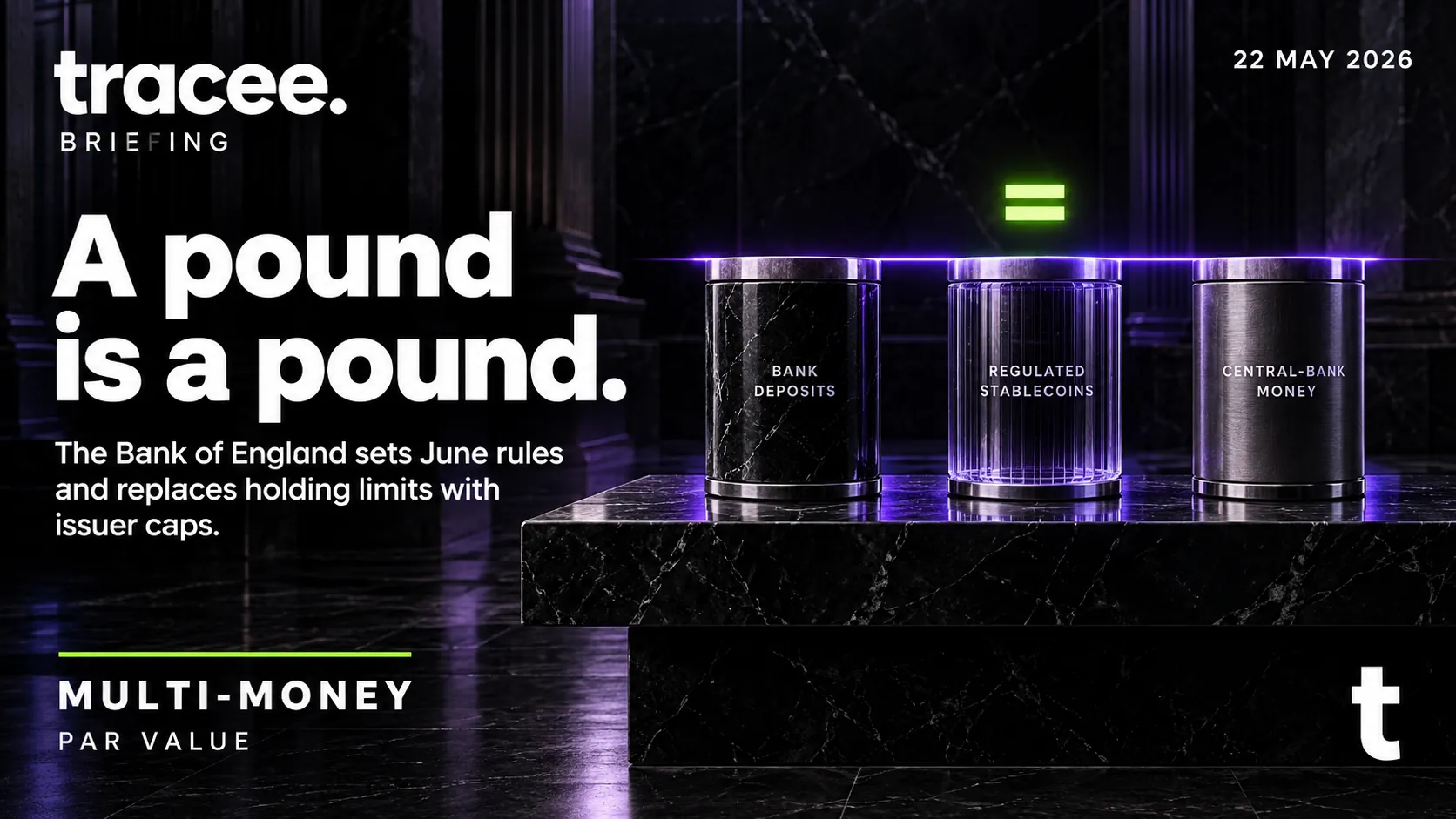
One speech at City Week. Three policy moves in the same paragraph.
That paragraph names three forms of money, states a design principle, and sets two deadlines. The design change from the November 2025 consultation sits in a separate part of the speech.
Two moves are live today. Two are forward obligations. One is an option kept open.
The 19 May speech and the 18 May BoE/FCA joint consultation together contain five distinct announcements. They carry different statuses and different implementation risks.
| Move | Status | Verdict |
|---|---|---|
| Draft stablecoin rules | Pending · June 2026 | Design shift confirmed. Aggregate issuance caps replace per-user holding limits (£20,000 / individual, £10M / business). Specific cap levels unpublished. |
| Final stablecoin framework | Pending · year-end 2026 | Convergence signal. Breeden explicitly aligns with the GENIUS Act's July 2026 deadline. Interoperability framing, not just scheduling. |
| PRA tokenised deposit guidance | Shipped | Capital clarity for banks. Prudential treatment of tokenised assets same as non-tokenised equivalents where legal rights are identical. PRA reaffirms banks should innovate. |
| BoE/FCA Digital Securities Sandbox consultation | Shipped · 18 May | Wholesale pipeline confirmed. 16 firms preparing to launch by late 2026. Covers tokenised collateral, settlement infrastructure, and capital treatment. |
| Retail CBDC | Exploring | Option kept open. "Potentially" in the multi-money mix. No issuance timeline. UK digital pound study ongoing since 2021. |
Rows three and four are facts on the ground. Rows one and two are obligations with public deadlines. The design shift from holding limits to issuance caps is the operative product news.
Two separate layers, built on the same interoperability mandate.
The speech draws a two-tier UK digital money architecture: a retail money layer covering forms of consumer-facing payment money, and a wholesale layer covering how tokenised securities trade and settle.
- The two layers are separate regulatory projects. The retail money framework governs forms of payment currency; the DSS governs how tokenised financial instruments trade and settle. Different regulation, different timelines, different risk profiles.
- The issuance cap design applies to the retail layer. When June draft rules arrive, the cap number will determine whether sterling stablecoin issuance is commercially viable in the UK. The DSS is unaffected by that number.
The design shift is the product news. Issuer caps make sterling stablecoin products viable for the first time.
The per-user holding limit was the architecture-killing constraint. The November 2025 consultation proposed £20,000 per individual and £10 million per business. Both figures are unenforceable on decentralised networks at commercial scale: any enterprise distributing a stablecoin through exchanges, custodians, and payment service providers cannot track per-wallet balances across counterparties in real time. The aggregate issuance cap replaces that constraint with a limit placed on the issuer directly, which is how the GENIUS Act and MiCA both approach the same stability problem. The principle is identical across all three frameworks: cap the total supply of a private monetary instrument, not the individual user.
"In line with the US timeline" is not a scheduling note. No BoE official had previously framed UK stablecoin rulemaking as explicitly aligned with the GENIUS Act's July 2026 deadline. The phrase signals that the BoE is building its framework to be compatible with frameworks that will govern the issuers most likely to seek UK authorisation, primarily US-domiciled permitted payment stablecoin issuers and EU EMT issuers already licensed under MiCA. The interoperability framing is deliberate.
The PRA reaffirmation to banks is the quietest move and arguably the most durable one. Confirming that tokenised bank liabilities receive the same prudential treatment as traditional deposits where the legal rights are identical removes the capital uncertainty that has kept UK bank tokenised deposit products in pilots rather than production. Combined with the stablecoin framework, the BoE has now given the product brief to both categories of UK digital money issuer in the same week.
The design shift solves the architecture problem. It does not yet solve the market size problem.
- The aggregate cap number is not published. June draft rules may set a level that replicates the holding-limit problem by a different mechanism, suppressing supply below commercial viability. The principle is sound; the calibration is everything.
- "Potentially a retail CBDC" is not a commitment. The UK digital pound project has been active since 2021. The BoE has consistently stated it will not decide before seeing what the private sector builds. The phrase adds optionality; it announces nothing.
- 16 firms preparing to launch is not 16 firms live. The DSS is a sandbox running until January 2029. Early-stage regulated sandboxes regularly miss go-live dates. The first actual trade matters more than the headcount of participants.
- Sterling stablecoin market does not yet exist at meaningful scale. No sterling-pegged stablecoin has reached £500 million in circulation. The regulatory framework is being built for a market that is still largely theoretical. Commercial demand from issuers must emerge after the rules are published, not before.
- BoE direct connection to tokenised networks in 2027 is an infrastructure plan, not a confirmed delivery. Central bank integration with public-chain settlement infrastructure involves technology, legal, and operational dependencies that have extended timelines elsewhere, including at the BIS.
Three major jurisdictions. The same framework design, arrived at from three directions.
The G5 stablecoin framework triad is now complete. The EU finalised MiCA's e-money token regime in December 2024. The US enacted the GENIUS Act in July 2025, with six agencies issuing proposed rules through May 2026 and final rules due July 18. The UK has now published a concrete timeline: June draft, year-end final. All three frameworks share the same structural design, full reserve backing, explicit redemption rights, and issuer licensing through a banking or e-money regulator. The divergence is scope, not philosophy: GENIUS Act covers USD payment stablecoins; MiCA covers all e-money tokens across the EEA; the BoE framework covers sterling-denominated systemic issuers in the UK.
The ECB contrast is explicit. Christine Lagarde has remained the most cautious G5 central bank voice on private stablecoins, citing monetary transmission risks and the priority of a digital euro. The Banque de France's Denis Beau and the Bundesbank's Joachim Nagel have each broken with Lagarde in the past three months, calling for private euro stablecoin mobilisation. Breeden's speech goes further than any of them: the BoE is not just tolerating private stablecoins alongside the central bank money supply, it is publishing the rules that enable them and the date by which those rules will be final. The 12 May briefing covered the ECB fracture; the BoE move is its structural counterpart in a separate jurisdiction.
A BIS working paper published on 6 May 2026 mapped the mechanism by which dollar stablecoin adoption in emerging markets channels local savings into US Treasury bills, reinforcing currency hierarchy. The UK faces a smaller version of the same dynamic: without a viable framework for regulated sterling stablecoins, UK retail payment flows risk defaulting to USD-denominated instruments. The multi-money framework is, among other things, a monetary sovereignty argument for why sterling instruments need to be competitive at the product level.
The framework is real. Whether the June cap number is commercially viable is the only question that matters now.
The Bank of England's 19 May speech marks the moment the UK joined the US and EU with a published timeline for regulated stablecoin issuance. The shift from per-user holding limits to aggregate issuer caps removes the architectural barrier that made sterling stablecoin products operationally unworkable at enterprise scale. The PRA reaffirmation on tokenised deposits gives UK banks the same clarity in the same week. Three frameworks, three jurisdictions, the same structural design. The variable is June: if the aggregate cap number allows meaningful commercial supply, the UK has a sterling stablecoin market. If it is set too low, the framework becomes a positioning move rather than an operating environment.
Three things to watch:
- The aggregate issuance cap number in June's draft rules. The level will determine whether sterling stablecoin issuance is commercially viable or constrained below meaningful scale. This is the single gating variable in the entire framework.
- The first live Digital Securities Sandbox transaction. Which of the 16 firms clears first, on which asset class, and whether a regulated stablecoin or tokenised deposit is used as the settlement medium.
- Whether a US or EU stablecoin issuer applies for UK systemic stablecoin authorisation. That application, if it arrives before year-end, would confirm the UK framework is attracting cross-border capital rather than only domestic issuers.
Related briefings on the same rails.

The BoE drops individual stablecoin holding limits in favour of aggregate caps and sets June 2026 for draft rules, with 16 Digital Securities Sandbox firms…
Read briefing
FASB's 18 August 2026 proposal would let stablecoins meeting a three-part redemption and reserve test sit on the cash-equivalents line, with comments due 19…
Read briefingThe Fed proposed GENIUS Act reserve, capital and application rules seven months after the OCC and five after the FDIC. None of the three is final yet.
Read briefing
OCC Comptroller Jonathan Gould pledged a final GENIUS Act rule by November, the first of five required regulators to name a date.
Read briefingThe FDIC's comment period on its GENIUS Act proposed rule closed June 9 with 338 submissions.
Read briefing
Section 20's effective date, the earlier of 18 January 2027 or 120 days after final rules issue, is untouched by the miss.
Read briefingSuggest a news item or request a private briefing.
Public briefings publish on no fixed cadence. Private briefings, written for one institution and one decision, are part of the consulting engagement formats.
Book a discovery call