
Japan's yen-to-dollar corridor runs on two-day settlement: Nomura and Circle sign to route $440 billion in daily FX transactions over USDC.
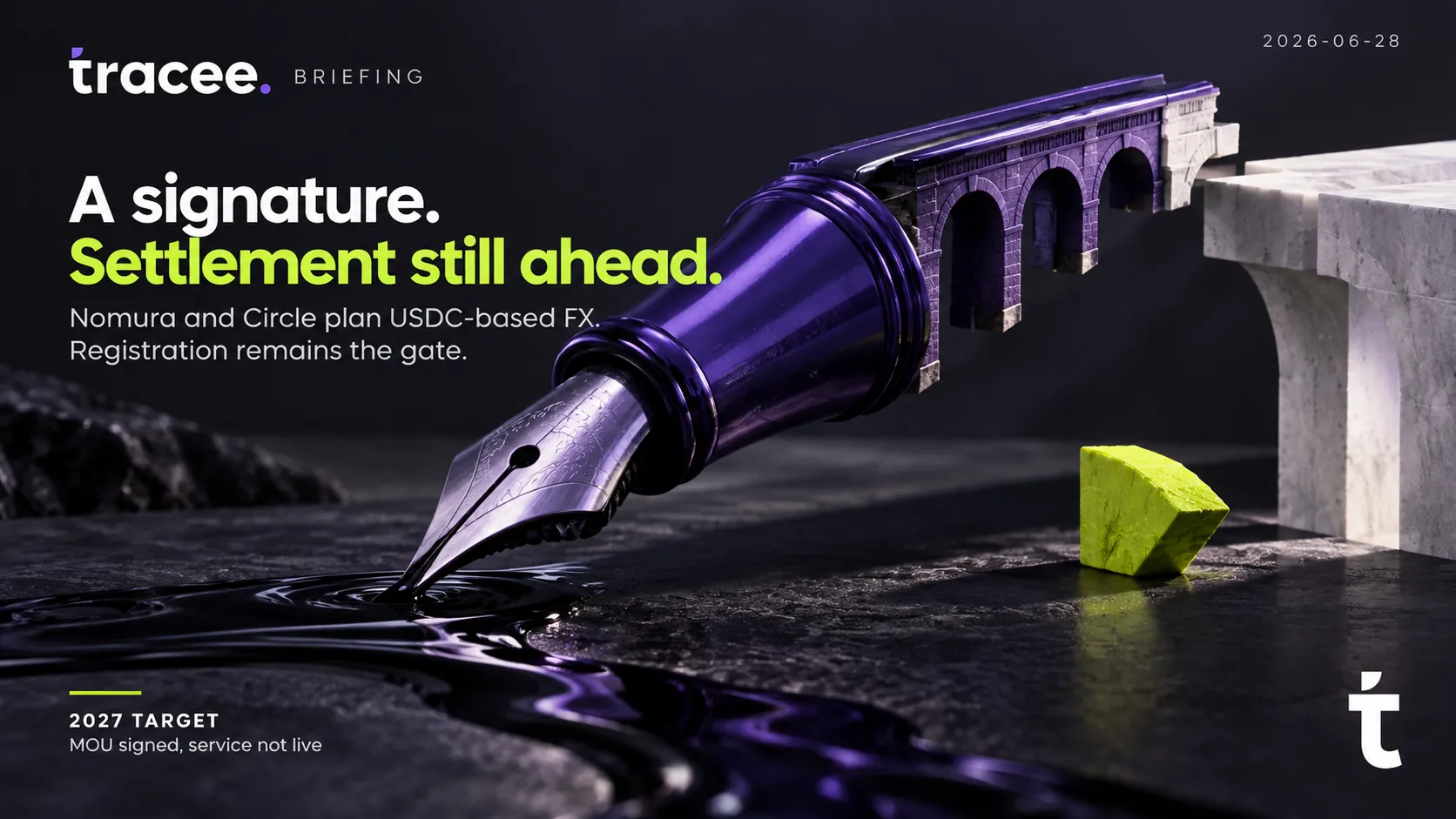
One announcement. One proof that Japan's regulatory gate has opened for dollar stablecoins.
The load-bearing sentence is the last one: Japan's PSA amendment is what made this announcement possible at all.
Four commitments in the MOU. One establishes USDC in Japan's FX infrastructure.
The announcement decomposes into four distinct decisions, each at a different stage of execution.
| Move | Status | Verdict |
|---|---|---|
| Circle and Nomura sign MOU for USDC-based FX settlement in Japan | Announced | The signature is the signal. Nomura is Japan's largest brokerage and a top-five global investment bank. Its name on a USDC FX platform converts stablecoin from a crypto instrument into a candidate treasury instrument for every Japanese corporate client it covers. |
| Japan's PSA trust-type framework as the regulatory basis | Shipped | The gate is open. The Payment Services Act amendment (effective June 1, 2026) created the "trust beneficiary right" category that allows USDC to operate under Japanese law. This gate was not open six months ago. The amendment is what moved this announcement from impossible to plausible. |
| USDC-settled yen-to-dollar FX transactions for Japanese corporates | Exploring | Not live. No disclosed blockchain architecture, no transaction cap, no counterparty agreements. The platform design is the work of 2026; the transactions are the work of 2027. |
| Nomura registered as a second EPSP for trust-type stablecoins in Japan | Pending | The single gate. SBI VC Trade is currently the only registered Electronic Payment Services Provider permitted to distribute trust-type stablecoins in Japan. Nomura must complete its own EPSP registration with the Financial Services Agency before it can manage USDC positions on behalf of clients. No application date has been disclosed. |
The EPSP registration status is what separates the announcement from the product. Until Nomura registers, no FX transaction can settle.
From a Nomura FX desk in Tokyo to a counterparty address, in minutes.
The settlement flow for a corporate yen-to-dollar FX transaction using USDC runs through five distinct layers, replacing the seven-hop correspondent banking chain with a direct on-chain delivery.
- The correspondent banking chain has seven hops; the USDC chain has one. A standard yen-to-dollar cross-border payment routes through the sending bank, a Tokyo correspondent, a New York correspondent, and the receiving bank, accruing latency and fees at each step. USDC settlement routes through Circle's on-chain minting to the counterparty's wallet with one confirmation.
- The yen leg is still off-chain. Nomura handles the yen side through conventional Bank of Japan settlement. Atomic delivery-versus-payment, where both legs settle simultaneously on a single ledger, is not yet part of this architecture. This is USDC-settled dollar FX, not USDC-settled FX pair settlement.
Nomura is not Circle's distribution partner. It is the compliance infrastructure Japan's corporate FX market cannot clear without.
The structural problem with dollar stablecoin FX in Japan has never been the technology. USDC has been a 24/7 settlement instrument since 2018. The problem was the regulatory perimeter: Japan's Payment Services Act had no category for a foreign trust-type stablecoin until June 1, 2026. The PSA amendment did not open a consumer wallet product. It opened an institutional FX settlement architecture, and the first institution to walk through that gate is Japan's largest brokerage.
The market signal is in Nomura's institutional exposure. Nomura covers more than 80,000 institutional clients across corporate treasury, trade finance, and international investment management. A USDC FX platform under Nomura's compliance umbrella makes USDC a treasury instrument for every corporate treasurer Nomura touches, without requiring any of those corporations to interact with a crypto exchange, manage their own wallets, or navigate the EPSP framework themselves. That is the distribution lever Circle does not have on its own.
The operating-hours argument closes a specific Japanese pain point. Japan's FX market is active when US dollar liquidity is thin: the Asian morning open runs before the New York interbank market opens, creating a window where yen-to-dollar payments queue overnight. USDC operates on a 24/7 blockchain; there is no overnight queue, no cutoff window, and no nostro account that needs to be pre-funded before the US market opens. For Japanese exporters managing dollar receivables from US buyers, the settlement lag is a working-capital cost. USDC removes it structurally, not as a product feature but as a property of the chain.
An MOU is not a product. Five gaps between this announcement and live FX settlement.
- No product architecture has been disclosed. The interface between USDC on-chain settlement and Nomura's trading systems, SWIFT messaging for off-chain counterparties, Bank of Japan reporting, and AML screening has not been described. Building that interface is the bulk of the 2026 work plan.
- Nomura's EPSP registration is undated. SBI VC Trade is Japan's sole registered trust-type stablecoin EPSP as of June 2026. Nomura has not disclosed when it will file or when it expects approval. The JFSA's EPSP review timeline is not published. This gap is not a formality; it is the legal prerequisite for any USDC position management on behalf of clients.
- The $440 billion market size is not a target. Japan's FX market processes $440 billion in daily transactions across all participants, instruments, and currencies, per BIS triennial survey data. The Nomura-Circle platform targets a subset of corporate yen-to-dollar FX. No total addressable market estimate has been disclosed.
- The yen leg does not settle on-chain. Nomura's conventional banking infrastructure handles the yen side. Atomic delivery-versus-payment on a single ledger is not part of the announced design. Corporate clients taking a two-day yen settlement risk and a minutes-fast dollar settlement will still carry an FX exposure window between the two legs.
- Trust-type stablecoin restrictions limit multichain utility. Japan's PSA trust-type framework routes USDC through the registered EPSP. On-chain transfers to wallets outside the EPSP's perimeter, including DeFi protocols, external exchanges, or non-EPSP wallets, are outside the trust-type framework. This limits the on-chain programmability of the dollar leg for Japanese corporate clients.
Japan opened its dollar stablecoin perimeter to two issuers on the same day, with opposite timelines.
On June 25, 2026, Japan's dollar stablecoin perimeter opened simultaneously on two tracks. On the same day Circle and Nomura signed their MOU, Ripple's RLUSD (USD-backed stablecoin, $1.7 billion market cap) received JFSA equivalence approval and went live on the SBI VC Trade VCTRADE platform as a Type 4 Electronic Payment Instrument, the first foreign-issued dollar stablecoin to clear the equivalence test. The two approaches diverge structurally: RLUSD is live at retail scale via SBI, with a ¥1 million per-transaction cap and Ethereum only; the Nomura-Circle platform targets institutional corporate FX, is not yet live, and has no disclosed transaction cap. Japan opened to two dollar stablecoins at once, but one is a retail product and one is a treasury instrument in formation.
A third parallel track is the yen side. MUFG, SMBC, and Mizuho signed their own MOU on June 10 to jointly issue a yen-pegged stablecoin on the Progmat platform by March 2027. The October 2026 Progmat working group report will name the cash leg for the JGB repo market, the decision the June 7 JGB repo briefing identified as the unresolved structural choice. If that working group selects USDC as the yen stablecoin conversion counterpart, the Nomura architecture becomes the interoperability layer between the yen-pegged token and the dollar settlement.
The regulatory context for this MOU is the Japan PSA amendment briefing (June 9), which decoded how the trust-type category put USDC inside the Japanese payment perimeter while leaving Tether without a category. That briefing identified the EPSP bottleneck: one distributor, one platform, narrow reach. The Nomura MOU is the first major institution to announce it will become a second EPSP, opening the PSA trust-type channel to a much larger institutional client base.
The gate is open. Now watch Nomura's EPSP registration and the first live corridor.
The Circle-Nomura MOU is the first institutional-grade commitment to use USDC as an FX settlement instrument in Japan, not as a retail payment token or a crypto product. What separates this announcement from every prior stablecoin FX claim is Nomura: Japan's largest brokerage brings corporate client distribution, domestic regulatory relationships, Bank of Japan settlement connectivity, and the compliance infrastructure that converts USDC from a blockchain instrument into a viable treasury tool for Japanese corporates. The Japan PSA amendment (June 1) created the regulatory architecture; Nomura is the distribution key that opens it commercially. The model mirrors exactly what Trace Finance demonstrated in Brazil in June 2026: stablecoin payment rails require a licensed, regulated banking intermediary to build the last mile between the on-chain dollar and the local financial system. In Japan, that intermediary is Nomura.
Watch three things:
- Nomura's EPSP registration with Japan FSA. The moment Nomura files or receives approval as a trust-type stablecoin EPSP is the single-gating event between this MOU and any live FX transaction. The filing date, the regulatory review timeline, and any conditions attached to the approval will set the real commercial launch window, not the "2027" headline.
- First live FX corridor and transaction structure. Which currency pair, which transaction size, and whether the yen leg settles on-chain or off-chain will determine whether this is USDC-settled FX (both legs on-chain, atomically) or USDC-assisted FX (dollar leg on-chain, yen leg conventional). The structural difference is significant for the corporate treasurer managing cross-currency settlement exposure.
- Progmat JGB repo working group cash-leg decision (October 2026). If MUFG, SMBC, and Mizuho select USDC as the dollar conversion instrument for their yen stablecoin, the Nomura-Circle platform becomes the institutional bridge between the two tracks of Japan's stablecoin build-out. That convergence decision, expected in the October 2026 working group report, is the macro-level signal to watch alongside the EPSP registration.
Common questions about Circle, Nomura, and Japan's USDC FX corridor.
What did Circle and Nomura announce?
What is Japan's trust-type stablecoin framework?
Why does Nomura's involvement matter?
What happened with RLUSD in Japan on the same day?
Is the platform live?
Related briefings on the same rails.
Japan's June 1 Payment Services Act amendment created two trust-type stablecoin categories: the foreign pathway (USDC, RLUSD) and the domestic Type III (JPYSC)…
Read briefingJapan's amended Payment Services Act creates the most portable regulatory framework for foreign stablecoins yet built in the G7: no domestic entity, no domestic…
Read briefing
Japan's dominant tokenized securities platform exits R3 Corda and lands on Avalanche L1 in June 2026, making ¥439.6B in tokenized real estate and corporate bonds…
Read briefing
JPYSC's own issuer and co-developer had already committed the token to Startale's Strium L1 in June, and Progmat already moved more than ¥439.6B in tokenized assets…
Read briefing
Visa has reached a $7 billion annualized stablecoin settlement run rate, up 50% quarter over quarter, across nine blockchains including Canton (JPMorgan Kinexys)…
Read briefing
Standard Chartered did not build a stablecoin. It built the first G-SIB-grade door into one, folding the second account institutional clients used to need with…
Read briefingSuggest a news item or request a private briefing.
Public briefings publish on no fixed cadence. Private briefings, written for one institution and one decision, are part of the consulting engagement formats.
Book a discovery call