
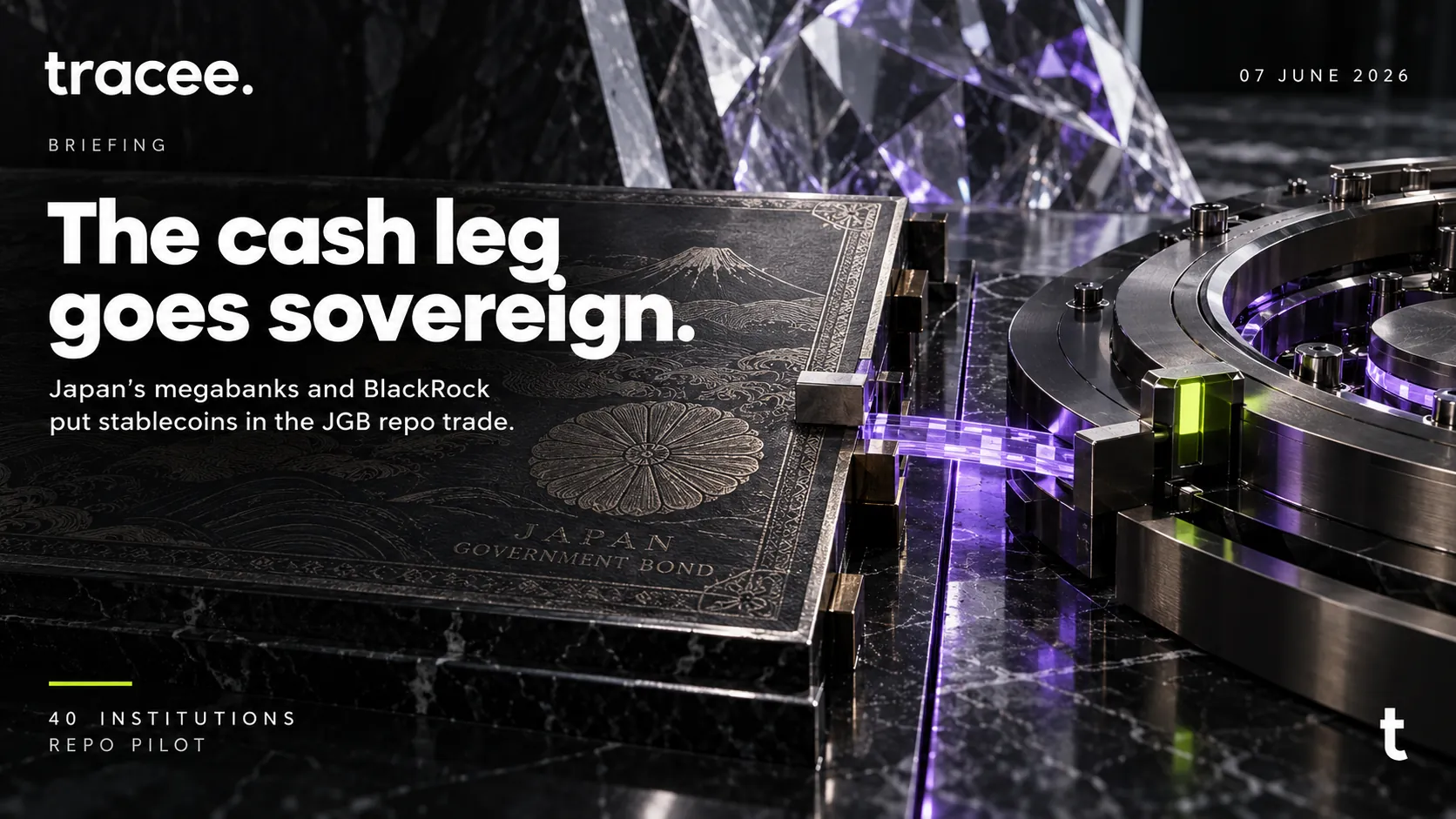
The cash leg goes sovereign: Japan's megabanks and BlackRock put stablecoins in the JGB repo trade.
Two announcements. One structural move underneath.
The infrastructure migration and the repo working group are one move in two parts: the chain switch is the precondition; the working group is what it enables.
One move shipped. Three still being scoped.
Four things are happening in this announcement. They are not all at the same stage.
| Move | Status | Verdict |
|---|---|---|
| Corda to Avalanche platform migration | Shipped | Real infrastructure event. ¥439.6B ($3B+) in tokenized assets moving to an EVM-compatible public chain by end of June 2026. Japan's dominant securities tokenization platform exits the permissioned stack. |
| JGB on-chain repo working group | Exploring | Study phase, not settlement. 40+ institutions committed to a joint study. No bonds settle on-chain yet. The WG report due October 2026 is the first binding deliverable. |
| Stablecoin as cash leg for T+0 repo | Exploring | Structural bet, not specification. The cash-leg stablecoin has not been named. Whether it is a yen-denominated token, USDC, or a bank-issued deposit token is the decision that determines the full architecture. |
| Cross-chain DvP via Datachain | Pending commercial launch | Interoperability layer available. Datachain supports delivery-versus-payment settlement across non-Avalanche rails. Activation depends on the commercial launch date and the stablecoin selection. |
The migration is done; the repo initiative is a credible plan with Japan's full financial establishment behind it.
Four layers connect to collapse a T+1 repo into T+0.
The stack runs from Japan's sovereign bond custody infrastructure down to on-chain atomic settlement. Two layers are live; two are being specified.
The architectural decision that has not yet been made is the cash leg: a yen-denominated stablecoin would keep the entire transaction in domestic currency; USDC would introduce FX conversion; a bank-issued deposit token would keep the cash inside the regulated banking system but limit programmability.
This is not another tokenization pilot. It is the first sovereign repo market to commit to the stablecoin cash leg.
The JGB repo market is the largest repo market outside the US. Japan's government bond repo runs at roughly $1.6 trillion in daily outstanding volume. Every repo transaction today settles T+1: the bond moves today, the cash settles tomorrow. For a market that size, one day of settlement lag locks up capital that could otherwise be deployed. Replacing that lag with T+0 atomic delivery-versus-payment removes a structural inefficiency that has existed for decades. This is not a startup chasing margin; it is Japan's financial establishment identifying a specific cost and proposing a specific fix.
The Corda exit is the deeper move. Progmat migrating from R3 Corda to Avalanche is not a chain preference story. Corda is a private, permissioned ledger optimized for bilateral settlement between known counterparties. Avalanche L1 is EVM-compatible, composable with the broader institutional DeFi ecosystem, and interoperable with public-chain stablecoins. That migration means Japan's tokenized securities are now on the same technical standard as Ethereum-native institutional products. BlackRock's BUIDL, Ondo's OUSG, and any future yen-denominated stablecoin all now speak the same language as Progmat's tokenized JGBs.
BlackRock Japan's presence signals something specific. BlackRock already runs BUIDL, its tokenized money market fund, on Ethereum. BUIDL is engineered as eligible reserve for payment stablecoin issuers under the GENIUS Act. If the JGB repo working group selects a dollar-denominated cash leg, BUIDL or a similar product could serve as the reserve substrate on the asset-management side. BlackRock is not participating as a passive observer; it is positioning as a potential cash-leg provider for the world's second-largest government bond market.
The assembly is real. The settlement is not yet.
- Nothing settles on-chain today. The working group publishes its report in October 2026. Commercial issuance is a year-end 2026 target. Every date in this announcement is a target, not a commitment.
- The cash-leg stablecoin has not been named. This is the binding architectural decision. A yen-pegged stablecoin would require a licensed yen EMT issuer that does not yet exist at commercial scale. USDC introduces FX risk. A bank-issued deposit token limits the programmability the initiative is built around. Each choice leads to a different settlement model.
- Economic rights, not the bonds themselves. Japan's existing book-entry JGB infrastructure and its withholding tax regime create legal constraints. The consortium will tokenize the economic rights attached to bonds held in custody, not the bonds directly. This is a workable structure but it is not the cleanest version of on-chain sovereignty.
- 40 institutions is a working group, not a launch consortium. Participation in a study group does not commit MUFG, Mizuho, or SMBC to using the system at commercial scale. The gap between "we participated in the WG" and "we send $10B through it every day" is where most pilots die.
- Bank of Japan posture is unresolved. The Bank of Japan is a Project Agorá participant and has experimented with tokenized central bank reserves. Whether it will provide BoJ digital reserves as the settlement cash, rather than a private stablecoin, is unresolved and would be the structurally cleaner outcome.
Japan joins a global wave but its contribution to it is the largest sovereign asset class yet committed.
The macro frame is set by three parallel events in 2026. The BIS Project Agorá Phase 1 results, published May 27, proved atomic multi-currency cross-border settlement using tokenized central bank reserves and tokenized commercial bank deposits across eight central banks including the Bank of Japan. The tracee briefing on Project Agorá showed that the cash leg of cross-border settlement remains unresolved: no currency pair has yet committed to real-value atomic settlement. Japan's JGB repo initiative is a domestic-market proof-of-concept that could produce the cash-leg precedent Agorá needs.
The DTCC October 2026 tokenization launch will put US equities, ETFs, and Treasuries on Canton Network, as covered in the tracee briefing on DTCC and Stellar. Japan's timeline runs parallel: WG report October 2026, commercial issuance end of 2026. These are not competing initiatives; they are the US and Japan producing institutional tokenized securities infrastructure on the same calendar. The convergence question is whether the cash legs, a US dollar stablecoin and a hypothetical yen stablecoin, are interoperable.
Japan's digital securities market is projected to exceed ¥1.05 trillion ($7B+) by end of 2026. Progmat holds 63% of that market, meaning the chain choice Progmat made for Avalanche is effectively Japan's chain standard for tokenized securities. If the JGB repo model works on Avalanche, European sovereign repo (German Bunds, French OATs, UK Gilts) faces a working precedent. The ECB Pontes DLT settlement system, targeting Q3 2026 launch, is the European infrastructure that would need to connect to that precedent to produce a global on-chain repo market.
The infrastructure is live. The settlement model is the next gate.
Japan's dominant tokenized securities platform exits Corda and lands on a public EVM chain in June 2026 with $3B in assets. The same platform assembles Japan's three megabanks, BlackRock Japan, and 37 other institutions to design stablecoin-settled repo for a $1.6T government bond market. The Avalanche migration is the enabling infrastructure; the working group is the first institutional commitment to use it for sovereign debt. The October report will name a stablecoin. That stablecoin choice is the architectural decision that determines whether this becomes a domestic Japanese proof-of-concept or the template for on-chain sovereign repo globally.
Three things to watch:
- The October 2026 WG report: which stablecoin carries the cash leg. Yen-pegged token, USDC, or bank-issued deposit token. Each choice produces a structurally different market and a different regulatory path through Japan's Payment Services Act.
- Bank of Japan posture on tokenized reserves. As a Project Agorá participant, the BoJ could provide the cleanest cash leg: central bank digital money. Whether it chooses to do so for a private-sector repo market is the policy decision that could make or break T+0 settlement at scale.
- First Progmat Avalanche live asset class. The migration completes end of June 2026. Which asset class settles its first transaction on Avalanche, and whether Datachain's cross-chain DvP activates alongside it, sets the precedent for the JGB implementation architecture.
Related briefings on the same rails.

JPYSC's own issuer and co-developer had already committed the token to Startale's Strium L1 in June, and Progmat already moved more than ¥439.6B in tokenized assets…
Read briefingSix actors decomposed: Ondo (issuer), Ripple (holder), XRP Ledger (venue), Mastercard MTN (orchestrator), Kinexys (cross-border cash rail), and two correspondent…
Read briefingFour moves stacked under one headline: two shipped (multichain expansion, DeFi composability via Uniswap and Euler), two exploratory (tokenized ETFs, staked ETH ETF…
Read briefing
The IMF's contribution isn't new data. It is the first time a multilateral institution has placed tokenized deposits, stablecoins, and wholesale CBDC on equal…
Read briefingJLTXX, filed 12 May and effective 13 May, is J.P. Morgan's second tokenized MMF on Ethereum after MONY. The bank that argued in public for two years that deposits…
Read briefing
Japan's June 1 Payment Services Act amendment created two trust-type stablecoin categories: the foreign pathway (USDC, RLUSD) and the domestic Type III (JPYSC)…
Read briefingSuggest a news item or request a private briefing.
Public briefings publish on no fixed cadence. Private briefings, written for one institution and one decision, are part of the consulting engagement formats.
Book a discovery call