
No exchange, no FX corridor: Crédit Agricole's EURXT stablecoin exists to settle its own fund subscriptions.
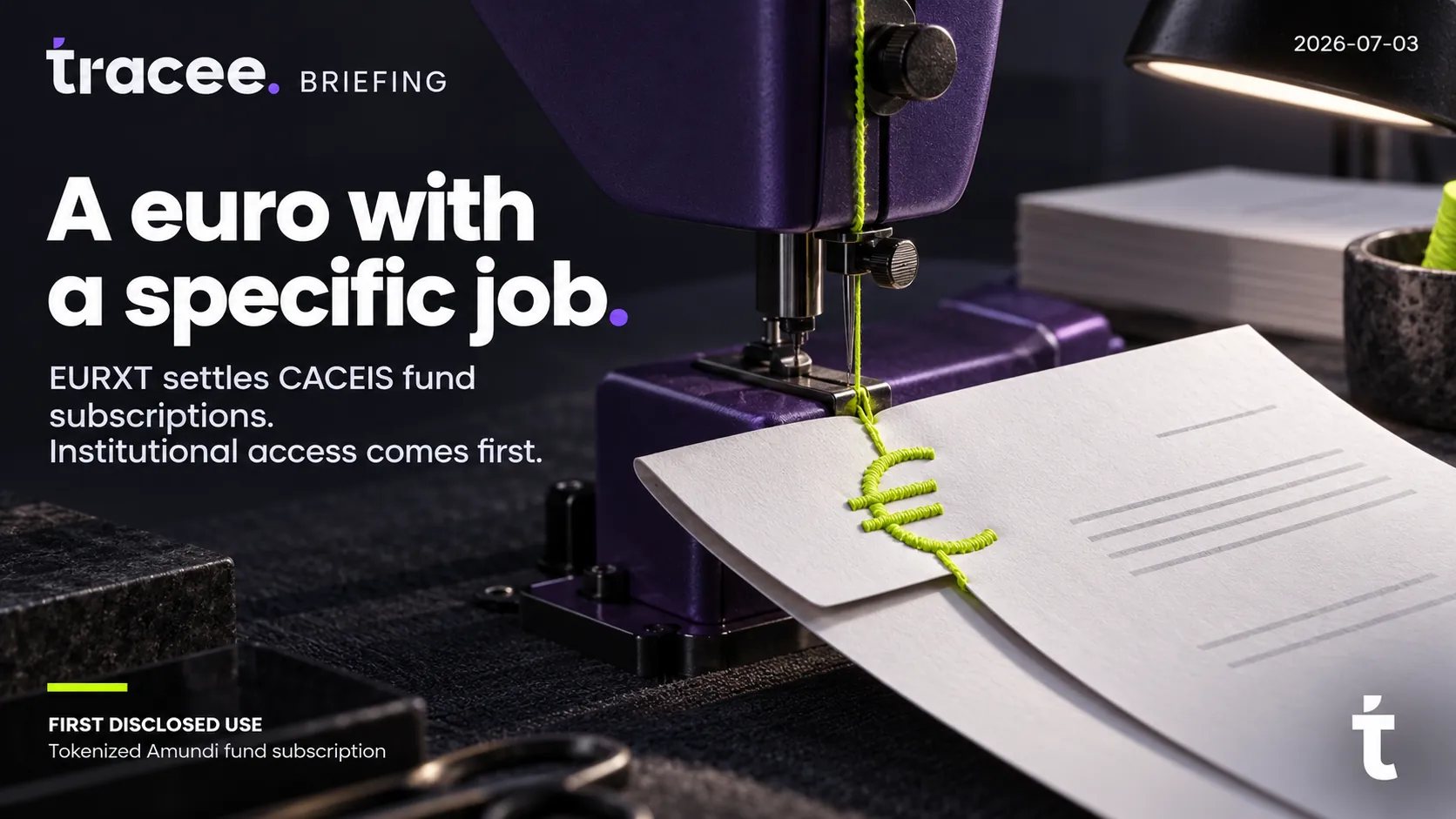
One euro stablecoin, one fund trade, and a client base that starts and ends inside CACEIS itself.
The token launched with its use case already wired in: CACEIS's own fund-settlement business, not a market to go find one in.
Five facts define the launch. Only one of them involves anyone outside CACEIS.
Rate each move by what actually shipped on 1 July, not by the word "stablecoin" in the headline.
| Move | Status | Verdict |
|---|---|---|
| EURXT issuance: euro-pegged electronic money token, ERC-20 on Ethereum, reserves held at CACEIS Bank | Shipped | A credit institution's token, not a fintech's. CACEIS Bank issues EURXT directly as an ACPR-supervised credit institution, the MiCA route that requires a white paper notification, not a separate e-money licence. |
| Initial supply: 20.02 million EURXT, roughly €20M, backed 1:1 | Shipped | Small by design. A fraction of EURCV's reported circulation and further behind EURC's, sized to one settlement job, not a trading market. |
| First transaction: EURXT settles a subscription into a tokenised Amundi Luxembourg UCITS money market fund | Shipped | The actual news. A European first: the cash leg and the fund-share leg both move on-chain in the same transaction. |
| Access: CACEIS institutional and corporate clients only, €10,000 minimum subscription | Shipped | A closed loop, not a market. No retail path and no third-party distributor has been named. |
| Secondary market: exchange listing, wallet integration, or FX use case | Pending | The part EURCV already has and EURXT does not. SG-FORGE's EURCV trades on MetaMask; EURXT has no disclosed venue outside CACEIS's own rails. |
The only move built for someone other than CACEIS is the fund settlement itself. Everything else stays inside the bank.
The token never has to leave the building. Issuer, custodian, and counterparty are the same banking group.
Compare the loop EURXT runs in against where SG-FORGE's EURCV, Circle's EURC, and the Qivalis consortium sit.
- The loop closes inside one balance sheet. CACEIS is issuer, custodian, and the settlement venue for its own fund clients, so no external market has to show up for the token to work.
- That is also why it cannot be compared to EURCV yet. EURCV has to attract liquidity outside Société Générale. EURXT does not, because it was not built to.
Three reasons a €20M token matters more than its size suggests.
The captive use case is the point, not a limitation. CACEIS is a top-tier European asset servicer; fund subscription and redemption is its core business, not a market it has to win from scratch. Pairing EURXT with a live subscription into a tokenised Amundi fund gives it guaranteed transaction volume from day one, something EURCV and EURC still have to build through FX desks and exchange listings.
A second French bank now issues its own MiCA token, not a shared one. Crédit Agricole follows Société Générale as the second major French banking group to issue a bank-owned euro electronic money token. Both chose their own balance sheet over the 37-bank Qivalis consortium, which is still waiting on a Dutch central bank licence more than a year after it formed. Big banks are not waiting for a shared euro stablecoin utility; they are each building their own.
Tokenised fund settlement is a real mechanic, not a wrapper. Settling a money market fund subscription in a stablecoin collapses a two-leg process, cash transfer then fund-share allocation, into one on-chain transaction. That is the settlement-cycle gap fund administrators price into cutoff times, and it is the cost EURXT is built to remove, not stablecoin trading volume.
The plumbing works. Five things the launch does not yet answer.
- No retail or third-party path. EURXT is scoped to CACEIS's own institutional and corporate client base, with no disclosed plan to reach retail holders or non-CACEIS distributors.
- No secondary market. Unlike EURCV, which trades on MetaMask, EURXT has no announced exchange listing, wallet integration, or FX use case.
- €20M is a rounding error. Initial supply is a fraction of EURCV's reported circulation and further behind EURC's; Crédit Agricole's ACT 2028 plan sets no public target for EURXT's growth.
- One fund, one manager, disclosed so far. The Amundi transaction is the only live use case named. Whether EURXT extends to other asset managers distributed through CACEIS is not stated.
- The reserve mix is not itemised. CACEIS confirms 1:1 backing and custody at CACEIS Bank but has not broken out the instruments behind the €20M, a level of detail UK and MiCA systemic-tier issuers are now required to publish.
Euro stablecoins keep launching. The euro's share of the market has not moved.
EURXT lands the day after MiCA's transitional deadline closed on 1 July 2026, forcing Tether out of the licensed EU market and leaving Circle the only top-ten licensed dollar issuer, covered in the 1 July MiCA briefing. It also follows Euroclear's move to use SG-FORGE's USDCV as the cash leg for commercial paper settlement, covered 27 June: a second infrastructure incumbent choosing a bank-issued MiCA stablecoin over a public one for a specific settlement job, that time a global CSD, this time an asset servicer.
Euro stablecoins remain roughly 0.3% of the global stablecoin market, per ECB Executive Board member Isabel Schnabel's 1 June remarks, against a market the BIS Annual Economic Report placed at 99% USD-denominated as of end-May. EURXT does not move that share; €20M does not register against a market above $300B. What it adds is a second large bank choosing its own MiCA authorization over the Qivalis consortium model, while Qivalis itself remains a licence application, not a live product.
EURXT is not competing for stablecoin market share. It is competing to be plumbing CACEIS's own fund clients never have to think about.
Crédit Agricole built EURXT as internal settlement infrastructure, not a currency looking for adoption: an ACPR-supervised bank issuing its own euro token, sized to one existing business line, with a live transaction on day one and no stated ambition to trade outside its own client base. That is a narrower and more defensible bet than SG-FORGE's FX-facing EURCV or the still-unlicensed Qivalis consortium, but it only proves itself inside CACEIS's own custody franchise, not across a euro stablecoin market that Schnabel and the BIS both describe as still barely existing.
Watch three things:
- Whether EURXT extends beyond CACEIS's own book. Third-party asset managers or distributors adopting EURXT is the test of whether this is a product or a plumbing fix.
- Qivalis's De Nederlandsche Bank EMI licence decision. The clearest read on whether the 37-bank consortium model can still compete with single-issuer bank tokens.
- Whether other European custodians follow. BNP Paribas Securities Services, State Street, and Clearstream each face the same choice: build a captive MiCA token like EURXT, or adopt EURCV or EURXT as a third party.
Common questions about Crédit Agricole's EURXT and the euro stablecoin landscape.
What did Crédit Agricole announce on 1 July 2026?
What is EURXT and how is it backed?
Can retail investors buy EURXT?
How does EURXT differ from SG-FORGE's EURCV and Circle's EURC?
What is the Qivalis consortium and how does it compare to EURXT?
Related briefings on the same rails.
Qivalis crossed a threshold on 20 May that Circle EURC has never crossed: 37 supervised European banks signed as equity shareholders, creating a distribution…
Read briefing
Standard Chartered did not build a stablecoin. It built the first G-SIB-grade door into one, folding the second account institutional clients used to need with…
Read briefing
Japan's June 1 Payment Services Act amendment created two trust-type stablecoin categories: the foreign pathway (USDC, RLUSD) and the domestic Type III (JPYSC)…
Read briefing
JPMorgan is not neutral on Clarity Act yield provisions: it operates Kinexys, is building JPMD (a deposit token that can pay yield), and anchors the TCH tokenized…
Read briefing
The FCA's 30 June rules and the Bank of England's 22 June rules are two tiers of one UK stablecoin regime, not two separate regimes.
Read briefing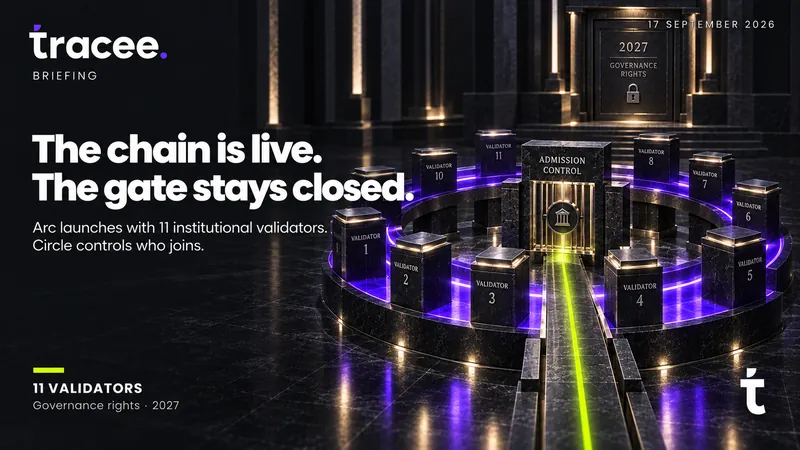
Circle's Arc mainnet went live with 11 institutional validators, BlackRock and Visa among them, USDC as gas, and sub-second finality.
Read briefingSuggest a news item or request a private briefing.
Public briefings publish on no fixed cadence. Private briefings, written for one institution and one decision, are part of the consulting engagement formats.
Book a discovery call