
Project Pythagore had a dollar problem: Euroclear taps SG-FORGE's USDCV as the cash leg for USD commercial paper on DLT rails.
One collaboration announcement. One structural gap it exposes in the dollar's digital architecture.
The structural claim is in the last clause: the dollar corridor has no wholesale CBDC. That absence is what creates the opening for USDCV.
Four moves in the announcement. One restructures how European commercial paper settles in dollars.
The announcement decomposes into four distinct decisions, each with a different weight.
| Move | Status | Verdict |
|---|---|---|
| Euroclear and SG-FORGE formally collaborate on USD NEU CP settlement | Announced | The announcement is the event. Euroclear settles more than $37 trillion in securities annually across 90+ markets. Its name on an assessment of stablecoin settlement is institutional infrastructure signalling, not a bilateral experiment. |
| USDCV designated as candidate USD cash leg for tokenized NEU CP | Exploring | First in class. No global central securities depository has previously designated a bank-issued, MiCA-regulated stablecoin as the candidate cash leg for a fixed-income instrument class. This is a category-defining label, not a product feature. |
| Project Pythagore extended into the dollar corridor | Exploring | Gap-driven, not opportunistic. Pythagore uses central bank money for euro NEU CP. The Fed has no wholesale CBDC. The dollar corridor was structurally unaddressed. USDCV fills a vacancy the dollar's institutional architecture created. |
| Live USD NEU CP transaction settled in USDCV on DLT | Pending | Not yet. No completed settlement, no production timeline, no volume disclosed. The announcement describes an assessment phase. Execution is a later milestone. |
The third move is the structural one: the dollar's absence from wholesale CBDC infrastructure is a market condition, not a policy choice that will resolve soon.
From currency issuer to global settlement infrastructure, in four layers.
The settlement flow for a USD-denominated NEU CP instrument on DLT requires four layers: the instrument, the cash leg, the settlement backbone, and the off-chain reserve.
- The euro track has central bank money; the dollar track does not. Project Pythagore uses Banque de France-issued digital euros as its EUR cash leg. The equivalent Federal Reserve instrument does not exist. USDCV is not a second choice; it is the only MiCA-regulated option available for the dollar corridor.
- Euroclear is the weight, not SG-FORGE. SG-FORGE issuing USDCV is a product decision. Euroclear assessing USDCV as a settlement instrument is an infrastructure signal. Those two carry different information about where institutional consensus is moving.
The dollar has no wholesale CBDC. Euroclear just assigned that slot to a French bank's MiCA stablecoin.
Euroclear's involvement changes the category of what this is. A stablecoin company announcing it will settle commercial paper on DLT is a product claim. The world's largest securities settlement system assessing the same stablecoin as its cash leg is an infrastructure standard in formation. Euroclear does not run pilots for publicity. Its assessment of USDCV will inform the reserve, legal, and operational architecture for an entire short-term funding instrument class across 90+ markets.
MiCA compliance is what put USDCV in the room. The MiCA transitional period closes July 1, 2026. After that date, Tether USDT has no EU regulatory standing on licensed markets. Circle's USDC is issued by a US entity. USDCV is the only dollar stablecoin issued by an MiCA-authorised EU entity under the EMT framework, supervised by France's ACPR. Euroclear, as a Belgian-regulated financial market infrastructure, has direct incentive to use an EU-regulated counterpart for its settlement cash rather than a non-EU-issued instrument.
The BIS preferred architecture is partially present here. The BIS Annual Economic Report 2026 (June 23) recommended tokenized commercial bank deposits, not private stablecoins, as the settlement layer. USDCV is issued by a bank subsidiary rather than a standalone issuer, which places it closer to the BIS preferred form than USDT or USDC, but it is still an EMT, not a deposit. The BIS architecture requires wholesale CBDC to anchor the system. Its absence in the dollar corridor is precisely the structural gap that Euroclear and SG-FORGE are navigating.
Exploration, not execution. Five constraints the announcement does not resolve.
- No transaction has settled. The announcement describes a collaboration to explore and assess. No completed USDCV-settled NEU CP has been disclosed. No production date. No transaction volume. The gap between "assessing" and "settling" in post-trade infrastructure is measured in months to years, not weeks.
- USDCV is small at $20M. The NEU CP market operates at hundreds of billions. A stablecoin with a $20M market cap cannot provide meaningful liquidity at that scale without a significant issuance programme. Scale will require either a capital injection into SG-FORGE's issuance programme or demand-side pull from institutional investors choosing USDCV as their preferred dollar instrument.
- MiCA's reserve constraint tightens as USDCV grows. Under MiCA, stablecoin issuers that breach the significant issuer threshold must hold 60% of reserves in EU bank deposits. At current scale, USDCV is not significant. If the Euroclear collaboration drives volume, the 60% EU bank deposit requirement will become an active operational constraint and a drag on yield.
- Project Pythagore's euro track is itself still in progress. The EUR NEU CP migration onto DLT with central bank money has not completed its first live settlement phase. The USDCV dollar extension is a second-phase milestone on a first-phase pipeline that is still running.
- Regulatory sign-off for Euroclear's stablecoin use is unconfirmed. Euroclear operates under Belgian law and is supervised as a systemically important financial market infrastructure. Whether the National Bank of Belgium and EU oversight bodies have given comfort on stablecoin settlement instruments has not been disclosed. Regulatory approval is a prerequisite for any live deployment.
Three parallel moves confirm stablecoin is now the default cash leg for DLT settlement.
On June 20, the HIFI, DRW, and Marex repo settlement on Canton proved that a dollar stablecoin (USDCx, a Circle xReserve instrument) could serve as the atomic cash leg in an institutional repo against US Treasury collateral. The Euroclear announcement follows the same structural logic: DLT-native instrument, stablecoin cash leg, institutional infrastructure as the settlement backbone. The pattern is repeating across asset classes and geographies within the same month. That is not coincidence; it is the institutional market converging on a settlement architecture.
The MiCA July 1 enforcement deadline changes the competitive landscape for USDCV specifically. After that date, only MiCA-authorised stablecoin issuers can operate on EU-licensed venues. USDT is excluded. USDC, issued by a US entity, is tolerated under existing transitional arrangements but is not issued under EU law. USDCV, issued by SG-FORGE under MiCA's EMT framework, becomes the only dollar stablecoin with a fully EU-regulatory basis for institutional use. That is a narrow but durable competitive position inside European financial market infrastructure.
The May 2026 SG-FORGE Canton briefing decoded how EURCV and USDCV reached Canton as a Super Validator move. The Euroclear announcement is a different vector: not a governance seat on an institutional blockchain, but adoption by the settlement backbone for European fixed income. SG-FORGE is now present at both layers: the institutional permissioned network (Canton) and the traditional post-trade infrastructure (Euroclear). These two moves, taken together, represent a deliberate two-track institutional distribution strategy for SG-FORGE's stablecoins.
Post-trade infrastructure has made its first choice. Now wait for the ECB to respond.
Euroclear's assessment of USDCV as a settlement cash instrument is the first moment a systemically important global CSD has formally designated a bank-issued, MiCA-regulated stablecoin as the candidate cash leg for a fixed-income instrument class. The dollar's absence from wholesale CBDC infrastructure created the structural vacancy. MiCA compliance determined who fills it. If the assessment converts to production, it will set the operational and regulatory template for stablecoin-settled commercial paper settlement across European markets, an outcome that would pressure both the ECB's digital euro timeline and the Fed's CBDC prohibition decision in a direct and measurable way.
Watch three things:
- Project Pythagore EUR track completion. When Euroclear settles the first EUR NEU CP transaction in central bank money on DLT, that milestone sets the blueprint for the USDCV dollar follow-through. The date and volume of that first EUR settlement will determine the realistic timeline for any USDCV production deployment.
- First USDCV-settled NEU CP transaction. The moment exploration converts to production. The disclosed amount, the counterparty category, and whether USDCV is used for the full settlement or only a portion will reveal whether institutional demand is there and whether SG-FORGE's $20M market cap can scale to meet it.
- ECB and National Bank of Belgium positioning. Whether EU supervisors of financial market infrastructures treat stablecoin settlement in Euroclear as acceptable under their oversight frameworks, or whether they require central bank money, is the binding regulatory question. A public comfort letter or supervisory guidance would be the clearest positive signal; silence or a request for central bank money instead would stall the programme before its first transaction.
Common questions about Euroclear, USDCV, and the NEU CP settlement.
What is USDCV?
What is a NEU CP and what is Project Pythagore?
Why is there no wholesale CBDC dollar equivalent?
What does Euroclear actually do, and why does its name matter?
Is this live?
Related briefings on the same rails.
SG-FORGE deployed EURCV ($97M) and USDCV ($20M) on Canton Network and joined as an Ecosystem Super Validator on 12 May 2026, the first MiCA-authorized e-money token…
Read briefing
On June 22, 2026, the US Senate passed the 21st Century ROAD to Housing Act 85-5, with the House having cleared it 358-32. Buried in Section 1001: a four-year…
Read briefing
On April 17, ESMA confirmed: MiCA's transitional period closes July 1, 2026 with no extension. The result is a bifurcated market.
Read briefing
Eight central banks (Bank of England, FRBNY, Banque de France, Bank of Japan, Bank of Korea, Bank of Mexico, Swiss National Bank, Bank of Canada) and 40+ private…
Read briefing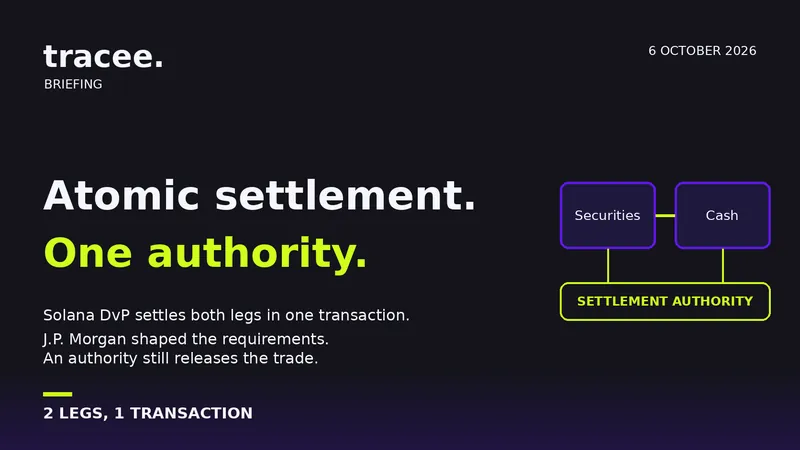
Solana DvP is an MIT-licensed, audited escrow that releases a securities leg and a cash leg in one transaction.
Read briefing
Japan's dominant tokenized securities platform exits R3 Corda and lands on Avalanche L1 in June 2026, making ¥439.6B in tokenized real estate and corporate bonds…
Read briefingSuggest a news item or request a private briefing.
Public briefings publish on no fixed cadence. Private briefings, written for one institution and one decision, are part of the consulting engagement formats.
Book a discovery call