
The investor list is the product: Wall Street commits $355M to the settlement layer it already runs on.
One press release. Twenty-five institutional owners and a DTCC deadline buried inside.
The round is not the story. The roster is. Every institution on that list already has operational exposure to Canton.
Four facts on the ground. One open question that matters more than the rest.
Five discrete events are compressed into a single announcement. Ranked by structural consequence:
| Move | Status | Verdict |
|---|---|---|
| $355M equity round, a16z leads at $100M contribution, valuation ~$2B | Shipped | Oversubscribed. Target was $300M. Round closed at $355M with 25-plus named institutional investors. The oversubscription is a signal of demand, not a rounding adjustment. |
| Institutional investor roster spans all tiers of capital markets | Shipped | The roster IS the product. Citadel Securities handles more than 20% of U.S. equity volume. Broadridge settles $10T daily. CME Group runs the world's largest derivatives exchange. DTCC is the counterparty for U.S. post-trade. SoFi is already on Mastercard's Canton settlement rail. |
| DTCC Treasury tokenization MVP: controlled production environment, H1 2026 | In progress | H1 2026 ends this month. The MVP is a minimum viable product with a limited participant set. Full commercial scale targets October 2026. Cash-leg resolution is the gating variable. |
| Canton metrics at close: $4T monthly volume, $6T RWA, 700-plus participants, $12B in digitally native securities issued | Shipped | Production-grade, not pilot. Settlement has been reduced from T+5 to T+0 in under 60 seconds on live workflows. The network is already commercial at scale. |
| M&A and ecosystem acquisition strategy | Exploring | No targets named. CEO Yuval Rooz confirmed acquisitions as a use of proceeds. The candidates are obvious: Fnality, Partior, or a European DLT infrastructure provider to close the Pontes gap. Announcement expected within 12 months. |
Four facts and one open signal. The M&A move will be as consequential as the raise itself.
One privacy-preserving ledger. Four institutional networks wired in, one cash leg still unsettled.
Canton sits between the applications layer and settlement finality. Privacy and compliance logic run at the contract level via Daml, not at the network perimeter.
- Sub-transaction privacy is the architectural differentiator. Repo and collateral workflows require that counterparties cannot see each other's full position. Canton implements this at the smart contract level via Daml's authorization model. Ethereum and Solana cannot offer this without off-chain obfuscation, which reintroduces custody risk. This is why DTCC chose Canton over public chains for Treasury settlement.
- The investor list is also the participant list. Every named investor is either already on Canton or a credible first-mover in its next commercial phase. The raise does not create distribution; it funds the defense of distribution the network already has.
Three structural changes that did not exist before June 11.
DTCC now has a funded counterparty. The October 2026 Canton go-live is not just a DTCC product decision; it is a Digital Asset reliability commitment. Before this raise, Digital Asset was well-networked but lightly capitalized. After it, the company has the reserves to staff the compliance, legal, and engineering redundancy that running systemically critical settlement infrastructure requires. When DTCC tokenizes U.S. Treasuries on Canton, the operational expectations are identical to those of any other DTCC-connected provider. $355M funds the readiness to meet them.
The oversubscription changes the competitive narrative. The round targeted $300M and closed at $355M. When ADIA, Apollo, BNP Paribas, HSBC, and Citadel Securities all take the same infrastructure bet, the question is no longer whether Canton is a viable institutional settlement layer. The question becomes which competing infrastructure providers do not have strategic alignment with the institutions that matter.
The M&A signal is the most forward-looking part of the announcement. CEO Yuval Rooz named acquisitions as a use of proceeds. Canton's current architecture handles asset settlement for DTC-custodied securities and institutional derivatives. It does not yet have a native cash leg for DvP, a cross-border interoperability bridge to European DLT platforms, or a lightweight integration layer for smaller institutions. Each of those gaps maps to an acquisible company: Fnality for the cash leg in wholesale settlement, Partior for cross-border, or a European DLT infrastructure provider in the ECB's Appia contact group for EU market presence.
$355M funds the infrastructure. Five things it does not resolve.
- The cash leg is not solved. Canton handles the asset leg. The stablecoin or deposit token that settles DvP transactions on Canton has not been designated for DTCC's October go-live. JPMD, USDC, and SoFiUSD are all in the ecosystem; none is formally confirmed as the settlement instrument. OCC final rules (July 18) determine whether non-bank issuers compete with JPMD on equal regulatory terms for this role.
- $4T monthly volume is bilateral, not open market. Canton's volume comes primarily from repo and collateral management between known institutional counterparties. Scaling to open secondary market settlement with millions of transactions from unknown counterparties is a harder product problem that capital alone does not solve.
- Canton is permissioned and not interoperable with public chains by default. Public-chain assets, BUIDL on Ethereum and USDC on Solana, cannot interact with Canton's settlement layer without a cross-chain bridge. That bridge does not exist at institutional scale. The Canton settlement layer and the public-chain tokenized asset ecosystem remain parallel markets until it does.
- The DTCC October go-live is limited production, not commercial launch. The first Canton-based DTCC transactions will use a controlled set of participants and a defined subset of asset types. Full commercial scale depends on SEC rulemaking that follows the limited production phase.
- The valuation is thin against the strategic stakes. A $2B valuation on $355M raised is a 5.7x book multiple. If DTCC's October launch succeeds and the cash-leg gap is closed, the next round reprices sharply. If either delays, the multiple compresses before it expands. The investors who took the round at $2B are making a bet with a tight margin on execution.
DTCC, Visa, Mastercard, and the BIS all converge on the same settlement architecture.
Three networks chose Canton before this raise. Visa reached $7B annualized in stablecoin settlement across nine blockchains including Canton, as tracked in the tracee briefing from 16 May 2026. Mastercard added Canton to its eight-chain stablecoin settlement network in June 2026, covering USDC, PYUSD, RLUSD, and SoFiUSD. SG-FORGE became the first MiCA-authorized stablecoin issuer to join Canton as an Ecosystem Super Validator in May, giving EURCV governance rights over the network's collateral eligibility rules. The $355M raise does not create Canton's strategic position; it funds its defense and expansion.
The BIS Project Agorá proof-of-concept from May 2026 proved that atomic cross-border settlement works using tokenized central bank reserves and commercial bank deposits. The architecture Agorá tested is the same architecture Canton was built for. The difference is environment: Agorá ran in a central-bank sandbox with 40 institutions and no commercial counterparties. Canton runs at $4T monthly volume with production workflows. Agorá's real-value phase remains unscheduled; DTCC's October go-live is the production deployment of the same architectural principle.
The SEC's June 12 proposal to rescind Regulation NMS Rule 611, the trade-through rule that has prevented AMM-based DeFi venues from trading tokenized U.S. equities, adds a demand-side driver. Rule 611's rescission, if finalized by Q1 2027, would make tokenized U.S. equity trading on decentralized venues legally permissible, creating an asset class that needs institutional-grade settlement infrastructure. Canton, as the only network currently wired into DTCC with production DvP capabilities, is the most proximate candidate to serve that demand.
The settlement layer is funded. Now it has to settle.
Digital Asset has capitalized the settlement layer that DTCC, Visa, Mastercard, and SG-FORGE have already plugged into. The $355M converts a network-effects bet into a funded one: the company can now hire, acquire, and run the compliance and reliability infrastructure that production capital markets demand. The October 2026 DTCC limited production go-live is the first live test of whether the bet was right. What follows directly from it are the cash-leg decision, the commercial-scale licensing, and the first acquisition that will signal whether Digital Asset is building a U.S.-only settlement layer or a cross-border one.
Three things to watch:
- DTCC Canton limited production go-live (October 2026). The first live transactions prove whether Canton handles post-trade load with real counterparties under production conditions. Any delay resets the investor narrative and the commercial-scale licensing timeline.
- Cash-leg selection for DvP on Canton. JPMD, USDC, or another deposit token must be designated to settle asset delivery against payment. OCC GENIUS Act final rules (July 18, 2026) set the competitive perimeter that determines whether non-bank stablecoin issuers can contest the cash leg with JPMorgan's deposit token.
- First M&A move from Digital Asset. CEO Yuval Rooz named acquisitions as a use of funds. The first acquisition reveals whether the strategy is to close the cash-leg gap (Fnality), extend cross-border reach (Partior), or bridge to European DLT infrastructure (an ECB Appia contact-group participant).
Common questions about Canton Network and the Digital Asset raise.
What is Canton Network?
What is DTCC's relationship to Digital Asset and Canton?
What makes Canton different from public blockchains for institutional settlement?
Why does the investor list matter structurally?
What is the cash-leg problem for DvP settlement on Canton?
What might Digital Asset acquire?
Related briefings on the same rails.
HIFI, DRW, and Marex completed the first competitive onchain repo on Canton on 17 June, settling U.S. Treasuries against USDCx in seconds with Tradeweb RFQ pricing…
Read briefing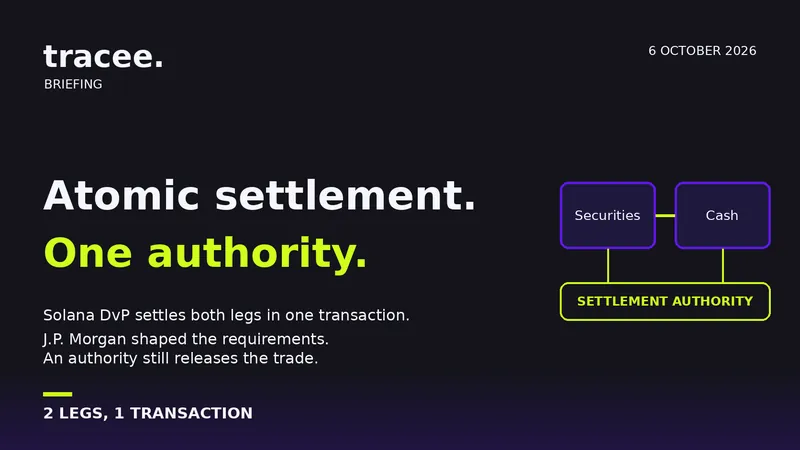
Solana DvP is an MIT-licensed, audited escrow that releases a securities leg and a cash leg in one transaction.
Read briefing
The ledger moves tokenized deposits 24/7, including weekends and overnight, running on a permissioned Linea-style network with Chainlink CCIP as its…
Read briefing
Broadridge's Distributed Ledger Repo platform, already moving $351 billion a day, added G7 government securities to a collateral list that had been US Treasuries…
Read briefing
Circle's Arc mainnet went live with 11 institutional validators, BlackRock and Visa among them, USDC as gas, and sub-second finality.
Read briefing
Japan's dominant tokenized securities platform exits R3 Corda and lands on Avalanche L1 in June 2026, making ¥439.6B in tokenized real estate and corporate bonds…
Read briefingSuggest a news item or request a private briefing.
Public briefings publish on no fixed cadence. Private briefings, written for one institution and one decision, are part of the consulting engagement formats.
Book a discovery call