
The missing cash leg: BIS proves atomic cross-border settlement works and moves Project Agorá to real money.
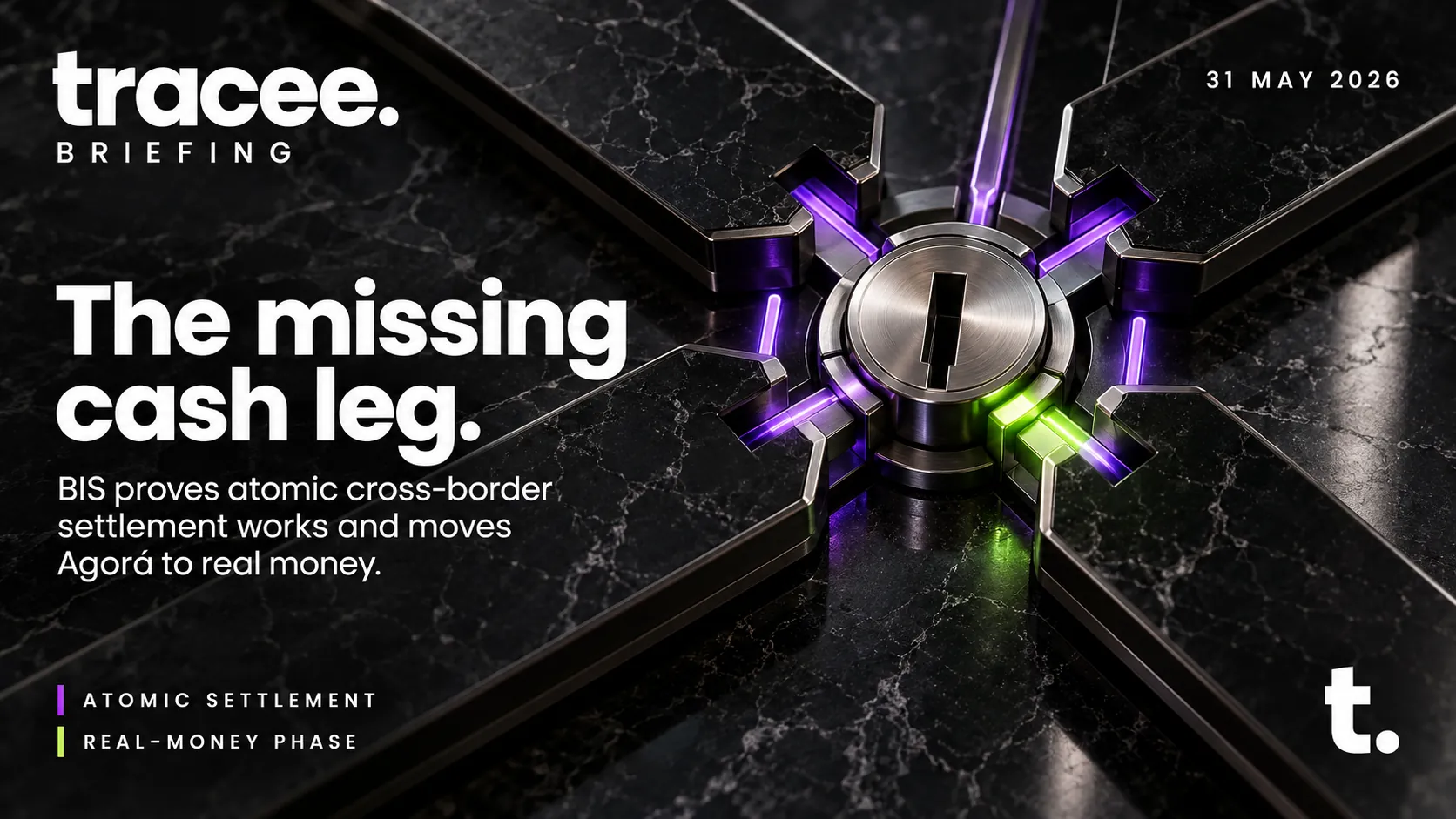
One press release. Four years of multilateral coordination reduced to three findings.
Three claims with different evidentiary weight. One is proven in simulation. One is announced without a date. One has no timeline at all.
Phase 1 delivered three results. Phase 2 has one gate and no date.
| Move | Status | Verdict |
|---|---|---|
| Atomic settlement of multi-currency cross-border payments using tokenized central bank reserves and commercial bank deposits | Phase 1 shipped | Proof-of-concept, not production. Eight central banks and 40+ private banks demonstrated atomic, multi-currency cross-border settlement in simulation. First multilateral result at this scale and institutional depth. |
| Shared compliance screening across all participant banks | Phase 1 shipped | Structural gain confirmed. Sanctions and AML checks run once and are shared across the platform, eliminating the redundant independent screening that is the primary source of delay in correspondent banking today. |
| Privacy preservation at balance and transaction level | Phase 1 shipped | Regulatory-compatible architecture. Cryptographic techniques protect participant data without blocking regulatory access. SWIFT and ISO 20022 compatible: the platform extends the existing stack, it does not replace it. |
| Real-value testing with select currencies and participants | Announced, no date | The next gate. Simulated settlement is proven. Real liquidity pressure, legal finality, and dispute resolution under live conditions are unproven. No currency pair or start date has been named. |
Phase 1 is a technical proof. Phase 2 is where institutional commitments become binding.
Two layers on one shared ledger, each under its own sovereign control.
The central design choice is what separates Project Agorá from Fnality or Partior: central bank money stays under each central bank's domestic control. The shared platform provides connectivity and settlement logic; it does not hold or custodize reserves. The two layers, the commercial bank deposit (what businesses hold) and the central bank reserve (what settles it), are both tokenized and placed on the same programmable surface. The atomic step is the link between them.
Each central bank's reserve ledger stays under its own jurisdiction throughout the transaction. The shared platform is the coordination layer, not the custodian. That design makes the politics tractable and limits deployment speed: every new participant requires bilateral agreement between their central bank and the platform's governance body.
The cash leg was always the missing piece. Now it has a working prototype and a next phase.
Every tokenized asset pilot has hit the same wall. The Kinexys Treasury pilot settled the dollar payment through wire transfers. The DTCC/Stellar integration listed "No on-chain cash leg" as its most significant honest limit. Project Agorá is the multilateral institutional answer to that gap. The asset leg is going on-chain through DTCC (October 2026) and Stellar (H1 2027). Project Agorá is building the cash leg from the other direction.
The shared compliance finding is more valuable than the atomic settlement result. The main cost of cross-border payments is not the settlement itself: it is the independent, sequential compliance checks that each correspondent bank runs, sometimes reaching different conclusions. A shared compliance layer agreed by eight central banks and 40+ private banks cuts that at the source. This finding does not depend on further development; it is already proven in simulation and ready to deploy.
The participant list signals market consensus, not research interest. JPMorgan, Citi, HSBC, BNY, Deutsche Bank, MUFG, NatWest, Euroclear, and Mastercard do not join eight central banks in a four-year project out of curiosity. When this cohort converges on an architecture, the result is a pre-standard. The political alignment required to deploy a common wholesale settlement layer is harder to achieve than the technical proof. Project Agorá has done the harder work first.
Prototype to production is not a technical problem.
- Phase 1 used no real money. Simulated settlement is not the same as live liquidity management. Real-value testing will expose whether atomic settlement holds under actual stress: large-value transactions, counterparty failures, connectivity interruptions, and simultaneous settlement demand across multiple currency pairs.
- Legal finality has no framework. Atomic settlement is technically proven. The cross-border legal question, which jurisdiction's law governs a disputed settlement executed on a shared ledger, is not answered. No multilateral treaty for on-chain interbank finality exists, and that gap cannot be closed by technology alone.
- Correspondent banking is preserved, not replaced. The architecture keeps existing bank relationships intact. The 40+ private participants are the correspondent banks. The platform makes them faster; it does not disintermediate them. Existing incumbents are not at risk here: they designed the system.
- Retail and SME payments are outside scope. Project Agorá is wholesale interbank settlement: large-value, low-volume, institutional. Consumer remittances and SME cross-border flows run on different rails and are not part of this work.
- Governance across eight central banks is unsettled. Which jurisdiction's rules apply when a CHF-JPY settlement involves a Swiss counterparty and a Japanese beneficiary on a platform governed by a BIS committee? The governance framework has not been published.
Three approaches to the same problem. Only one has eight central banks.
Three initiatives are building toward the same wholesale cash layer. Fnality holds real Bank of England omnibus funds today, with eight bank shareholders including Barclays, BNY, Commerzbank, Goldman Sachs, and Santander. Fnality settled its first live sterling transactions in late 2025: operational, narrow, and sterling-concentrated. Partior, founded by JPMorgan, DBS, Standard Chartered, and Deutsche Bank in Singapore, runs multi-currency interbank settlement in USD and EUR with expansion into additional currencies through 2026: production-scale, limited network. Project Agorá is neither operational nor narrow. It is the broadest coalition, covering eight currency zones including the Federal Reserve Bank of New York and the Bank of Japan, with the deepest private sector bench. Banks on Fnality's shareholder list and Partior's client roster are both in Agorá's 40+ participant group.
Those institutions will not fund three separate settlement layers indefinitely. If the BIS publishes real-value results in 2026, the pressure on Fnality and Partior to align on interoperability standards increases substantially. The alternative is three competing wholesale cash rails with overlapping participants, which is not a stable equilibrium for any of them.
The asset leg has a launch date. The cash leg now has a working prototype.
Both sides of atomic cross-border delivery-versus-payment are on defined development tracks for the first time. DTCC goes live on Canton in October 2026 for the asset leg. Project Agorá moves to real-value testing for the cash leg, with no date and no currency pair announced. Neither side has committed to convergence. The next twelve months determine whether the two tracks are building toward each other or past each other.
Three things to watch:
- Which currency pair runs real-value testing first. USD-EUR is the most likely starting pair. If the Federal Reserve Bank of New York runs live transactions before year-end, US banking regulators will have to form a public position on wholesale tokenized settlement infrastructure faster than current policy timelines suggest.
- Legal finality legislation. Which jurisdiction passes the first statute giving cross-border DLT settlement the same legal standing as a wire transfer. The EU's DLT Pilot Regime and the GENIUS Act are the closest existing frameworks; neither reaches multi-currency interbank finality.
- Convergence with Fnality and Partior. Whether Agorá, Fnality, and Partior agree on interoperability or each builds a separate wholesale cash layer. Three competing settlement rails with overlapping participants is not a stable equilibrium.
Related briefings on the same rails.
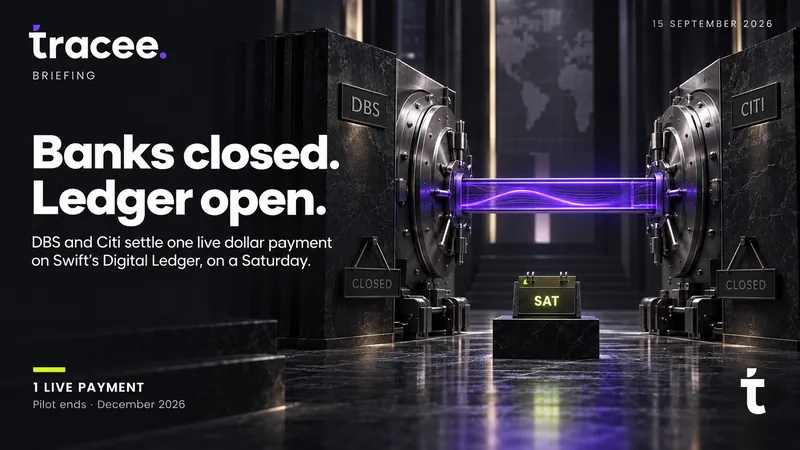
DBS and Citi settled a live USD payment via tokenized deposits on Swift's Digital Ledger in minutes on a Saturday.
Read briefingSix actors decomposed: Ondo (issuer), Ripple (holder), XRP Ledger (venue), Mastercard MTN (orchestrator), Kinexys (cross-border cash rail), and two correspondent…
Read briefingOn June 16, China's e-CNY Centre International signed 26 institutions as CBETS direct participants for live cross-border digital yuan settlement in eight corridors.
Read briefing
ECB Executive Board member Isabel Schnabel told Jackson Hole that central banks must put their own money on-chain or lose the settlement layer to dollar stablecoins.
Read briefing
Japan's dominant tokenized securities platform exits R3 Corda and lands on Avalanche L1 in June 2026, making ¥439.6B in tokenized real estate and corporate bonds…
Read briefingPontes went live with 13 banks and four DLT operators settling wholesale tokenised assets in central bank money.
Read briefingSuggest a news item or request a private briefing.
Public briefings publish on no fixed cadence. Private briefings, written for one institution and one decision, are part of the consulting engagement formats.
Book a discovery call