
The first competitive onchain repo: HIFI, DRW, and Marex prove the $12.6 trillion U.S. repo market can settle atomically with a stablecoin and a prime broker.
One press release. Five moves in the settlement stack.
Six sentences. Five distinct engineering decisions. Each one earns its place in the stack separately.
Four things are live. One test is still ahead.
Five moves in this announcement, separated by what is on the ground and what remains to be proven.
| Move | Status | Verdict |
|---|---|---|
| Live atomic UST repo settlement on Canton | Shipped | First commercial execution. DRW supplied tokenized U.S. Treasuries; HIFI provided USDCx; Canton settled both legs simultaneously in seconds with no counterparty exposure between legs. |
| Tradeweb RFQ price discovery | Shipped | Market-standard pricing. Trade executed via request-for-quote on Tradeweb, the same competitive framework dealer-to-client repo markets use. Not a bilaterally negotiated rate. |
| Fiat-to-stablecoin cash path | Shipped | The wedge. Fiat enters via the RTP rail, converts to USDC, wraps to USDCx for Canton settlement. At maturity, the flow reverses automatically. A complete live pipeline from bank account to atomic settlement and back. |
| Prime broker in the structure | Shipped | Institutional structure complete. Marex's role places a regulated prime broker inside a fully onchain trade for the first time, adding the credit intermediation layer institutional repo desks require. |
| Production volume and multi-party scale | Exploring | Not yet proven. No transaction size disclosed. One counterparty pair. The test of simultaneous multi-party settlement at repo-market scale remains ahead. |
The first four are facts. The fifth is the question that separates a demonstration from a market.
Four layers, one cash path, and zero settlement risk between legs.
The trade runs through four distinct layers, each with a specific job. Tradeweb prices. Three institutions take positions. Canton settles atomically. The RTP-to-USDCx pipeline funds the cash leg from fiat in real time.
- The cash path is the architectural claim. Every prior onchain settlement architecture had the same gap: how does fiat-denominated cash become the atomic cash leg in a DvP trade without pre-funding? HIFI's pipeline answers that with a live, automated route: bank account to RTP to USDC to USDCx, completing in the same seconds as Canton's settlement.
- Canton's privacy model is load-bearing. Repo desks do not disclose position sizes, counterparties, or treasury allocations to a public network. The fact that Canton does not expose this data is not a feature flag. It is the structural prerequisite that makes institutional participation possible.
The Tradeweb RFQ is the structural claim. Competitive pricing is what separates a market from a bilateral agreement.
Before this trade, "onchain repo" meant two parties agreeing on terms off-chain and settling on-chain. Pricing was bilateral. Here, a competitive request-for-quote on Tradeweb sets the repo rate, the same mechanism dealer-to-client repo desks use across $12.6 trillion in daily outstanding exposures. That distinction is not cosmetic. A market requires price discovery among multiple participants. A bilateral agreement does not. This trade imports the former into the latter.
BIS Project Agorá, published 27 May, proved atomic settlement works with tokenized central bank reserves. That proof required eight central banks and forty-plus private institutions and produced no live commercial transaction. HIFI's June 17 trade proves the same atomic settlement works with a private stablecoin funded from a standard fiat rail, and produces a live executed trade with a named prime broker. The two approaches are converging toward the same result from opposite ends of the institutional hierarchy.
The maturity reversal is the programmable-money proof. In traditional repo, the unwind requires a separate instruction, a separate settlement cycle, and a separate window of counterparty exposure. Here, the reversal executes automatically along the same path. That is not a convenience feature. It is the difference between a digitized paper process and a fully programmable settlement primitive.
One trade is a proof of concept. Five open questions before it becomes the market standard.
- No amount disclosed. The trade size is unknown. Whether HIFI placed $10 million or $1 billion changes the question entirely. A small-value demonstration and a full-scale capital allocation are different claims. Neither has been made here.
- USDCx is not central bank money. The cash leg settles in USDC, a private stablecoin. The BIS, ECB, and Federal Reserve all target a central bank liability for the wholesale cash leg at scale. Stablecoin settlement satisfies commercial demand; it does not satisfy the central bank purist requirement, and regulators have not signaled they treat them as equivalent.
- One counterparty pair is not a market. Repo markets create liquidity because dozens of participants price simultaneously. A single trade between HIFI and DRW, brokered by Marex, proves the plumbing. It does not prove the market depth that institutional treasury desks need before migration.
- DTCC's cash-leg requirement is unresolved. DTCC goes live on Canton in October 2026 for the asset leg. It has not confirmed which instrument settles the cash leg. If DTCC specifies a bank deposit token or a central bank obligation rather than USDCx, this architecture may not port directly to the most important settlement event of the year.
- Regulatory treatment of stablecoin settlement finality is open. The GENIUS Act and OCC final rules (due 18 July) govern payment stablecoins. Whether USDCx qualifies as a permissible settlement instrument for federally regulated repo under those rules remains an interpretive question without a published answer.
Tradeweb invested in Digital Asset nine days ago. This week it priced the first live repo on the network Tradeweb just backed.
Digital Asset raised $355 million on 11 June, in a round that included Tradeweb as an institutional investor alongside a16z, ADIA, Apollo, BNP Paribas, HSBC, Citadel, and CME Group. Canton Network was already processing $4 trillion in monthly notional. The week after that close, Tradeweb prices the first live repo on that same network. The capital alignment and the commercial execution are parts of the same thesis, not separate announcements. For the full breakdown of what Digital Asset's raise means for the settlement stack, see the June 13 briefing on that round.
Two architectural approaches are converging toward the same problem from opposite directions. BIS Project Agorá (27 May) proved that tokenized central bank reserves can serve as the atomic cash leg in cross-border settlement, with eight central banks and real institutional backing. HIFI's 17 June trade proves a private stablecoin funded from the RTP rail can do the same in domestic repo, without waiting for a CBDC. When ECB Pontes goes live in Q3 2026 with a central bank money cash leg on DLT platforms, the two paths converge. KfW's December 2026 coupon is the first scheduled live test of that convergence in European bond settlement.
Before 17 June, the question of which dollar instrument would carry the cash leg in DTCC's October 2026 Canton launch was genuinely open. The three candidates were USDCx (HIFI's commercial path), a DTCC-designated bank deposit token, and a Federal Reserve obligation. Canton's architecture supports all three. HIFI has now demonstrated that the first path works in a live trade with a named prime broker and market-standard pricing. Whether DTCC accepts that answer or specifies a different instrument is the most important pending decision in the U.S. onchain settlement stack.
Before this trade, onchain repo was theoretical. After it, the $12.6 trillion market has a live commercial answer with a named prime broker and competitive market pricing.
HIFI, DRW, and Marex did not run a pilot. They ran a trade: U.S. Treasuries as collateral, USDCx funded from fiat via RTP as the cash leg, Tradeweb RFQ as the pricing mechanism, Marex as the prime broker, and Canton as the settlement layer where both legs closed simultaneously in seconds with no counterparty exposure between them. The maturity reversal happened automatically. The amounts and counterparties stayed private. That is a fully assembled institutional repo settlement architecture, live on 17 June 2026. The question is no longer whether the plumbing works. It is who owns the cash leg when DTCC flips the switch in October.
Watch three things:
- DTCC's October 2026 cash-leg decision. Does DTCC confirm USDCx, specify a bank deposit token, or require a central bank obligation? That decision sets the settlement standard for the most consequential onchain launch of the year.
- OCC GENIUS Act final rules, 18 July. Determines whether USDCx's USDC backing qualifies as a permissible stablecoin instrument under the incoming federal framework for repo and other institutional settlement uses.
- First multi-counterparty Canton repo trade. When more than one counterparty pair settles simultaneously on Canton in a live repo, the network moves from demonstration to market. That is the liquidity test the first trade cannot answer.
Related briefings on the same rails.
Digital Asset raised $355M led by a16z on June 11, with ADIA, Apollo, BNP Paribas, HSBC, Citadel Securities, and Tradeweb among 25-plus institutional investors.
Read briefing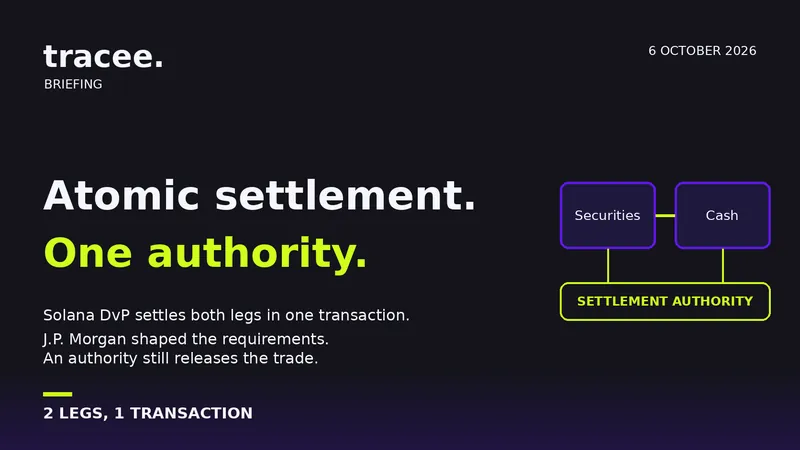
Solana DvP is an MIT-licensed, audited escrow that releases a securities leg and a cash leg in one transaction.
Read briefing
The ledger moves tokenized deposits 24/7, including weekends and overnight, running on a permissioned Linea-style network with Chainlink CCIP as its…
Read briefing
Broadridge's Distributed Ledger Repo platform, already moving $351 billion a day, added G7 government securities to a collateral list that had been US Treasuries…
Read briefing
Japan's dominant tokenized securities platform exits R3 Corda and lands on Avalanche L1 in June 2026, making ¥439.6B in tokenized real estate and corporate bonds…
Read briefing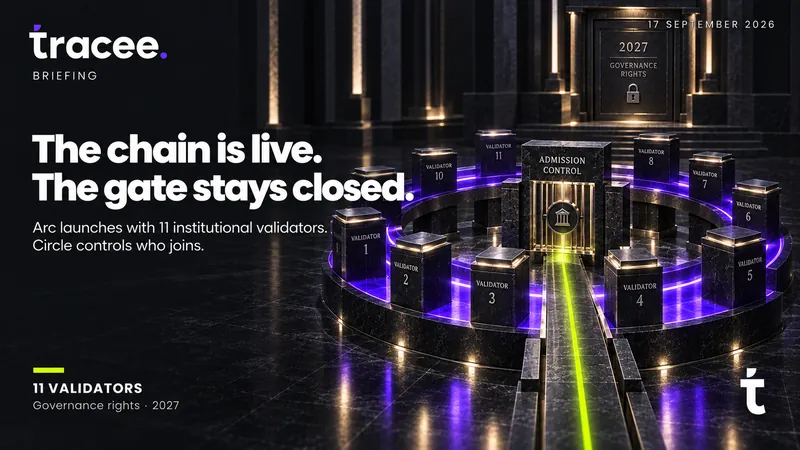
Circle's Arc mainnet went live with 11 institutional validators, BlackRock and Visa among them, USDC as gas, and sub-second finality.
Read briefingSuggest a news item or request a private briefing.
Public briefings publish on no fixed cadence. Private briefings, written for one institution and one decision, are part of the consulting engagement formats.
Book a discovery call