
A deposit is a deposit: FDIC confirms chartered bank tokens keep deposit insurance, stablecoin holders do not.
One proposed rule. Two legal categories for the digital dollar, set in motion before the ink is dry.
That paragraph closes 338 public comments and draws a legal line the banking industry lobbied to put in exactly this place.
Four regulatory determinations in one proposal. One of them hands US banks a structural advantage stablecoin issuers cannot replicate without a bank charter.
The FDIC's GENIUS Act NPRM closed its comment window on June 9. Rate each determination on its own weight.
| Determination | Status | Verdict |
|---|---|---|
| Deposit definition is technology-neutral: a bank deposit token is a deposit, FDIC insurance applies | Proposed | The structural moat. JPMD, the TCH network's planned deposit tokens, and any bank-issued tokenized deposit carry FDIC coverage by the same logic that covers a checking account. |
| Stablecoin holders receive no pass-through FDIC coverage | Proposed | The legal gap confirmed. Reserve assets parked at a bank by a stablecoin issuer are insured only as that issuer's corporate deposit, capped at $250,000. Individual USDC or RLUSD holders have no direct FDIC protection. |
| BPI, TCH, and CBA filed jointly in support of the technology-neutral framing | Filed | Coordinated lobby win. The three major US banking industry groups submitted a unified comment on the June 9 deadline, explicitly welcoming the FDIC's proposed approach and the distinction it creates between bank deposit tokens and stablecoin claims. |
| FinCEN and OFAC comment period on AML and sanctions compliance for stablecoin issuers also closed June 9 | Closed | All three NPRMs complete. OCC (closed May 1), FDIC, and FinCEN/OFAC have all received public input. The GENIUS Act implementation architecture is settled in substance; OCC final rules due July 18 are the last legal gate. |
| Community bank concern: reward-bearing stablecoins could pull deposits out of local banks | Pending resolution | The real competitive fear. FDIC insurance is a static moat. The dynamic risk is yield: if GENIUS Act stablecoins offer rewards, insured or not, depositors may move. The final rule's yield treatment is unresolved. |
The insurance moat is now structurally encoded in proposed law. It is real, but it is one dimension of a competitive dynamic that the yield question has not settled.
Two tokens, one ledger: which one gets FDIC coverage depends entirely on who issued it, not what it does.
The FDIC's technology-neutral ruling creates two parallel tracks for the same digital dollar, separated by charter, not by function.
Both tracks hold the same US government paper at the bottom. The FDIC insurance line runs above the reserve layer, determined by the issuer's charter, not the asset composition.
For institutional buyers who need FDIC coverage, the TCH tokenized deposit network just got a pitch that no stablecoin issuer can match.
Fiduciaries check the FDIC box first. Pension funds, insurance companies, endowments, and regulated money market managers operate under mandates that require FDIC-insured or equivalent instruments for operating cash. A tokenized bank deposit qualifies. A payment stablecoin, regardless of reserve quality, does not. For that class of institutional buyer, the TCH network's offer is structurally different from Circle's or Ripple's, and the FDIC ruling has now confirmed the distinction in proposed law.
The timing is not accidental. The TCH tokenized deposit network was announced on June 5, six days after this comment deadline was set and four days before it closed. JPMorgan, Citi, Bank of America, Wells Fargo, and 14 other US banks are building shared infrastructure that is, by design, FDIC-insured. The joint BPI and TCH comment on June 9 confirms the play: banks built the network, then lobbied the regulator to confirm the insurance advantage. The architecture and the advocacy arrived together.
For emerging market and humanitarian payment corridors, the ruling changes nothing. FDIC insurance is irrelevant for a MoneyGram agent in Manila or a cross-border remittance rail in sub-Saharan Africa. Payment stablecoins win those use cases on speed, cost, and reach, not on insurance. The two tiers are naturally specializing: FDIC-insured deposit tokens for institutional treasury; payment stablecoins for programmable rails and underserved corridors. The FDIC has not closed the stablecoin market. It has drawn the institutional perimeter.
The insurance advantage is structural. It is also bounded in ways the banking lobby's comment letter does not highlight.
- FDIC coverage caps at $250,000 per depositor per institution. For a corporate treasury holding $50 million in tokenized deposits, only $250,000 is insured per bank. The advantage over a stablecoin is real for retail and small-business balances; it narrows dramatically for large institutional positions unless the TCH network engineers per-holder pass-through insurance, which the FDIC has not proposed for tokenized deposits either.
- This is a proposed rule, not a final rule. The FDIC will review 338 comments before finalizing. The technology-neutral framing has broad industry support, but community banks want stricter yield restrictions on stablecoins; some consumer advocates want pass-through insurance for stablecoin holders. The final rule may shift on either point.
- The GENIUS Act's reserve requirements already make payment stablecoins extremely safe. USDC backed 1:1 by T-bills and overnight repos is not a credit risk. The absence of FDIC insurance does not mean holders face loss; it means they face the (remote) insolvency risk of the issuer entity. For most use cases, GENIUS Act reserves are adequate protection without FDIC coverage.
- A future Congress could create pass-through insurance for stablecoin holders. Several advocacy groups filed comments proposing a new stored-value insurance category. The FDIC's ruling does not preclude that legislative path. The current advantage is a function of regulatory choice, not permanent architecture.
Three moves in five weeks that together define what "bank money on a blockchain" means in the United States.
The FDIC ruling is the third in a sequence. On June 5, the TCH tokenized deposit network was announced by 18 US banks targeting H1 2027, with no blockchain vendor selected but with RTP and CHIPS connectivity built in. On June 6 this site published the structural read: the network's pitch is not programmability, it is institutional legitimacy. The FDIC ruling on June 9 delivered the legal foundation that makes the pitch credible. A chartered bank's tokenized deposit is an insured deposit. A payment stablecoin is not. That sentence is now proposed US law.
The global parallel runs in the opposite direction. The ECB's June 2026 annual report on the international role of the euro showed the stablecoin market at $300 billion at end-2025, up 50% year-on-year, with 99% of that in USD-pegged tokens. The ECB's answer to dollar-token dominance is the digital euro, targeted for 2029 if legislation passes this year. The US banking industry's answer is the FDIC-insured deposit token network, targeting H1 2027. The ECB is defending the euro's international role through a central bank instrument; US banks are defending the dollar's domestic primacy through a chartered institution instrument. Different tools, same structural pressure.
For builders designing payment architecture today, the two-tier landscape is the operating reality. Cross-border and retail payment flows will run on GENIUS Act-compliant stablecoins because they are cheaper and faster on public chains. Institutional treasury and settlement flows at regulated US banks will run on FDIC-insured deposit tokens because compliance mandates require it. The TCH briefing from June 6 sketched the infrastructure. This ruling confirms the legal logic beneath it.
Same dollar, same T-bill reserve, different legal wrapper, and that difference now has a name: deposit insurance.
The FDIC has used the GENIUS Act's implementation process to confirm what the banking industry lobbied for: deposit insurance follows the bank charter, not the smart contract. Bank deposit tokens issued by FDIC-insured institutions are insured deposits. Stablecoin holders are not. For institutional buyers who need the insurance label, this is a decisive advantage for the TCH network and any bank-issued tokenized deposit. For payment corridors, remittance networks, and DeFi composability, the ruling changes nothing: those markets do not need FDIC coverage. The architecture has split cleanly, and the next gating event is July 18.
Three things to watch:
- OCC final rules, July 18, 2026. The OCC's rule is the anchor document for the full GENIUS Act framework. Whether it maintains the FDIC's technology-neutral deposit framing, and how it handles yield restrictions, will define whether bank deposit tokens have a durable advantage or a temporary one.
- TCH vendor selection, Q3 2026. The network has no blockchain vendor. Which chain carries FDIC-insured tokenized deposits will be the most consequential infrastructure selection in US digital asset history. Ethereum, Canton (JPMorgan Kinexys), or a private rail are the live candidates.
- Whether any non-bank stablecoin issuer acquires a bank charter. Circle has an OCC conditionally approved national trust bank application outstanding. If approved, USDC issued by a chartered Circle bank would qualify for the same technology-neutral deposit treatment. That would close the insurance gap and compress the entire two-tier architecture.
Common questions about FDIC insurance and digital dollar architecture.
Are stablecoins covered by FDIC deposit insurance?
What is a bank deposit token and why is it treated differently from a stablecoin?
What did BPI, TCH, and CBA argue in their joint comment?
When will the GENIUS Act final rules be issued?
Why are community banks worried about stablecoins even if stablecoin holders lack FDIC coverage?
Related briefings on the same rails.
The Fed proposed GENIUS Act reserve, capital and application rules seven months after the OCC and five after the FDIC. None of the three is final yet.
Read briefingSeven axes where the two paths diverge: issuer license, backing, regulation, insurance, network, yield, and example issuers.
Read briefing
Treasury proposed a rule defining when a stablecoin is "issued in the United States" and "offered or sold" to a US person, borrowing from Regulation S and extending…
Read briefingThe OCC published draft PS-01 weekly reserve forms and PS-02 quarterly financial condition forms for all Permitted Payment Stablecoin Issuers on June 12, 2026.
Read briefing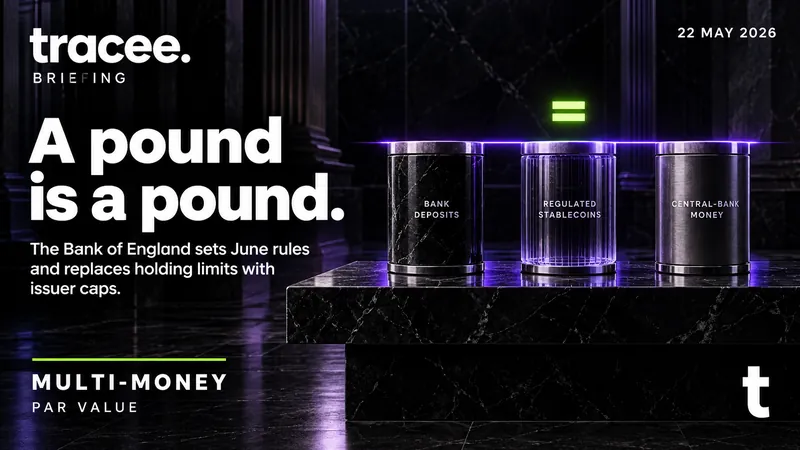
The Bank of England drops the £20,000 individual stablecoin holding limit in favour of aggregate issuance caps on providers, sets June 2026 for draft rules and…
Read briefing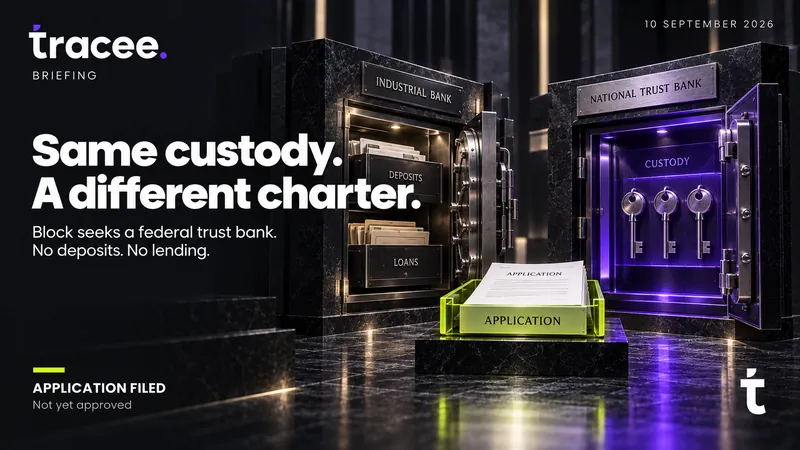
Block filed 4 September for a second bank charter, Builders Bank, an uninsured trust bank barred from taking deposits or making loans.
Read briefingSuggest a news item or request a private briefing.
Public briefings publish on no fixed cadence. Private briefings, written for one institution and one decision, are part of the consulting engagement formats.
Book a discovery call