
Eighteen banks, one ledger: Wall Street drafts The Clearing House to tokenize deposits and put stablecoins on notice.
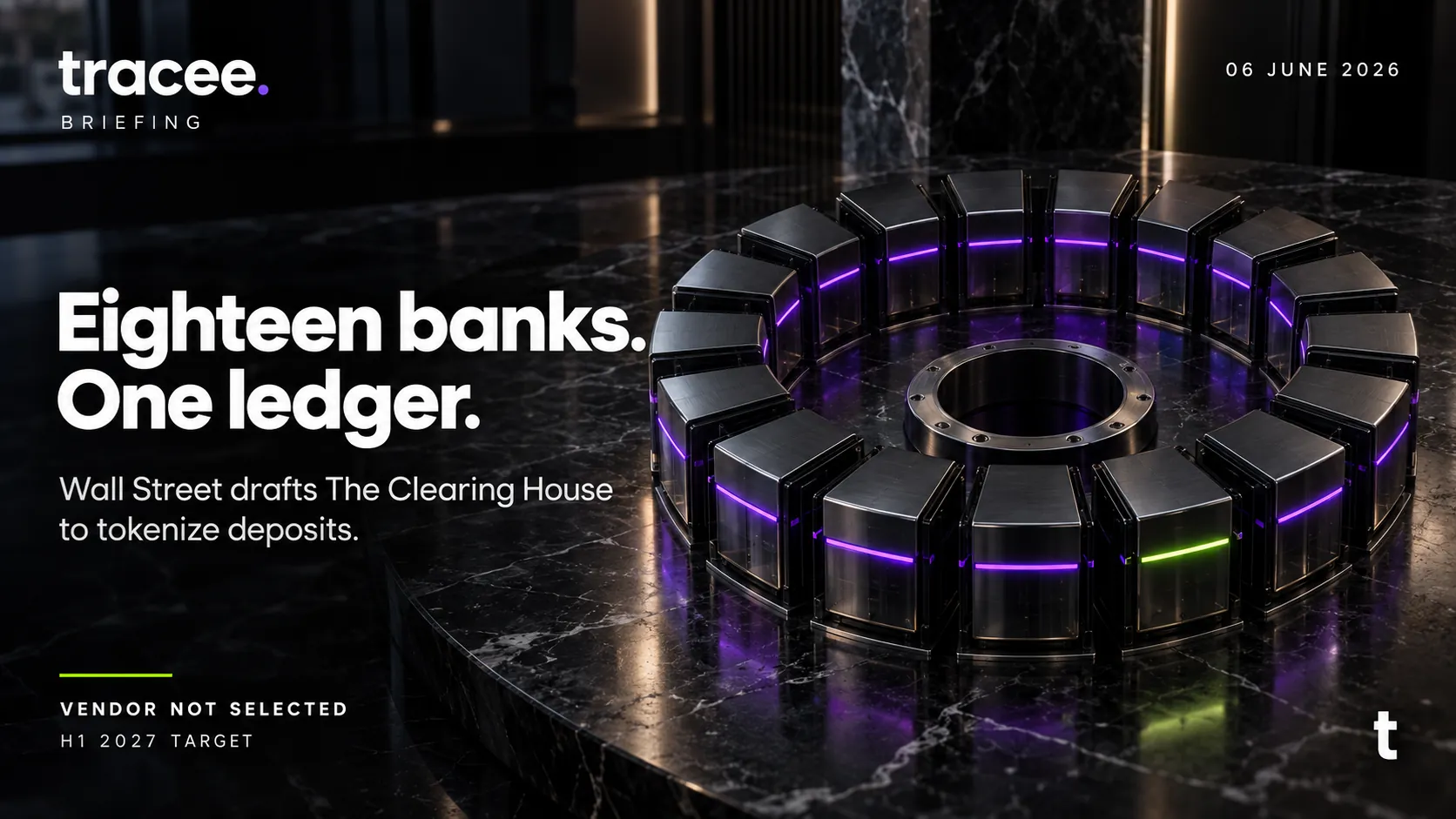
Four facts announced. One critical gap buried underneath.
The coalition and the operator are decided. The ledger itself does not exist yet. That gap is where the analytical work starts.
Five commitments on the table. Two have shipped, three are still open.
Each commitment carries different analytical weight. Separated and rated:
| Move | Status | Verdict |
|---|---|---|
| 18-bank coalition sign-on | Shipped | Landmark breadth. All four US systemic banks plus 14 regional peers under one operating governance structure. No prior US deposit network has assembled this coalition. |
| The Clearing House as operator | Shipped | Governance by design. TCH is co-owned by these same banks and runs RTP® and CHIPS®. The choice embeds the network inside existing bank-owned infrastructure, no new institution created. |
| Blockchain vendor selection | Pending | The gating decision. Permissioned Ethereum, Canton, ZKsync/Prividium, or a proprietary stack each set different programmability and interoperability ceilings for all 18 members. |
| H1 2027 network launch | Target | Optimistic. GENIUS Act final rules land by July 18; CLARITY Act remains in the Senate. Regulatory readiness will pace the rollout, not the code. |
| Programmable treasury for multinationals | Exploring | The real prize. Conditional payments, 24/7 cross-border liquidity, same-day FX settlement. The vendor choice determines whether any of this arrives at launch or comes later. |
The two shipped items are structural foundations. The three open items are where the briefing lives.
The deposit stays in the bank. The token carries the value across the ledger.
Every dollar in the network starts as an FDIC-insured deposit at an originating bank and ends as a credit at a receiving bank. The token is the coordination mechanism between the two.
- The deposit never leaves the banking system. Unlike a stablecoin transfer, no value moves to a non-bank custodian. The token is destroyed once the receiving bank credits its customer. FDIC insurance applies throughout the flow.
- The one unbuilt layer defines the ceiling. The TCH permissioned ledger is the only component without a vendor. Everything above and below it exists today. The vendor choice sets the programmability ceiling for all three bottom-layer use cases.
Three reasons this is bigger than a joint press release.
Scale arrives with the wiring. TCH's RTP® and CHIPS® already clear more than $2 trillion daily. When a token layer connects to that infrastructure, programmability arrives at systemic scale on day one of launch. The four lead banks hold roughly $8 trillion in US deposits combined. A multinational treasurer whose receivables, payroll, and supplier payments run across those four deposit books can start running conditional, programmable payment flows the moment the network is live. That is not a pilot. It is a rewiring of institutional treasury operations at the largest scale ever attempted.
The regulatory moat is already built. Tokenized deposits are regulated as bank liabilities under existing law. No GENIUS Act license required, no reserve attestation, no new compliance program. Circle, Tether, and PayPal face a GENIUS Act compliance burden that locks in by July 18, 2026. The TCH network's member banks face none of it. That asymmetry is structural advantage baked into the choice of operator, not a competitive edge that can be copied.
TCH governance locks in the utility model. Co-owned by the member banks, TCH operates as a shared utility rather than a profit-extracting intermediary. When TCH launched RTP® in 2017, adoption concentrated in large institutions first, then broadened as the Federal Reserve's FedNow® followed in 2023. A tokenized deposit network run by TCH will follow the same pattern: institutional first, access broadening as the regulatory framework matures.
The commitments are real. The network is not, yet.
- No vendor, no network. A signed coalition and a named operator are not running code. Vendor selection is the first gating event, and it has not happened. Until it does, the H1 2027 target is a planning horizon, not a delivery commitment.
- FDIC insurance stops at the deposit. The deposit is insured; the token representing it is not. If the DLT layer fails or is exploited, recovery runs through legacy legal processes, not smart-contract reversal. The regulatory protection is one layer below the programmable surface.
- Interoperability with Cari is unresolved. Cari Network, backed by five regional banks including Huntington and KeyBank (both also in the TCH coalition), runs on ZKsync's Prividium and targets a Q4 2026 retail launch. Two overlapping bank memberships building on incompatible stacks is a fragmentation risk nobody has addressed publicly.
- Cross-border reach is domestically scoped at launch. RTP® and CHIPS® are US-only infrastructure. International corridors require Partior, Fnality, or bilateral arrangement outside TCH's perimeter. The programmable cross-border FX use case is on the roadmap but requires a separate, unsolved integration.
- Stablecoins have a 12-month head start on treasury relationships. USDC is live in 180+ countries. On June 4, Mastercard opened its Multi-Token Network to six stablecoins across eight chains (see the Mastercard briefing). A 2027 TCH launch gives stablecoins a full year to cement the treasury integrations this network will want.
Stablecoins on card rails, deposits on bank rails: two architectures racing the same treasurer.
The GENIUS Act's final rules, due July 18, 2026, define the compliance burden for non-bank stablecoin issuers: capital requirements, reserve attestations, AML programs. The TCH network sidesteps this framework entirely, no new license, no new charter, no reserve attestation beyond existing bank regulation. The CLARITY Act, advancing in the Senate, adds a yield prohibition: stablecoin issuers cannot pay deposit-style interest, while banks can. That asymmetry, not the DLT itself, is the structural moat the TCH coalition is building toward. The CLARITY Act briefing has the full regulatory read.
The competitive frame from the past 48 hours is explicit. On June 4, Mastercard opened its Multi-Token Network to six stablecoins across eight chains and added intraday and weekend settlement cycles. On June 5, the TCH announcement landed. The Citi Tokenization 2030 report, published June 3 (see the Citi briefing), projects $5.5 trillion in tokenized real-world assets by 2030 and names bank-led tokenized deposits as the dominant institutional vehicle through the early years. Two architectures for programmable money are now converging on the corporate treasurer from opposite directions.
Globally, the BIS's Project Agora proved atomic multi-currency wholesale settlement works in simulation and moved to real-value testing (see the BIS briefing). DTCC goes live for tokenized equities and Treasuries in October 2026. The TCH network is the US commercial banking system's answer to both: a programmable deposit rail that connects to the same settlement infrastructure DTCC will use for the asset leg.
The structural case holds. The vendor, the regulator, and Cari will determine everything else.
The TCH tokenized deposit network is the most coordinated structural response the US banking system has ever mounted against a competitive threat from outside the regulated perimeter: 18 institutions, $2 trillion in existing daily settlement infrastructure, FDIC backing as the trust anchor, and a regulatory framework that places the new compliance burden on competitors rather than on the network itself. What remains open is the technology choice, the regulatory calendar, and whether banks can move fast enough to matter before stablecoins lock in the treasury relationships this network will want.
Watch three things over the next six months:
- Blockchain vendor selection (Q3 2026). Canton, Prividium, or permissioned Ethereum sets the programmability ceiling and determines whether TCH and Cari can interoperate rather than fragment the market.
- GENIUS Act final rules (July 18, 2026). The OCC and FDIC rules define the compliance burden on stablecoin issuers. The gap between that burden and bank deposit regulation is the TCH network's operating moat, confirmed or closed on that date.
- Cari Network Q4 2026 retail launch. If Cari proves the tokenized deposit model before TCH goes live, it either validates the architecture or reveals that two incompatible standards are the real problem to solve in 2027.
Common questions about tokenized deposits and The Clearing House.
What is The Clearing House and why is it operating this network?
What is a tokenized deposit, and how does it differ from a stablecoin?
Why hasn't a blockchain vendor been selected yet?
What is the Cari Network?
What does the GENIUS Act have to do with this announcement?
What does programmable treasury mean in practice?
Related briefings on the same rails.
Quant was named vendor for the tokenized deposit network 25 US banks are building, closing the watchpoint tracee flagged in June. No blockchain has been named yet.
Read briefing
The ledger moves tokenized deposits 24/7, including weekends and overnight, running on a permissioned Linea-style network with Chainlink CCIP as its…
Read briefing
JPMorgan is not neutral on Clarity Act yield provisions: it operates Kinexys, is building JPMD (a deposit token that can pay yield), and anchors the TCH tokenized…
Read briefingThe FDIC's comment period on its GENIUS Act proposed rule closed June 9 with 338 submissions.
Read briefing
SoFi Bank, N.A. made SoFiUSD available to its 14.7 million consumer members on 27 May 2026, the first stablecoin issued by a federally chartered national bank…
Read briefing
DTCC named Stellar as the first public, permissionless blockchain for DTC-custodied securities on 27 May 2026, with availability targeted for H1 2027.
Read briefingSuggest a news item or request a private briefing.
Public briefings publish on no fixed cadence. Private briefings, written for one institution and one decision, are part of the consulting engagement formats.
Book a discovery call