
Japan's FSA wants a family-trust tax rule off stablecoins: the fix helps one issuer today, and April 2027 is the earliest it can land.
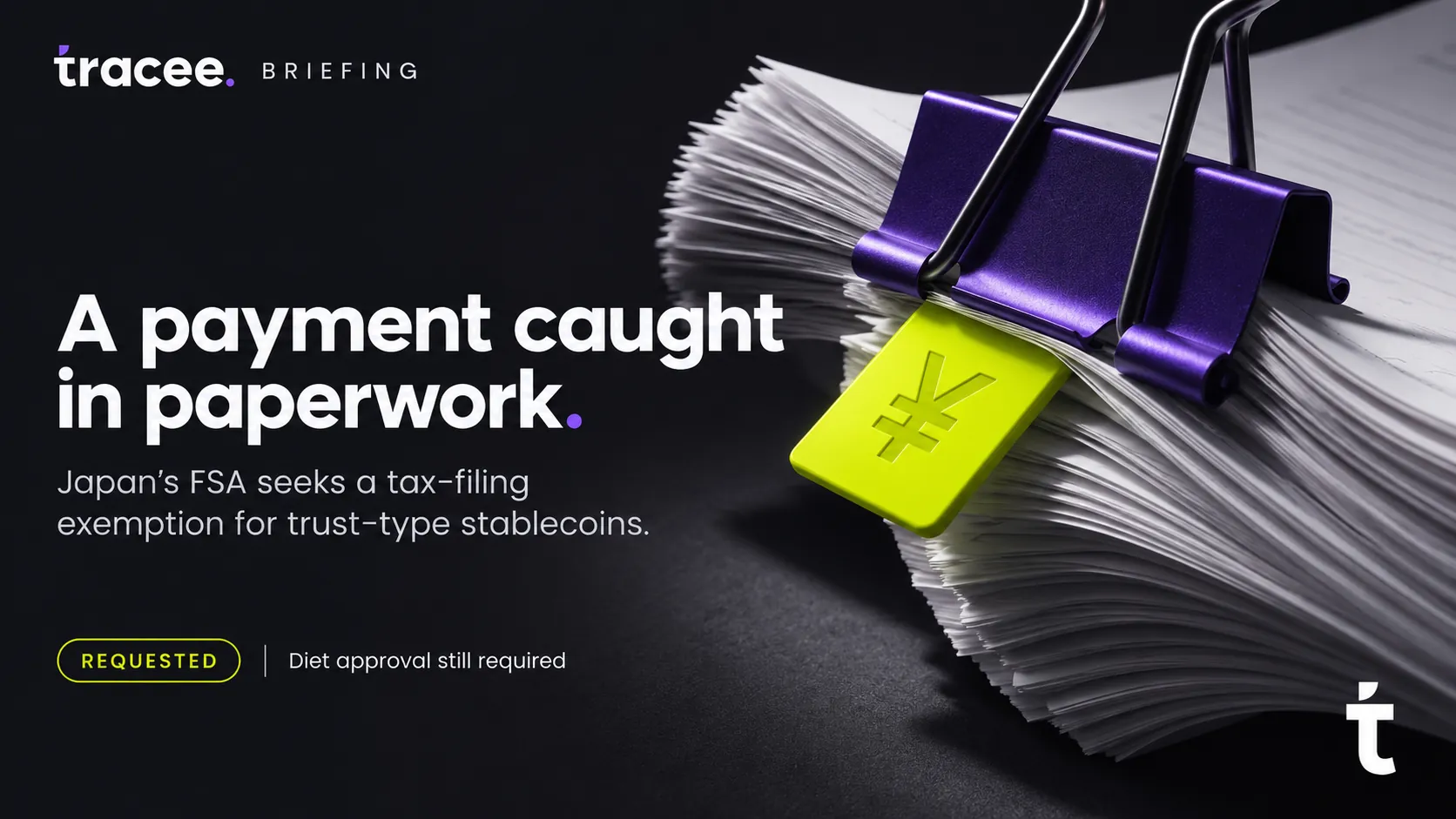
A filing meant for grandparents' trusts, applied to a token that turns over all day.
Japan's trust tax code was written for a trust with a handful of named beneficiaries who rarely change. A stablecoin is a trust with beneficiaries who change every time someone pays for coffee. The FSA is asking the tax code to notice the difference.
One request, two beneficiaries, and one constraint left standing.
Four elements of the filing, rated on what actually changes if the Diet adopts it.
| Element | Status | Verdict |
|---|---|---|
| Exemption from per-beneficiary tax filing on domestic trust-type stablecoins | Requested | The core ask. Removes a reporting duty that makes high-frequency transfer economically unworkable for a trustee. |
| Same exemption for foreign trust-type stablecoins recognized as electronic payment instruments | Requested | The door left open. Extends the fix to issuers beyond Japan's own trust banks, once any exist. |
| Yen-value cap on trust-type stablecoin transactions | Untouched | Not part of this. Paperwork gets lighter; the size ceiling on the instrument does not move. |
| Diet approval and 1 April 2027 effective date | Not decided | Still a request. The ruling coalition's tax panel rules in December; nothing is law yet. |
Two of the four rows are the request itself. The other two are what the request quietly leaves alone: the cap on how much can move, and the calendar for whether any of this actually happens.
Six actors, one collision, between a payments law and a tax law written decades apart.
The friction sits at the seam between the regime that lets a trust bank issue a stablecoin and the older tax rule that still governs any trust in Japan.
The diagram makes one thing visible that the headline does not:
- The FSA is fixing its own regime from the outside. It cannot rewrite trust tax law itself; it has to ask the Ministry of Finance to do it, on the ministry's own annual clock.
- Only one box at the bottom is occupied. The exemption is being built for a market of one issuer, with a second lane left open for issuers who do not exist yet.
Three reasons a tax filing tweak says more than its size suggests.
A licensing regime is not enough on its own. Japan built one of the world's more specific stablecoin frameworks in its 2023 Payment Services Act amendment, naming banks, trust companies, and registered fund-transfer businesses as the three permitted issuer types. A trust bank can legally issue JPYSC today. The tax code, unrelated legislation written before any of this existed, can still make that license impractical to use. The FSA going to the Ministry of Finance is an admission that licensing and taxation have to be fixed as two separate projects, not one.
The fix follows the product, not the other way around. JPYSC has been live long enough for its trustee to run into the filing rule in practice, not in theory. This is a regulator responding to an operational complaint from a market of one, which is the ordinary, unglamorous way stablecoin regulation actually gets built: one friction point at a time, after someone tries to use the thing.
The foreign-issuer clause is a placeholder for competition that has not arrived. No foreign trust-type stablecoin currently operates in Japan under electronic-payment-instrument recognition. Writing the exemption to cover them anyway signals the FSA expects that lane to fill, and would rather the tax rule be ready before a second issuer needs it than write a new request each time one shows up.
A request is not a rule. Five reasons to size this correctly.
- It is one line in an annual request package. Every ministry and agency files tax reform requests every August. The ruling coalition's tax panel can accept, narrow, or drop any of them before the December outline, and the Diet still has to pass the resulting bill.
- 1 April 2027 is the earliest date, not a committed one. That is the start of Japan's next fiscal year, and it only applies if the request survives the process untouched.
- Exactly one issuer benefits today. JPYSC is the sole live trust-type stablecoin. Until a second one launches, this is compliance plumbing for SBI Shinsei Trust Bank, not a market-wide unlock.
- The transaction cap stays in place. The request is explicit that it does not touch the separate yen-value ceiling on trust-type stablecoin transactions. Reporting gets lighter; the instrument does not get bigger.
- The foreign-issuer clause has no test case yet. No electronic-payment-instrument-recognized foreign issuer currently operates a trust-type stablecoin in Japan, so that half of the request is unverified until one does.
Tracee's second Japan briefing this year finds the same three names, one layer lower in the stack.
Tracee's July briefing on SBI Solana Global covered JPYSC and Progmat as distribution infrastructure, SBI Holdings betting on a third chain for its stablecoin stack. This request sits one layer below that: not which chain a token settles on, but whether the tax code lets it move at all once it is live. Both briefings converge on the same two names, SBI and Progmat, because Japan's trust-type stablecoin category currently has one occupant, and every regulatory move in it is a move about that occupant.
The contrast with other jurisdictions is instructive. The US GENIUS Act and the EU's MiCA both spend their text on reserve composition, redemption rights, and issuer licensing, the questions of whether a stablecoin is safe to hold. Japan's FSA is instead fixing a downstream tax mechanic that has nothing to do with safety and everything to do with whether a compliant, licensed instrument can actually be used the way a payment instrument needs to be used: transferred often, by many people, without triggering a filing built for a will.
The licence was never the hard part. The tax code was.
Japan already lets a trust bank issue a stablecoin. What it had not yet done was update the tax rule that governs every trust in the country to notice that this particular trust's beneficiaries change a thousand times before lunch. The FSA's 31 August request is a regulator debugging its own regime from outside, one filing requirement at a time, for a category that currently holds exactly one product. It changes nothing yet. It is also the kind of unglamorous fix that has to land before "trust-type stablecoin" means more than JPYSC.
Watch three things:
- Whether the ruling coalition's tax panel keeps this request intact in the December 2026 FY2027 outline, the step that turns a filing into a real change.
- Whether a second trust-type stablecoin issuer launches before the exemption even takes effect, which would test whether the filing rule was really the blocker.
- Whether the FSA separately revisits the yen-value cap on trust-type stablecoins, the constraint this request left standing.
Common questions about Japan's FSA and trust-type stablecoin taxation.
What did Japan's FSA request about stablecoin taxes?
Why is this a problem for stablecoins specifically?
Which stablecoin does this affect today?
Does this remove the transaction limit on trust-type stablecoins?
Where can I read the original source?
Related briefings on the same rails.
Japan's amended Payment Services Act creates the most portable regulatory framework for foreign stablecoins yet built in the G7: no domestic entity, no domestic…
Read briefing
Block filed 4 September for a second bank charter, Builders Bank, an uninsured trust bank barred from taking deposits or making loans.
Read briefing
FASB's 18 August 2026 proposal would let stablecoins meeting a three-part redemption and reserve test sit on the cash-equivalents line, with comments due 19…
Read briefing
The SEC sent "Amendments to the Custody Rules" to the White House on 25 August, reviving a crypto custody rewrite that died under Gensler in 2025.
Read briefingThe ECB and 27 EU central banks want MiCA's 60% bank-deposit quota gone, replaced by a liquidity test, and the stablecoin yield ban widened to lending and staking.
Read briefing
On the second anniversary of its own MiCA authorization, Circle disclosed that only 3 of the world's top 50 stablecoins are MiCA-compliant, and publicly pushed the…
Read briefingSuggest a news item or request a private briefing.
Public briefings publish on no fixed cadence. Private briefings, written for one institution and one decision, are part of the consulting engagement formats.
Book a discovery call