
SBI Holdings and Solana Foundation launch SBI Solana Global: Japan gets a third chain in its stablecoin stack, and SBI's own yen token was headed somewhere else first.
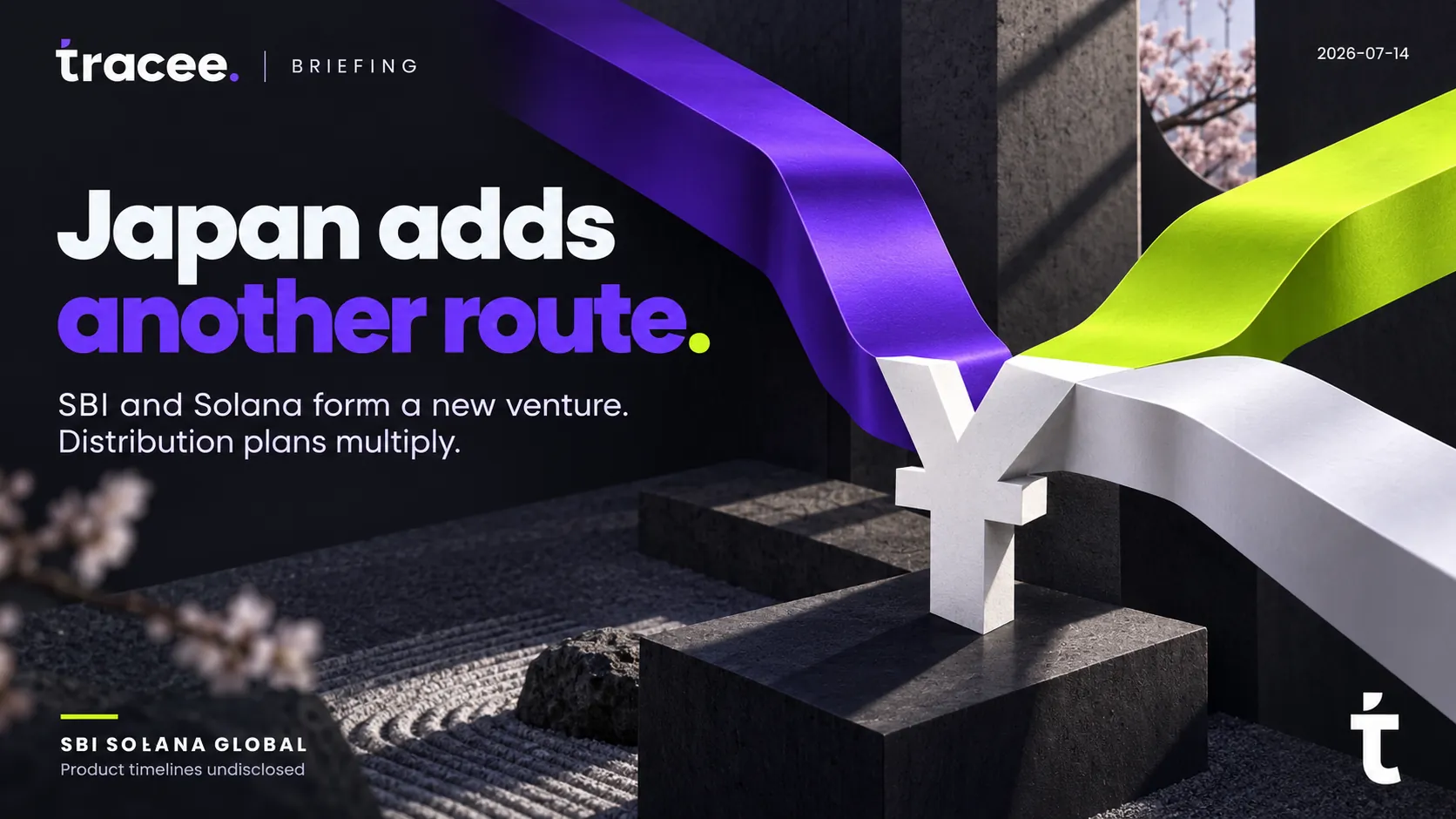
SBI hands its Corda-era subsidiary to Solana, and folds the yen stablecoin project in as one of five new business lines.
The word doing the heavy lifting is "distribution." JPYSC's own issuer committed the token to a different chain five weeks ago.
Five lines on the slide, and only the ownership change is a transaction.
Rated against what each line actually commits to:
| Move | Status | Verdict |
|---|---|---|
| Solana Foundation equity stake in SBI R3 Japan | Shipped | Real, terms undisclosed. A blockchain foundation buying into a bank-affiliated entity is a step up from ecosystem grants, but neither side named a stake size or valuation. |
| Rebrand to SBI Solana Global | Shipped | Naming, not infrastructure. The entity swaps its R3 Corda-era name for a Solana one. No code, client, or product changed hands on day one. |
| JPYSC stablecoin distribution | Pending | Contradicts the standing plan. JPYSC's issuer and co-developer had already committed the token to a different chain. See section 03. |
| Tokenized RWA, cross-border settlement, institutional services | Exploring | Three lines, zero named clients. Corporate bonds, commercial paper, funds, and real estate are listed as target categories with no issuer, size, or date attached. |
| AI-agent payment rails | Exploring | Pre-product. No spec, pilot, or counterparty named. |
Two moves are a transaction. Three are labels on a slide.
SBI's digital-asset holdings run through two subsidiaries that both touch JPYSC. Solana joins one of them, not the other.
Lay the two SBI subsidiaries and Japan's other bank-backed tokenization effort side by side, and the chain count triples.
- JPYSC now has two declared destinations, not one. Startale's Strium L1 was the committed migration path in June. SBI Solana Global's distribution line adds Solana in July without saying which one retires.
- The Corda exit is the throughline. SBI R3 Japan's own name signaled its R3 Corda heritage; Progmat left Corda for Avalanche five weeks earlier. Neither of Japan's bank-backed tokenization efforts is still betting on the permissioned chain both started on.
Three reasons this is a chain contest inside one keiretsu, not just between rivals.
SBI's own group now points JPYSC at two chains from two subsidiaries, five weeks apart. SBI Shinsei Trust Bank and Startale committed the token to Strium L1 on June 24. SBI Solana Global lists JPYSC distribution as a founding line on July 13. Nothing public reconciles the two, which means the ambiguity is internal to SBI, not a rival picking a fight with it.
Solana Foundation buying equity is new behavior, not new money. Foundations fund ecosystem grants and developer tooling as a rule. Taking a stake in a bank-affiliated entity is Solana bidding for institutional balance-sheet defaults on yen rails, the same positioning Avalanche and R3 Corda already occupied inside Japan's own stack before this deal.
AI-agent payment rails is the tell for how this positions against Western rivals. Circle's trust bank and the Clearing House's tokenized deposit network are both defending existing custody and deposit flows. SBI Solana Global is the first name in tracee's Japan coverage to put agent-native payments in its founding business lines rather than bolt the idea on later.
The stake is real. Five things it does not yet establish.
- No financial terms disclosed. Stake size, valuation, and governance rights in SBI Solana Global are all unstated.
- JPYSC's own migration plan pointed elsewhere first. Startale's Strium L1 was the committed destination as of the June 24 launch. Nothing in the July 13 announcement says that plan is cancelled, only that a Solana distribution line now exists alongside it.
- "Japan's on-chain financial market" is not a new category. Progmat already moved more than ¥439.6 billion in tokenized real estate and corporate bonds onto a public chain in June, ahead of this announcement.
- Zero named institutional clients. Tokenized RWA, cross-border settlement, and institutional services are stated targets with no counterparty, size, or date.
- AI-agent payment rails has no spec. No pilot, no counterparty, no timeline; it is a business-line label, not a product.
Japan is building its stablecoin stack from three directions at once, and the megabanks still have to pick one in October.
tracee's June 29 briefing on JPYSC's launch named the Progmat megabank consortium's blockchain decision, due in October 2026, as the watchpoint that would decide whether JPYSC becomes Japan's yen stablecoin standard or one of two competing ones. This announcement does not answer that question. It adds a third chain bet, Solana, to a field that already held two, Progmat's Avalanche and Startale's Strium L1, before MUFG, SMBC, and Mizuho have chosen either.
tracee's June 7 briefing on Progmat's own migration off R3 Corda already flagged the JGB repo market's October working-group report as the moment that would set the cash-leg standard for Japan's sovereign bond settlement. That report and the megabank stablecoin decision are increasingly the same event, and now have to weigh three live Japanese chain bets instead of one.
The wider frame is the same one running through tracee's coverage of Circle's trust bank, SWIFT's tokenized deposit pilot, and the Clearing House network out of the US, and Ripple's and Bridge's MiCA licenses out of the EU: every jurisdiction is assembling regulated rails for institutional stablecoins and tokenized assets in parallel, not in sequence. Japan's version of that race now runs inside a single conglomerate as much as between competitors.
SBI bought Solana a foothold, not a decision. The chain that actually clears Japan's institutional money is still Progmat's and Startale's call to make.
SBI Solana Global is a real equity transaction wrapped around five aspirational business lines, one of which, JPYSC distribution, does not yet reconcile with the token's own committed migration to Startale's Strium L1. The rebrand buys Solana a bank-affiliated foothold in Japan and buys SBI a second chain to court the same megabank consortium that Progmat is already courting on Avalanche. Whether any of this changes what Japan's institutions actually settle on depends on decisions neither SBI nor Solana Foundation has made yet.
Watch three things:
- Whether JPYSC actually launches on Solana, stays on its Strium L1 path, or runs both. SBI Solana Global's own announcement does not say the Strium plan is cancelled.
- Whether SBI Solana Global names a first tokenized RWA issuer or institutional client. Zero named at launch.
- The Progmat megabank consortium's October 2026 blockchain decision. MUFG, SMBC, and Mizuho now choose among at least three Japanese chain bets, not one.
Common questions about SBI Solana Global and Japan's on-chain finance race.
What did SBI Holdings and the Solana Foundation announce?
Does this mean JPYSC is moving to Solana?
Is this really Japan's first on-chain financial market?
What is Progmat, and how does it relate to this?
Where can I read the original source?
Related briefings on the same rails.
Japan's dominant tokenized securities platform exits R3 Corda and lands on Avalanche L1 in June 2026, making ¥439.6B in tokenized real estate and corporate bonds…
Read briefing
The IMF's contribution isn't new data. It is the first time a multilateral institution has placed tokenized deposits, stablecoins, and wholesale CBDC on equal…
Read briefingSix actors decomposed: Ondo (issuer), Ripple (holder), XRP Ledger (venue), Mastercard MTN (orchestrator), Kinexys (cross-border cash rail), and two correspondent…
Read briefingJLTXX, filed 12 May and effective 13 May, is J.P. Morgan's second tokenized MMF on Ethereum after MONY. The bank that argued in public for two years that deposits…
Read briefingFour moves stacked under one headline: two shipped (multichain expansion, DeFi composability via Uniswap and Euler), two exploratory (tokenized ETFs, staked ETH ETF…
Read briefing
Japan's June 1 Payment Services Act amendment created two trust-type stablecoin categories: the foreign pathway (USDC, RLUSD) and the domestic Type III (JPYSC)…
Read briefingSuggest a news item or request a private briefing.
Public briefings publish on no fixed cadence. Private briefings, written for one institution and one decision, are part of the consulting engagement formats.
Book a discovery call