
Ripple completes the pattern Bridge predicted: the same Luxembourg license pair now covers 30 EEA states, and Ripple's own stablecoin still can't launch under it.
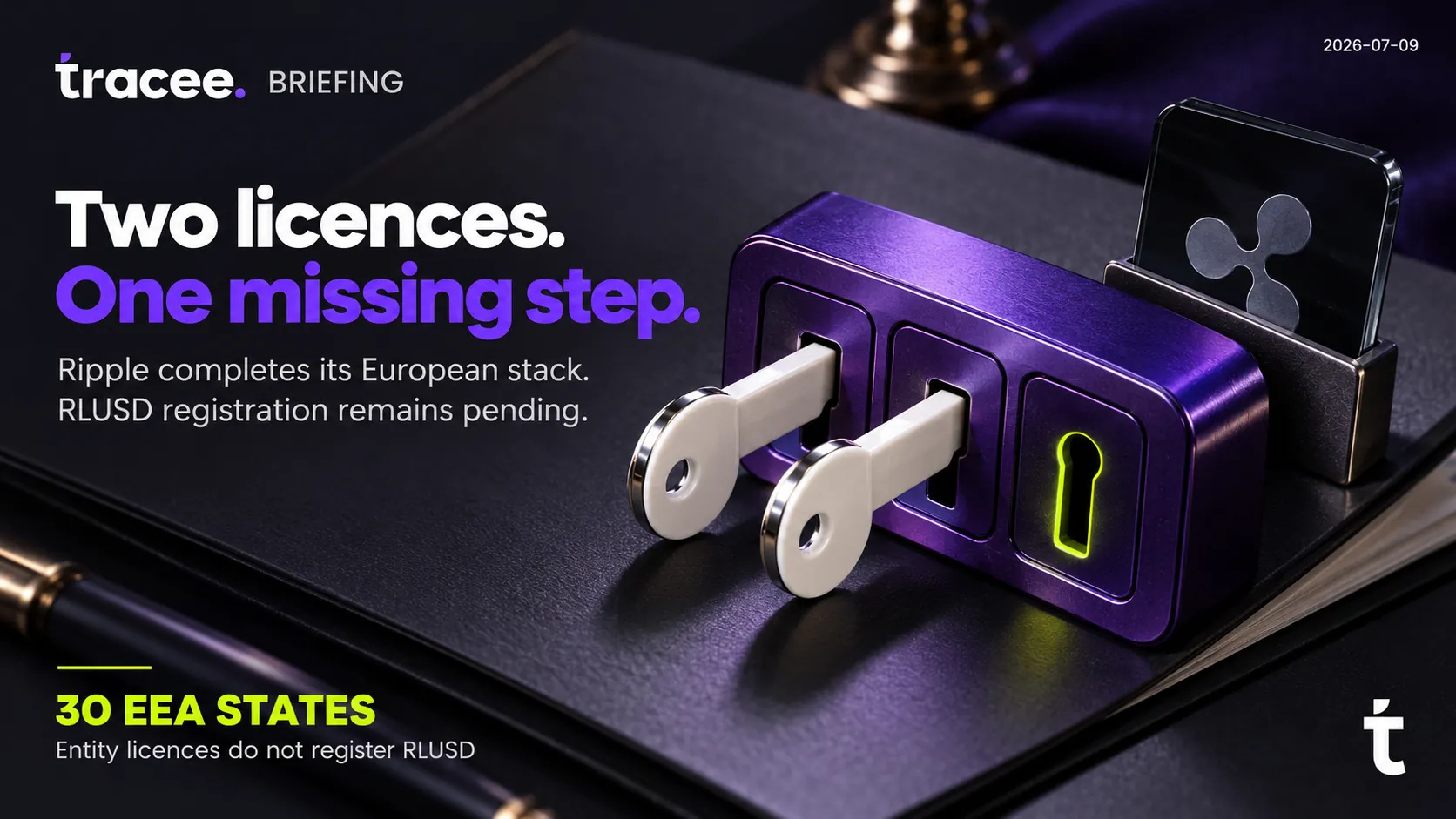
One upgrade, five weeks in the making, completes a license pair Ripple started building in January.
The two licenses did not arrive together. That six-month gap is the detail most coverage skipped.
Five items, one of them is still missing.
Rated against what each authorization actually unlocks:
| Move | Status | Verdict |
|---|---|---|
| EMI license, Luxembourg | Shipped | Old news. Ripple has held this since February. The fiat leg of its stack was never the open question. |
| CASP authorization, preliminary to full | Shipped | The completion, not the discovery. Ripple's CASP process started before Bridge's and took five weeks longer to close, split across two separate grants rather than one filing. |
| 30-country EEA passport | Shipped | Wider than Bridge's. 30 EEA states against Bridge's 27 EU states, the extra three coming from Iceland, Liechtenstein, and Norway's EEA membership. |
| RLUSD registered as an EU e-money token | Pending | The gap that matters. Not listed in ESMA's EMT register as of July 2026. The license pair does not put Ripple's own stablecoin on a regulated EU venue. |
| European institutional client under new CASP scope | Exploring | Capacity, not volume. The license activates custody, exchange, and execution services for banks and corporates. None has been named publicly yet. |
The first three rows confirm what was already expected once Bridge set the template. The fourth is the one the headlines mostly left out.
Two grants, six months apart, activate two products and leave a third blocked.
Ripple's Luxembourg entity now runs the fiat and crypto-asset legs itself, but what that unlocks downstream is uneven.
- The license pair is complete, the product stack is not. Payments and custody are live under the new authorization. RLUSD, the asset Ripple actually issues, is not.
- MiCA treats infrastructure and issuance as separate tracks. A CASP-plus-EMI combination clears the pipes. Putting a specific stablecoin through them still requires its own EMT registration.
Three reasons this is a data point, not a repeat.
tracee named this exact move as a watchpoint four days ago. The July 7 Bridge briefing flagged whether Circle, Ripple, or Paxos would pursue the same CASP-plus-EMI structure in Luxembourg. Ripple already held the EMI half; completing the CASP half on July 6 answers the question before the ink on that watchpoint dried.
The two paths to the same license pair are not equivalent. Bridge closed both authorizations in a single filing on July 2. Ripple assembled its own over six months, EMI in February, CASP in July, with a preliminary grant on each leg before full authorization. One approach is faster to announce; the other has been running longer and covers more ground.
Ripple's passport is structurally wider. Thirty EEA countries against Bridge's twenty-seven EU states is not a rounding difference. Iceland, Liechtenstein, and Norway sit outside the EU but inside the EEA's single market, and Ripple's authorization reaches them without a separate filing.
The license stack is real. Four gaps separate it from RLUSD trading in the EU.
- RLUSD is not registered as an EU e-money token. MiCA classifies a single-currency stablecoin as an EMT requiring its own ESMA registration, distinct from the CASP and EMI licenses Ripple's entity holds. Until that registration lands, RLUSD cannot be offered to EU retail investors or listed on a MiCA-licensed exchange.
- "First" is contested from two directions. Bridge closed its combined grant four days earlier, in one filing. Ripple's EMI license predates that by five months. Neither company's press language settles which one actually got there first, because they were not running the same race.
- No European institutional client is named under the new CASP scope. The authorization activates capacity for custody, exchange, and payment execution. A signed bank or corporate relationship using it has not been disclosed.
- The sequential build is not evidence this route is faster. Ripple's own CASP process ran five weeks longer than the CSSF's preliminary-to-full timeline for Bridge. A second data point confirms the venue, not the speed.
Luxembourg's CSSF is turning into a pattern, and the EU's stablecoin registration layer is turning into the real bottleneck.
MiCA's transitional period closed on June 30, 2026, the deadline tracee covered in its June 24 ESMA briefing. Two days later, Bridge became the first non-bank platform tracee tracked to pair a CASP authorization with an EMI license in one Luxembourg filing, a move covered in tracee's July 7 briefing. Ripple's completion of the same pair, four days after that briefing published, turns a single instance into a pattern worth watching rather than a one-off.
What the pattern does not yet resolve is the layer above it. Bridge is infrastructure with no stablecoin of its own to register. Ripple has one, RLUSD, already circulating at roughly $1.7 billion, and it still sits outside ESMA's EMT register. That gap suggests the CASP-plus-EMI combination is becoming a solved problem for non-bank platforms, while getting a specific stablecoin through MiCA's separate e-money token authorization remains the slower, unresolved step.
Every EMT registration to date has gone to bank-adjacent or single-purpose issuers: Circle's EURC, Crédit Agricole's EURXT. A blockchain-native issuer the size of RLUSD reaching that register would be a materially different signal than the license pair alone, since it would test whether ESMA applies the same bar to a company built outside traditional finance.
The pipes are built. What flows through them is still waiting on a different regulator's sign-off.
Ripple's completed license pair confirms the pattern tracee flagged four days earlier and extends it: CSSF Luxembourg now looks like the default venue for non-bank platforms clearing the EEA in one filing rather than thirty. But holding a CASP authorization and an EMI license activates payments and custody, not a stablecoin. RLUSD's absence from ESMA's EMT register is the reminder that MiCA treats infrastructure licensing and stablecoin registration as two separate approvals, and the second one is still open.
Watch three things:
- Whether Ripple files for RLUSD's EMT registration next. The license pair is done; the stablecoin it was arguably built to support is not yet cleared to use it.
- Whether a third non-bank platform follows Bridge and Ripple into the same CSSF structure. Two instances in one week is a pattern. A third turns it into the standard route.
- Whether Ripple names a European bank or corporate client under the new CASP scope. That is the point the license stops being capacity and becomes revenue.
Common questions about Ripple's MiCA and EMI licenses.
What did Ripple just receive from Luxembourg's regulator?
Is this the same license pairing Bridge got from Stripe?
Can RLUSD now be bought and sold across the EU?
What can Ripple's license actually be used for today?
How does this compare to Bridge's dual license, which tracee covered on July 7?
Where can I read the original source?
Related briefings on the same rails.
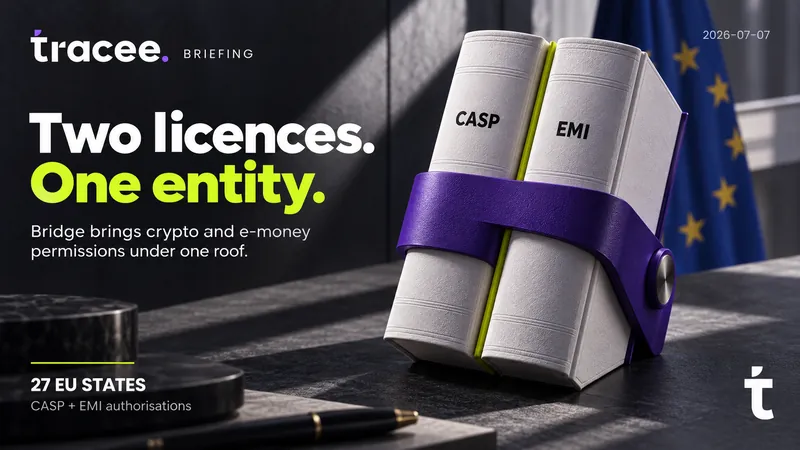
MiCA's transitional period closed June 30; two days later, Bridge became the entity holding both a CASP authorization and an EMI license from the same Luxembourg…
Read briefing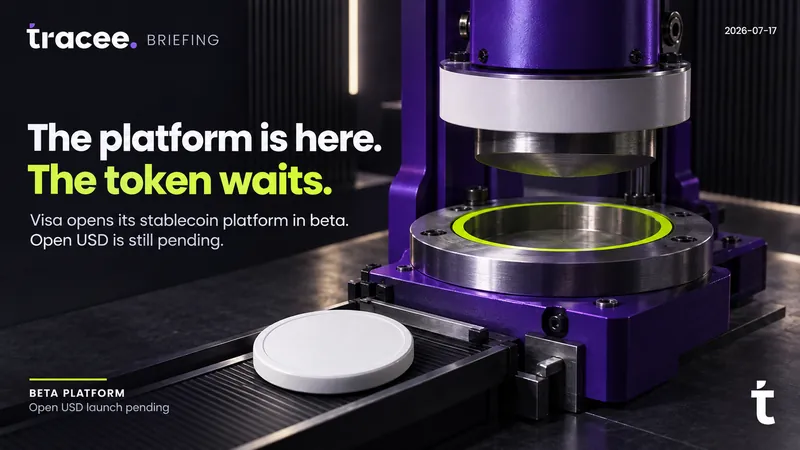
Open USD is not yet live; Open Standard has said its native Solana launch comes later in 2026.
Read briefing37 banks across 15 EU countries back Qivalis ahead of a second-half 2026 launch, with a DNB e-money licence still pending and Fireblocks as the infrastructure layer.
Read briefing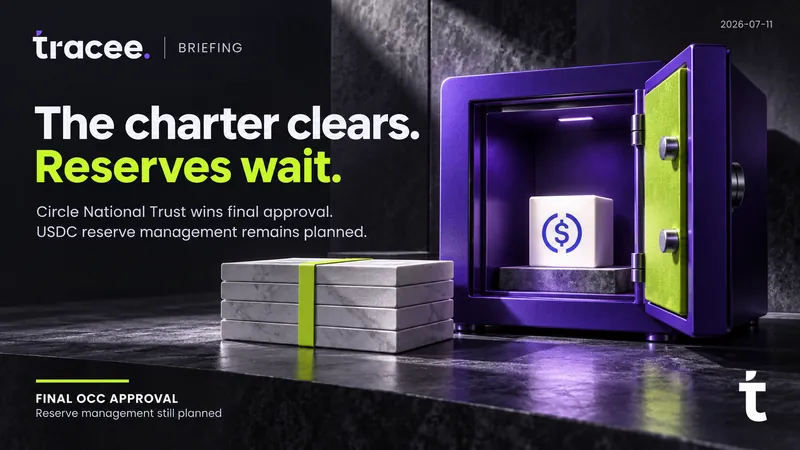
The new bank custodies digital assets for Circle and its own affiliates under direct federal supervision.
Read briefingOn June 16, 2026, State Street Investment Management launched SSCXX, a Rule 2a-7 government money market fund built explicitly as a GENIUS Act reserve management…
Read briefing
The Finland-based euro clearing business behind the raise is real and revenue-generating.
Read briefingSuggest a news item or request a private briefing.
Public briefings publish on no fixed cadence. Private briefings, written for one institution and one decision, are part of the consulting engagement formats.
Book a discovery call