
Bridge goes pan-European: Stripe's stablecoin platform collapses two EU licenses into one Luxembourg entity.
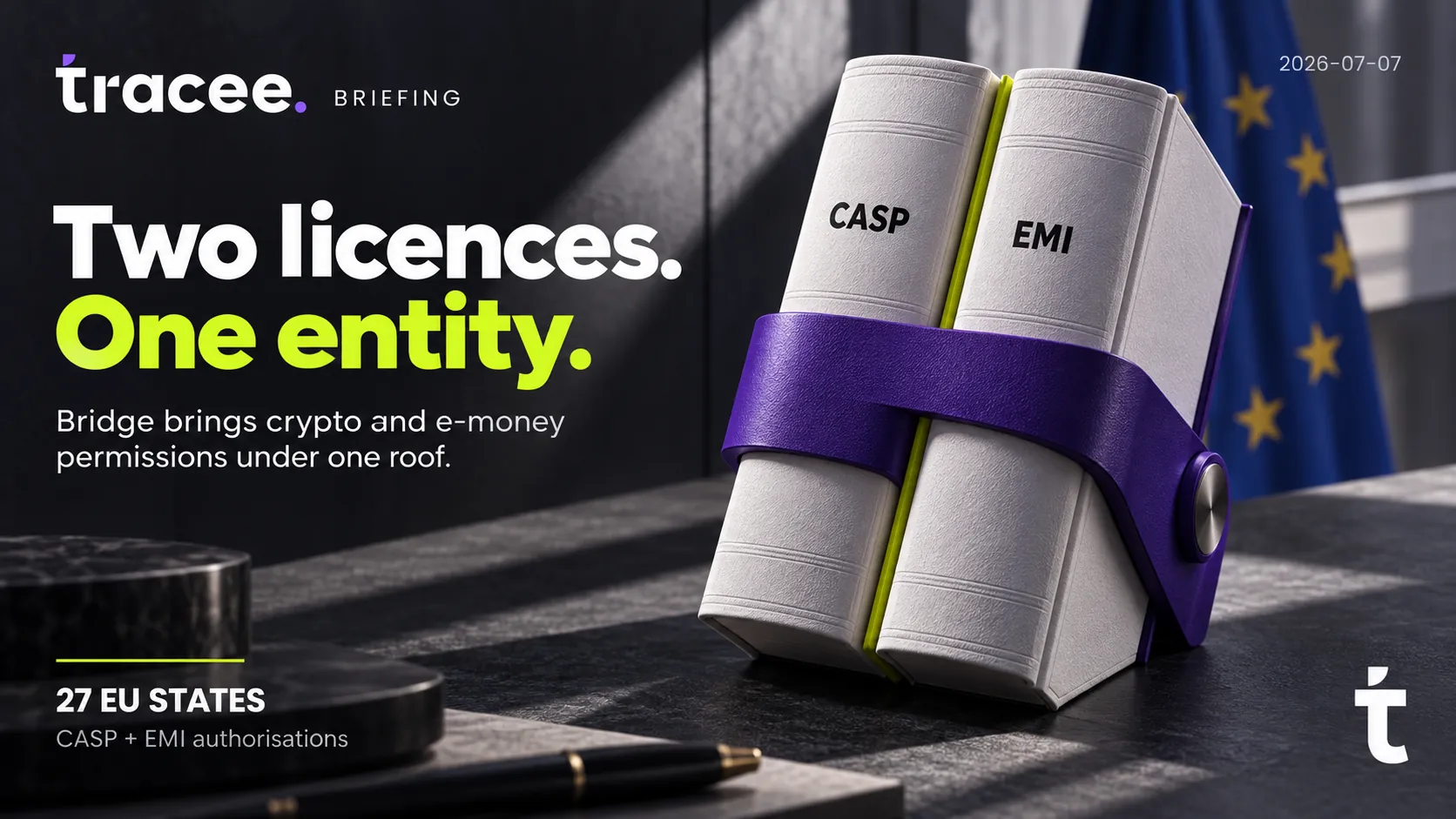
One Luxembourg filing, two regulatory relationships collapsed into one.
Two authorizations, one license holder: that pairing is the part of this announcement worth reading past the headline.
Five items, one of them is the wedge.
Luxembourg's CSSF issued two distinct authorizations to Bridge in the same filing. Rated against what each one actually changes:
| Move | Status | Verdict |
|---|---|---|
| MiCA CASP authorization | Shipped | Incremental. Luxembourg's CSSF has issued CASP authorizations to several stablecoin infrastructure firms this year, including a preliminary grant to Ripple on June 23. Bridge joins a queue that already exists; it does not open it. |
| EMI license, same entity | Shipped | The wedge. Most CASPs still route the e-money leg through a separate bank or partner EMI. Bridge now holds both authorizations itself, closing the gap that has kept stablecoin platforms dependent on a banking partner. |
| 27-state passport | Shipped | Meaningful. A single Luxembourg approval now covers every EU member state, replacing the country-by-country relationships a payments platform has historically needed to move euro-denominated funds. |
| Client-issued euro stablecoins | Exploring | Optionality. The license lets Bridge's business customers mint their own branded euro stablecoins on its rails. No client has named one publicly yet. |
| Visa card volume, now fully licensed | Shipped | Proof of demand. Visa's Bridge-powered stablecoin card program, live in 18 countries with a plan for 100-plus by year end, was already running the commercial volume this license formalizes. |
The first and fourth rows restate what the market already expected. The second row is the one that changes how a euro stablecoin platform gets built.
One entity, two licenses, twenty-seven markets.
Bridge's stack now runs both the crypto-asset leg and the euro cash leg from the same regulated entity, then passports the result across the bloc.
- The two licenses used to sit in different companies. Most CASPs pair with an outside e-money or banking partner for the fiat leg. Bridge now runs both ends of the pipe itself.
- The passport is the product. Twenty-seven separate market entries collapse into one Luxembourg filing, and that filing, not the underlying stablecoin technology, is the actual commercial unlock.
Three reasons this outranks a routine license grant.
One entity now replaces a network of partners. A stablecoin-payments platform serving the EU has typically needed a CASP registration for the crypto side and a separate bank or e-money partner for the fiat side. Bridge collapsing both into one Luxembourg entity means it no longer needs a banking partner to move euro balances at scale, the dependency that has capped how fast non-bank platforms could grow inside MiCA.
Bridge is infrastructure, not an issuer. The license does not put a Bridge-branded stablecoin into anyone's wallet. It lets any EU business mint one on Bridge's rails. That makes Bridge a horizontal layer competing for the same real estate as the bank-led tracks tracee has already covered: Qivalis's 37-bank coalition and Crédit Agricole's EURXT. Bridge is racing them from the infrastructure side, not the issuance side.
The timing is not incidental. The grant landed two days after MiCA's transitional period closed on June 30, and nine days after Ripple's preliminary CASP grant from the same Luxembourg regulator. CSSF is turning into the default venue for non-bank crypto infrastructure seeking bloc-wide passporting, the role Ireland has long played for payments EMIs.
The license is real. Five gaps separate the grant from a functioning euro stablecoin economy.
- "First" is not a confirmed claim. Coverage across outlets calls this a milestone, but none names a rival non-bank platform that already holds a MiCA CASP and an EMI license in the same entity. The absence of a named competitor is not proof Bridge is first.
- No stablecoin has shipped under the license yet. The authorization grants capacity. No Bridge client has been named building a branded euro stablecoin on it.
- Two rulebooks, one balance sheet. EMI status carries minimum own-funds and client-money safeguarding rules; MiCA layers custody segregation and reserve requirements for the crypto side on top. Bridge now answers to both regimes from a single entity, which raises its compliance surface rather than lowering it.
- Reserve composition of any client-issued stablecoin is unspecified. Crédit Agricole's EURXT and the Qivalis coalition have each published a reserve structure. Bridge's disclosures do not, because under this license the reserve backing sits with the business that mints the stablecoin, not with Bridge itself.
- A license is not distribution. Holding a CASP and an EMI authorization does not by itself win merchants, cards, or remittance corridors. Bridge already had commercial traction through Visa; the license protects that traction, it does not create new demand.
The euro stablecoin race now has three tracks, and Bridge just cleared the one no bank consortium has finished.
MiCA's transitional period closed on June 30, 2026, the deadline tracee covered in its June 24 ESMA briefing. Bridge's dual license is the first concrete institutional move by a non-bank payments platform in the week after that deadline, and it lands as the bloc's stablecoin infrastructure sorts into three distinct tracks.
Track one is the bank consortium: Qivalis's 37-bank coalition, still waiting on its own EMI license from De Nederlandsche Bank for an H2 2026 launch. Track two is single-bank issuance: Crédit Agricole's EURXT, issued through CACEIS on July 1 with an initial €20 million and a €10,000 minimum subscription tied to a tokenized Amundi money-market fund. Track three, the one Bridge just entered, is infrastructure providers licensing themselves directly rather than issuing a coin at all.
Ripple's preliminary CASP grant from the same Luxembourg regulator on June 23 is the closest parallel, though Ripple's filing does not pair an EMI license in the same move. If other non-bank platforms follow Bridge's CASP-plus-EMI structure instead of partnering with an outside bank, Luxembourg's CSSF becomes the default address for every payments company that wants the euro stablecoin market cleared in one filing rather than 27.
The stablecoin didn't change. The company that can legally move it across 27 states, did.
Bridge's dual license does not launch a new stablecoin and does not name a new customer. It removes the one EU regulatory reason Stripe's infrastructure still needed a banking partner to move euro balances at scale. That turns Bridge into a horizontal rail competing with the bank consortiums for who wires the euro stablecoin economy, not who issues it, and it does so from a single Luxembourg filing instead of 27 separate ones.
Watch three things:
- Which business names the first branded stablecoin built on Bridge's new license. That is the point this authorization stops being potential and becomes a product.
- Whether Circle, Ripple, or Paxos pursue the same CASP-plus-EMI structure in Luxembourg. A second filing turns this into a pattern instead of a one-off.
- Whether Qivalis secures its DNB EMI license before Bridge's infrastructure captures the volume the coalition was built to serve. The bank consortium and the infrastructure layer are now racing on the same clock.
Common questions about Bridge's MiCA and EMI licenses.
What did Bridge just receive from Luxembourg's regulator?
What does an EMI license let Bridge do that a CASP license alone does not?
Is Bridge launching its own euro stablecoin?
How does this relate to Visa's stablecoin card program with Bridge?
How does Bridge's move compare to the bank-led euro stablecoin efforts tracee has covered?
Where can I read the original source?
Related briefings on the same rails.
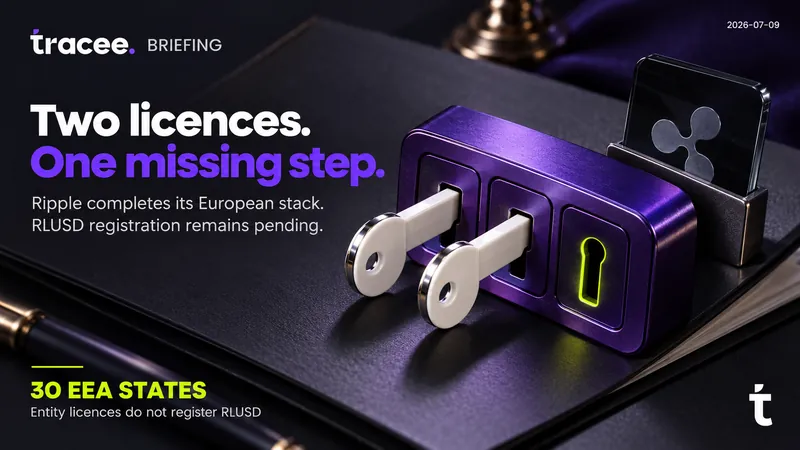
tracee's July 7 Bridge briefing flagged whether Circle, Ripple, or Paxos would pursue the same CASP-plus-EMI structure in Luxembourg.
Read briefing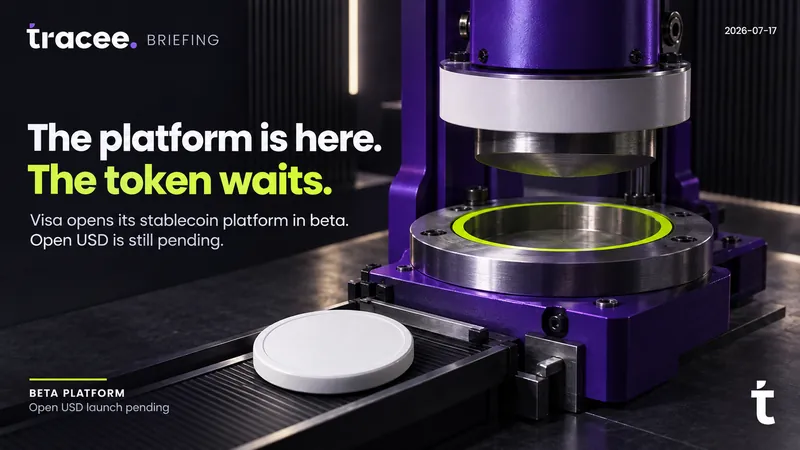
Open USD is not yet live; Open Standard has said its native Solana launch comes later in 2026.
Read briefing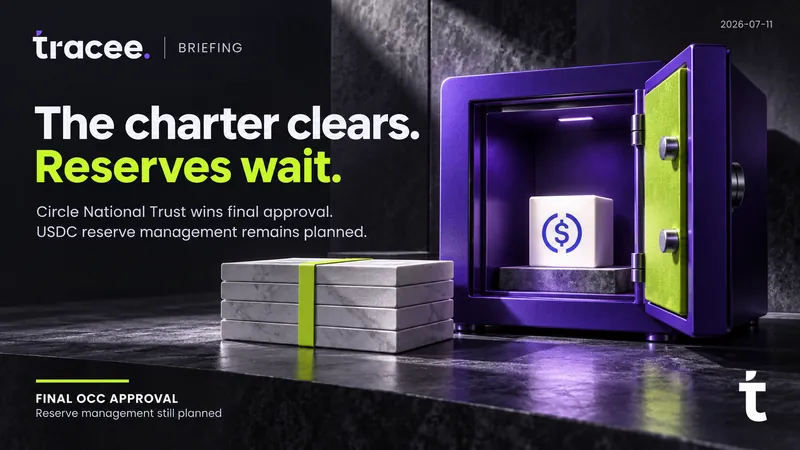
The new bank custodies digital assets for Circle and its own affiliates under direct federal supervision.
Read briefing37 banks across 15 EU countries back Qivalis ahead of a second-half 2026 launch, with a DNB e-money licence still pending and Fireblocks as the infrastructure layer.
Read briefingOn June 16, 2026, State Street Investment Management launched SSCXX, a Rule 2a-7 government money market fund built explicitly as a GENIUS Act reserve management…
Read briefing
The Finland-based euro clearing business behind the raise is real and revenue-generating.
Read briefingSuggest a news item or request a private briefing.
Public briefings publish on no fixed cadence. Private briefings, written for one institution and one decision, are part of the consulting engagement formats.
Book a discovery call