
SWIFT's blockchain ledger goes live with 17 banks across six continents: the messaging network adds a 24/7 tokenized deposit overlay, and final settlement still clears through the correspondent rails underneath it.
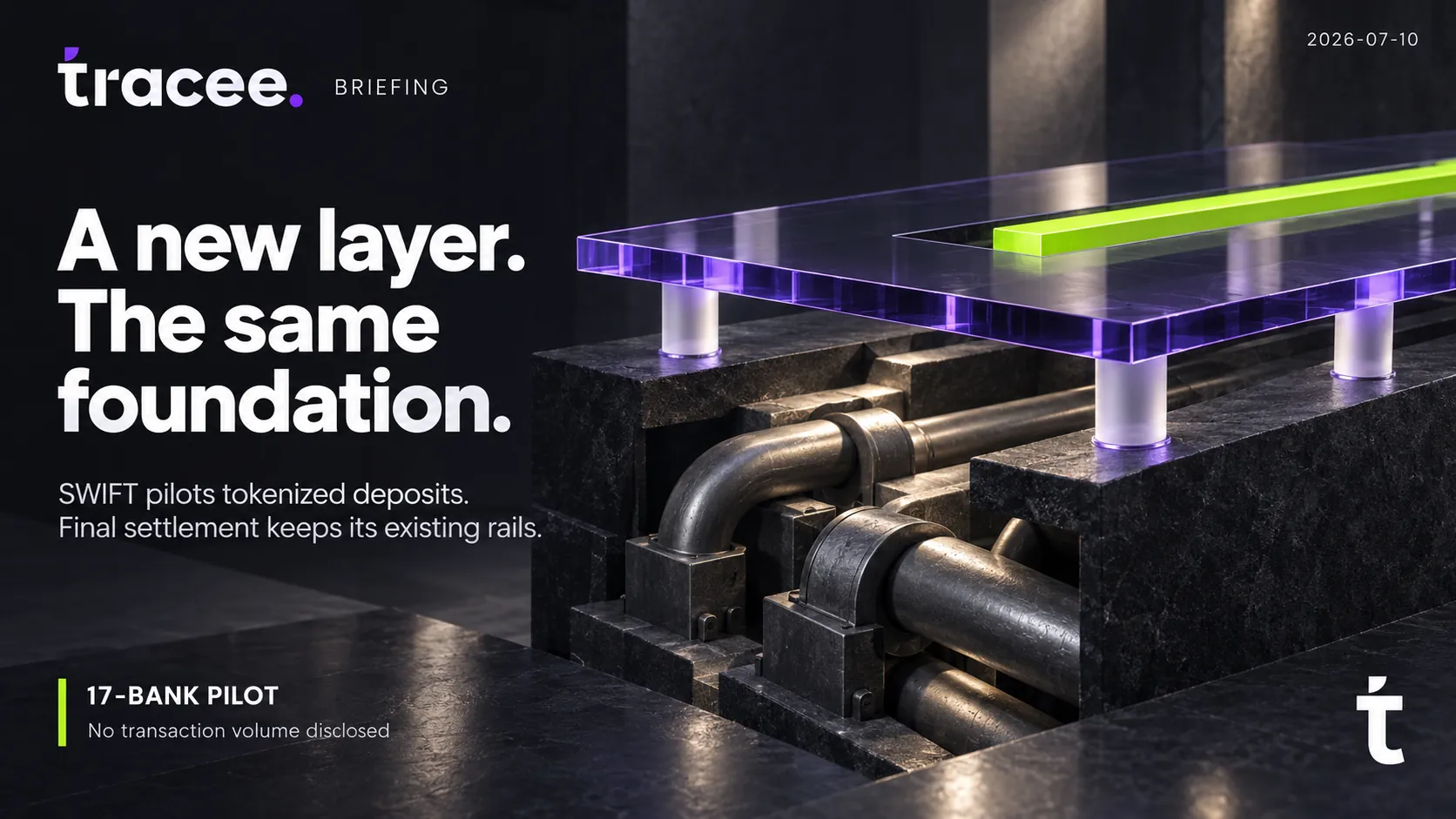
Nine months of development, and the fifty-year-old cooperative ships a blockchain network on schedule.
Nine months of development produced an overlay, not a replacement. That distinction is the whole briefing.
Five moves, and the one that would make this a settlement rail isn't shipped yet.
Rated against what each piece actually ships:
| Move | Status | Verdict |
|---|---|---|
| Blockchain ledger, initial use | Shipped | Real, but permissioned. Not public Linea. SWIFT operates its own enterprise network built on Linea-style zk-EVM architecture from Consensys. |
| 17-bank pilot, six continents | Shipped | Breadth, not depth. ANZ, BNP Paribas, BNY, Citi, DBS, First Abu Dhabi Bank, FirstRand, HSBC, Itaú Unibanco, Lloyds, Mashreq, MUFG, OCBC, Standard Chartered, UBS, UOB, and Wells Fargo signed on. No live transaction volume disclosed. |
| Chainlink CCIP interoperability layer | Shipped | The wiring choice. Connects the permissioned ledger to public and other permissioned chains, so tokenized deposits move without SWIFT bridging bilaterally to every counterparty network. |
| 24/7 tokenized deposit movement | Exploring | Liquidity, not settlement finality. Deposits move round the clock; the money behind them still clears through correspondent banking on its existing schedule. |
| Currency and corridor prioritization | Pending | Not yet scheduled. SWIFT says rollout will be phased with participant banks. No committed date or currency pair is public. |
The ledger and the bank list are real. The piece that would turn this into a settlement rail, rather than a faster way to move liquidity toward one, is not.
One new layer, bolted on top of the network SWIFT already runs.
The ledger does not sit underneath SWIFT's existing rails. It sits on top of them.
- The overlay sits above, not underneath. Tokenized deposits move on the new ledger; the money they represent still settles on the correspondent rails SWIFT already runs.
- Chainlink CCIP is the interoperability bet. It lets the permissioned ledger reach other chains without SWIFT building a bilateral bridge to each one.
Three reasons this is SWIFT defending its network, not disrupting it.
SWIFT is a messaging cooperative, not a settlement rail, and tokenized deposits threaten to route around the messaging layer entirely. Bank consortia building their own tokenized deposit networks, Partior (JPMorgan, DBS, Temasek) and The Clearing House's coming network among them, do not need SWIFT's instructions to move value once the asset itself lives on a shared ledger. Building its own ledger keeps SWIFT inside that conversation rather than watching banks settle around it.
The bank list is the signal, not the technology. HSBC, Citi, DBS, UBS, Standard Chartered, and Wells Fargo are also named in other bank consortia building competing rails. The same institutions hedging across multiple networks says more about where conviction actually sits than any single pilot does.
Nine months is fast for SWIFT specifically, a cooperative that has run its existing messaging standard for decades. Measured against dedicated blockchain infrastructure players like Partior or Fnality, which have iterated on live networks for years, the same timeline reads as a fast start on a long catch-up, not a lead.
The ledger is live. Four things it does not yet do.
- No live transaction is disclosed. Seventeen banks are named participants. A completed tokenized deposit transfer, cleared and settled through the ledger, has not been published.
- Final settlement still runs on the old rails. Liquidity moves 24/7 on the new ledger; the underlying money still clears through correspondent banking during existing settlement windows, per market participants close to the pilot.
- No currency or corridor has been prioritized. SWIFT says rollout will be phased with participant banks deciding which currencies and corridors go first. No committed date or pair is public.
- It competes with banks it depends on. Partior, Fnality, and The Clearing House's network share member banks with this pilot. SWIFT's ledger has to earn a place among rails its own members are separately funding.
Every 2026 tokenized deposit initiative runs into the same binding constraint: correspondent banking, not tokenization.
tracee's June 25 briefing on the BIS Annual Economic Report described a preferred architecture built on jurisdiction-specific wholesale ledgers layered with a shared ledger for tokenized commercial bank deposits. SWIFT's launch is the closest thing yet to that shared layer built by an institution its 11,000-plus member banks already trust, rather than by a new entrant asking them to onboard somewhere else.
tracee's June 30 briefing on JPMorgan's stablecoin-yield warning named The Clearing House's tokenized deposit network, targeting roughly 18 banks for a first-half 2027 launch, as the bank track's answer to stablecoin rails. SWIFT's pilot runs a similar bank count a year earlier and shares several names, Citi and Wells Fargo among them, handing those banks two competing bank-owned rails to weigh before either is fully live.
The constraint repeats across both projects and across the BIS architecture: the tokenization layer is the easy part. Correspondent banking, with its settlement windows and bilateral credit lines, is what every 2026 tokenized deposit initiative still has to move through, and none of them has replaced it yet.
SWIFT proved it can still ship. It has not yet proven the ledger settles anything faster than the network underneath it.
SWIFT's ledger proves a fifty-year-old cooperative can ship blockchain infrastructure in nine months, on schedule, with the banks that already trust it. What it has not yet proven is that tokenized deposits moving 24/7 on a new ledger settle any faster than money moving five days a week on the old one, because the settlement leg has not moved yet.
Watch three things:
- Whether a live, disclosed transaction clears through the ledger. The pilot bank list is not evidence of a working rail until one transfer, cleared end to end, is published.
- Whether SWIFT names the first currency corridor and priority banks for phased rollout. That is the point the ledger stops being a proof of concept and becomes a route someone actually uses.
- Whether The Clearing House's competing tokenized deposit network converges with SWIFT's ledger or stays a separate rail. Overlapping member banks cannot fund two winning rails indefinitely.
Common questions about SWIFT's blockchain ledger.
What did SWIFT just launch?
Which banks are piloting SWIFT's blockchain ledger?
Does this replace correspondent banking?
How does this compare to The Clearing House's tokenized deposit network?
Where can I read the original source?
Related briefings on the same rails.

Eighteen US banks, including all four systemic institutions, have committed to a shared tokenized deposit network operated by The Clearing House, targeting a…
Read briefing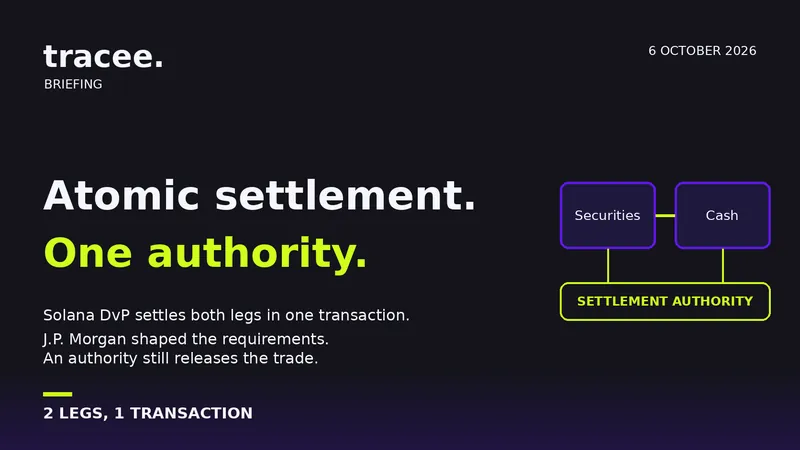
Solana DvP is an MIT-licensed, audited escrow that releases a securities leg and a cash leg in one transaction.
Read briefing
DBS and Citi settled a live USD payment via tokenized deposits on Swift's Digital Ledger in minutes on a Saturday.
Read briefingDigital Asset raised $355M led by a16z on June 11, with ADIA, Apollo, BNP Paribas, HSBC, Citadel Securities, and Tradeweb among 25-plus institutional investors.
Read briefingHIFI, DRW, and Marex completed the first competitive onchain repo on Canton on 17 June, settling U.S. Treasuries against USDCx in seconds with Tradeweb RFQ pricing…
Read briefingQuant was named vendor for the tokenized deposit network 25 US banks are building, closing the watchpoint tracee flagged in June. No blockchain has been named yet.
Read briefingSuggest a news item or request a private briefing.
Public briefings publish on no fixed cadence. Private briefings, written for one institution and one decision, are part of the consulting engagement formats.
Book a discovery call