
The US and UK publish a joint stablecoin roadmap: two treasuries agree on the reserve rule and leave the border in place.
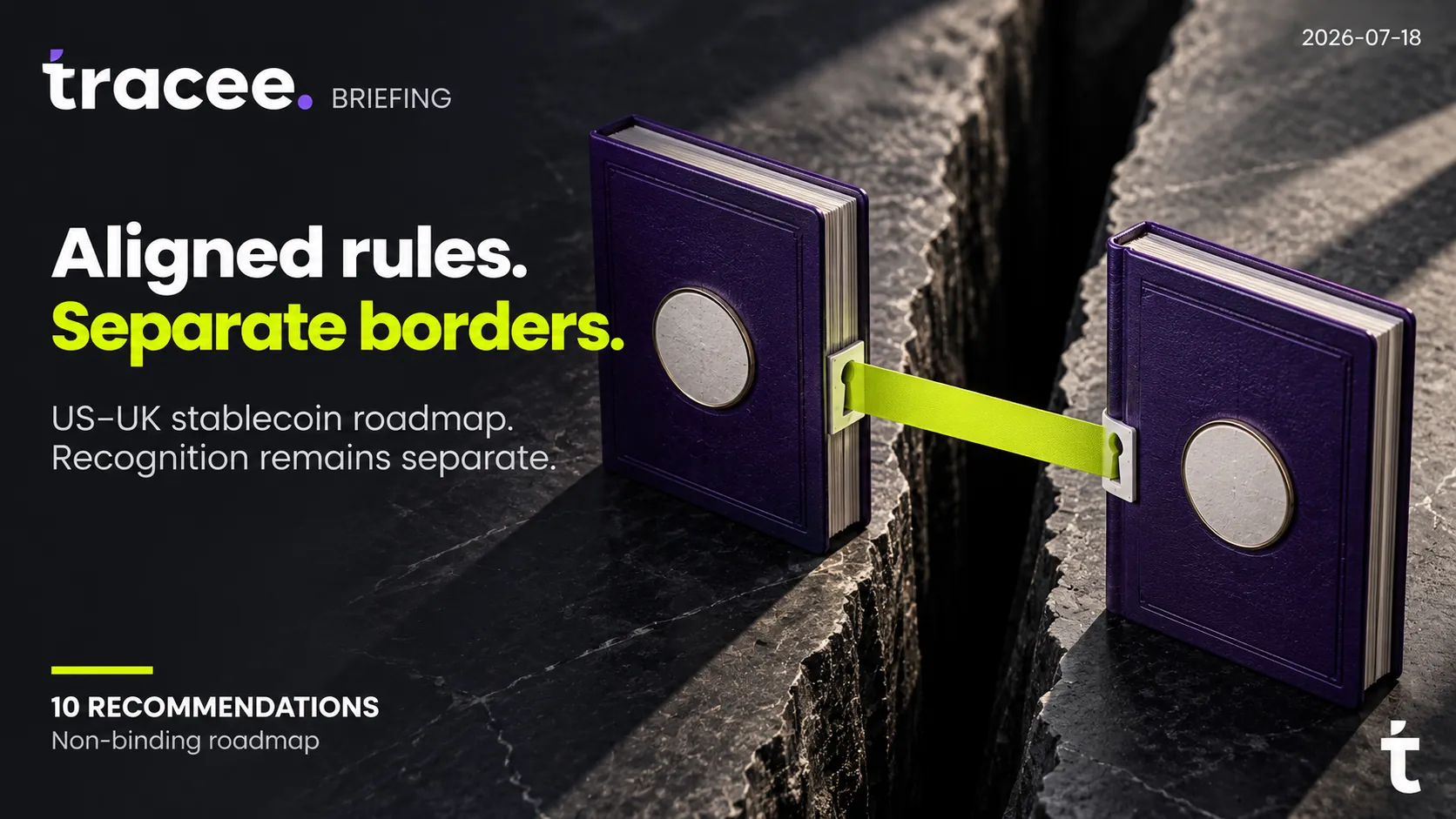
Two treasuries publish ten recommendations and a joint stablecoin statement, and neither country has to change a rule because of it.
Ten recommendations, one restated reserve standard, zero new law. The gap between those three is the briefing.
Four moves in one publication, and only one changes what a regulator has to draft next.
Rated against what each element actually commits either government to:
| Move | Status | Verdict |
|---|---|---|
| Ten-point Taskforce roadmap published | Shipped | Real, but a register. Five digital-asset and five capital-markets recommendations, none legally binding on either country. |
| Joint statement affirming 1:1 stablecoin backing | Shipped | Restates, does not create. GENIUS Act reserve rules and the Bank of England's June 2026 framework already require full backing in cash and HQLA. The two governments are agreeing they already agree. |
| Regulators told to align settlement finality and margin-collateral treatment | Exploring | The actual prize, unscheduled. The Bank of England, CFTC, FCA, and SEC are asked to seek common approaches, with no draft rule and no deadline attached. |
| Private-sector working group for cross-border tokenization pilots | Pending | Twelve months before anything ships. The group tests use cases and recommends standards; it does not implement them. |
One clause instructs regulators to draft something new. The rest documents positions both governments already held.
One taskforce sits on top of two rulebooks, and nothing underneath it merges.
Laid out top to bottom, the roadmap adds a coordination layer without touching either country's separate rulemaking track underneath it.
- The coordination sits above both rulebooks. Neither the GENIUS Act track nor the BoE/FCA track changes because of this publication.
- The missing layer is licensing, not backing. Reserve standards already matched before 14 July. What still splits the market is who gets to operate where.
Three reasons this is diplomacy doing a job legislation has not.
The reserve-standard alignment removes a real argument, even without new law. tracee's 4 July briefing on the IMF's fragmentation warning named the GENIUS Act's 100% T-bill requirement against MiCA's 60% bank-deposit floor as live evidence that tokenized finance was fragmenting by design, not accident. This roadmap does not touch MiCA. It does close the gap between the two largest stablecoin economies on the planet. That is smaller than a global standard and larger than nothing.
Recommendation 2 is where the actual money sits. Letting stablecoins and tokenized money market funds count as margin collateral at central counterparties would expand institutional demand well past the retail payment use case every prior briefing in this catalogue has actually been about. No draft rule exists yet, which is why the move is rated Exploring, not Shipped.
The working group buys a year, not a shortcut. Twelve months of testing "real-world cross-border tokenization use cases" produces recommendations for the next rulemaking cycle, not a live corridor in 2026. Treat the pilot mandate as a research grant, not a launch date.
The signal is real. Five things it does not establish.
- No mutual recognition. A stablecoin issuer licensed in one country still needs separate authorization in the other. UK Economic Secretary to the Treasury Lucy Rigby floated "forms of recognition or alignment" in May 2026, and this roadmap does not go that far.
- Nothing is binding. Each of the ten recommendations still routes through each country's own separate rulemaking process. The roadmap sets direction, not law.
- The reserve-backing convergence predates the roadmap. GENIUS Act rules and the Bank of England's June 2026 framework already matched on 1:1 HQLA backing before 14 July. The joint statement documents agreement; it does not manufacture it.
- Banking groups are already pushing back. Industry critics have warned the loosely worded cross-border provisions could accelerate deposit outflows from community and regional banks, the same pressure the ECB's Cipollone raised about Europe three days later, from the opposite side of the Atlantic.
- No named pilot, no named institution. The twelve-month working group has a mandate, not a member list or a first transaction to point to.
MiCA is not in this conversation, which leaves a third rulebook still unreconciled.
The Transatlantic Taskforce is a two-country instrument. tracee's 4 July briefing on the IMF's fragmentation warning named three settlement assets and three regimes competing for the same function: US stablecoins, EU e-money tokens, and tokenized bank deposits. This roadmap narrows the gap between exactly two of those regimes, the GENIUS Act track and the UK framework covered in tracee's 1 July briefing on the FCA's two-tier regime. MiCA's 60% bank-deposit floor for significant tokens is untouched by any of it.
The OCC's own GENIUS Act final rules are due the day after this briefing publishes, the same 18 July 2026 statutory deadline flagged as a watchpoint in four separate tracee briefings this month. Whichever version the OCC lands on now has a UK counterpart looking over its shoulder: a US framework that diverges from what Washington just told London it would build invites the same fragmentation the IMF warned about, inside the one bilateral relationship built to prevent it.
The roadmap is a floor, not a bridge.
The US and UK spent ten months of taskforce work to discover their stablecoin reserve rules already matched, then published that discovery as ten recommendations and a joint statement. It is the first government-to-government document treating GENIUS Act and Bank of England stablecoin rules as compatible rather than parallel, and Recommendation 2's push to align settlement finality and margin-collateral eligibility is the one clause with real institutional upside if regulators act on it. None of that is mutual recognition, none of it is binding, and none of it changes what a stablecoin issuer has to file to operate on both sides of the Atlantic tomorrow.
Watch three things:
- Whether the OCC's 18 July final rules diverge from anything this roadmap just committed to. The statutory deadline lands one day after this document published.
- Whether the working group names a first pilot institution and corridor inside its twelve-month window. A testing mandate is not a transaction.
- Whether Lucy Rigby's "forms of recognition" comment turns into an actual mutual-recognition proposal. That is the step this roadmap conspicuously skipped.
Common questions about the US-UK stablecoin roadmap.
What did the US and UK Treasuries announce on 14 July 2026?
Does the roadmap create mutual recognition between US and UK stablecoin rules?
What is Recommendation 2 of the Taskforce roadmap?
How does this connect to the IMF's tokenization fragmentation warning?
Where can I read the original source?
Related briefings on the same rails.

The IMF's contribution isn't new data. It is the first time a multilateral institution has placed tokenized deposits, stablecoins, and wholesale CBDC on equal…
Read briefing
South Korea's FSC unveiled a three-phase roadmap for tokenized securities, with legal recognition for institutional funds, bonds and unlisted shares effective 4…
Read briefing
The Fed proposed GENIUS Act reserve, capital and application rules seven months after the OCC and five after the FDIC. None of the three is final yet.
Read briefing
BMO, CIBC, National Bank, RBC, Scotiabank and TD signed a joint statement to explore a shared CAD tokenized deposit, with no platform, vendor or date named yet.
Read briefing
On 22 June, the Bank of England published its Policy Statement and draft Code of Practice for sterling systemic stablecoins, completing the reserve architecture the…
Read briefing
tracee's July 7 Bridge briefing flagged whether Circle, Ripple, or Paxos would pursue the same CASP-plus-EMI structure in Luxembourg.
Read briefingSuggest a news item or request a private briefing.
Public briefings publish on no fixed cadence. Private briefings, written for one institution and one decision, are part of the consulting engagement formats.
Book a discovery call