
Three settlement assets, no shared rulebook: the IMF warns tokenization could fragment global finance as easily as it unifies it.
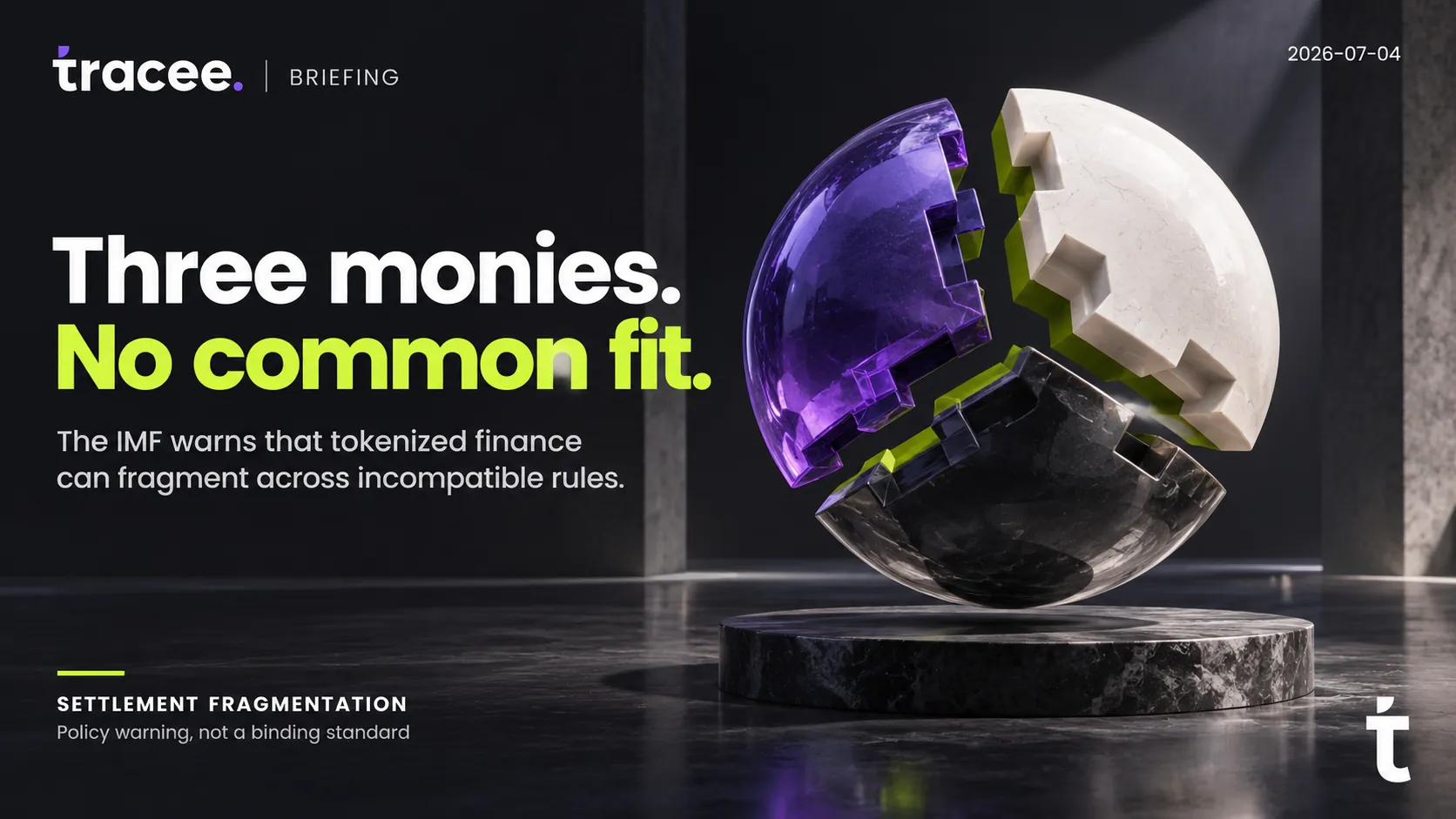
One blog post, three settlement assets, and a warning the IMF says depends entirely on what regulators do next.
Naming all three as rivals, not a public-versus-private choice, is the actual news.
Five moves define the note. Only one of them is a genuinely new argument.
Rate each claim by what the IMF actually delivered on 1-2 July, not by the word "fragment" in the headlines it produced.
| Move | Status | Verdict |
|---|---|---|
| A three-way settlement asset taxonomy: tokenized bank deposits, stablecoins, tokenized central bank reserves | Shipped | The genuinely new part. No prior IMF publication has rated all three architectures side by side. BIS's 23 June Annual Economic Report graded stablecoins alone against a three-property test. |
| Fragmentation warning: divergent national rules risk incompatible platforms and trapped liquidity | Shipped | A warning, not a finding. Adrian names the failure mode. The note does not quantify how much liquidity is already siloed or model a fragmentation scenario. |
| Procyclical liquidity risk: automated margin calls, instant redemption, and 24/7 settlement outrunning firms' liquidity management | Shipped | An old risk, a new trigger. Margin calls and redemption runs are not new to finance. Tying them explicitly to tokenized settlement speed is. |
| GENIUS Act vs. MiCA reserve divergence cited as live evidence of fragmentation | Shipped | Not new, just newly footnoted. tracee covered the same 100% T-bill versus 60% EU bank deposit split on 24 June. The IMF cites it; it did not discover it. |
| A named standard-setter, timeline, or binding rule to prevent the fragmentation it warns about | Pending | The part missing entirely. No mandate, no working group, no date, unlike BIS's Project Agora, already building with 8 central banks and 40-plus institutions. |
Four shipped claims and one open question. The open question decides whether this note ages into policy or into a citation.
One ledger technology produces three settlement assets. Each one is regulated on a different track.
Lay the IMF's taxonomy over the reserve rules already in force and the fragmentation risk stops being hypothetical.
- One ledger, three assets. Tokenization is a technology, not a settlement asset. Deposits, stablecoins, and wholesale CBDC are competing to do the same job, not variants of the same answer.
- The split in the diagram is already live. Circle running separate US and EU reserve pools is the exact incompatible-platforms scenario the IMF warns about, not a hypothetical.
Three reasons a scorecard from the IMF outranks one from any single regulator.
The three-way race finally has a referee, not just competitors making their own case. BIS's June chapter judged stablecoins against a singleness, elasticity, and integrity test. The Fed's CBDC ban committed the US to private stablecoins. The Bank of England built rules for its own tokenized-deposit and stablecoin regime. Adrian's note is the first to place tokenized deposits, stablecoins, and wholesale CBDC on the same page as rival architectures for the same settlement job, not one institution defending its own preferred model.
The fragmentation risk it names is already the reserve rulebook in force. GENIUS requires 100% T-bills and cash with no deposit floor. MiCA requires significant e-money token issuers to hold at least 60% of reserves in EU bank deposits. Circle now runs the two reserve pools separately to satisfy both. That is not a future risk scenario. It is the operating reality the IMF's warning describes in the present tense.
Naming the taxonomy is also naming the lobbying map. Every incumbent building tokenized deposits, every stablecoin issuer running GENIUS or MiCA reserves, and every central bank staffing a wholesale CBDC pilot now has an IMF citation to argue its own architecture is the one regulators should converge on, not fragment around.
The taxonomy is clean. Five things the note does not answer.
- No quantitative model. The note describes a fragmentation scenario. It does not estimate a probability, a trigger threshold, or a stress-test result.
- No enforcement mechanism. IMF Notes are not binding. The call for common settlement standards and cooperative oversight has no assigned standard-setter and no date, unlike BIS's Project Agora, already under construction with 8 central banks.
- The taxonomy doesn't call the winner. Tokenized deposits, stablecoins, and wholesale CBDC remain live candidates in every jurisdiction tracee tracks. The note describes the race; it does not settle it.
- The GENIUS/MiCA example is a citation, not a discovery. tracee flagged the same reserve split on 24 June. The IMF uses it as illustrative evidence of a risk it is already naming, not new information.
- The urgency is partly rhetorical. Central banks have debated tokenization's fragmentation risk since Project Agora launched in 2022. "Strengthens or fragments" sharpens the headline on the same multi-year argument.
Three national bets are already on the table. The IMF just put them on the same page.
The note lands nine days after the BIS's own Annual Economic Report chapter graded stablecoins against a singleness, elasticity, integrity test, covered in tracee's 25 June briefing, and a day after Crédit Agricole's CACEIS settled its first tokenized fund trade in a bank-issued euro stablecoin, covered 3 July. All three sit inside the same five-week run that produced the US ban on a Fed CBDC through 2030, covered in the 26 June briefing, the Bank of England's systemic stablecoin rulebook, covered 23 June, and MiCA's transitional deadline, covered in the 24 June briefing. The IMF's three-way taxonomy is the first to put all three national bets, US stablecoins, UK tokenized deposits, EU-leaning wholesale CBDC, on a single page as competing answers to the same question.
GENIUS's 100% T-bill and cash requirement and MiCA's 60% EU bank deposit floor for significant e-money tokens are not new rules; both were final by 22 June 2026. What the IMF adds is the explicit claim that this divergence is itself the systemic risk, not merely a compliance cost Circle absorbs by running two reserve pools.
The IMF didn't discover a new risk. It put a name on the one the market already lives with.
Adrian's note adds no new data. It is the first time a multilateral institution has placed tokenized bank deposits, stablecoins, and tokenized central bank reserves on equal footing as rival settlement assets, rather than judging one in isolation, and admitted the world has already chosen fragmentation over convergence: a US reserve rule built for T-bills, an EU reserve rule built for bank deposits, and an issuer, Circle, running both books at once because no shared standard exists to pick one. The "strengthens or fragments" framing sharpens an argument central banks have had since Project Agora launched, but the evidence behind it, GENIUS, MiCA, and Circle's dual reserve pools, is real and already in production.
Watch three things:
- OCC's GENIUS Act final rules, 18 July 2026. Sets whether the US reserve regime narrows or widens the gap with MiCA's bank-deposit floor.
- ECB's Pontes decision, Q3 2026. The clearest signal on whether the EU doubles down on wholesale CBDC as its answer to the IMF's taxonomy.
- DTCC's Canton go-live, October 2026. The first large-scale test of whether settlement can interoperate across more than one of the IMF's three asset types, or confirms the fragmentation it warns about.
Common questions about the IMF's tokenization fragmentation warning.
What did the IMF say about tokenization on 1-2 July 2026?
What are the three settlement assets the IMF named?
Is Circle really running two separate reserve pools?
How does this compare to the BIS's June 2026 report on stablecoins?
What would prevent the fragmentation the IMF warns about?
Related briefings on the same rails.
Japan's dominant tokenized securities platform exits R3 Corda and lands on Avalanche L1 in June 2026, making ¥439.6B in tokenized real estate and corporate bonds…
Read briefing
JPYSC's own issuer and co-developer had already committed the token to Startale's Strium L1 in June, and Progmat already moved more than ¥439.6B in tokenized assets…
Read briefingJLTXX, filed 12 May and effective 13 May, is J.P. Morgan's second tokenized MMF on Ethereum after MONY. The bank that argued in public for two years that deposits…
Read briefingSix actors decomposed: Ondo (issuer), Ripple (holder), XRP Ledger (venue), Mastercard MTN (orchestrator), Kinexys (cross-border cash rail), and two correspondent…
Read briefingFour moves stacked under one headline: two shipped (multichain expansion, DeFi composability via Uniswap and Euler), two exploratory (tokenized ETFs, staked ETH ETF…
Read briefing
ECB Executive Board member Isabel Schnabel drew a direct structural parallel between stablecoins and money market funds at the 2026 Bank of Korea International…
Read briefingSuggest a news item or request a private briefing.
Public briefings publish on no fixed cadence. Private briefings, written for one institution and one decision, are part of the consulting engagement formats.
Book a discovery call