
Singleness, elasticity, integrity: BIS names three structural failures in the $320B stablecoin market and draws the blueprint for what passes the test.
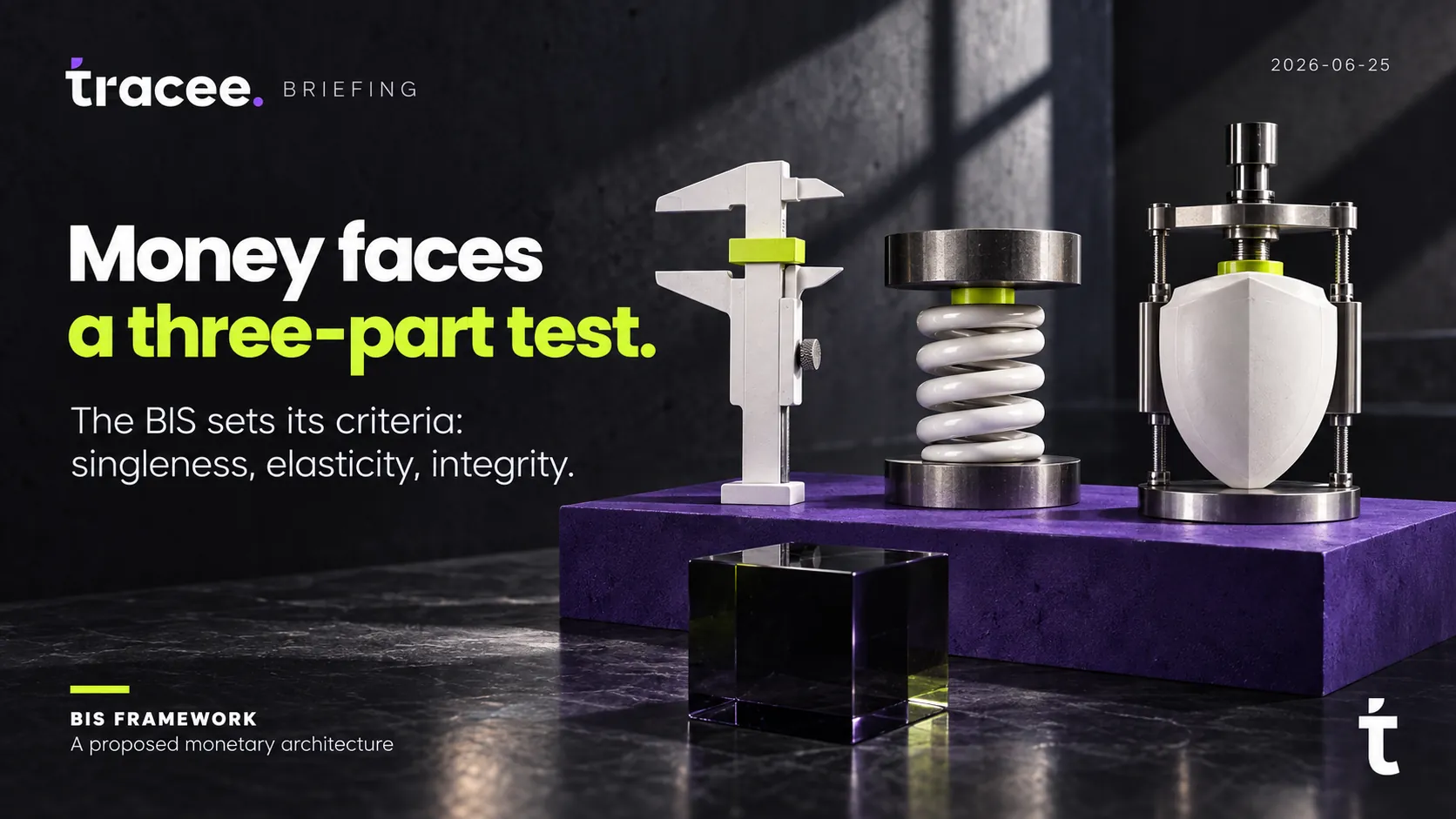
One paragraph from the annual report. A verdict every central bank governor signed off on.
The BIS Annual Economic Report is not a working paper. It is the multilateral consensus view of the institution whose board includes every G10 central bank governor.
Five moves, all published. The BIS sets a testable standard for sound money and names who fails it.
Chapter III of the 2026 AER does five things. The first two establish the test. The third names the preferred architecture. The fourth names the risk that justified the timing. The fifth names the live proof of concept.
| Move | Status | Verdict |
|---|---|---|
| Three structural flaws in current stablecoins named: singleness, elasticity, integrity | Published | A testable framework. Each flaw is a measurable failure condition, not a qualitative concern. Any new monetary instrument can now be assessed against the same three criteria. |
| Stablecoins explicitly do not qualify as sound money under the BIS framework | Confirmed | Not a policy preference. The BIS frames this as a technical failure: current stablecoin designs do not meet necessary conditions for the monetary role their proponents claim for them. |
| Unified ledger architecture proposed: tokenized commercial deposits (retail) plus jurisdiction-specific wholesale CBDC (interbank) | Proposed | Two-layer design. One shared ledger for tokenized commercial bank deposits across institutions. Separate, jurisdiction-specific ledgers for tokenized central bank reserves. Both layers interoperate to preserve par redemption. |
| Dollar dominance risk documented: approximately 99% of the $320B stablecoin market is USD-denominated | Documented | Sovereign pressure, named. BIS explicitly frames dollar-denominated stablecoin growth as a monetary sovereignty risk for non-dollar jurisdictions, providing a formal rationale for restrictive national frameworks. |
| Project Agorá named as proof of concept for the unified ledger architecture | Pilot: real-value stage undated | Controlled validation. Eight central banks and 40-plus private institutions proved atomic cross-border settlement under Phase 1. Real-value testing announced; date and currency pair undisclosed. |
All five moves are in print. The unified ledger is the only one that remains a proposal rather than a completed fact.
Two layers, one anchor. Central bank reserves underwrite commercial deposits, which carry retail payments.
The BIS preferred architecture separates the interbank settlement layer from the retail payment layer, connecting them through a structural par-redemption guarantee.
The muted layer is not a new criticism. It is the BIS translating three longstanding monetary science principles into a precise disqualification test for any instrument claiming the monetary role.
This is not one central bank's opinion. It is the shared analytical baseline every major regulator now works from.
The AER is the BIS's highest-authority publication. Working papers, quarterly reviews, and bulletins are staff analysis. The Annual Economic Report is the institution's official position: every G10 central bank governor sits on the BIS Board, and the AER represents their shared diagnostic view. When the BIS names three precise failure conditions for a $320 billion asset class, it is setting the terms on which every subsequent regulatory action will be evaluated.
The timing is deliberate. The chapter published June 23, six days before MiCA's transitional period closes on July 1 and 25 days before the OCC must publish GENIUS Act final rules on July 18. Three major stablecoin regulatory frameworks are in their final determination phase simultaneously. A BIS verdict at this moment is not coincidental. It is the most authoritative framing the central banking community can insert into that process without direct rulemaking authority.
The framework creates a structural asymmetry between jurisdictions. The BIS preferred architecture, tokenized commercial deposits anchored to central bank reserves, maps most closely to the EU and UK approaches: MiCA places 60% of EMT reserves in supervised EU bank deposits; the Bank of England's June 22 draft requires 30% in unremunerated central bank cash. The GENIUS Act is furthest from the preferred architecture: it treats private stablecoins as the primary monetary instrument, with reserve held in T-bills rather than anchored to central bank liabilities. The AER does not name the GENIUS Act. The implication is structural, not political.
The BIS names the architecture. It does not build it, fund it, or bind any regulator to adopt it.
- No enforcement authority. The BIS issues analysis, not rules. Chapter III does not oblige any jurisdiction to adopt the unified ledger, restrict stablecoin issuance, or incorporate the three-property test into national law. Each jurisdiction decides independently.
- The unified ledger does not exist at commercial scale. Project Agorá proved the concept in a controlled pilot with eight central banks. No live system currently implements the full two-layer architecture at transaction volumes comparable to existing stablecoin rails or card networks.
- The singleness critique applies most precisely to unregulated stablecoins. GENIUS Act compliant stablecoins address singleness partially: a licensed PPSI has a legal par-redemption obligation at issuance. The BIS framework requires structural par redemption as a property of the monetary architecture, not just a regulatory obligation. The distinction is consequential but the chapter does not fully engage with it.
- Tokenized deposits have their own unresolved problems. Legal finality across jurisdictions, deposit insurance portability, insolvency treatment for tokenized claims, and interoperability between different bank-issued deposit tokens are all unresolved. The chapter proposes tokenized deposits as the preferred retail layer without fully accounting for the governance and legal infrastructure they require.
- Wholesale CBDC timelines are multi-year. The preferred architecture requires jurisdiction-specific wCBDC ledgers as the settlement layer. No G10 central bank has a fully operational wholesale CBDC at the scale the architecture requires. The preferred path is architecturally correct and commercially unavailable simultaneously.
Three reserve frameworks, three reserve architectures. None of them is what the BIS prefers, and the gap is now on the record.
The 2025 BIS Annual Economic Report Chapter III first formalized the unified ledger concept and established the case for tokenization as a monetary system upgrade. The 2026 chapter intensifies the argument by naming specific disqualifications. The pattern is deliberate: each AER chapter builds on the last, constructing a multi-year intellectual foundation for a central-bank-anchored monetary architecture. The three-property test is the sharpest tool the 2026 chapter adds to that foundation.
The three-pole regulatory divergence reached its current configuration in the five weeks before this chapter published. MiCA's July 1 deadline locked a framework that requires 60% of EMT reserves in EU supervised bank deposits, the closest existing framework to the BIS preferred architecture. The Bank of England's June 22 draft Code of Practice requires 30% unremunerated central bank deposits, costing approximately 130 basis points per year at the current UK base rate. The GENIUS Act, whose final rules publish July 18, proposes 100% reserves in T-bills and cash, all yield-bearing, with stablecoins as the primary monetary instrument. The MiCA framework and the BoE framework are architecturally closer to the BIS preference than the GENIUS Act, but neither implements the full two-layer design.
The institutions building toward the BIS preferred architecture are not regulators. They are the 18-bank Clearing House tokenized deposit network targeting H1 2027, the DTCC October 2026 Canton go-live, and Project Agorá moving toward real-value testing. Each is building one layer of what the BIS chapter describes. None has committed to a timeline that delivers the full two-layer system at scale within the next 24 months.
The diagnostic is published. Three properties, one preferred architecture, three gating events that test it.
The BIS Annual Economic Report 2026 delivers the most authoritative multilateral verdict yet on monetary architecture: current stablecoins fail three necessary conditions for sound money, and the preferred replacement is a two-layer system of tokenized commercial bank deposits over jurisdiction-specific wholesale CBDC rails. That verdict does not bind any regulator, override the GENIUS Act, or accelerate the BoE's October 2027 authorization timeline. But it is the shared analytical baseline of every major central bank, and the three-property test will frame every significant regulatory proceeding on monetary instruments from here.
Watch three things:
- OCC GENIUS Act final rules, July 18. The US framework's treatment of stablecoins as the primary payment money layer is the first major regulatory position that explicitly diverges from the BIS singleness standard. The gap between the two architectures becomes measurable on that date, and the political pressure it creates on EU and UK rule-setters will be visible almost immediately.
- DTCC Canton, October 2026. DTCC's choice of cash leg instrument, tokenized deposit or stablecoin, is the first institutional-scale live test of the BIS architecture thesis. If DTCC selects a tokenized deposit instrument, the preferred architecture has its first large-scale endorsement from a systemically critical infrastructure provider.
- ECB Pontes, Q3 2026. The first commercial deployment of a wCBDC bridge connecting DLT settlement rails to central bank reserves. If Pontes launches on schedule, the BIS preferred architecture has its first live layer in Europe, and the unified ledger moves from concept to partial reality.
Common questions about the BIS Annual Report 2026 and the sound money test.
What is the BIS Annual Economic Report?
What are the three structural failures BIS identifies in current stablecoins?
What is the BIS unified ledger concept?
How does the BIS framework compare to the GENIUS Act?
What is Project Agora and how does it relate to the unified ledger?
Related briefings on the same rails.
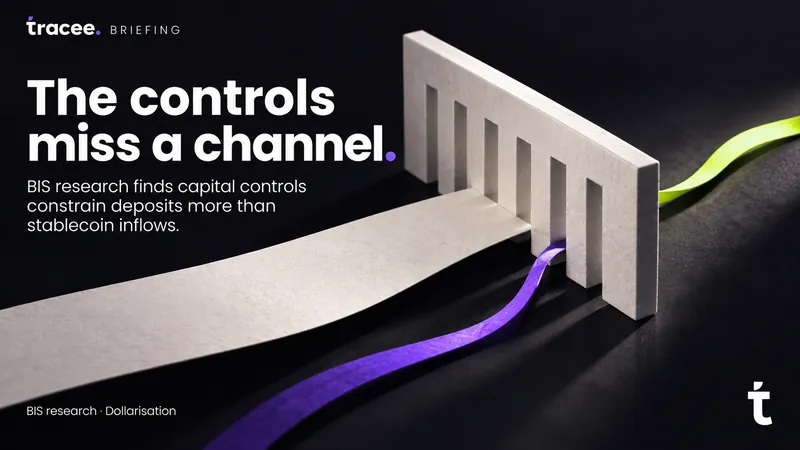
Countries requiring approval for residents to hold foreign-currency bank accounts show dollarization ratios 25 to 32 percentage points lower than countries without…
Read briefing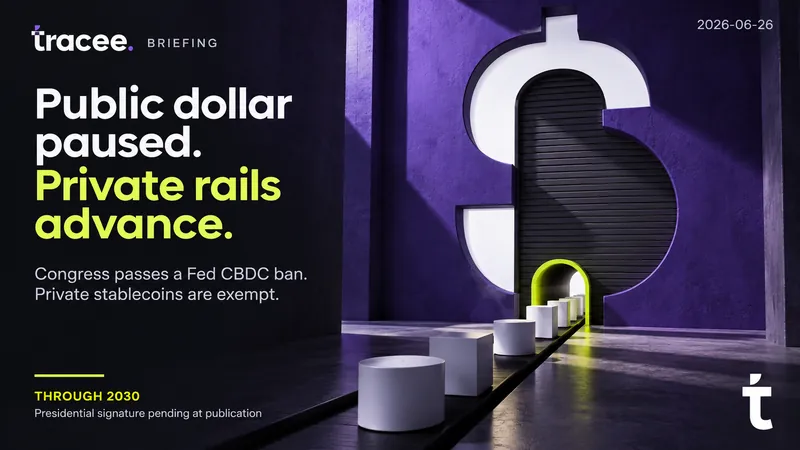
On June 22, 2026, the US Senate passed the 21st Century ROAD to Housing Act 85-5, with the House having cleared it 358-32. Buried in Section 1001: a four-year…
Read briefing
BIS General Manager Pablo Hernandez de Cos told the Fed's Jackson Hole symposium that stablecoins aren't credible as payment at scale, restating the BIS's own June…
Read briefing
21 banks, from Bank of America to MUFG, committed to build a jointly owned dollar stablecoin company, three days after the BIS told Jackson Hole that tokenized…
Read briefing
On 22 June, the Bank of England published its Policy Statement and draft Code of Practice for sterling systemic stablecoins, completing the reserve architecture the…
Read briefingOn June 16, China's e-CNY Centre International signed 26 institutions as CBETS direct participants for live cross-border digital yuan settlement in eight corridors.
Read briefingSuggest a news item or request a private briefing.
Public briefings publish on no fixed cadence. Private briefings, written for one institution and one decision, are part of the consulting engagement formats.
Book a discovery call