
The infrastructure thesis: Citi puts $5.5T on the table and hands the tokenization roadmap to DTCC, Nasdaq, and ICE.
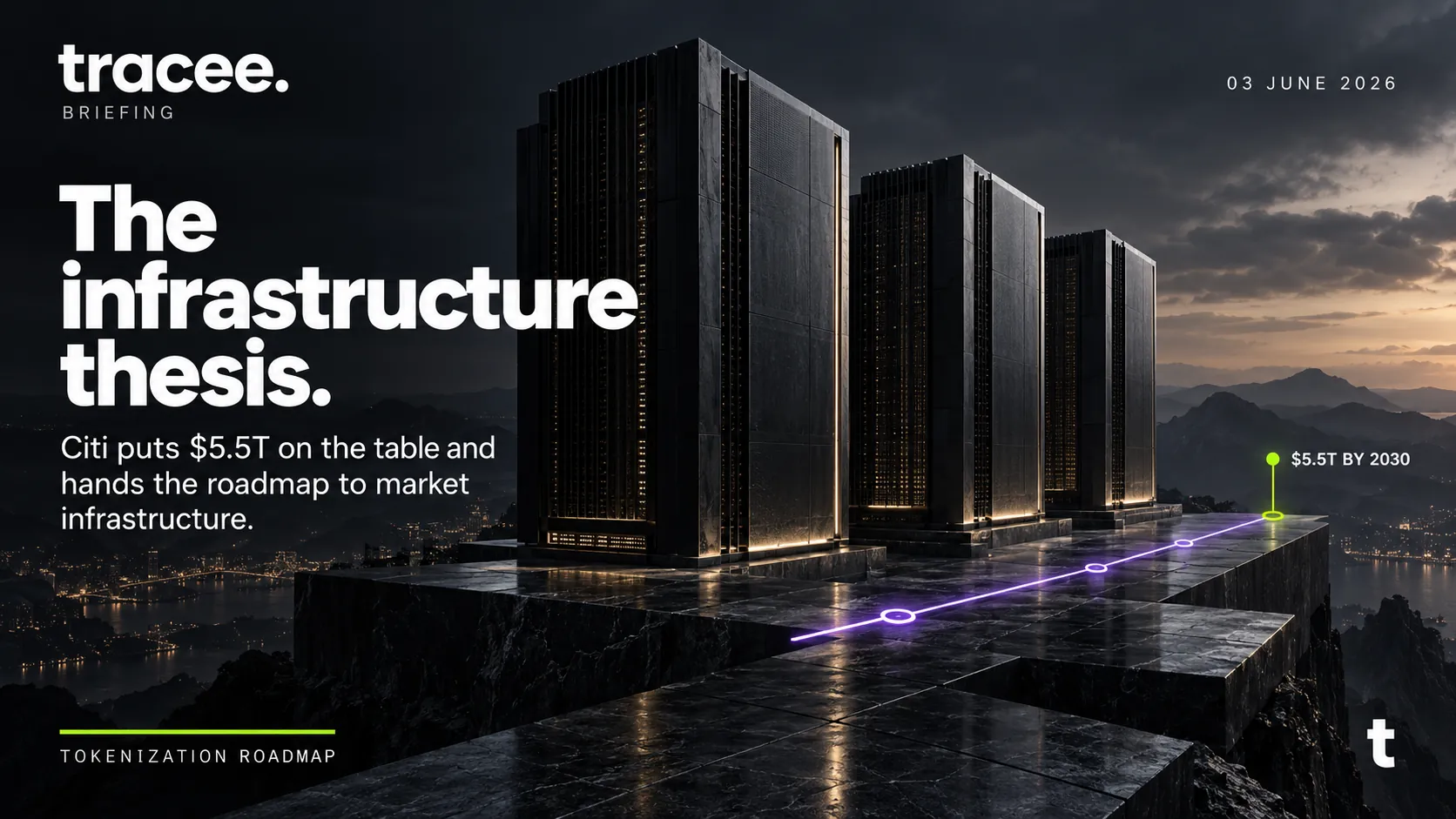
One report. Three infrastructure incumbents, one feedback loop, and one honest ceiling.
That paragraph contains the model's structural engine, its three infrastructure bets, and its most important honest admission, all in one place. The private market figures are where the admission lives.
Three projections are load-bearing. Two are honest about the ceiling.
| Claim | Status | Verdict |
|---|---|---|
| $5.5T base case for tokenized real-world assets by 2030 ($2.7T–$8.2T range) | Published | New reference figure. Sets the institutional consensus ceiling for tokenization conversations through 2027. Conservative relative to BCG ($16T) and Standard Chartered ($30T). |
| 10% US T-bill penetration, 3% US public equity, 5% MMF penetration assumed by 2030 | Published | Load-bearing assumptions. Each requires a separate regulatory gate: GENIUS Act OCC rules, SEC equity framework, DTCC go-live. Three simultaneous events, all dated in the next twelve months. |
| Stablecoin market reaches $1.9T by 2030, generating up to $1T in on-chain T-bill reserve demand | Published | The structural engine. Stablecoin growth is not a parallel story to tokenization. It is the primary demand driver for on-chain Treasuries and the feedback loop that validates the DTCC infrastructure investment. |
| DTCC (October 2026), Nasdaq, and ICE named as the infrastructure carriers | Published | The structural argument. TradFi incumbents, not crypto-native platforms, carry the tokenization market to scale. Crypto-native platforms are absent from the model. That is not an oversight. |
| Private credit and private equity capped at approximately $100B each globally | Published | The honest admission. Legal transfer restrictions, accreditation requirements, and LP governance rights persist on any chain. Tokenization solves the settlement problem; it does not solve the legal one. |
Rows one through three carry the headline. Rows four and five are the argument underneath it.
From $17B to $5.5T: two demand drivers, three infrastructure carriers, one feedback loop.
The Citi model has a structural sequence: stablecoin reserve demand generates Treasury tokenization volume, which validates DTCC infrastructure, which enables equity tokenization at scale. The private market tier sits outside the loop.
The feedback loop runs bottom-up: stablecoin growth drives Treasury tokenization demand, which funds DTCC's October launch economics, which enables equity tokenization. The private tier is outside the loop and properly capped.
The stablecoin-to-Treasury loop is the engine the report does not label by that name.
Stablecoin issuers hold reserves in short-duration US instruments. As the stablecoin market grows from $300B today to $1.9T by 2030, reserve demand grows proportionally. Citi estimates that growth alone generates up to $1 trillion in demand for on-chain US Treasuries. The GENIUS Act OCC rules (due July 18, 2026) and DTCC's October 2026 go-live are the two events that determine whether that demand materializes on-chain or continues to flow through the existing off-chain T-bill market. The sequence is mechanical: stablecoin regulation enables scale, scale demands reserves, reserves demand tokenized infrastructure, DTCC provides it. Four steps, four scheduled dates.
The private market ceiling is the most analytically honest part of the report. Private credit and private equity both cap at approximately $100B globally by 2030, despite widespread industry optimism about tokenized alternatives. Transfer restrictions on fund interests, accreditation requirements, capital call mechanics, and LP governance rights do not disappear when an interest is represented as a token. Tokenization solves the settlement and distribution problems of private assets. It does not solve the legal and governance problems. Citi is right to treat the private market case as a long-dated option rather than a near-term volume driver.
The model is mechanically sound. Every load-bearing assumption is a gating event with a scheduled date.
- GENIUS Act OCC final rules are due July 18, 2026. The stablecoin-to-Treasury feedback loop does not function at scale without the rule. If the OCC delays past the statutory deadline, the entire demand curve shifts right and the $1.9T stablecoin figure becomes speculative.
- DTCC's October 2026 Canton go-live is the single enabling event for equity tokenization. Without it, the 3% US equity penetration assumption has no settlement infrastructure to run on. One calendar event. One point of concentration risk in the model.
- $2.6T in retail digital equity demand assumes a 10% behavioral shift by 2030. No analogous mass migration has been established in any financial product transition at this speed. It is the most aggressive behavioral assumption in the model and the one with the least empirical precedent.
- Non-USD tokenized assets are absent from the model. The $5.5T figure covers US T-bills, US equities, and global private markets with no explicit treatment of European, Asian, or emerging market tokenized securities. Euro stablecoins at 0.3% of global volume will not be a demand driver in any scenario this model captures.
- The $17B baseline mixes access regimes. Current tokenized MMFs are restricted to accredited institutional buyers. Comparing that starting point to a retail-accessible $5.5T endpoint conflates two different investor populations and requires regulatory expansion of the eligible pool that the report assumes but does not model.
Three events in the next six months determine whether the Citi base case is a forecast or a ceiling.
The DTCC-Stellar briefing from May 27 laid out the architecture this report's equity numbers depend on: DTC custody unchanged, chain selection a distribution decision, 50+ firms including BlackRock, Goldman Sachs, and Ondo Finance building on the same service. Canton Network goes live for limited production in July 2026 and broader production in October. DTCC's July volume number, not the announcement, is the first real signal on whether the 3% equity penetration assumption has infrastructure underneath it.
The BIS Project Agorá finding from May 27 identified the cash leg as the structurally missing piece in cross-border atomic settlement. The stablecoin-to-Treasury feedback loop is precisely the mechanism that could provide that cash leg: stablecoin issuers holding on-chain Treasuries as reserves are already operating a programmable dollar settlement layer. When DTCC's asset leg goes live in October, the question of convergence between the two architectures becomes concrete. Neither Project Agorá nor DTCC has committed to convergence yet. That gap is not in the Citi model.
The SEC innovation exemption for tokenized equities, granted to Kraken, Coinbase, and Robinhood in May 2026, is a six-month bridge rule. It keeps crypto-native platforms in the digital equity market until DTCC's permanent infrastructure makes the exemption irrelevant. Citi's model bets on the DTCC settlement layer as the permanent winner. The exemption is not in the model because it is transitional, not structural. That read is correct.
The Citi number is not a prediction. It is a roadmap with three gating events, all scheduled in the next twelve months.
The arithmetic of the $5.5T base case rests on three events all dated before year-end: GENIUS Act OCC rules final by July 18, DTCC Canton equity settlement live in October, and at least one established retail platform creating the digital equity wrapper Citi's $2.6T retail demand number requires. If all three clear, the model's compounding dynamics are real and the figure could prove conservative. If any one slips, the demand curves recalibrate. The useful read of this report is not the headline number. It is the three-event checklist underneath it.
Watch three things:
- GENIUS Act OCC final rules, July 18, 2026. The stablecoin-to-Treasury loop requires compliant issuers at scale. The rule is the switch that enables the feedback mechanism the entire model depends on.
- DTCC Canton limited production volume, July 2026. First real equity tokenization settlement data. The number, not the announcement, is the signal. Low volume in July makes October's broader launch a political event, not a market one.
- Which retail platform creates the regulated digital equity wrapper. Robinhood, Fidelity, or Coinbase creating the retail-accessible tokenized equity product is the event that unlocks the $2.6T retail demand assumption. No such product exists today. Without it, Citi's largest single demand line has no distribution channel.
Common questions about the Citi Tokenization 2030 report and its projections.
What is the Citi Tokenization 2030 report?
How do stablecoins drive Treasury tokenization demand?
Why does the report cap private credit and private equity at $100B?
What does the GENIUS Act OCC rule have to do with tokenization?
Is $5.5T by 2030 a realistic forecast?
Related briefings on the same rails.
The SEC releases a conditional exemption for crypto-native platforms to offer tokenized US equities outside full broker-dealer registration.
Read briefing
DTCC named Stellar as the first public, permissionless blockchain for DTC-custodied securities on 27 May 2026, with availability targeted for H1 2027.
Read briefingBMO, CIBC, National Bank, RBC, Scotiabank and TD signed a joint statement to explore a shared CAD tokenized deposit, with no platform, vendor or date named yet.
Read briefing
21 banks, from Bank of America to MUFG, committed to build a jointly owned dollar stablecoin company, three days after the BIS told Jackson Hole that tokenized…
Read briefingJLTXX, filed 12 May and effective 13 May, is J.P. Morgan's second tokenized MMF on Ethereum after MONY. The bank that argued in public for two years that deposits…
Read briefing
The CFTC submitted RIN 3038-AF80 to the White House OIRA on 17 September, two days after the Senate's Clarity Act cloture vote failed 49-50. The rule text is…
Read briefingSuggest a news item or request a private briefing.
Public briefings publish on no fixed cadence. Private briefings, written for one institution and one decision, are part of the consulting engagement formats.
Book a discovery call