
The GENIUS Act rulemaking clock had no date on it for a month: the OCC just put one on the wall, November, and it still doesn't move January 18, 2027.
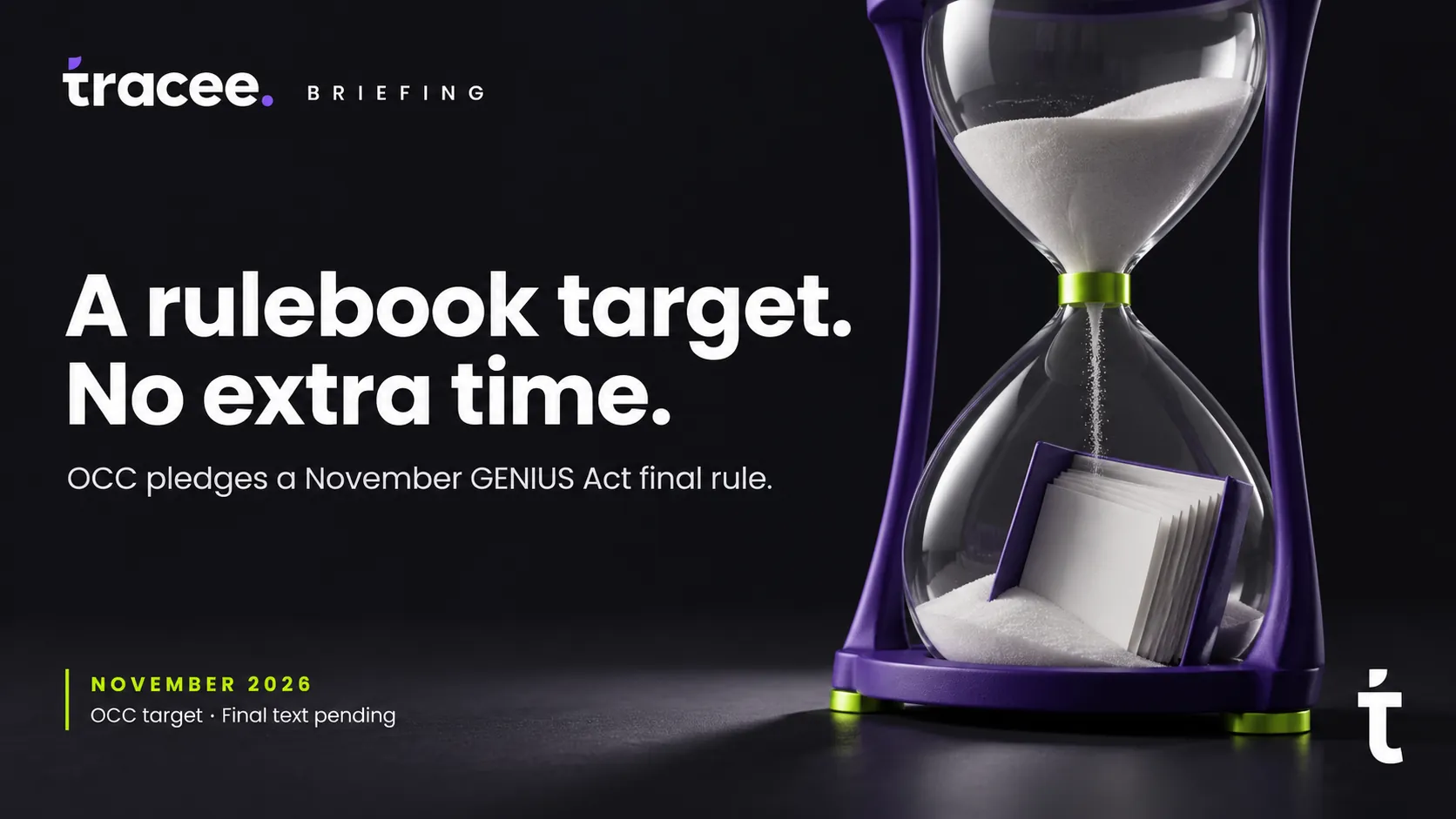
One fireside chat in Jackson Hole, and the first calendar month any regulator has named.
A month ago, no federal regulator had a final GENIUS Act rule or a public date for one. Now one of five does.
Rate the fireside chat against what actually changed on paper.
Gould's remarks bundled a rulemaking pledge with an unrelated charter-approval statistic. Separated out:
| Move | Status | Verdict |
|---|---|---|
| OCC names November for its final GENIUS Act rule | Shipped | The first date. No regulator had committed to a month before this; OCC's own July target had already slipped once. |
| January 18, 2027 compliance runway | Unchanged | Fixed by statute. A November rule cannot move a deadline the law already set as the earlier of two triggers. |
| FDIC, NCUA, Federal Reserve, and the FinCEN CIP rule | Pending | No matching date. Four of five required rulemakings remain proposals with no finalization month announced. |
| Eightfold rise in digital-asset charter activity | Shipped | Real, but OCC's own count. 23 of 40 charter applications since January 2025 involve digital assets, an OCC-selected comparison window. |
| Final rule text itself | Pending | Still doesn't exist. November is a spoken commitment, not a Federal Register filing. |
One credible new date, one unrelated statistic riding along with it, and four regulators still silent. The rulebook itself is still three months away at best.
Five regulators, five rulebooks, one effective date none of them controls alone.
Here is why OCC finishing early does not change when the GENIUS Act actually bites.
- Regulator speed cannot pull the deadline earlier. Only a rule finalized before roughly 20 September 2026 would make the 120-day clock beat 18 January 2027, and none has.
- Regulator delay cannot push it later either, past a point. Whatever OCC, FDIC, NCUA, and the Fed do, 18 January 2027 is the outer bound the statute sets.
November buys applicants a rulebook, not more time to read it.
The practical stakes sit with the OCC's own licensing pipeline. Thirteen digital-asset applications sit on its public tracker, including Payward National Trust Company, Revolut Bank US, EDX Trust, Agora National Trust Bank, and PAYO Digital Bank. Circle, Ripple, Paxos, BitGo, and Fidelity Digital Assets already hold conditional national trust charters granted since December 2025. Every one of them needs OCC's final permitted-issuer rule, not the proposal, to convert conditional status into something they can operate under past 18 January 2027.
A November rule is the difference between applying blind and applying with certainty. Gould's own framing, that OCC's stablecoin oversight mirrors its founding 1860s mandate to standardize the reserves behind bank-issued notes, signals the agency wants applications moving well before the compliance date, not filed at the deadline against a rule nobody has finished reading.
That distinction is also why the eightfold charter-growth figure Gould cited matters less than it sounds. It describes activity under proposed rules that could still change before November. The number that will actually matter is how many of the 13 pending applications convert to unconditional charters once a final rule exists to convert against.
One regulator spoke. Four things that pledge does not settle.
- November is a spoken pledge, not a filing. OCC's own original target, the statutory 18 July 2026 deadline, already slipped once; a fireside-chat commitment carries no penalty if it slips again.
- Four of five required regulators remain silent on timing. FDIC's subsidiary-issuance rule, NCUA's credit union standards, and the joint Federal Reserve and FinCEN Customer Identification Program rule are all still proposals with no announced finalization month.
- The eightfold charter figure is OCC's own comparison, not an audited statistic. It measures 23 of 40 applications since January 2025 against four years of the prior administration, a window OCC chose and reported on itself.
- Conditional charters are not final approvals. Circle, Ripple, Paxos, BitGo, and Fidelity Digital Assets hold conditional national trust status; none has converted to an unconditional charter, and OCC's final rule is a precondition for that conversion.
The same week Treasury priced Tether's gap, OCC is the regulator racing hardest to finish.
Per tracee's 20 July briefing, the GENIUS Act's one-year rulemaking deadline passed on 18 July 2026 with all five regulators still holding proposals. Tracee's 20 August briefing covered Treasury's separate proposal on who counts as issuing a stablecoin "in the United States," itself still a proposal, and noted Gould's November pledge in passing. This briefing is the dedicated read on that pledge and what it does and does not change.
The joint FinCEN, OCC, Federal Reserve, FDIC, and NCUA Customer Identification Program rule that tracee covered in its briefing on the GENIUS Act's KYC perimeter closed its own comment window on 21 August 2026, the same day as this briefing. That rule still needs to move from proposal to final text on its own separate track, unconnected to OCC's licensing rule.
Three dates now sit on the same calendar: the FinCEN-led CIP rule's comment window closed 21 August 2026, OCC's Gould has pledged a final rule by November, and the GENIUS Act's compliance runway ends 18 January 2027 regardless of either. None has moved without slipping once already.
This is progress on one rulebook. It is not progress on the deadline.
OCC is the first of five GENIUS Act regulators to put a specific month on its final rule, and the pledge is credible enough to plan around: it comes from the Comptroller himself, at a named venue, with an OCC press release behind it. But the statute's earlier-of trigger means January 18, 2027 was always the outer bound, and nothing OCC does in November moves it closer or further away. What November actually buys the market is a finished OCC rulebook to apply against, while FDIC, NCUA, the Federal Reserve, and FinCEN's joint rule remain open questions on the same clock.
Watch three things:
- Whether OCC actually ships a final rule in November, or slips a second time after missing its original July target.
- Whether FDIC, NCUA, or the Federal Reserve name a comparable date now that OCC has set a public precedent for doing so.
- How many of the 13 pending digital-asset applications convert to unconditional charters once a finished rule exists for OCC to approve them against.
Common questions about OCC's November GENIUS Act pledge.
What did OCC Comptroller Jonathan Gould actually announce?
Does a November final rule move the GENIUS Act's compliance deadline?
Have the other regulators also committed to a November date?
What did Gould say about digital asset bank charters?
Where can I read the original source?
Related briefings on the same rails.

Section 20's effective date, the earlier of 18 January 2027 or 120 days after final rules issue, is untouched by the miss.
Read briefingThe Fed proposed GENIUS Act reserve, capital and application rules seven months after the OCC and five after the FDIC. None of the three is final yet.
Read briefing
Treasury proposed a rule defining when a stablecoin is "issued in the United States" and "offered or sold" to a US person, borrowing from Regulation S and extending…
Read briefing
FASB's 18 August 2026 proposal would let stablecoins meeting a three-part redemption and reserve test sit on the cash-equivalents line, with comments due 19…
Read briefing
The Bank of England drops the £20,000 individual stablecoin holding limit in favour of aggregate issuance caps on providers, sets June 2026 for draft rules and…
Read briefing
South Korea's FSC unveiled a three-phase roadmap for tokenized securities, with legal recognition for institutional funds, bonds and unlisted shares effective 4…
Read briefingSuggest a news item or request a private briefing.
Public briefings publish on no fixed cadence. Private briefings, written for one institution and one decision, are part of the consulting engagement formats.
Book a discovery call