
Japan had the dollar framework: SBI issues the yen stablecoin and sits on both legs of Japan's on-chain FX corridor.
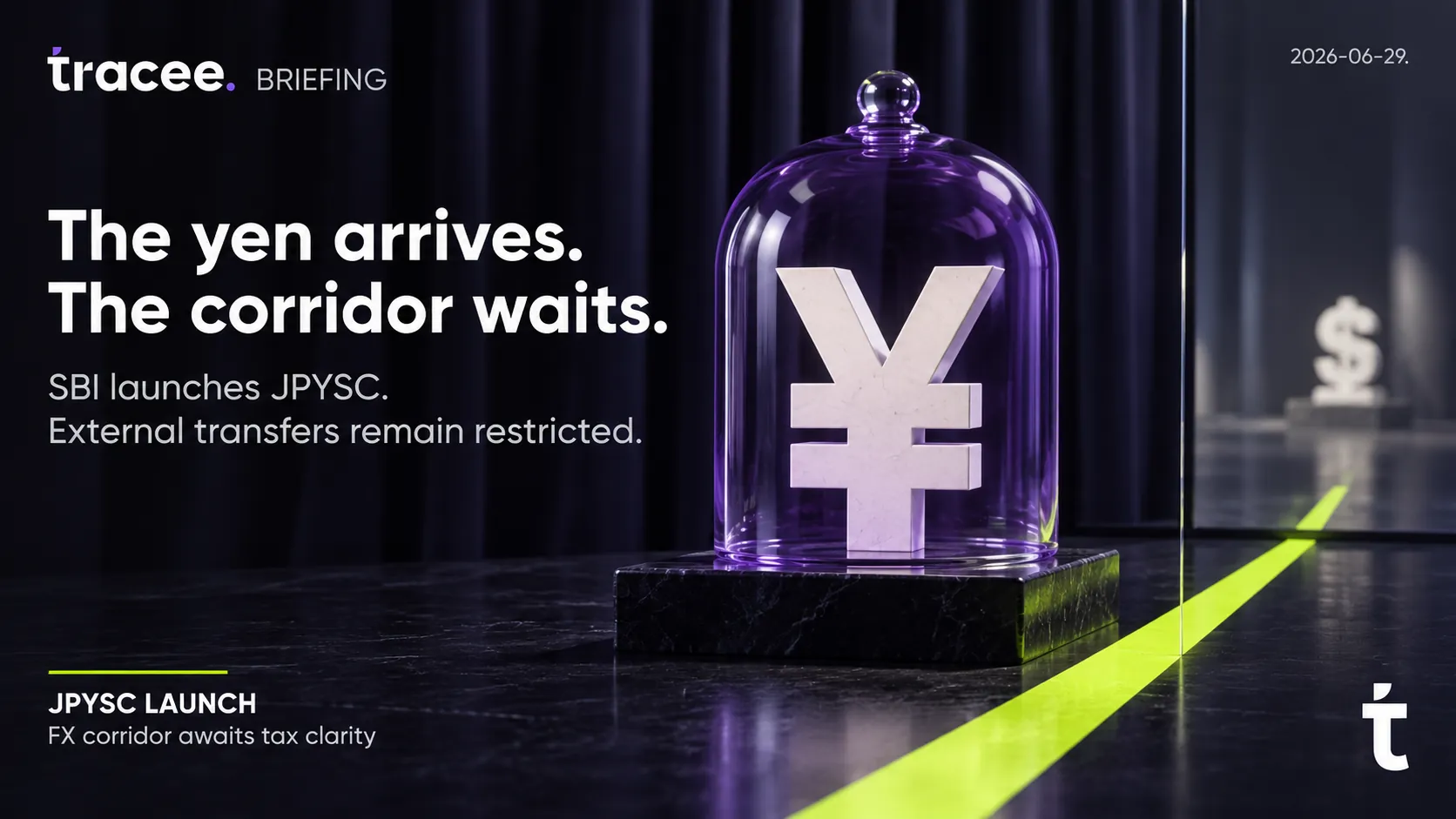
Three moves on one day. One of them closes the missing leg of Japan's stablecoin FX architecture.
The third sentence is the load-bearing one: SBI VC Trade is already Japan's sole registered EPSP for USDC distribution. JPYSC makes it the yen leg issuer at the same address.
Five moves in one announcement. Two are structural. Three are gated.
June 24 combined an issuance, a listing, an acquisition, a pending migration, and a stated future product in a single news day. Each item carries different execution risk.
| Move | Status | Verdict |
|---|---|---|
| JPYSC issued by SBI Shinsei Trust Bank as Japan's first Type III trust-type yen stablecoin | Shipped | The JPY leg is live. Trust law applies: full asset segregation, redemption rights, and up to 50% JGB allocation. The prepaid-type transaction cap is structurally removed. JPYSC is a different legal and financial object from every prior Japanese yen stablecoin. |
| RLUSD listed on SBI VC Trade as first JFSA-cleared foreign dollar stablecoin on a Japanese domestic exchange | Shipped | SBI holds both dollar stablecoins. SBI VC Trade now distributes USDC (sole EPSP, trust-type) and lists RLUSD (JFSA equivalence, Type 4). One regulated exchange controls the dollar-side stablecoin perimeter for all of Japan. |
| SBI Holdings acquires Bitbank for ¥46.7B ($289M), creating Japan's largest regulated crypto exchange | Announced | Distribution scale locked in. 2.92 million accounts, ¥1.1 trillion in assets under custody. The merged SBI entity leads bitFlyer and Coincheck by trading volume and account base. |
| JPYSC migration from Ethereum to Strium L1 public blockchain | Pending | Technically ready, legally blocked. Startale confirmed Strium L1 infrastructure is prepared. Japan's National Tax Agency has not clarified how stablecoin-to-stablecoin conversion is taxed. External wallet withdrawal is suspended until that guidance arrives. |
| JPYSC/USDC on-chain liquidity pools for yen-dollar FX | Exploring | Stated purpose, no product architecture. SBI named dollar liquidity pools as JPYSC's strategic objective. No trading mechanism, pricing model, DeFi protocol, or timeline has been announced. The tax blocker applies here too. |
The first two rows are facts on the ground. The last two are conditional on a tax ruling Japan has not yet published.
One group, two legs, one walled garden separating the corridor from the market.
Japan's on-chain FX stack now has both a yen instrument and a dollar instrument at the same regulated distribution point. The architecture of what SBI controls, and where the perimeter sits, is what matters.
- SBI sits on both legs of the corridor, but the corridor is not yet open. Distributing USDC and issuing JPYSC from the same group creates the necessary condition for yen-dollar on-chain FX. The sufficient condition is Japan's tax authority clarifying that converting JPYSC to USDC does not trigger a taxable disposal event.
- Startale Group holds the blockchain key. Strium L1 is an institutional blockchain purpose-built for tokenized asset settlement, co-funded by SBI ($50 million) and Sony Innovation Fund ($13 million). When the tax ruling arrives, the migration path from Ethereum to Strium L1 is pre-built.
The Type III classification is not a regulatory label. It is a different financial object that opens a yield channel the prepaid model cannot touch.
The structural difference between Type III and the prepaid-type stablecoin that preceded it is not subtle. Japan's prepaid electronic payment instruments, including JPYC, must hold all reserves in highly liquid bank deposits, cannot invest in JGBs, and carry a ¥1 million per-transaction cap designed to limit systemic exposure. JPYSC operates under trust law: assets are legally segregated in a trust structure with statutory redemption rights, the reserve allocation can reach 50% JGBs, and there is no transaction ceiling. At institutional scale, the JGB allocation is the relevant variable. A 50% JGB reserve generates yield that a prepaid stablecoin cannot produce, which means JPYSC can sustain a fee-free or near-zero-cost model for institutional users while the stablecoin earns on its reserve book.
The June 1 Payment Services Act amendment created two distinct trust-type categories, and JPYSC fills the one that was empty. The amendment's foreign stablecoin pathway (trust beneficiary right) allows USDC and RLUSD to operate under Japanese law via a registered EPSP. That is the dollar leg. The domestic Type III category, also introduced June 1, is the yen leg. Before June 24, no issuer had claimed it. JPYSC is the first production instrument to fill the domestic Type III category, converting the regulatory architecture from theoretical to operational.
The Bitbank acquisition is the scale multiplier. JPYSC and USDC access through SBI VC Trade is currently available to SBI VC Trade's existing account base. Once the Bitbank merger closes, the combined exchange serves 2.92 million accounts with ¥1.1 trillion in assets under custody, making it Japan's largest regulated crypto operator. That distribution base is what converts a stablecoin architecture into a commercially relevant FX platform, independent of whether the tax blocker resolves this quarter or next year.
The architecture is complete. The corridor is not open yet, and four gaps separate the design from the trade.
- The tax blocker is real and undated. Japan's National Tax Agency has not published guidance on whether converting JPYSC to USDC constitutes a taxable disposal. Until it does, institutional clients cannot execute yen-to-dollar conversions inside a stablecoin pool without incurring uncertain capital gains treatment. SBI cannot set a commercial launch date for its FX corridor product while this ruling is pending.
- JPYSC is in a closed loop at launch. No external wallet withdrawal, no DeFi access, no transfer to any address outside SBI VC Trade's permissioned system. This is not a soft constraint; it is the design boundary SBI chose pending regulatory clarity. The instrument is live and legal, but its utility is currently limited to SBI VC Trade account-internal movements.
- Strium L1 is not yet a live production blockchain. Startale describes the infrastructure as ready for JPYSC migration, but Strium L1 is still in pre-production phase. The migration timeline is coupled to both the tax ruling and Strium's mainnet launch, which makes the dependency chain two steps deep.
- The Progmat megabank consortium is building a competing yen stablecoin. MUFG, SMBC, and Mizuho signed an MOU in June 2026 to jointly issue a yen-pegged trust-type stablecoin via the Progmat platform, targeting March 2027. If that consortium selects a different blockchain, a different reserve structure, or a different distribution architecture, Japan's yen stablecoin market could fragment rather than converge on JPYSC.
- The ¥10 billion initial supply is orders of magnitude below the FX volumes that matter. Japan's daily FX market turns over $440 billion (BIS triennial data). JPYSC's ¥10 billion launch supply is approximately $62 million. Even with the Bitbank merger, institutional FX use cases require supply measured in trillions of yen to be commercially relevant as a settlement instrument.
Japan is building its stablecoin stack from both ends simultaneously, and the October working group report will decide which yen instrument connects to which dollar rail.
Three briefings now map Japan's on-chain monetary architecture. The June 9 Japan PSA briefing decoded the regulatory framework that created the Type III and foreign trust-type categories. The June 28 Circle-Nomura briefing decoded the institutional FX commitment: Nomura taking the USDC dollar leg to 80,000-plus corporate clients, once its EPSP registration clears. JPYSC completes the picture: the yen leg is now issued, regulated, and sitting at the same exchange that already distributes the dollar side.
The competitive frame is the Progmat megabank consortium. MUFG, SMBC, and Mizuho are building a yen stablecoin on Progmat targeting a March 2027 launch, with a blockchain decision expected in October 2026. That October working group report, identified in the June 7 JGB repo briefing as the cash-leg decision point for the JGB repo market, is now also the competitive selection event for Japan's yen stablecoin standard. If the megabanks choose JPYSC-compatible rails, SBI's architecture becomes the interoperability standard. If they choose a different instrument, Japan's yen stablecoin layer could operate as two separate standards with no automatic conversion between them.
The international context is the BIS Annual Economic Report Chapter III (June 23, covered in the BIS stablecoins briefing), which identified Japan's dual-layer architecture (central bank reserves plus commercial bank deposits) as the structural model. JPYSC's JGB reserve allocation sits precisely at the intersection the BIS describes: commercial bank trust money backed by sovereign instruments, not central bank liabilities. The question the BIS raised (who controls the money if the issuer runs?) is answered by trust law here: SBI Shinsei Trust Bank's trust structure segregates assets from the issuer's balance sheet. That is the architectural answer to the BIS critique of commercial stablecoins without trust-law backing.
The yen leg is live. Now watch the tax ruling, the Progmat choice, and whether the corridor opens before March 2027.
JPYSC is the instrument Japan's regulatory architecture made possible on June 1 and SBI activated on June 24. It is not a retail payment token; it is the institutional yen leg of an on-chain FX corridor that SBI has spent the past month positioning to control from both ends. The Type III trust classification, the JGB reserve allocation, the absence of a transaction cap, and the explicit intent to pair JPYSC with dollar stablecoins in liquidity pools: these are architectural choices, not product features. SBI now distributes USDC as Japan's sole trust-type EPSP, lists RLUSD as the first JFSA-cleared dollar stablecoin, and issues JPYSC as the yen counterpart. Japan's stablecoin FX stack is structurally in place. What is missing is the tax ruling that would allow the two legs to trade against each other on-chain, and the Progmat megabank decision in October 2026 that will determine whether that stack becomes a standard or the first of two competing ones.
Watch three things:
- Japan National Tax Agency guidance on stablecoin-to-stablecoin conversion. This is the single gate between JPYSC as a closed SBI VC Trade instrument and JPYSC in an active yen-dollar liquidity pool. The ruling date, the tax treatment model (disposal event or currency conversion), and any holding-period conditions will set the commercial launch timeline for every yen-dollar on-chain FX product in Japan, not just SBI's.
- Strium L1 mainnet launch and JPYSC migration. Startale Group has confirmed the infrastructure is ready. The transition from Ethereum to Strium L1 will determine whether JPYSC can reach institutional counterparties outside SBI VC Trade's permissioned environment. The launch date and the migration mechanics will also reveal whether Strium L1 can handle the transaction volumes required for institutional FX settlement.
- Progmat megabank consortium cash-leg and blockchain decision (October 2026 working group report). MUFG, SMBC, and Mizuho will name their yen stablecoin blockchain, reserve structure, and conversion architecture in October. If their design is compatible with JPYSC, SBI's two-leg position becomes the connective tissue of Japan's stablecoin settlement layer. If it is not, Japan enters 2027 with two parallel yen stablecoin standards and no clear dominant architecture.
Common questions about JPYSC and Japan's yen-dollar stablecoin corridor.
What is JPYSC?
How does JPYSC differ from JPYC?
Why does it matter that SBI distributes both JPYSC and USDC?
What is Startale Group's role?
Is JPYSC freely usable?
What else happened on June 24?
Related briefings on the same rails.
Japan's amended Payment Services Act creates the most portable regulatory framework for foreign stablecoins yet built in the G7: no domestic entity, no domestic…
Read briefing
Japan's dominant tokenized securities platform exits R3 Corda and lands on Avalanche L1 in June 2026, making ¥439.6B in tokenized real estate and corporate bonds…
Read briefing
The Circle-Nomura MOU is the first institutional-grade commitment to use USDC as an FX settlement instrument in Japan, not as a retail payment token.
Read briefing
The FCA's 30 June rules and the Bank of England's 22 June rules are two tiers of one UK stablecoin regime, not two separate regimes.
Read briefing
Standard Chartered did not build a stablecoin. It built the first G-SIB-grade door into one, folding the second account institutional clients used to need with…
Read briefing
EURXT is not built to trade. It is built to settle CACEIS's own tokenised fund subscriptions, giving it captive volume from day one that SG-FORGE's EURCV and…
Read briefingSuggest a news item or request a private briefing.
Public briefings publish on no fixed cadence. Private briefings, written for one institution and one decision, are part of the consulting engagement formats.
Book a discovery call