
Stablecoin Ramp Architecture.
How on-ramps and off-ramps are built: who holds the money, controls the keys and bears the risk.
Author Bassel Assaad, PhD PDF For banks, payment institutions and fintechs
Free during the launch only. The booklet will be paid afterwards.
Three questions decide every ramp.
-
01
Who is the trading counterparty?
It decides where market and settlement risk sit, how the operator earns and which licence family applies.
-
02
Where is the fiat, and whose money is it?
Operator money or client money. The account chosen decides the licence and what the bank must accept.
-
03
Who controls the crypto, and for whom?
Whoever can move the asset without the customer is usually its custodian, the most demanding authorisation a ramp may need.
Every model in the booklet is answered against these three.
See inside.
Four real pages, shown in part. The rest is in the PDF.
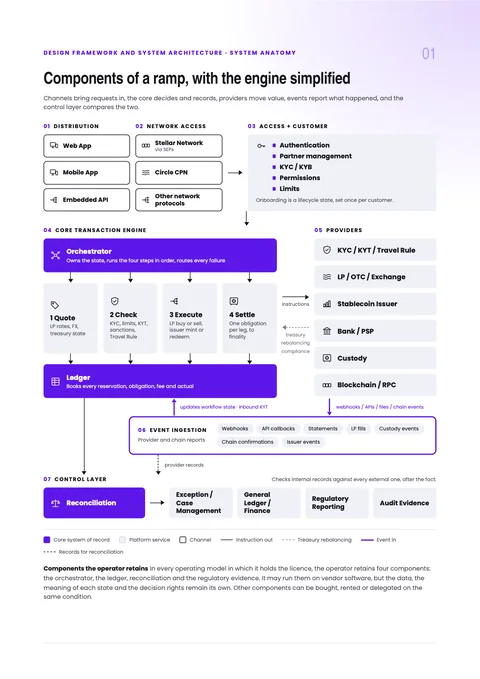
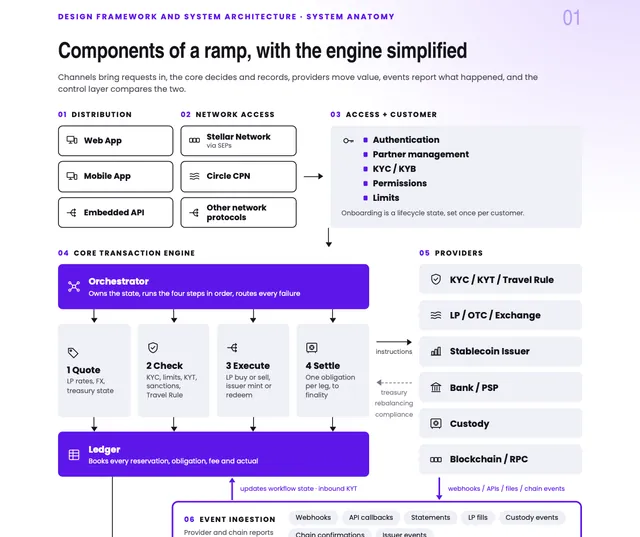
System anatomy
Every component of a ramp on one page. Where the operator holds the licence it keeps four of them: the orchestrator, the ledger, reconciliation and the regulatory evidence.
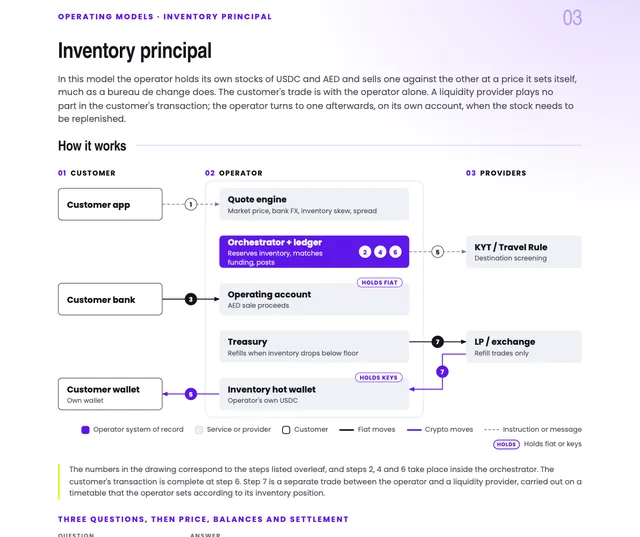
One model: inventory principal
The operator sells USDC from its own stock at a price it sets, much as a bureau de change does, and refills from a liquidity provider later. Each of the five models is laid out this way.
One trade, four ways
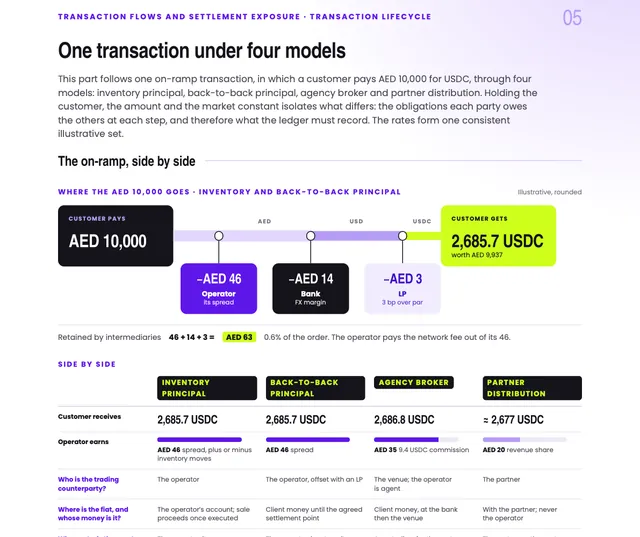
A customer pays AED 10,000 for USDC under four models and receives between about 2,677 and 2,686.8 USDC. The page shows who owes whom at each step, and who carries the settlement risk.
Providers map
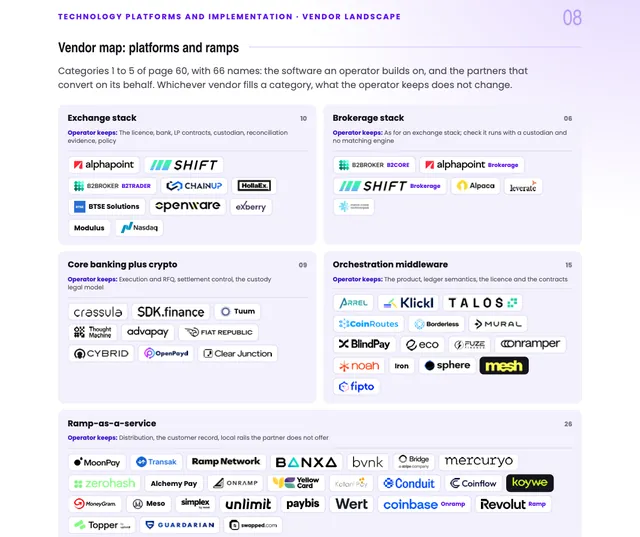
66 named vendors in five categories, from exchange and brokerage stacks to ramp-as-a-service partners, each with what the operator keeps. A stack leaves the regulated work with the operator; a ramp partner takes it on.
What's inside.
- 01 Design framework and system architecture: Design questions, regulatory tests, the records that must agree and the system anatomy.
- 02 Legal roles and asset control: Who is the trading counterparty, where the fiat sits and whose money it is, and who controls the crypto.
- 03 Operating models: Inventory principal, back-to-back principal, agency broker, trading venue and partner distribution.
- 04 Operating configurations: Configuration fields, custodial accounts, institutional arrangements and common combinations.
- 05 Transaction flows and settlement exposure: On-ramp and off-ramp lifecycles, quote acceptance, funding workflows, ownership and settlement exposure.
- 06 Core infrastructure and controls: Banking and client money, wallets, liquidity, off-ramp treasury, ledger, reconciliation and financial-crime controls.
- 07 Architecture selection: Decision tree, selection criteria, hybrids and alternative designs.
- 08 Technology platforms and implementation: Vendor landscape, integration patterns, build versus buy, testing, production readiness and scaling.
What fintechs will be able to decide.
A deep understanding of the on- and off-ramp space, and of how to build a ramp.
- Which operating model fits, and the licence it implies.
- What to require from your bank, custodian and liquidity provider.
- How to keep client money, the ledger and reconciliation consistent.
- How to test a provider before you sign.

Get the booklet.
Free during the launch only; the booklet will be paid afterwards. Tell us who you are and we send the PDF to your professional email.
- Sent within two business days
- Professional email addresses only
- One optional follow-up, never a mailing list
Your booklet is on its way.
The PDF lands in your inbox within two business days. If you need it sooner, write to hello@traceeapp.com.
Your email client is opening.
We've composed the request with your details. Press Send in your mail client to deliver it. The PDF lands in your inbox within two business days. If nothing opened, write to hello@traceeapp.com.
Common questions about the booklet.
What is a stablecoin on-ramp and off-ramp?
An on-ramp converts fiat money, such as dollars, euros or dirhams, into a stablecoin. An off-ramp converts the stablecoin back into fiat and pays it to a bank account. Between the two sit a bank account, a liquidity provider, a wallet and a ledger, and the operator's legal role decides who holds each one.
Who is the booklet for?
Banks, payment institutions and fintechs that are building, buying or partnering for a fiat-to-stablecoin ramp, and their product, risk, compliance and treasury teams. It covers centralised, regulated ramps run by a supervised operator that depends on a banking relationship.
What operating models does it cover?
Five: inventory principal, back-to-back principal, agency broker, trading venue and partner distribution. Each is tested against the same three questions: who the trading counterparty is, where the fiat sits and whose money it is, and who controls the crypto and for whom.
How do I get it?
The booklet is free during the launch only, and will be paid afterwards. Fill in the form on this page with your name, professional email, company and role, and we send the PDF to that address within two business days.