
Augustus just raised $180 million at a $1 billion valuation, and the banking license the round is priced on is still a conditional yes from the OCC, not a charter.
One release, two milestones, and only one of them has actually happened.
The funding round closed. The bank the round is priced against has not opened, not yet.
Four claims in one release. One is capital. The rest wait on a regulator's signature.
Rated against what has actually closed, not what the release implies:
| Claim | Status | Verdict |
|---|---|---|
| $180M Series B at $1B valuation | Shipped | Closed. Tiger Global led; Hummingbird, QED, and the founders of Nubank, Ramp, Circle, and Deel joined. $210M raised since 2022. |
| Euro clearing, Finland EMI | Shipped | The real business. Already live, processing billions of euros a year for clients including Kraken. This is what the raise is actually built on. |
| OCC conditional national bank charter | Pending | Real, but the eighth, not a first. Granted May 2026. Only eight institutions have received this conditional approval since 2010. Conditional means Augustus cannot yet operate as a chartered bank. |
| US dollar clearing, "Global Dollar Bank" | Pending | The headline product does not exist. Depends on final OCC approval, no date disclosed, and a Federal Reserve master account Augustus has not been publicly granted. |
Two of the four claims are operating fact. Two are a regulatory bet the release folds into the same paragraph as the money.
One rail is wired and running. The other is drawn on the diagram, not built.
Strip the release down to what plugs into what, and the gap between the live business and the pitched one is structural, not rhetorical.
- Only the left branch clears money today. The euro side is a working, revenue-generating rail. The dollar side is a charter application with a valuation attached.
- The expansion markets are the pitch, not the customer list. Latin America, Southeast Asia, the Middle East, and Africa are named as targets. None are named as live dollar-clearing clients.
Three reasons this raise is worth tracking even before the charter finalizes.
If the charter lands, it is a genuine new dollar-access rail for exactly the corridors tracee tracks. A chartered bank with Fed access and stablecoin-native infrastructure would let fintechs in Latin America, Southeast Asia, the Middle East, and Africa clear dollars without routing through a correspondent bank at every hop. That is a real gap in emerging-market settlement, not a marketing gap.
The "AI era" framing is a bet on always-on, machine-speed settlement. A clearing bank built for autonomous agents making payments at any hour is a plausible next demand curve. It is also entirely unproven at institutional scale, and nothing in the release demonstrates it beyond the tagline.
Augustus's biggest client today may become tomorrow's competitor. Kraken's parent, Payward, has separately filed for its own OCC national trust charter. The euro clearing business the raise is actually built on runs partly through a relationship with a company chasing the same regulatory status Augustus is chasing for dollars.
A $1 billion valuation buys attention. Five things it does not buy yet.
- Conditional is not final. Augustus cannot clear a single dollar as a chartered bank today. The OCC has disclosed no date for final approval, or confirmation it is coming at all.
- No Federal Reserve master account. Direct Fed payment-rail access, the feature that would actually differentiate Augustus from a correspondent-banking relationship, has not been publicly requested or granted.
- The euro business is the whole company today. Every dollar of revenue Augustus can point to comes from the Finland EMI, not from the US charter the $1 billion valuation is priced against.
- Being eighth is not being first. Circle, Ripple, Paxos, and BitGo already hold comparable OCC national trust charters. "First clearing bank for the AI era" describes a product tagline, not a regulatory milestone.
- The youngest-CEO framing is a press hook, not a risk credential. If final approval lands, Ferdinand Dabitz, 25, would be the youngest federally chartered bank CEO in over 140 years, a fact about optics, not about balance-sheet or compliance experience.
Augustus joins a short OCC list while the rulebook that list operates under is still unfinished.
Augustus's conditional charter puts it alongside Circle, Ripple, Paxos, and BitGo on the OCC's list of institutions building bank-grade rails for stablecoin-era dollars. It arrives while the federal rulebook meant to govern that activity is still unfinished: tracee's briefing on the GENIUS Act's missed rulemaking deadline showed five agencies still working from proposals, not final rules, as of 20 July 2026.
The emerging-market ambition sits one layer below where tracee has already tracked activity. Western Union's USDPT stablecoin, issued by Anchorage Digital Bank, already moves dollars into the Philippines and Bolivia as a consumer-facing settlement asset. Augustus is not proposing to compete with that token. It is proposing to be the correspondent-banking replacement underneath the fintechs that issue or move stablecoins like it, a different layer of the same stack.
A $1 billion valuation and a conditional charter buy attention. They do not buy a banking license.
What Augustus can show today is a working euro clearing business in Finland. What it is selling investors is a bet: that the OCC finishes what it started in May, that the Federal Reserve grants a master account nobody has confirmed publicly, and that fintechs across Latin America, Southeast Asia, the Middle East, and Africa clear dollars through a four-year-old company rather than through the correspondent banks and larger stablecoin issuers already courting the same corridors. The euro rail is real. The Global Dollar Bank is still a slide.
Watch three things:
- Whether the OCC grants final approval, and on what timeline. The only event that turns Augustus Bank, N.A. from an application into an operating entity.
- Whether Augustus discloses progress on a Federal Reserve master account. The difference between a chartered bank and a chartered bank still routing dollars through someone else's Fed access.
- What happens to Kraken's OCC national trust charter application. Its outcome touches the client relationship Augustus's current euro business depends on.
Common questions about Augustus and its OCC charter.
What did Augustus just raise, and at what valuation?
Does Augustus have a US banking license?
What does Augustus actually do today?
Why is Augustus's OCC charter being called a first when it is the eighth since 2010?
Where can I read the original source?
Related briefings on the same rails.
The new bank custodies digital assets for Circle and its own affiliates under direct federal supervision.
Read briefing37 banks across 15 EU countries back Qivalis ahead of a second-half 2026 launch, with a DNB e-money licence still pending and Fireblocks as the infrastructure layer.
Read briefingOn June 16, 2026, State Street Investment Management launched SSCXX, a Rule 2a-7 government money market fund built explicitly as a GENIUS Act reserve management…
Read briefing
Open USD is not yet live; Open Standard has said its native Solana launch comes later in 2026.
Read briefing
MiCA's transitional period closed June 30; two days later, Bridge became the entity holding both a CASP authorization and an EMI license from the same Luxembourg…
Read briefing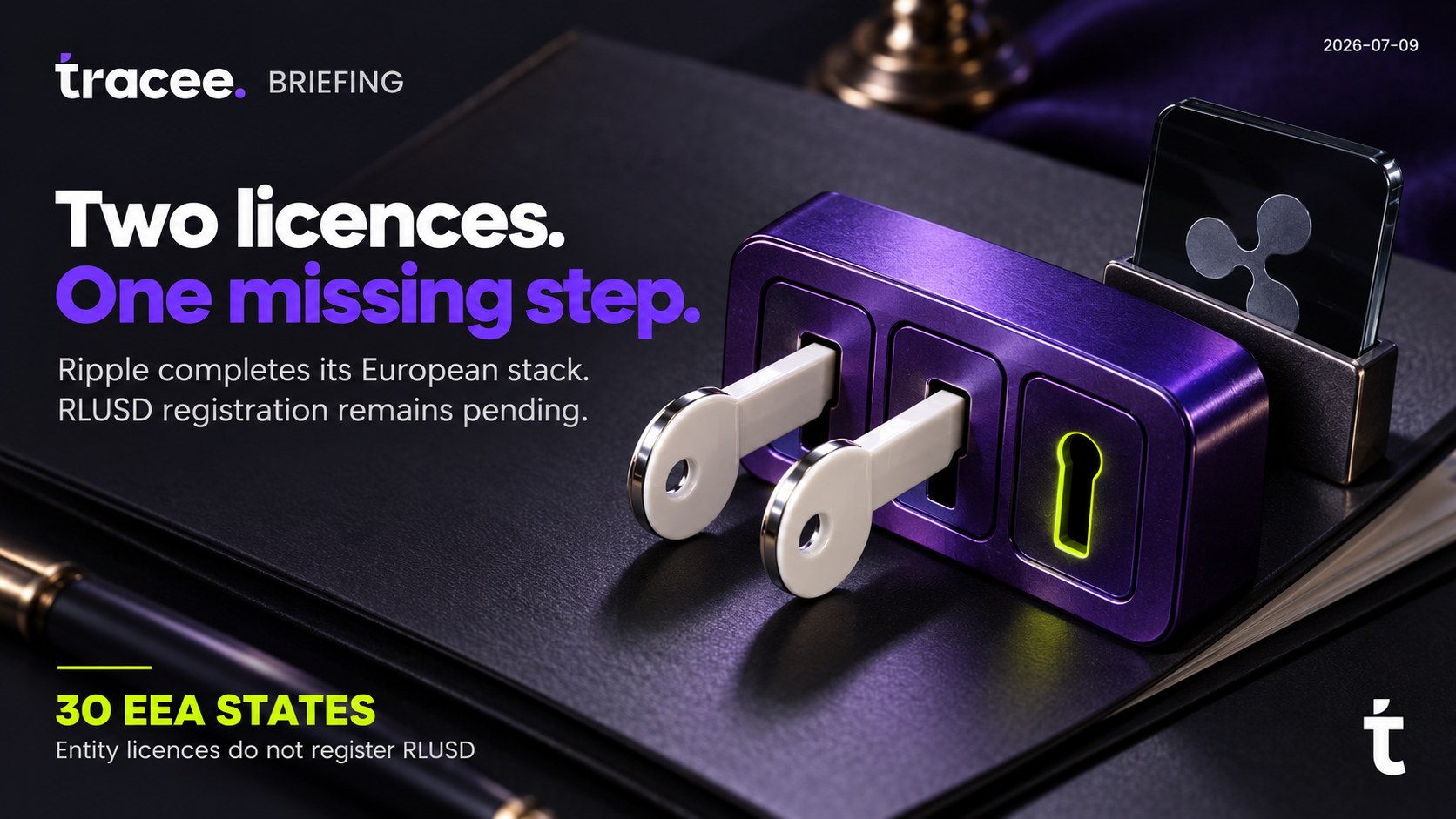
tracee's July 7 Bridge briefing flagged whether Circle, Ripple, or Paxos would pursue the same CASP-plus-EMI structure in Luxembourg.
Read briefingSuggest a news item or request a private briefing.
Public briefings publish on no fixed cadence. Private briefings, written for one institution and one decision, are part of the consulting engagement formats.
Book a discovery call