
Circle stops renting blockspace: BlackRock, Visa and nine other institutions become Arc's validators, and Circle alone still decides who else gets a seat.
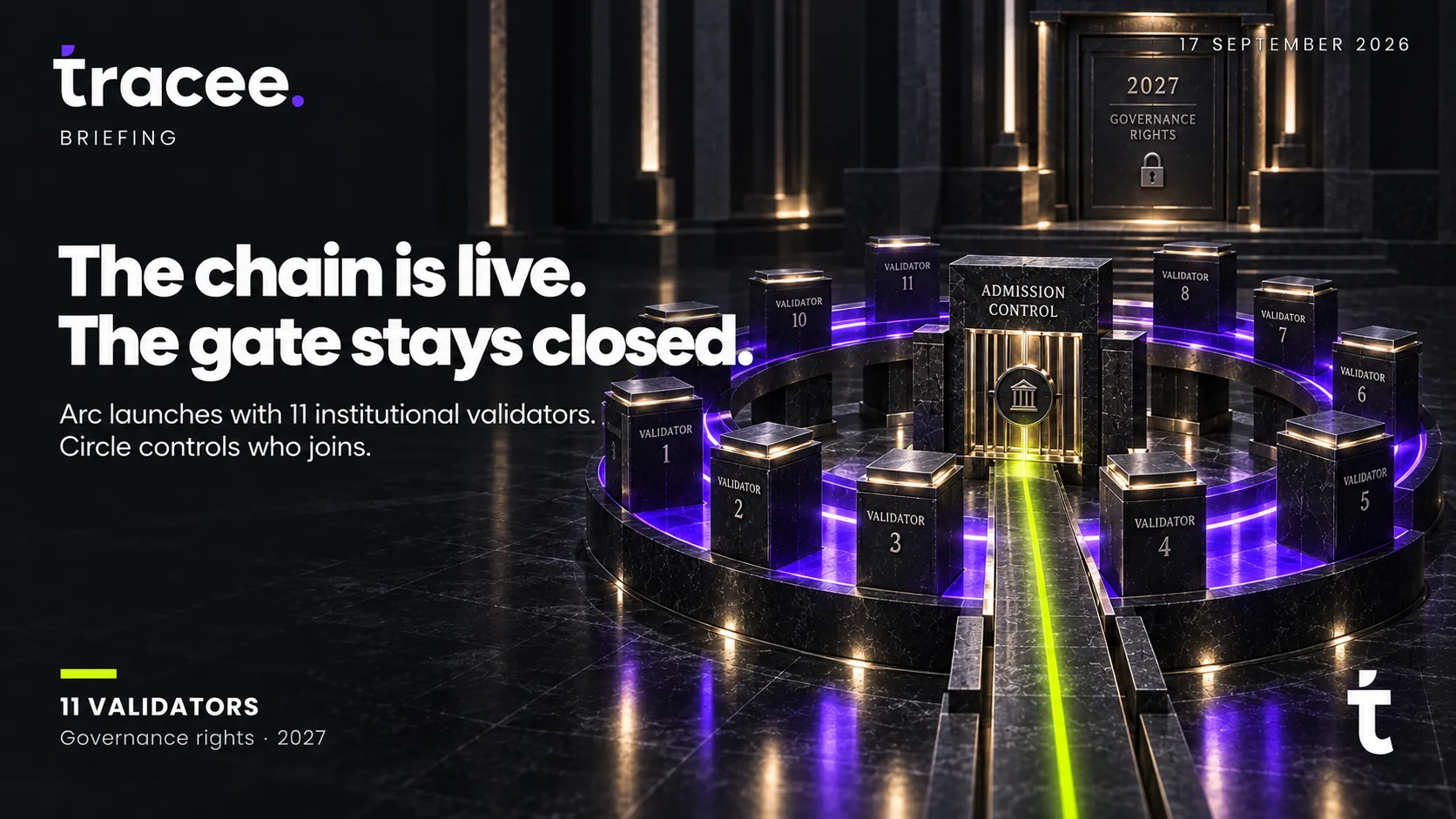
Circle called it the biggest launch since USDC. The architecture underneath decides if that's true.
That is Circle's own framing. What it leaves out is who gets to decide the network's membership, and it isn't a vote.
Five things shipped on 16 September. Only one of them is still a promise.
Strip the launch down to what is actually live today, versus what is scheduled for later.
| Move | Status | Verdict |
|---|---|---|
| Arc public mainnet live | Shipped | Real, not a roadmap. The chain is running, EVM-compatible, and taking transactions today, not promised for a future quarter. |
| USDC gas and sub-second finality | Shipped | Incremental as a feature, new as a source. Stablecoin-denominated gas and fast finality exist elsewhere; the stablecoin issuer building it itself is the new part. |
| Eleven institutional validators producing blocks | Shipped | The wedge. BlackRock, DTCC, Visa and Mastercard running consensus infrastructure is a different commitment than holding USDC on a balance sheet. |
| 10 billion ARC genesis mint | Shipped | Positioning, not utility yet. The supply exists and is allocated, but ARC is not tradeable and carries no live governance rights. |
| Proof-of-Stake transition, validator governance to token holders | Pending, targeted 2027 | The part that would make this decentralized. Until it lands, protocol upgrades and validator admission stay with Circle. |
Four rows are live infrastructure. The fifth row is the one that determines whether "eleven validators" ever becomes "eleven votes."
Institutions run the consensus layer. One company still runs the admissions office.
Here is what actually settles where, and who decides who is allowed to help settle it.
- The consensus layer is real, the control layer isn't decentralized. Eleven named institutions produce blocks, but Circle alone decides who joins, who leaves, and what the protocol does next.
- The token is a claim on a future, not a governance instrument today. ARC's staking and voting rights exist on paper and activate only once the Proof-of-Stake transition ships.
Three reasons this is bigger than one more Layer 1.
Circle just stopped being a tenant. USDC has spent five years living on chains Circle does not control: Ethereum, Solana, half a dozen others. Arc is Circle owning the building instead of renting floors in someone else's. That is the structural bet behind Allaire calling it the biggest launch since USDC, and it is the correct comparison: USDC made Circle a currency issuer, Arc is the attempt to make it a settlement-layer operator too.
The validator list is a customer list that agreed to co-sign consensus. Getting BlackRock, DTCC, Visa and Mastercard to hold USDC is a sales win. Getting them to run block-producing infrastructure is a different order of commitment, closer to becoming part-owners of the plumbing than users of it. That distinction is what the eleven names are actually worth.
This is Circle's entry in a race that already has a bank-led team. JPMorgan, Citi, Bank of America, Wells Fargo and more than a dozen peers are separately building a Clearing House tokenized deposit network, targeting first-half 2027, to keep settlement inside bank-owned rails rather than cede it to stablecoins or a retail CBDC. Arc is the stablecoin issuer's version of the same wager: whoever owns the settlement layer captures the institutional flow, not whoever merely issues the token that moves across it.
Circle built a blockchain with a public explorer. Whether it is decentralized is a separate question.
- Consortium chain, not a permissionless one. Validator admission is Circle's corporate decision, not a protocol-governed process; critics, including on-chain commentator Adam Cochran, call Arc a private settlement rail with a public explorer rather than a true blockchain.
- Regulated validators can be compelled. USDC has already frozen addresses at law enforcement's request. The same censorship exposure now sits at the consensus layer, spread across eleven identifiable, regulated institutions any of which could be ordered to act.
- No specific regulatory sign-off on Arc itself. Circle's trust charter covers USDC issuance; the New York Department of Financial Services had not issued a determination on the Arc network as of launch, leaving institutional participants without an explicit regulatory green light.
- ARC's governance is a promise, not a mechanism. Token holders get no vote on fees, inflation, or protocol changes until the Proof-of-Stake transition Circle has only targeted, not committed, for 2027.
- Day-one activity is mostly familiar names doing familiar things elsewhere first. Aave, Morpho and Uniswap redeploying on a new chain is not the same evidence as new institutional settlement volume choosing Arc over the rails it already uses.
Every large institution is placing the same bet twice. Own the pipe, not just the token that moves through it.
Arc lands three weeks after the ECB's Project Pontes targeted a 21 September go-live for tokenized central-bank settlement, and in the same month tracee tracked Broadridge scaling its tokenized repo platform and DBS and Citi proving Swift's ledger can move tokenized deposits on a weekend. The common thread across a central bank, a repo platform, a bank pilot and now a stablecoin issuer is the same: control of the settlement layer is the contest, not the choice of which token or currency rides on top of it.
Arc's bet and the Clearing House network's bet come from opposite starting points but chase the same outcome. Banks are tokenizing deposits so settlement stays inside deposit-taking institutions. Circle is building its own chain so settlement stays inside a stablecoin issuer's infrastructure instead of a bank's or a public chain's. Both camps are recruiting the same class of institutional names as validators or members; which rail captures live settlement volume, rather than which one launches first, is the question 2027 is supposed to answer.
The consensus is institutional. The control isn't, not yet, and "decentralized" is doing marketing work the architecture doesn't support.
Arc is a live, technically credible settlement rail with genuine institutional participation at the consensus layer, arguably Circle's biggest structural move since USDC itself. But the same regulated status that persuaded BlackRock, DTCC and Visa to sign on is what leaves Arc exposed to being ordered to censor, and Circle alone, not a protocol vote, still decides who else is allowed to help run it.
Watch three things over the next year:
- Whether NYDFS or another regulator issues a specific determination on Arc's status. Tells you whether institutional participants get the regulatory clarity they are currently operating without.
- Whether the Proof-of-Stake transition ships on the 2027 target. Tells you whether "governance" becomes real or stays a whitepaper promise.
- Whether real settlement volume moves onto Arc, not just app redeployments. Tells you whether Arc wins share from the Clearing House network's bank-owned rail or just adds a second logo to the same institutions' infrastructure list.
Common questions about Circle's Arc mainnet.
What is Circle's Arc mainnet?
Who are Arc's founding validators?
Is the ARC token available to buy?
Is Arc a decentralized blockchain?
How does Arc compare to the bank-led Clearing House tokenized deposit network?
Related briefings on the same rails.
Standard Chartered did not build a stablecoin. It built the first G-SIB-grade door into one, folding the second account institutional clients used to need with…
Read briefingQivalis crossed a threshold on 20 May that Circle EURC has never crossed: 37 supervised European banks signed as equity shareholders, creating a distribution…
Read briefing
Japan's June 1 Payment Services Act amendment created two trust-type stablecoin categories: the foreign pathway (USDC, RLUSD) and the domestic Type III (JPYSC)…
Read briefing
EURXT is not built to trade. It is built to settle CACEIS's own tokenised fund subscriptions, giving it captive volume from day one that SG-FORGE's EURCV and…
Read briefing
The FCA's 30 June rules and the Bank of England's 22 June rules are two tiers of one UK stablecoin regime, not two separate regimes.
Read briefing
JPMorgan is not neutral on Clarity Act yield provisions: it operates Kinexys, is building JPMD (a deposit token that can pay yield), and anchors the TCH tokenized…
Read briefingSuggest a news item or request a private briefing.
Public briefings publish on no fixed cadence. Private briefings, written for one institution and one decision, are part of the consulting engagement formats.
Book a discovery call