
The Senate recessed without voting on the CLARITY Act, and community banks, not crypto's usual opponents, stalled it.
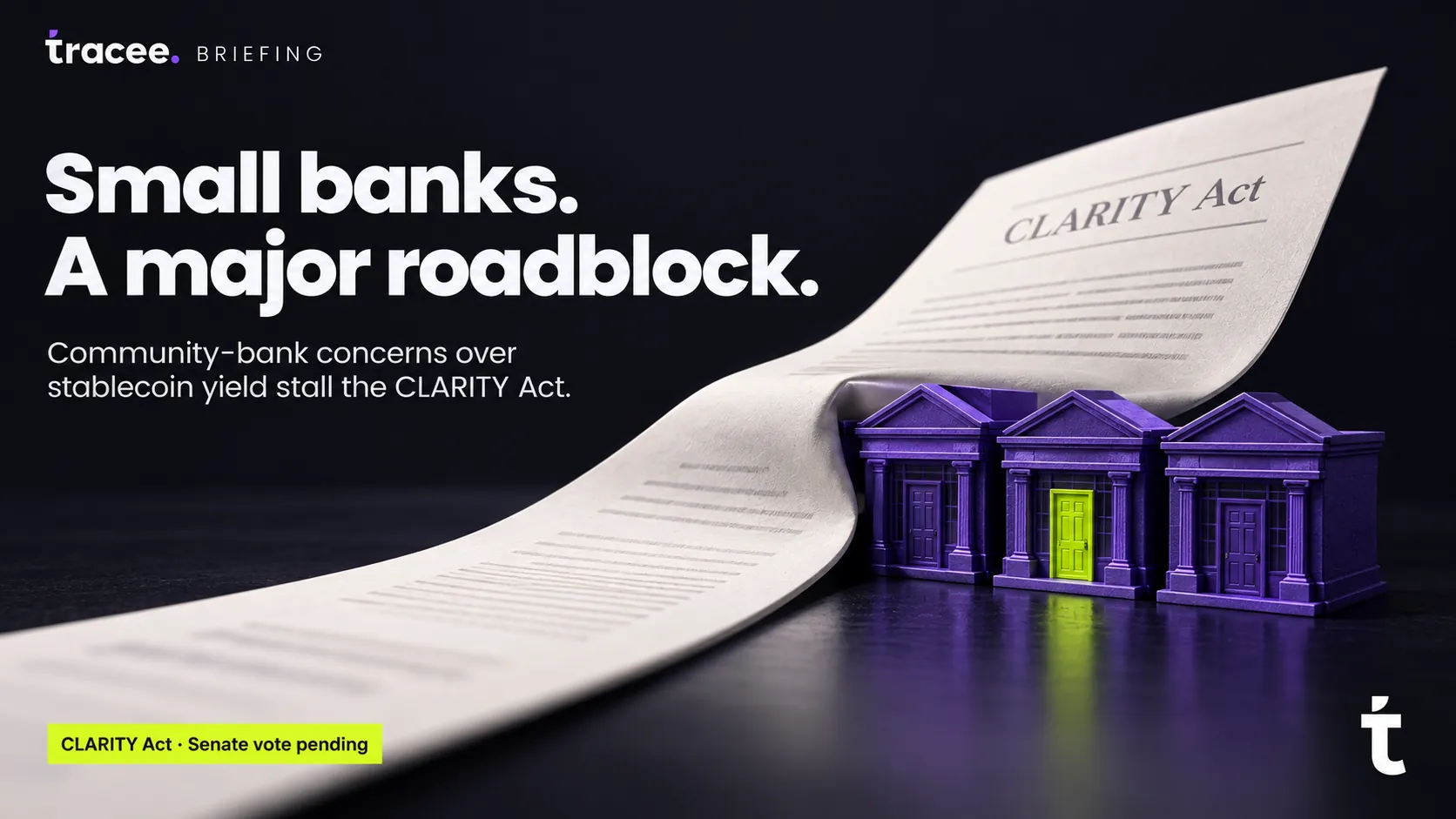
One senator, one sentence, and the loudest lobby in the CLARITY Act fight is not who anyone expected.
Hawley was describing calls from Missouri community bankers and farmers, not from crypto lobbyists on either side of the bill.
Five claims sit inside one recess. Two are confirmed. Three are still open.
Rated against what the Senate has actually done, not what the deadline pressure implied:
| Claim | Status | Verdict |
|---|---|---|
| Senate opens first-stage procedural vote to keep the bill alive | Shipped | Real. Cleared 8 August, the minimum step needed to avoid the bill dying over recess. |
| Senate adjourns for August recess with no floor vote | Confirmed | Real. The pre-recess deadline leadership had targeted was missed outright. |
| Floor vote rescheduled for 15 September | Pending | Not locked. A leadership target, not a binding calendar slot. |
| Stablecoin yield provision rewritten to satisfy community banks | Pending | Not done. No amended bill text addressing the rewards loophole has been published. |
| Ethics, illicit-finance, and DeFi provisions resolved | Pending | Unresolved. These disputes predate the stablecoin fight and remain open regardless of it. |
One procedural vote kept the bill technically alive. Everything that would make it law again is still undecided.
The CLARITY Act's stall isn't a crypto problem. It's a deposit-competition problem wearing a crypto bill's clothes.
Strip the procedural noise down to where the bill is actually blocked.
- The blockers aren't the usual crypto skeptics. Hawley and Moran otherwise back the bill's market-structure architecture; their objection is narrow, aimed at one provision.
- Community banks did what Wall Street usually does. Weeks of direct constituent lobbying, not a K Street campaign, moved the two votes the bill needed.
Three reasons this delay outlasts the news cycle it made.
The CLARITY Act decides who regulates a stablecoin, not just whether one is legal. The GENIUS Act, which tracee covered missing its own one-year rulemaking deadline on 20 July, sets issuance and reserve rules. CLARITY sets the market-structure layer underneath it: the SEC/CFTC jurisdiction split, and now, the line on stablecoin yield. Without it, the reserve rules GENIUS already wrote sit on top of an undefined market structure.
Yield is the one dial regulators haven't fixed anywhere yet. US banks pay depositors interest to hold their balances; stablecoin issuers, barred from paying interest directly under GENIUS, have tested reward and cashback structures instead. CLARITY was the vehicle community banks hoped would close that gap. Delay leaves the door exactly as open as it was in July.
A September vote competes with a worse calendar, not a better one. Appropriations deadlines and the run-up to the 2026 midterms occupy the same floor time Thune has promised the bill "first thing." Bills that slip past a summer recess in a midterm year rarely get easier to pass. They get harder.
A procedural vote is not a deal. Five things the recess doesn't resolve.
- 15 September is a target, not a locked floor slot. Thune's "first thing" commitment is a leadership pledge; it has already lost to appropriations and recess scheduling once this year.
- No public bill text fixes the yield loophole yet. Community banks say the current language still lets issuers offer rewards tied to holding the token; no amended draft has closed that gap in public.
- The lobby isn't unanimous against passage. BlackRock, Fidelity, and other asset managers publicly back the CLARITY Act as drafted; a community-bank rewrite could cost that support.
- This doesn't touch GENIUS Act implementation. The GENIUS Act's own rulemaking, already missed once, runs on a separate regulatory track from CLARITY's market-structure fight.
- Two senators can hold a bill, not kill it. Hawley and Moran can withhold a vote; neither controls whether leadership eventually moves the bill without a full fix.
tracee has tracked four stablecoin-regulation deadlines slip in four weeks. This is the first one blocked by a bank lobby instead of a bureaucracy.
tracee's 20 July briefing covered the GENIUS Act's own one-year rulemaking deadline passing with five regulators still holding proposals, not final rules. The 18 July briefing on the US-UK stablecoin roadmap and the 30 July briefing on the EU's MiCA review both described frameworks still under construction while stablecoin issuance keeps scaling. CLARITY's delay adds a fourth open clock, but for a different reason: the first three slipped on regulator bandwidth. This one slipped on a floor vote count.
The dispute also reframes who counts as CLARITY's opposition. Every prior tracee briefing on US stablecoin policy covered crypto-industry actors pushing regulators to move faster. Here, the obstacle is retail banking's own trade lobby, worried that a stablecoin-adjacent yield product competes directly with the deposit base that funds small-town agricultural lending, the same dynamic BIS flagged at a macro level in tracee's 24 July briefing on stablecoin dollarization eroding capital controls abroad.
A September vote, if it happens, would be the first time Congress resolves a stablecoin-yield question directly, rather than leaving it to GENIUS Act rulemaking or state law. Every issuer running a rewards program, and every community bank watching its deposit base, is waiting on the same quarter hour of floor time.
The bill isn't dead. It's stuck exactly where GENIUS left the yield question open.
The Senate's failure to vote before recess is not, at bottom, a crypto story about industry pushback. It is a banking story about deposit competition that happened to attach itself to a crypto bill. Two Republican senators, not Democrats, not crypto skeptics, stalled a bipartisan-advanced bill because community bankers in their states made the deposit-flight risk concrete. Leadership has committed to a 15 September vote, but that commitment sits behind an unresolved provision, a crowded fall calendar, and a lobby split between Wall Street asset managers who want the bill passed as written and community banks who don't. Until the yield language changes publicly, the CLARITY Act's market structure, and the deposit-competition question underneath it, stays exactly where the GENIUS Act left it in July: unresolved.
Watch three things:
- Whether amended bill text on stablecoin yield appears before 14 September. The real signal of a deal, not just a floor-time promise.
- Whether Hawley and Moran hold their position. Two votes is enough to stall a 60-vote threshold; it takes a Wall Street-scale counter-lobby to move them back.
- Whether the 15 September vote happens at all. A second miss would push CLARITY past the point most legislative trackers consider salvageable in a midterm year.
Common questions about the CLARITY Act's Senate delay.
What happened with the CLARITY Act this week?
Why did Republican senators oppose their own party's bill?
How is this different from the GENIUS Act delay tracee covered in July?
Is the CLARITY Act dead?
Where can I read the original source?
Related briefings on the same rails.

GENIUS (signed July 2025) handled the stablecoin layer. CLARITY now draws the perimeter around everything it settles against: digital commodities to the CFTC…
Read briefingThe ECB and 27 EU central banks want MiCA's 60% bank-deposit quota gone, replaced by a liquidity test, and the stablecoin yield ban widened to lending and staking.
Read briefing
FASB's 18 August 2026 proposal would let stablecoins meeting a three-part redemption and reserve test sit on the cash-equivalents line, with comments due 19…
Read briefingSeven axes where the two paths diverge: issuer license, backing, regulation, insurance, network, yield, and example issuers.
Read briefing
Coinbase and Moov gave 1,000-plus community banks and credit unions stablecoin payment infrastructure five days before the Senate's Clarity Act cloture vote.
Read briefingJapan's amended Payment Services Act creates the most portable regulatory framework for foreign stablecoins yet built in the G7: no domestic entity, no domestic…
Read briefingSuggest a news item or request a private briefing.
Public briefings publish on no fixed cadence. Private briefings, written for one institution and one decision, are part of the consulting engagement formats.
Book a discovery call