
Coinbase hands community banks a stablecoin rail: the infrastructure shipped, the customers didn't, and the timing is the real story.

One quote, one pipe hiding underneath it.
Moov already touches those banks. Coinbase is renting them a pipe, not building a new front door.
Five moves in one release. Two of them are live today.
Coinbase's own description compresses a custody product, a distribution deal, and a regulatory bet into one paragraph. Rated on their own merits:
| Move | Status | Verdict |
|---|---|---|
| Custodial wallet + Payments API | Shipped | Real product. Coinbase Developer Platform's custodial accounts and stablecoin-movement API exist and are live infrastructure today. |
| Moov partnership signed | Shipped | Real distribution deal. Moov already serves 1,000-plus community banks and credit unions through card and real-time-payment rails. |
| First bank or credit union live | Pending | Not named. No pilot, corridor, minimum transaction size, or settlement currency disclosed on either side. |
| USDC, PYUSD, USDG support | Reported | Secondhand. Trade coverage, not language Coinbase itself confirms in the release. Treat the roster as provisional. |
| Timed to the Clarity Act vote | Pending Senate | The real gate. The 15 September cloture vote, five days out, decides more than this announcement does. |
Two rows are infrastructure that exists. Three are promises resting on a vote neither company controls.
Four layers, one new pipe threaded through Moov's rails.
Moov did not rebuild its stack. It plugged a stablecoin leg into the one it already runs for 1,000-plus institutions.
Two analytical points the diagram makes visible:
- The bank never touches crypto directly. Moov's existing relationship is the interface. Coinbase's wallet and API are the plumbing behind it, which is the pitch to a compliance officer who has never wanted to run a node.
- Coinbase is not the reserve. If USDC, PYUSD, or USDG depegs or a redemption queue backs up, that is Circle's, PayPal's, or the Global Dollar Network's balance sheet, not Coinbase's. The custodial wallet holds the token, not the risk of the token.
Coinbase is not selling banks a product. It is buying a lobby it doesn't currently have.
Community banks and credit unions, through their trade associations, have been among the loudest opponents of the Clarity Act in the Senate, warning that stablecoin yield-like rewards on exchanges could pull deposits out of small-town balance sheets. That opposition is one reason the bill needed a cloture vote at all rather than riding its 294-134 House margin straight through. Coinbase spent years building an exchange product for people who might disintermediate community banks. It just spent one announcement building a product for the banks themselves.
The mechanism matters more than the release lets on. Moov's 1,000-plus institutions do not need to understand blockchain custody, key management, or stablecoin redemption mechanics. They need one integration that shows up inside a system they already run. That is the same trade J.P. Morgan's Kinexys and Broadridge's DLR have made with their own institutional clients: sell the API, not the education.
None of this requires a single bank to go live before the 15 September vote. The announcement only has to exist by then.
Nothing in this announcement is live for a customer. Read the gaps before the press cycle does the arithmetic for you.
- No bank has switched on. Coinbase and Moov have named zero pilot participants as of publication.
- No corridors or minimums disclosed. Which payment types, transaction ceilings, or settlement currencies apply is unstated for any of the 1,000-plus institutions.
- No integration deadline. Neither company has committed to a date by which the first credit union customer goes live.
- The stablecoin roster is secondhand. USDC, PYUSD, and USDG appear in trade coverage, not in language Coinbase itself has confirmed on the record.
- The vote is not the bill. Cloture only opens debate on the Clarity Act. Passage, reconciliation with the House text, and a signature are separate, later gates.
The Senate math hasn't moved. The lobby math just did.
The Clarity Act needs 60 votes to clear cloture on 15 September. Republicans hold 53 seats, so at least seven Democrats have to cross over, the same math that stalled the bill before the August recess and pushed the vote to September in the first place. Nothing Coinbase announced changes a single vote count directly.
What it changes is the argument. Community bank trade groups have framed the bill's stablecoin provisions as a deposit-flight risk for institutions with no way to compete. A stablecoin rail, even an unlaunched one, undercuts that framing without a single amendment to the bill text. It is the same playbook Standard Chartered ran in Hong Kong and Revolut ran across the EEA this summer: distribute someone else's stablecoin rather than fight the category, then let the distribution deal do the political work.
Watch whether other core-banking and payments vendors, Jack Henry, Fiserv, FIS, follow with their own Coinbase-style integrations before 15 September. A second or third deal in the same window would confirm this is a coordinated industry response, not one company's timing.
The infrastructure is real. The constituency is the product.
Coinbase and Moov built something that works: a custodial wallet and a payments API that let a community bank offer stablecoin acceptance without hiring a blockchain engineer. But the release ships five days before a Senate vote and names no customer, no corridor, and no date, which makes the timing, not the technology, the actual news. Coinbase converted its most organized opposition into a constituency with something to sell, whether or not a single credit union goes live this quarter.
Watch three things over the next two weeks:
- The 15 September cloture vote. If it fails, the Coinbase-Moov announcement reverts to infrastructure with no urgency behind it.
- The first named bank or credit union. That is the moment this stops being a press release and starts being a product.
- Whether Jack Henry, Fiserv, or FIS answer with their own stablecoin integration. That would confirm the industry, not just Coinbase, is buying this argument.
Common questions about the Coinbase-Moov stablecoin partnership.
What did Coinbase and Moov announce?
Is stablecoin payment live at any community bank yet?
Which stablecoins does the partnership support?
Why is the timing tied to the Clarity Act?
How is this different from a bank issuing its own tokenized deposit?
Related briefings on the same rails.

Quant was named vendor for the tokenized deposit network 25 US banks are building, closing the watchpoint tracee flagged in June. No blockchain has been named yet.
Read briefing
Fiserv's platform is live with Roughrider Coin, a permissioned Solana token for 90+ North Dakota banks. No volume, supply or reserve figure is published.
Read briefing
Pontes went live with 13 banks and four DLT operators settling wholesale tokenised assets in central bank money.
Read briefing
DBS and Citi settled a live USD payment via tokenized deposits on Swift's Digital Ledger in minutes on a Saturday.
Read briefing
Revolut began rolling out EURR to customers in Denmark, Poland and Portugal while delisting Tether's USDT across the EEA under MiCA. Bridge, the Stripe-owned…
Read briefing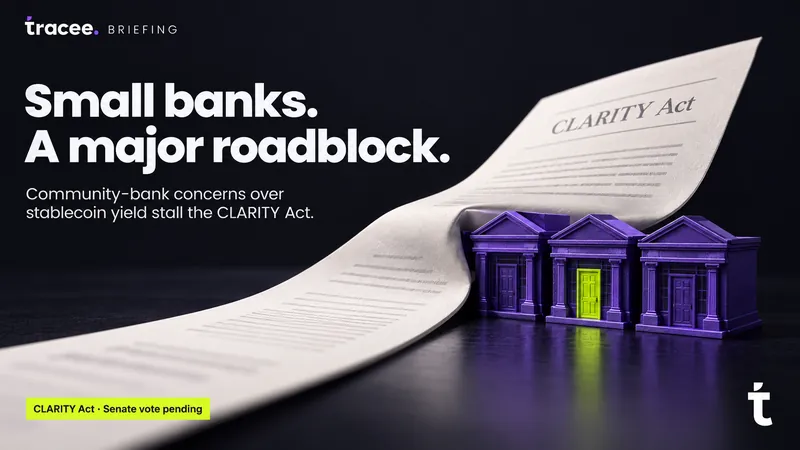
The Senate recessed on 10 August without a floor vote on the CLARITY Act after Senators Josh Hawley and Jerry Moran broke ranks over a stablecoin yield provision…
Read briefingSuggest a news item or request a private briefing.
Public briefings publish on no fixed cadence. Private briefings, written for one institution and one decision, are part of the consulting engagement formats.
Discuss your projectBook a discovery call