
FCA and Bank of England read 123 replies on UK tokenisation: collateral gets the near-term bet, stablecoins get a supervised sandbox seat, not a rulebook.

123 respondents graded the plan. The regulators graded the respondents back.
A feedback statement is not a rulebook. It is regulators telling the market which parts of its own pitch they believed.
Five things moved on 14 September. Only two of them are rules that already bind anyone.
Strip the document down to what actually changed, versus what was merely confirmed or promised.
| Move | Status | Verdict |
|---|---|---|
| Feedback Statement FS26/1 published | Shipped | Real data, not a discussion paper. 123 tallied responses give regulators a documented sentiment baseline to build a roadmap against. |
| Stablecoins as DSS settlement assets | Already live | Not new today. The Bank broadened Digital Securities Sandbox guidance to admit certain stablecoins earlier; FS26/1 restates it inside the wider push. |
| Tokenised collateral named the near-term priority | Exploring | Direction, not a rule. The Bank is considering tokenised assets in its own operations and consulting on CCP acceptance under UK EMIR. Nothing is finalised. |
| Full Tokenisation Roadmap | Pending | Promised, undated. "Later in 2026" is a season, not a date, and the roadmap is what turns intent into obligations. |
| Bank of England's statutory stablecoin mandate | Pending Parliament | Not law yet. The Financial Services and Markets Bill amendment giving the Bank a secondary objective on stablecoins was before the Lords on 7 and 9 September. |
One live rule, one live document. Everything else in this announcement is still a plan with a season attached, not a date.
One feedback statement, two workstreams, and a statutory fight running underneath both.
FS26/1 is the hinge between a May consultation and a roadmap that does not exist yet. Here is what it actually connects.
- The roadmap sits downstream of two workstreams, not one. Collateral and stablecoin settlement move on separate tracks with separate evidentiary bars before either becomes a general rule.
- The whole structure leans on a bill that has not passed. Without the Bank's statutory objective, its stablecoin work stays discretionary rather than mandated.
The regulator picked a winner, and it isn't the stablecoin story most of the industry pitched.
123 responses is the first quantified read on UK market sentiment toward tokenisation, and collateral mobility won it. Not payments, not settlement money, not a new dollar or sterling instrument. Respondents told two regulators that the clearest near-term value sits in making existing collateral move faster between counterparties. That reprioritises where UK custodians, CCPs and prime brokers should be spending build budget over the next twelve months: on collateral eligibility and CCP plumbing under UK EMIR, not on stablecoin settlement rails.
Stablecoins did not lose. They got contained. The DSS eligibility rule lets certain stablecoins settle securities trades, but only inside a supervised pilot, assessed case by case, against a regime that is itself still being finalised. That is a deliberate sequencing choice: let the market prove a stablecoin can behave like settlement money under supervision before writing it into permanent rules.
For firms building UK tokenisation strategy, the FS26/1 signal is unambiguous: pitch collateral use cases to regulators this year, and treat stablecoin settlement as a sandbox experiment to join, not a market to launch into.
Regulators graded the industry's pitch. They still haven't written the exam.
- "Later in 2026" is not a date. The Tokenisation Roadmap is the document that would turn today's priorities into obligations with deadlines, and it does not exist yet.
- Stablecoin DSS eligibility is case-by-case, not systemic. Sixteen firms, including Euroclear, HSBC and London Stock Exchange Group, are preparing to go live in the sandbox from late 2026; none has confirmed a live trade settled with a stablecoin leg.
- The Bank's stablecoin mandate is still a bill, not a statute. The Financial Services and Markets Bill amendment needs to clear the House of Lords before the Bank's secondary objective on stablecoins becomes a legal requirement rather than a policy choice.
- The regime the DSS test references is unfinished. The Bank's draft Code of Practice for recognised systemic stablecoin issuers is out for consultation until 22 September 2026 and won't be finalised until end of year.
- "Broadly supportive" describes sentiment, not commitments. A feedback statement records what 123 respondents said they wanted; it does not bind the regulators to deliver it on any particular schedule.
Every major settlement authority is choosing the same priority order. Plumbing first, new money second.
The UK's sequencing echoes what tracee has already tracked elsewhere this month. Canada's OSFI ruled tokenized deposits are legally ordinary deposits, no new licence required, before addressing anything stablecoin-shaped. DBS and Citi proved Swift's ledger can move tokenized bank deposits on a weekend, with no stablecoin involved at all. The pattern across three separate authorities and one bank pilot is the same: settle the collateral and deposit-rail questions with instruments regulators already understand, and treat stablecoins as the newer, more closely supervised layer on top.
The UK is also racing its own calendar. The ECB's Project Pontes targets a 21 September 2026 go-live for tokenized central bank money settlement, five days after FS26/1. A UK roadmap that slips past year-end risks London's wholesale tokenisation push looking reactive rather than early, at the exact moment continental infrastructure starts quoting a production date instead of a season.
The UK has a priority order now. It still doesn't have a roadmap, and the stablecoin mandate isn't law.
FS26/1 is the clearest signal yet that the FCA and Bank of England see tokenised collateral, not stablecoin settlement, as the UK's near-term wholesale tokenisation win. Stablecoins get a real but narrow foothold inside the Digital Securities Sandbox, gated case by case against a regime that is not yet finished, while the Bank's legal authority to support them at all still sits in a bill before the House of Lords.
Watch three things before year-end:
- Whether the Tokenisation Roadmap ships with dated commitments in 2026. A roadmap with no dates is just FS26/1 with a new cover page.
- Whether any of the 16 DSS firms settle a live trade with a stablecoin as the payment leg. That is the difference between an eligible instrument and a used one.
- Whether the Financial Services and Markets Bill amendment clears the Lords. Everything the Bank does on stablecoins beyond the sandbox depends on that objective becoming law.
Common questions about FS26/1 and UK tokenisation policy.
What did the FCA and Bank of England actually publish on 14 September 2026?
Can stablecoins now be used to settle trades in the UK?
Why did regulators prioritise tokenised collateral over stablecoins?
Is the Bank of England legally required to support stablecoins yet?
When will the UK's full Tokenisation Roadmap be published?
Related briefings on the same rails.
The BoE drops individual stablecoin holding limits in favour of aggregate caps and sets June 2026 for draft rules, with 16 Digital Securities Sandbox firms…
Read briefing
The FCA's 30 June rules and the Bank of England's 22 June rules are two tiers of one UK stablecoin regime, not two separate regimes.
Read briefingQivalis crossed a threshold on 20 May that Circle EURC has never crossed: 37 supervised European banks signed as equity shareholders, creating a distribution…
Read briefing
On 22 June, the Bank of England published its Policy Statement and draft Code of Practice for sterling systemic stablecoins, completing the reserve architecture the…
Read briefingThe Bank of England drops the £20,000 individual stablecoin holding limit in favour of aggregate issuance caps on providers, sets June 2026 for draft rules and…
Read briefing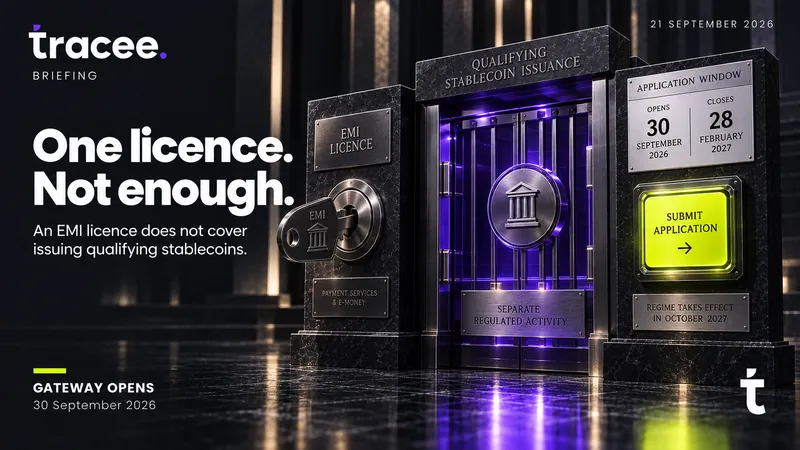
PS26/18 clarifies which of five newly regulated activities, issuing qualifying stablecoins included, an EMI licence does not cover.
Read briefingSuggest a news item or request a private briefing.
Public briefings publish on no fixed cadence. Private briefings, written for one institution and one decision, are part of the consulting engagement formats.
Book a discovery call