
The FCA just told UK stablecoin issuers which button to press. An e-money licence does not cover it, and the gateway opens in nine days.
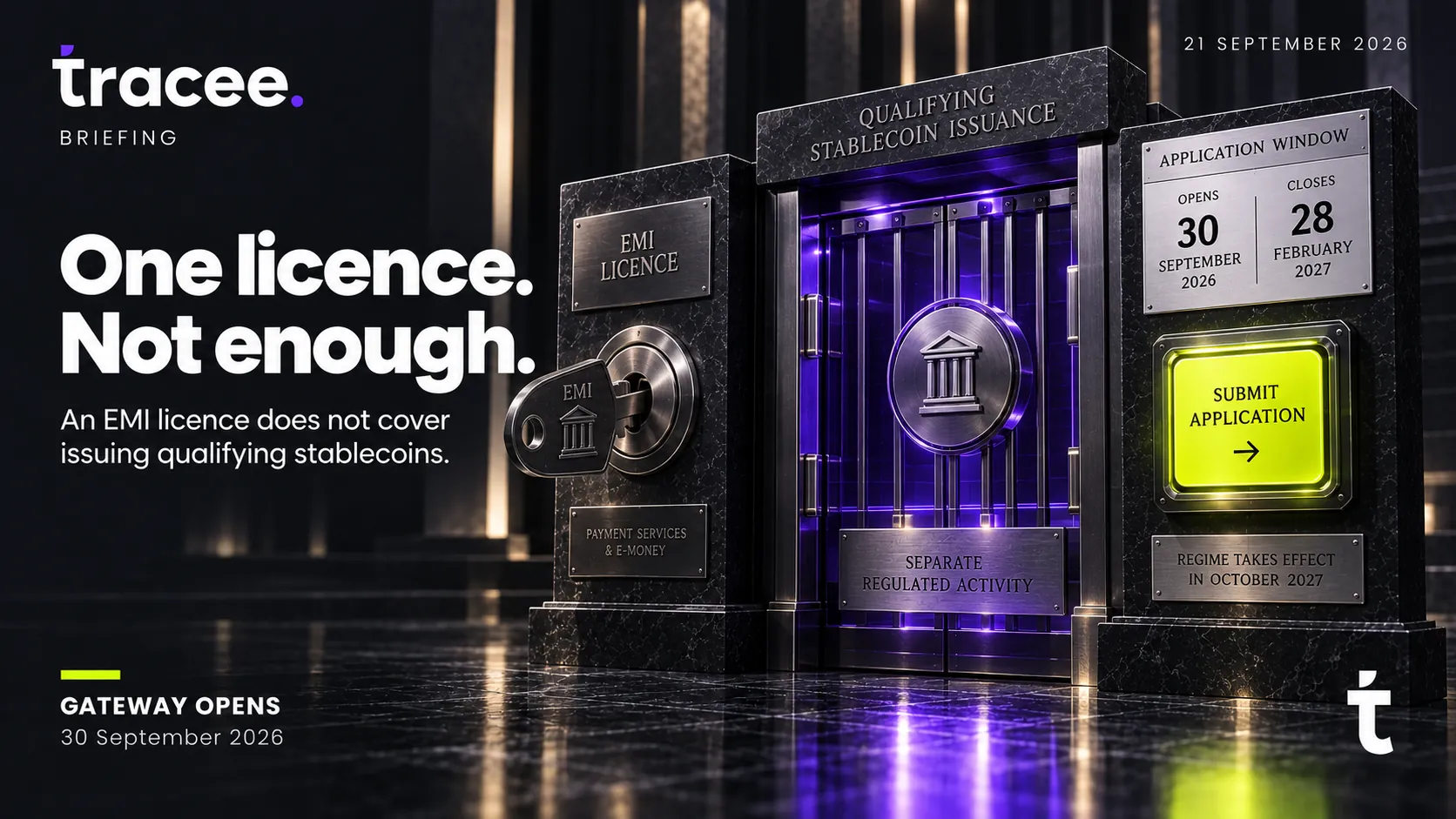
The filing record is six facts. None of them are new law.
PS26/18 creates no new obligation. It tells firms which box their existing business falls into, two weeks before the window to apply opens.
Five activities now sit inside the perimeter. Only two have any prior UK licence to point to.
Separate what is a genuinely new permission from what upgrades a registration that already existed.
| Activity | Prior UK coverage | Verdict |
|---|---|---|
| Issuing qualifying stablecoins | No prior licence | An EMI licence does not extend here. A firm already issuing a UK token under an e-money permission needs a separate cryptoasset authorisation to keep issuing lawfully. |
| Operating a cryptoasset trading platform | No prior licence | New venue category. Closest analogue is a MiFID-style trading venue; cryptoassets get the same regulated-venue treatment for the first time. |
| Dealing and arranging deals in cryptoassets | Registration only, until now | Upgrade, not a first licence. Brokers and OTC desks have operated under 2020 anti-money-laundering registration alone. |
| Safeguarding cryptoassets | Registration only, until now | Prudential upgrade. Replaces 2020 Money Laundering Regulations registration with full custody rules: capital, reconciliation, client-asset protection. |
| Arranging cryptoasset staking | No prior licence | Genuinely new. No comparable UK regulated activity existed before this regime. |
Two activities upgrade an existing registration. Three start from zero, issuing a stablecoin included.
The gate has one door, and a fork after it that almost nobody has reached yet.
Here is the path from an operating UK firm today to a permission it can actually rely on.
- The window is the actual deadline. Not 25 October 2027. Miss the five-month filing period and the savings provision does not apply.
- Systemic is still nobody. HM Treasury has not designated a single UK stablecoin systemic, so every current issuer sits on the FCA-only side of the fork.
The rules were final in June. The clock only started on 16 September.
The core UK cryptoasset regime, the perimeter itself, was settled across four policy statements on 30 June 2026. What changed with PS26/18 is narrower and more urgent: the FCA told firms, in plain terms, which of their existing UK operations fall inside that perimeter, two weeks before the window to apply opens.
tracee's briefing on the FCA and Bank of England's wholesale tokenisation feedback statement, published the same week, covered the other half of this regulatory sprint: collateral and repo tokenisation getting a near-term sandbox seat, stablecoins told to wait for a dedicated framework. PS26/18 is that dedicated framework's opening move, and it is aimed at retail-facing issuance, not wholesale collateral.
For any firm already running a UK stablecoin or an e-money-adjacent token under an EMI licence, PS26/18 turns 30 September into a forced decision date. File for the matching cryptoasset permission inside the five-month window, or risk the activity becoming unauthorised once the regime takes effect, since the savings provision protects only firms that applied on time.
The countdown is real. Almost everything it will actually decide is not.
- Guidance, not new rules. PS26/18 clarifies scope; the substantive requirements were already final on 30 June 2026. Nothing in the perimeter itself changed on 16 September.
- No enforcement precedent yet. No firm has been authorised, refused, or fined under this gateway. The boundary between a qualifying stablecoin and a specified investment cryptoasset, which decides which permission a yield-bearing token needs, is untested.
- No systemic stablecoin exists yet. HM Treasury has not designated a single UK stablecoin systemic, so the boundary between FCA-only oversight and joint Bank of England supervision remains theoretical for every current issuer.
- The regime does not bind until 25 October 2027. A firm that files inside the window keeps operating under the savings provision for over a year regardless. Nothing about the market changes on 30 September itself.
- UK-only. A stablecoin already compliant under MiCA in the EU or the GENIUS Act in the US gets no read-across. A firm live in all three still needs three separate authorisations.
Five regulators moved in seven days. This is the one with the nearest deadline attached.
The same week produced Circle's Arc mainnet launch on 16 September, the FCA and Bank of England's wholesale tokenisation statement the same day, the SEC's Innovation Exemption for tokenized stock on 17 September, the CFTC's own rulemaking filed with the White House on 18 September, and Bastion's conditional OCC trust charter, also 18 September, all covered by tracee this week. PS26/18 is the quietest of the five and the one with the nearest hard date: nine days from this briefing's publication.
It also inverts the usual comparison. The US Treasury's own implementing rules for payment stablecoins under the GENIUS Act are still at the proposal stage, with comments on its section 3 rulemaking due 19 October 2026, a month after this UK window opens. For once, London's stablecoin licensing clock is running ahead of Washington's, even as the Bank of England's own Code of Practice for systemic issuers, due by the end of 2026, and its expanded digital-money mandate remain unfinished behind it.
PS26/18 changes no obligation. It starts the clock on all of them.
For any EMI, payments, or crypto firm with UK stablecoin ambitions, 30 September, not 25 October 2027, is now the operative date. File inside the five-month window or risk the activity becoming unauthorised once the regime takes effect. The perimeter, five activities, three asset categories, was settled in June. What arrived on 16 September was the FCA finally telling firms which box their business falls into, and how little time is left to act on it.
Watch three things:
- How many firms file in the 30 September to 28 February window. The first hard data point on how many UK operators consider themselves caught.
- Whether HM Treasury designates the first systemic UK stablecoin. That would trigger joint Bank of England oversight for the first time under this regime.
- Further FCA guidance on the qualifying stablecoin versus specified investment cryptoasset boundary. The ambiguity most likely to produce the first contested authorisation decision.
Common questions about the FCA's stablecoin authorisation gateway.
What did the FCA publish on 16 September 2026?
Does an existing EMI or e-money licence cover issuing a stablecoin in the UK?
When does the FCA's authorisation window open?
What happens to stablecoins that become systemically important?
Does a MiCA or GENIUS Act authorisation carry over to the UK regime?
Related briefings on the same rails.

Block filed 4 September for a second bank charter, Builders Bank, an uninsured trust bank barred from taking deposits or making loans.
Read briefingGENIUS (signed July 2025) handled the stablecoin layer. CLARITY now draws the perimeter around everything it settles against: digital commodities to the CFTC…
Read briefing
Section 20's effective date, the earlier of 18 January 2027 or 120 days after final rules issue, is untouched by the miss.
Read briefingZerohash Europe received an EMI license from DNB on 18 May 2026, the first firm licensed under MiCAR to also hold full EMI status.
Read briefing
OCC Comptroller Jonathan Gould pledged a final GENIUS Act rule by November, the first of five required regulators to name a date.
Read briefing
South Korea's FSC unveiled a three-phase roadmap for tokenized securities, with legal recognition for institutional funds, bonds and unlisted shares effective 4…
Read briefingSuggest a news item or request a private briefing.
Public briefings publish on no fixed cadence. Private briefings, written for one institution and one decision, are part of the consulting engagement formats.
Book a discovery call