
Bastion just won a national trust charter for stablecoin infrastructure. The newest OCC bank in the wave does not issue a single stablecoin of its own.
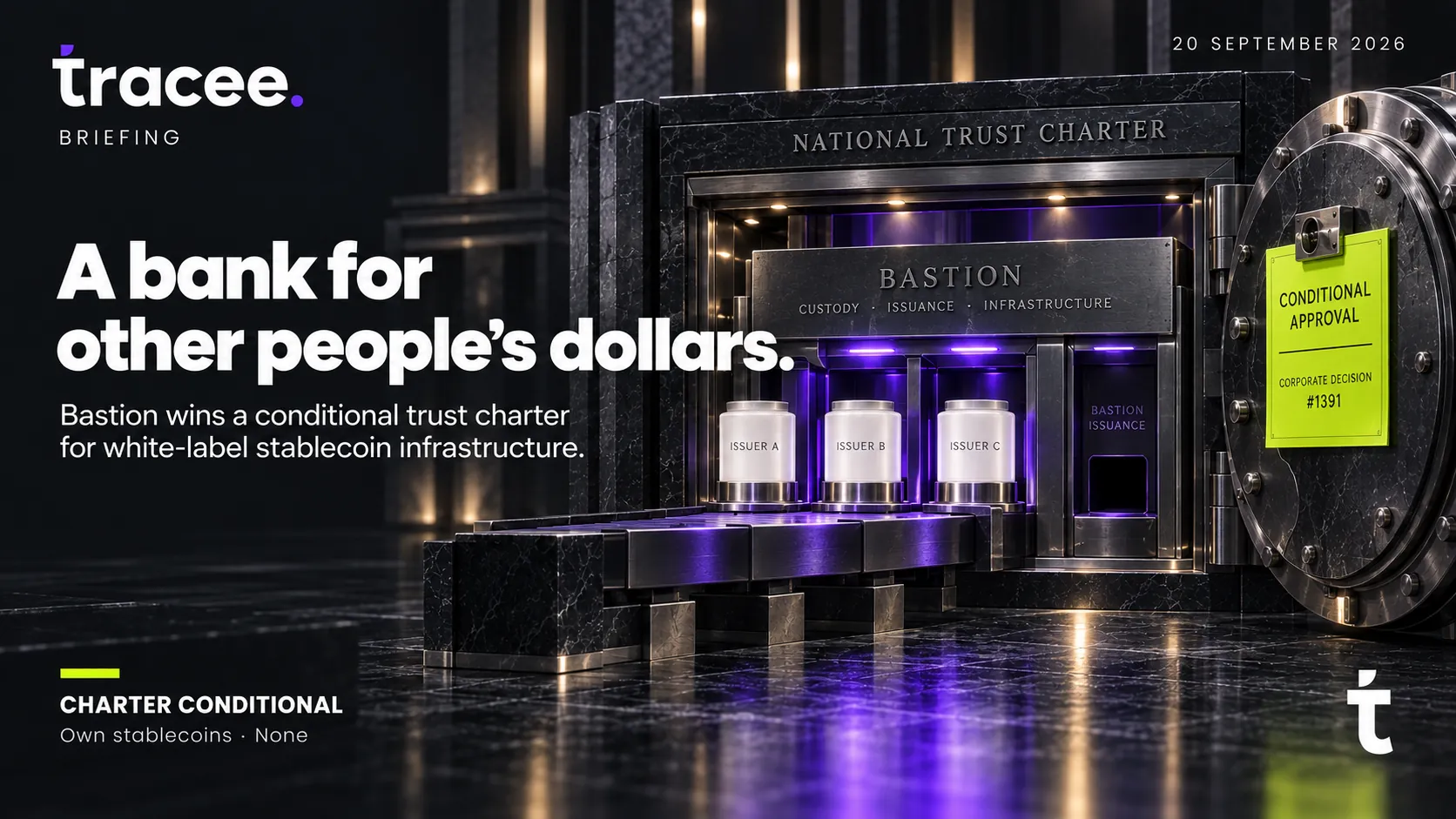
The filing record is five facts. Everything else is Bastion's own framing of what they mean.
Bastion's own release fills in what the OCC record does not: who this is for, and why an infrastructure vendor wanted a bank charter at all.
Five moves sit inside one approval, and only one of them is actually finished.
Strip the announcement down to what is confirmed, what is conditional, and what is still just a plan.
| Move | Status | Verdict |
|---|---|---|
| OCC preliminary conditional approval | Approved | Real, but preliminary. Corporate Decision #1391 clears Bastion to proceed toward a charter, not to operate under one. |
| New York trust charter converts to national | In process | Upgrade, not a first license. Bastion has held a New York State trust charter since February 2025. |
| Federal Reserve Bank stock purchase | Required | Mandatory precondition. No completion date has been disclosed. |
| Custody, wallet and white-label issuance scope | Confirmed | No deposits, no loans, no FDIC insurance, the same limits as every other 2025 to 2026 crypto trust charter. |
| Named enterprise or bank client under the charter | Undisclosed | None announced. The business case rests on existing clients, not a new one. |
One box is checked. Four are conditions, upgrades, or claims still waiting on proof.
Bastion sits between the issuer and the client, and the charter is what lets it stay there.
Bastion does not mint a stablecoin. It rents out the infrastructure, and now a federal charter, underneath somebody else's.
- One counterparty, not three. Bastion's pitch is a single federally supervised entity for custody, wallets and issuance, instead of the multi-hop trust chain tracee flagged in PYUSDx.
- The reserve risk stays with the client. Bastion custodies; it does not warrant what actually backs the token it is holding.
Two tracee briefings already described this problem. Bastion is the first infrastructure vendor to answer it with a charter.
tracee's PYUSDx briefing found three contractual hops between PayPal's downstream stablecoin issuers and the Paxos Trust reserve that actually backs the dollar, with neither PayPal nor M0 disclosing what license covers each hop. Bastion's model collapses the same custody-plus-issuance stack into one OCC-chartered entity that holds the license itself, rather than sitting several contractual steps from someone else's trust company.
tracee's Block briefing covered a similar restriction, no deposits, no FDIC insurance, when Block filed for its own OCC trust charter on 4 September. But Block was adding custody as a capability alongside an existing FDIC-insured bank. Bastion already runs this exact business under a state license; the federal charter converts what it does today into something a Tier 1 bank's risk committee is more likely to accept without a separate due-diligence fight.
The distinction matters because the OCC's trust-chartering wave has mostly rewarded issuers wanting to custody their own tokens. Bastion is the first purely infrastructure player in that wave to bet that its underlying business, running custody and issuance rails for other companies' stablecoins, is itself charter-worthy.
The approval is real. Almost everything Bastion needs to actually operate under it is not.
- Conditional is not final. Corporate Decision #1391 clears Bastion to proceed toward a charter; operating still requires satisfying the OCC's remaining conditions, including a Federal Reserve Bank stock purchase, on a timeline the OCC has not published.
- No deposits, no loans, no FDIC insurance. Bastion Platforms National Trust Company is a fiduciary, not a bank in the ordinary sense; the charter does not insure a single dollar held on its rails.
- Bastion is not the issuer. It custodies and operates infrastructure for other companies' stablecoins; the reserve quality, redemption terms and disclosure of each underlying token remain that client's problem, not a fact this charter certifies.
- No client has been named under the new charter. The one-counterparty pitch is asserted, not yet demonstrated with a live institutional program.
- The OCC has not published its own rubric. Why some of the roughly dozen crypto and fintech applicants in this wave cleared conditional approval faster than others, or how long "conditional" typically runs before a final charter, is not disclosed.
Bastion joins a wave that started with one bank, alone, for four years. It is the first to arrive from the infrastructure side, not the issuer side.
Anchorage Digital Bank held the only OCC crypto trust charter from 2021 until December 2025, when the OCC conditionally approved five at once: Circle, Ripple, BitGo, Fidelity Digital Assets and Paxos Trust. Protego, Bridge and Crypto.com followed in February 2026, Coinbase in April. tracee covered Block's own OCC filing on 4 September, still pending. Bastion's approval on 18 September brings the count of firms with at least conditional OCC approval to roughly eleven since Anchorage broke the seal, by tracee's count, based on public OCC and press disclosures.
tracee's SEC custody rule briefing covered the actual open question: a revived "qualified custodian" rulemaking, sent to the White House for review on 25 August, that will decide whether an OCC-chartered trust bank, Bastion included, satisfies institutional custody requirements under securities law. Bastion's charter answers a banking question. It does not touch that one.
The charter changes Bastion's regulator. It does not yet change who trusts Bastion with real institutional volume.
Bastion's conditional OCC approval is a positioning move, not a breakthrough. It converts a state trust charter an infrastructure vendor already held into a federal one, ahead of clients who increasingly want a single supervised counterparty rather than a multi-hop trust chain like the one tracee flagged in PYUSDx. The bet is sound on paper: fewer contractual hops, one federal regulator, no ambiguity about which license covers the custody layer. Nothing here proves institutions will actually consolidate onto it, and nothing here resolves whether the SEC's own custody rule will recognize an OCC trust bank as a qualified custodian in the first place.
Watch three things:
- The Federal Reserve Bank stock purchase and any other undisclosed conditions clearing. That is the actual gate between conditional and final.
- The SEC's custody rulemaking, sent to OIRA on 25 August, which decides whether Bastion's charter satisfies institutional qualified-custodian requirements.
- A named bank or enterprise client operating live under Bastion Platforms National Trust Company, the first real test of the one-counterparty pitch.
Common questions about Bastion's OCC trust charter.
What did the OCC approve for Bastion?
What does Bastion actually do?
How many crypto firms now hold OCC trust charters?
Is Bastion's approval final?
How does this connect to the SEC's custody rule?
Related briefings on the same rails.
The Central Bank of Ireland approved Schroders' SOAR share class, a tokenised money market fund built on J.P. Morgan's Kinexys platform.
Read briefingBNY moved Treasury-backed reserves tied to Ripple's RLUSD and OpenEden's USDO after Fedwire Securities Service's daily close.
Read briefing
Revolut began rolling out EURR to customers in Denmark, Poland and Portugal while delisting Tether's USDT across the EEA under MiCA. Bridge, the Stripe-owned…
Read briefing
PayPal, M0 and MoonPay took PYUSDx public: an infrastructure platform that wraps PYUSD into branded, company-issued stablecoins.
Read briefing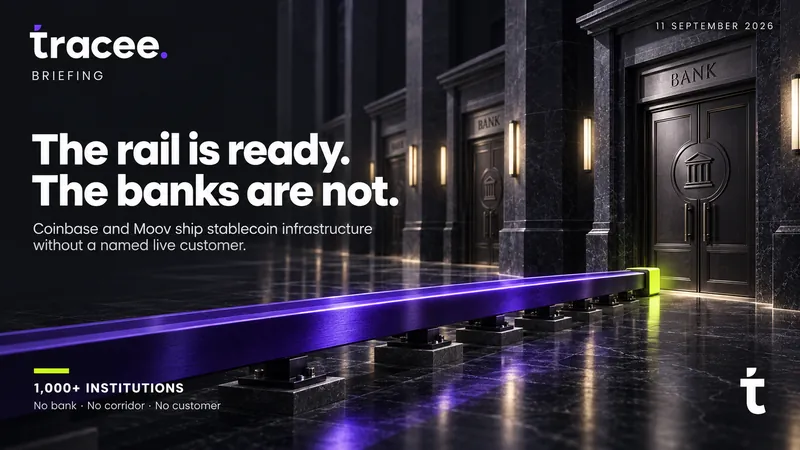
Coinbase and Moov gave 1,000-plus community banks and credit unions stablecoin payment infrastructure five days before the Senate's Clarity Act cloture vote.
Read briefingKfW issued its third eWpG blockchain bond on June 9, EUR 100M, with three experiments scheduled during the bond term: a chain migration from Polygon to SWIAT/RL1…
Read briefingSuggest a news item or request a private briefing.
Public briefings publish on no fixed cadence. Private briefings, written for one institution and one decision, are part of the consulting engagement formats.
Book a discovery call