
Schroders just tokenised a money market fund on J.P. Morgan's rails, and for the first time Kinexys carried someone else's fund, not the bank's own.
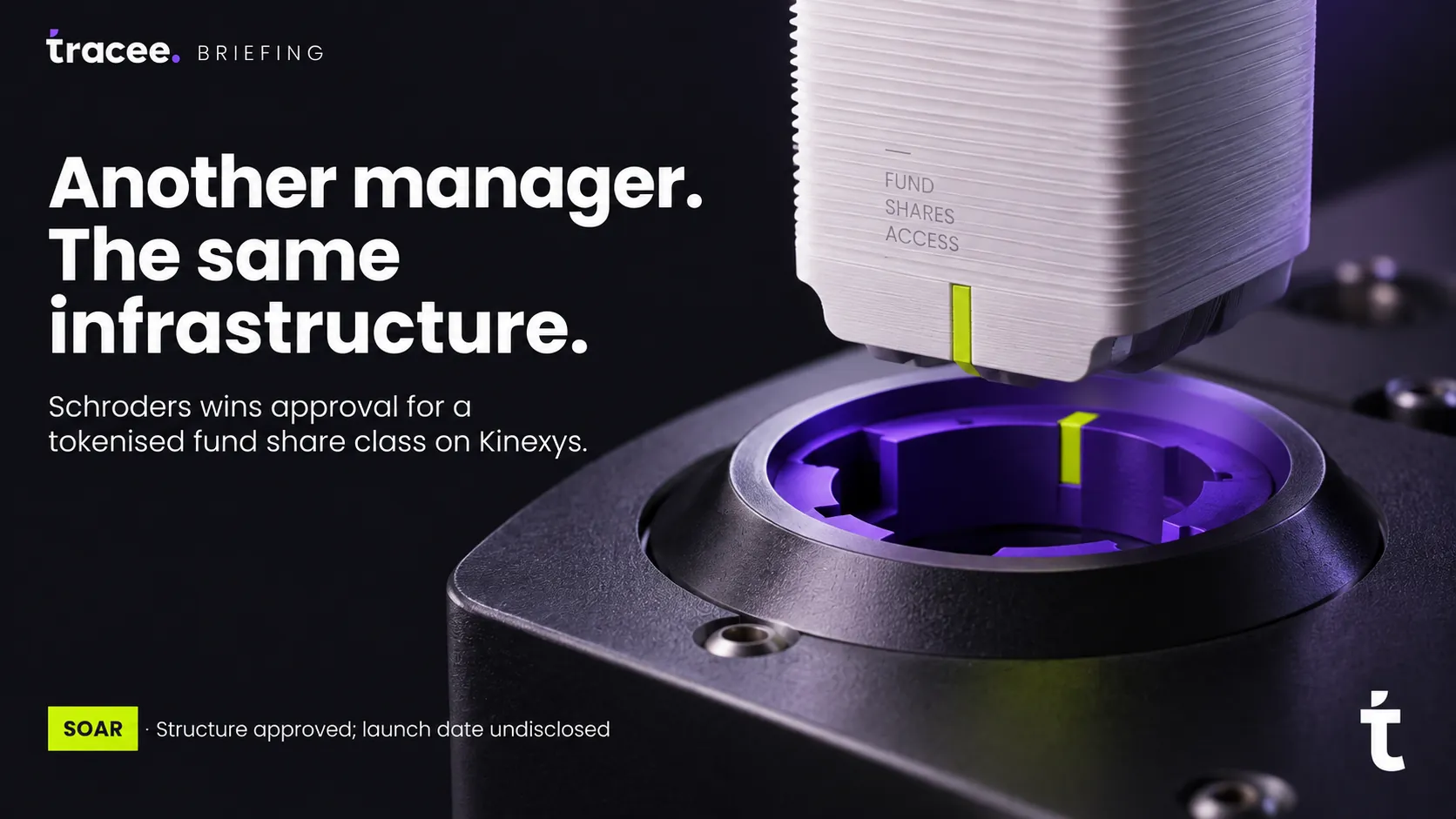
One regulatory approval, one line about access, efficiency and security.
The approval itself is one paragraph. What it changes about who is allowed to build on Kinexys is not.
Four claims sit inside one approval. Two are confirmed. Two are open questions the announcement does not answer.
Rated against what regulators and the two firms have actually confirmed, not what the framing implies:
| Claim | Status | Verdict |
|---|---|---|
| Central Bank of Ireland approves SOAR share class | Shipped | Real. A national regulator signed off on a tokenised share class of an Ireland-domiciled fund, not a sandbox pilot. |
| Share class runs on J.P. Morgan's Kinexys | Shipped | New. First time a competing asset manager's actively managed fund has used Kinexys rather than a J.P. Morgan-owned product. |
| Fund size, investor base, go-live date | Undisclosed | Not stated. The announcement covers structural approval only. |
| Kinexys opens to other asset managers | Unconfirmed | Not implied. One fund, one manager. No commercial terms disclosed for anyone else. |
A regulator approved a structure and a bank agreed to host a rival's fund on its rail. Everything about scale is still unknown.
Kinexys used to be J.P. Morgan's own rail. SOAR is the first time it carries someone else's fund.
Strip the announcement down to who sits where in the stack.
- The rail didn't change, the tenant did. Kinexys already tokenises J.P. Morgan's own funds. SOAR is the first outside manager on it.
- J.P. Morgan now earns infrastructure economics, not just fund economics. Hosting a competitor's fund is a different business than running your own.
Three reasons this is bigger than one Irish fund approval.
Kinexys just became infrastructure-as-a-service, not a proprietary product. Every prior Kinexys headline tracee has covered, the JLTXX filing, the Treasury redemption pilot, ran through funds J.P. Morgan itself issued. SOAR is the first evidence the bank will host a competing manager's fund on the same rail. That is a materially different business: toll revenue from every issuer who plugs in, instead of margin on J.P. Morgan's own balance sheet.
This is an actively managed fund, not a passive reserve vehicle. BUIDL, JLTXX, MONY, and State Street's SSCXX are short-duration, largely passive products built to qualify as eligible reserves under US stablecoin rules. SOAR is run by Schroders' credit team with active positioning. Tokenisation infrastructure reaching active management, not just T-bill baskets, is a wider addressable market than the reserve-fund race tracee has tracked so far.
The approval runs through Dublin, not Washington. Every US tokenised-fund story tracee has covered clears through the SEC or a GENIUS Act-adjacent federal charter. SOAR clears through Ireland's UCITS regime, the domicile of choice for European and globally distributed funds. If Kinexys can host a UCITS-approved tokenised share class, the addressable market for the rail extends well beyond the US eligible-reserve fight.
An approval is not a launch. Five things the announcement does not tell you.
- No AUM, no go-live date. Regulatory approval of the share class structure is confirmed. Assets under management, investor commitments, and a launch date are not.
- One fund, one manager. Nothing in the disclosure states whether other asset managers can access Kinexys on similar terms, or what J.P. Morgan would charge them.
- Investor base is undisclosed. Whether SOAR targets institutional treasuries, other asset managers, or a broader distribution channel has not been stated.
- Ireland approval is not a passporting guarantee. Central Bank of Ireland sign-off covers the Irish-domiciled structure. Regulatory treatment of tokenised UCITS share classes in other EU member states is still developing case by case.
- Kinexys' track record here is thin. The platform has run J.P. Morgan's own products at scale. Hosting a third party's actively managed fund, with a different manager's operational dependencies, is unproven.
tracee has covered Kinexys twice as J.P. Morgan's own product. This is the first time it shows up as someone else's infrastructure.
tracee's 13 May briefing on JLTXX covered J.P. Morgan filing the reserve substrate for other firms' stablecoins, JPMD on the liability side, JLTXX on the asset side, Kinexys running both, but Kinexys itself stayed a J.P. Morgan-owned rail. tracee's 9 May briefing on the tokenized Treasury pilot showed Kinexys as the cross-border cash leg in a six-actor pilot, again operating on J.P. Morgan's own book. SOAR is the first Kinexys story where the fund on top belongs to someone else entirely.
It also lands in a week of custody infrastructure moves that are not directly connected but rhyme structurally: BitGo launched Link, connecting external exchange accounts to its custody interface, on 3 August, and Spotex integrated with BitGo for regulated custody and prime brokerage on 5 August. Three different infrastructure providers, in the same week, each making the case that institutional balance sheets should route through their rail rather than build their own. SOAR is the highest-profile version of that pitch, because the customer is a rival asset manager, not a trading venue.
tracee's 17 June briefing on State Street's SSCXX noted that five custodians now offer structurally identical reserve products and that distribution, not product design, is the differentiator. SOAR tests the same question one layer up: whether a bank's tokenisation rail can win distribution among managers who compete with the bank's own fund business.
The fund is small and undisclosed. The precedent is the story.
Schroders' SOAR approval is not, on the numbers available today, a large event: no disclosed AUM, no confirmed launch date, one fund. What it establishes is that J.P. Morgan is willing to let Kinexys host a competing asset manager's actively managed fund, cleared through an EU regulator rather than a US one, and that a major UCITS domicile is willing to approve the structure. Every prior Kinexys briefing tracee has published involved J.P. Morgan's own funds on its own rail. This is the first time the rail itself, not the fund on top of it, is the product being tested.
Watch three things:
- Whether SOAR discloses AUM or a launch date. The first real signal of demand, not just regulatory approval.
- Whether a second asset manager announces a Kinexys-based tokenised share class. One customer is a pilot. Two is a platform.
- Whether the Central Bank of Ireland publishes general guidance for tokenised UCITS share classes. Would signal Ireland positioning as the domicile of choice for tokenised European funds, the way France's ACPR did for MiCA-licensed stablecoins.
Common questions about Schroders' SOAR and tokenised fund infrastructure.
What did Schroders and J.P. Morgan just announce?
Why is this different from BlackRock's BUIDL or J.P. Morgan's own tokenised funds?
How big is the SOAR fund and when does it launch?
Does this mean other asset managers can now use Kinexys?
Where can I read the original source?
Related briefings on the same rails.
Pontes went live with 13 banks and four DLT operators settling wholesale tokenised assets in central bank money.
Read briefingNeither grant buys a live payment. Both fund the governance and reconciliation systems behind pilots that were already running on Stellar.
Read briefing
The OCC conditionally approved Bastion's national trust charter on 18 September, Corporate Decision #1391.
Read briefing
ECB Executive Board member Isabel Schnabel told Jackson Hole that central banks must put their own money on-chain or lose the settlement layer to dollar stablecoins.
Read briefing
Keeta Stablecoins move natively across Keeta Network, Ethereum, Solana and Base via LayerZero's Omnichain Fungible Token standard.
Read briefing
Revolut began rolling out EURR to customers in Denmark, Poland and Portugal while delisting Tether's USDT across the EEA under MiCA. Bridge, the Stripe-owned…
Read briefingSuggest a news item or request a private briefing.
Public briefings publish on no fixed cadence. Private briefings, written for one institution and one decision, are part of the consulting engagement formats.
Book a discovery call