
Revolut ships a euro stablecoin: the neobank rents the rails instead of owning the mint.
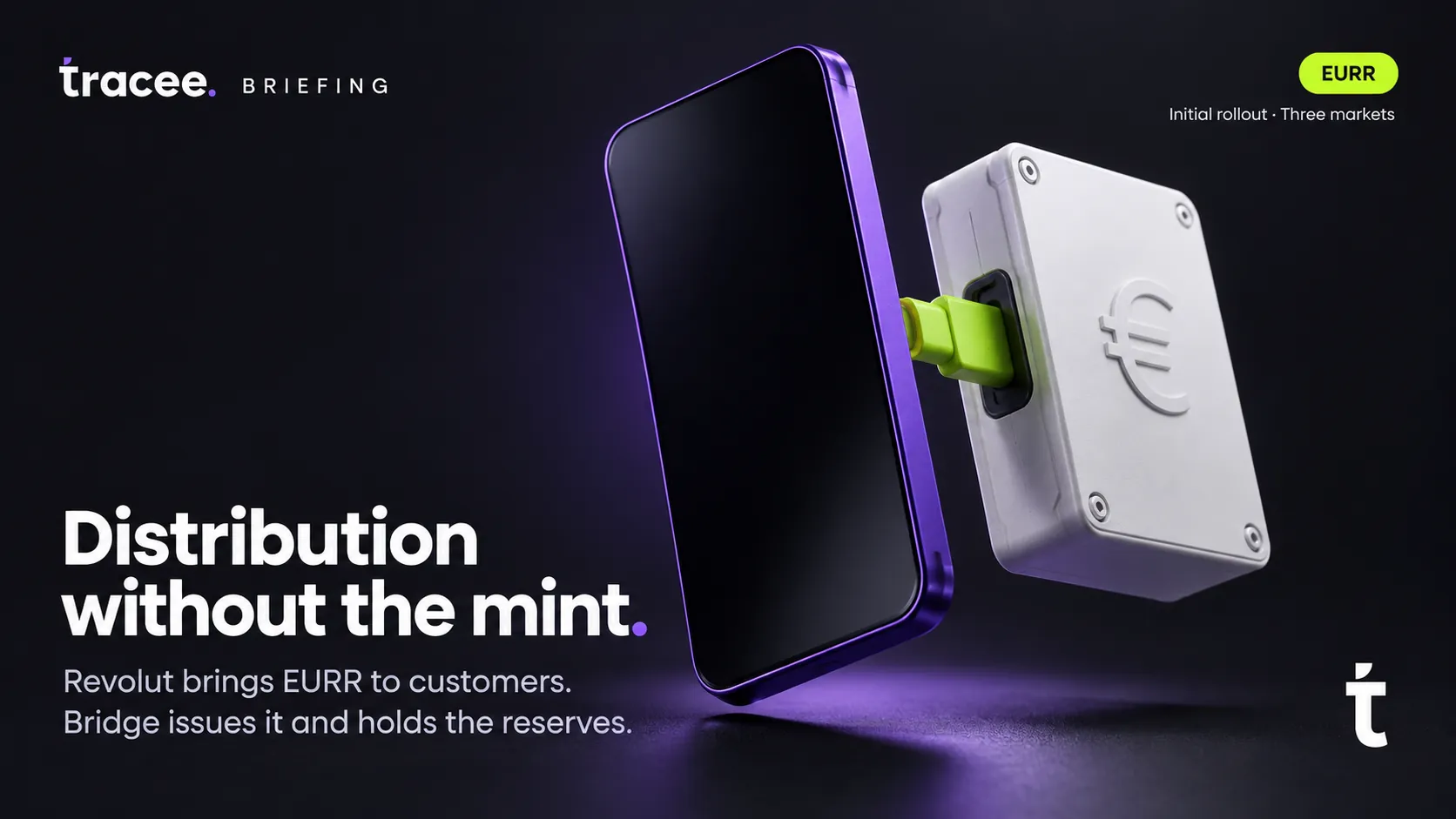
One launch. Two companies doing very different jobs.
Read past the "Revolut launches a stablecoin" headline and the interesting fact is who is not on the hook for the reserves. Revolut distributes. Bridge issues.
Five moves in one announcement. Only two of them are actually new.
Strip the launch copy and rate each piece on its own merits.
| Move | Status | Verdict |
|---|---|---|
| EURR live in Denmark, Poland, Portugal | Shipped | Narrow, real. About 2M of Revolut's 80M customers have access on day one. |
| Issuer and distributor split | Shipped | The wedge. Bridge issues and holds reserves; Revolut never touches the mint. |
| USDT delisted across EEA and Switzerland | Shipped | Forced, not chosen. Tether skipped MiCA authorization; the rule did the work. |
| Deployment on Ethereum and Polygon | Shipped | Table stakes. Standard chain choice for a 2026 MiCA token, not a differentiator. |
| Additional currency tokens | Exploring | Signaled only. Separate regulatory pathways, no launch date. |
A euro stablecoin going live is routine in 2026. An issuer and a distributor formally splitting the job is not, and it is the piece that will get copied.
Four layers, and Revolut's balance sheet sits outside all of them.
Here is what carries EURR from a customer's phone to the reserves backing it.
Two things the diagram makes visible:
- Revolut's balance sheet never appears. The reserves sit on Bridge's books, under Luxembourg's CSSF, not under Revolut's Cyprus license or any Revolut banking entity.
- The scarce layer is the top one. Any MiCA-licensed issuer can mint a euro token. Only a handful of platforms bring 80 million pre-KYC'd customers to route it through.
Two reasons this outranks another euro stablecoin.
Issuance and distribution just formally unbundled. Circle issues and distributes EURC. Societe Generale-FORGE issues and distributes EURCV. Revolut inverted that: it brought the customer relationship and the MiCA distribution license, and let Bridge carry the issuer obligations, the reserve custody, and the redemption liability. That is a licensing and balance-sheet decision as much as a product one, and it gives every other neobank sitting on a large KYC'd base a template that does not require becoming an e-money issuer first.
MiCA just showed it has teeth, not just paperwork. Tether is the largest stablecoin issuer in the world by circulation, and it is still being removed from one of Europe's largest retail platforms because it chose not to file for authorization. A regulation is only as credible as the enforcement that follows it, and a forced delisting of the incumbent is a sharper signal than another compliant launch would have been on its own.
The launch copy is thin on what EURR is not. Take the gaps seriously.
- Not a deposit. EURR is an e-money token under MiCA. Holders get none of the protection a deposit-guarantee scheme would provide if Bridge failed.
- Single-issuer dependency. Every euro EURR that Revolut ever distributes rests on Bridge's reserve management and solvency. The split that makes the model scalable also concentrates counterparty risk in one infrastructure firm.
- Reach is narrow at launch. Three EEA markets and roughly 2 million customers, against 80 million Revolut serves across the region. The template exists; the scale does not yet.
- The field is already crowded. EURC, EURCV, and the 37-bank Qivalis consortium token are all competing for the same euro-stablecoin use case, which fragments liquidity rather than consolidating it around one rail.
Two bets on the euro stablecoin, running in parallel.
Europe now has two competing models for who owns euro stablecoin distribution. Wholesale banks are pooling reserves through consortium structures like the 37-bank Qivalis token, aimed at interbank and corporate settlement. Revolut just showed the retail counterpart: a single distributor with a large existing customer base, paired with a licensed issuer that specializes in reserve management. Neither model has won yet, and they are not mutually exclusive.
The Tether removal is not an isolated MiCA enforcement action. The European Commission's targeted consultation on revising MiCA, running to 31 August 2026, is examining whether to extend the regulation's scope to stablecoins issued outside the EU and to tokenized deposits, precisely the kind of gap that let USDT circulate in Europe without full authorization for as long as it did. The direction of travel is toward closing that gap, not loosening it.
The token is not the news. The org chart behind it is.
EURR is not a breakthrough stablecoin. It is proof that a neobank can capture stablecoin revenue and relevance without ever becoming an issuer, by pairing its distribution license with a specialist reserve manager. Every large retail platform with a MiCA footprint and no appetite to run reserve compliance now has a template to copy rather than a decision to build from scratch.
Watch three things over the next two quarters:
- EEA rollout pace beyond the first three markets. Tells you whether the 2M-customer beachhead scales toward the full 80M base.
- Whether other neobanks strike similar issuer partnerships. Tells you if the distribution-not-issuance model gets copied or stays a one-off.
- The outcome of the MiCA review consultation closing 31 August 2026. Tells you whether non-EU issuers like Tether get a path back into the EU or stay locked out for good.
Common questions about Revolut's EURR stablecoin.
What is Revolut's EURR stablecoin?
Does Revolut issue EURR itself?
Why is Revolut removing Tether's USDT from Europe?
Is EURR the same as a bank deposit?
How does EURR compare to Circle's EURC or SG-FORGE's EURCV?
Where else is EURR available and what comes next?
Related briefings on the same rails.

Coinbase and Moov gave 1,000-plus community banks and credit unions stablecoin payment infrastructure five days before the Senate's Clarity Act cloture vote.
Read briefing
The OCC conditionally approved Bastion's national trust charter on 18 September, Corporate Decision #1391.
Read briefing
The Central Bank of Ireland approved Schroders' SOAR share class, a tokenised money market fund built on J.P. Morgan's Kinexys platform.
Read briefing
PayPal, M0 and MoonPay took PYUSDx public: an infrastructure platform that wraps PYUSD into branded, company-issued stablecoins.
Read briefingBNY moved Treasury-backed reserves tied to Ripple's RLUSD and OpenEden's USDO after Fedwire Securities Service's daily close.
Read briefing
KPMG issued an unqualified opinion on Tether International's FY2025 financial statements, its first full audit after two years of quarterly attestations, confirming…
Read briefingSuggest a news item or request a private briefing.
Public briefings publish on no fixed cadence. Private briefings, written for one institution and one decision, are part of the consulting engagement formats.
Book a discovery call