
BNY tested a Treasury settlement after Fedwire's daily close, using two stablecoin issuers whose reserves it already custodies on both sides of the trade.
A client letter says the weekend gap just closed once, and doesn't say for whom else it would close the same way.
The sentence names the two issuers and skips the fact that makes the test possible at all: BNY already custodies both of their reserves.
Four claims sit inside the letter, and only one of them describes something that already happened.
Rated against what the letter and its coverage actually disclose:
| Move | Status | Verdict |
|---|---|---|
| After-hours Treasury transaction, post-Fedwire close | Shipped | One test, disclosed after the fact. BNY moved Treasury-backed reserves tied to RLUSD and USDO once Fedwire Securities Service's daily close had passed. No transaction size, exact date, or independent confirmation beyond BNY's own letter is disclosed. |
| BNY custodies both issuers' reserves already | Shipped | Not new, but the reason the test worked. BNY is RLUSD's primary reserve custodian and already provides custody and investment management for OpenEden's tokenized Treasury fund, so the transaction never needed a bank outside BNY's own books. |
| Tokenized Treasuries and pilot trades on BNY's private blockchain | Exploring | Dated, not delivered. BNY says "by the end of 2026," with no named counterparty, asset size, or chain disclosed. |
| "Always-on" settlement of conventional and tokenized Treasuries | Pending | 2027 target, one full cycle away. The single test disclosed this week sits an entire year ahead of the capability BNY says it is building toward. |
One row is a live, if unverified, transaction. The other three are a custody fact already true before this letter and two dated promises.
Two rival stablecoins, one Treasury custodian, and a ledger that doesn't need Fedwire open to move.
The transaction never left the bank that already held both issuers' collateral.
- The test never left BNY's own ledger. Both reserve pools already sat inside BNY's custody, so moving money after hours meant updating internal book entries, not routing a trade through the Fed's own rails.
- Fedwire's calendar is the constraint that's still there. The test worked around Fedwire's daily close; it didn't reopen Fedwire. Any leg that needs a bank outside BNY's custody still waits for business hours.
Stablecoins settle every day of the week. Their government-debt collateral still keeps banker's hours.
The gap this test targets is real and structural, not cosmetic. RLUSD and USDO both trade around the clock, but the short-dated Treasuries backing them settle through Fedwire, a system that runs on business days. A redemption wave that lands on a Saturday hits collateral that is, in the strictest sense, frozen until Fedwire reopens. BNY's test is a bet that the fix sits at the custodian layer, not at the Fed.
BNY didn't need the market's cooperation to run this test, because BNY already is the market for these two issuers. RLUSD's reserves and OpenEden's Treasury fund both sit in BNY's custody today, which is what let the bank move assets after Fedwire's close without a second institution's rails involved at all.
That framing cuts both ways. It's a genuine capability, proven once, inside one bank's books. It says nothing yet about whether a stablecoin issuer whose reserves sit with a different custodian, or split across several, gets the same after-hours flexibility, since that would require either Fedwire itself to extend its calendar or every custodian in the chain to offer the same internal workaround BNY just demonstrated on its own clients.
A single test between two existing clients is not a market capability. Four questions the letter leaves for the reader to chase down.
- No transaction size or date disclosed. The client letter describes the mechanism, not the trade. There is no dollar figure, timestamp, or confirmation independent of BNY's own account.
- Both issuers already bank with BNY. RLUSD and USDO aren't a representative sample; they're BNY's own custody clients. Whether a custodian without an existing relationship on both sides of a trade can replicate this is untested.
- Fedwire itself didn't move. The test avoided Fedwire's daily close; it didn't extend it. Any leg of a transaction that needs a bank outside BNY's custody still waits for Fedwire's business hours.
- "Always-on" is a 2027 promise with a 2026 placeholder in between. Tokenized Treasury pilot trades are dated only "by the end of 2026," with no named counterparty or asset size attached yet.
BNY already sits underneath more than one rival stablecoin's reserves, and this test is what that concentration is actually for.
BNY's reach into stablecoin reserves is not new. Tracee's 11 July briefing noted that USDC's reserve management stays with BNY Mellon even after Circle's own OCC-chartered trust bank opened. Tracee's coverage of the five-custodian reserve-fund race counted BNY Dreyfus's BSRXX fund alongside BlackRock, Goldman Sachs, JPMorgan, and State Street as one of five structurally identical products competing for the same issuer cash. RLUSD and USDO now add a second data point: BNY isn't just one custodian among several, it's the custodian sitting on both sides of a transaction between two issuers who compete with each other for the same dollar-stablecoin market.
The 24/7 ambition also has a mirror image already in the record. Tracee's 10 July briefing on SWIFT's blockchain ledger found the same asymmetry from the other direction: tokenized deposits already move continuously on that ledger, but final settlement still clears through SWIFT's correspondent banking rails underneath it. BNY's test is the same seam approached from the Treasury side: the token or reserve leg wants to run non-stop, and the settlement leg it ultimately depends on, Fedwire in this case, still runs on a five-day week.
As stablecoin reserves scale, a redemption promise that quietly depends on the day of the week is a liquidity question regulators, not marketers, will end up counting the hours on.
The after-hours transfer is real, and it happened inside one bank's own books. The 24/7 Treasury market it's named after is still a 2027 promise.
BNY's test proves a large custodian can move Treasury-backed reserves on its own ledger outside Fedwire's operating calendar, when both sides of the trade already bank with it. It does not prove Fedwire's calendar is changing, and it does not prove a stablecoin issuer whose reserves sit elsewhere gets the same flexibility. Treat this as a real capability demonstrated once, on the narrowest possible sample, with a 2027 target attached that depends on scaling far beyond it.
Watch three things:
- Whether BNY discloses a transaction size, date, or a counterparty bank outside its own custody book for this or a follow-up test.
- Whether BNY's private-blockchain tokenized Treasury pilot ships by its stated end-of-2026 deadline, and with which counterparty.
- Whether the Federal Reserve extends Fedwire Securities Service's own operating calendar, the one dependency this test worked around rather than removed.
Common questions about BNY's after-hours Treasury settlement test.
What did BNY actually disclose about after-hours Treasury settlement?
Which stablecoins were involved, and does BNY custody both of their reserves?
Does this mean Fedwire now operates 24/7?
What is BNY's stated timeline for tokenized Treasuries and always-on settlement?
Where can I read the original source?
Related briefings on the same rails.
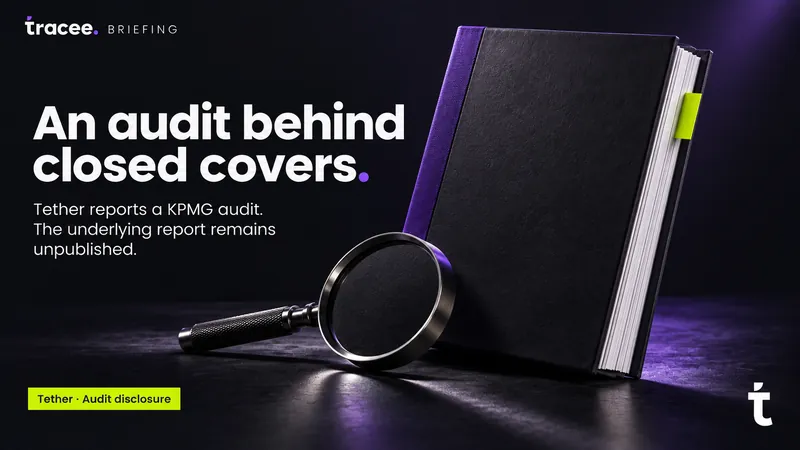
KPMG issued an unqualified opinion on Tether International's FY2025 financial statements, its first full audit after two years of quarterly attestations, confirming…
Read briefing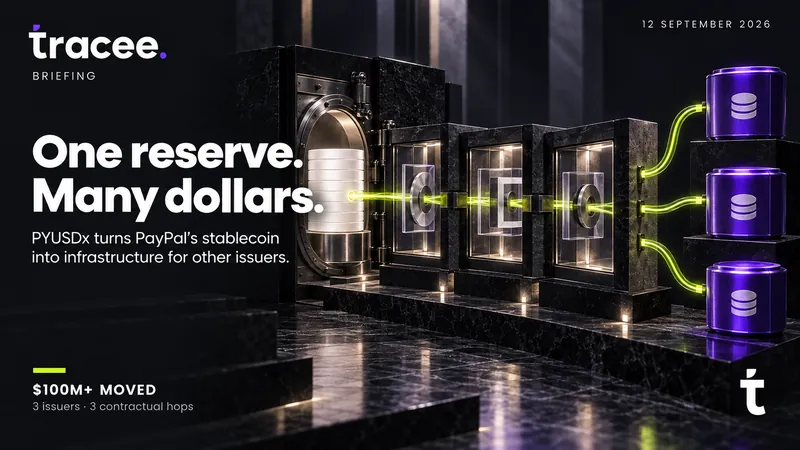
PayPal, M0 and MoonPay took PYUSDx public: an infrastructure platform that wraps PYUSD into branded, company-issued stablecoins.
Read briefing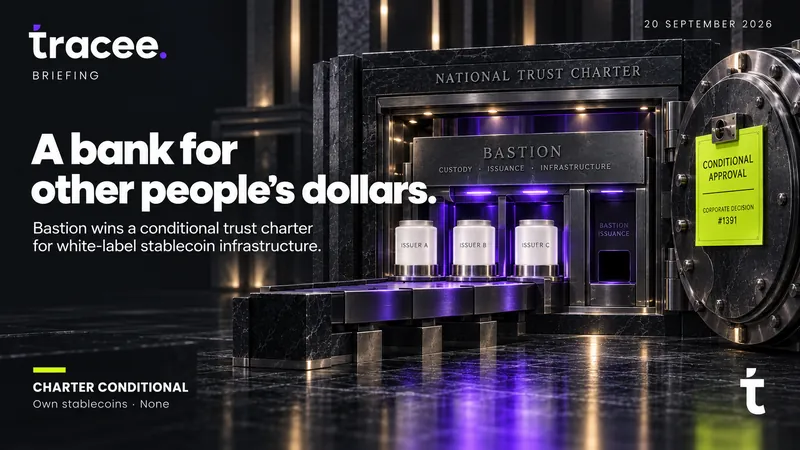
The OCC conditionally approved Bastion's national trust charter on 18 September, Corporate Decision #1391.
Read briefingKfW issued its third eWpG blockchain bond on June 9, EUR 100M, with three experiments scheduled during the bond term: a chain migration from Polygon to SWIAT/RL1…
Read briefing
Standard Chartered announced it is the first bank distributor of HKDAP, Hong Kong's first regulated HKD stablecoin.
Read briefing
Broadridge's Distributed Ledger Repo platform, already moving $351 billion a day, added G7 government securities to a collateral list that had been US Treasuries…
Read briefingSuggest a news item or request a private briefing.
Public briefings publish on no fixed cadence. Private briefings, written for one institution and one decision, are part of the consulting engagement formats.
Book a discovery call