
Block already runs a bank that takes deposits: the one it just asked the OCC for can't, and that's the point.
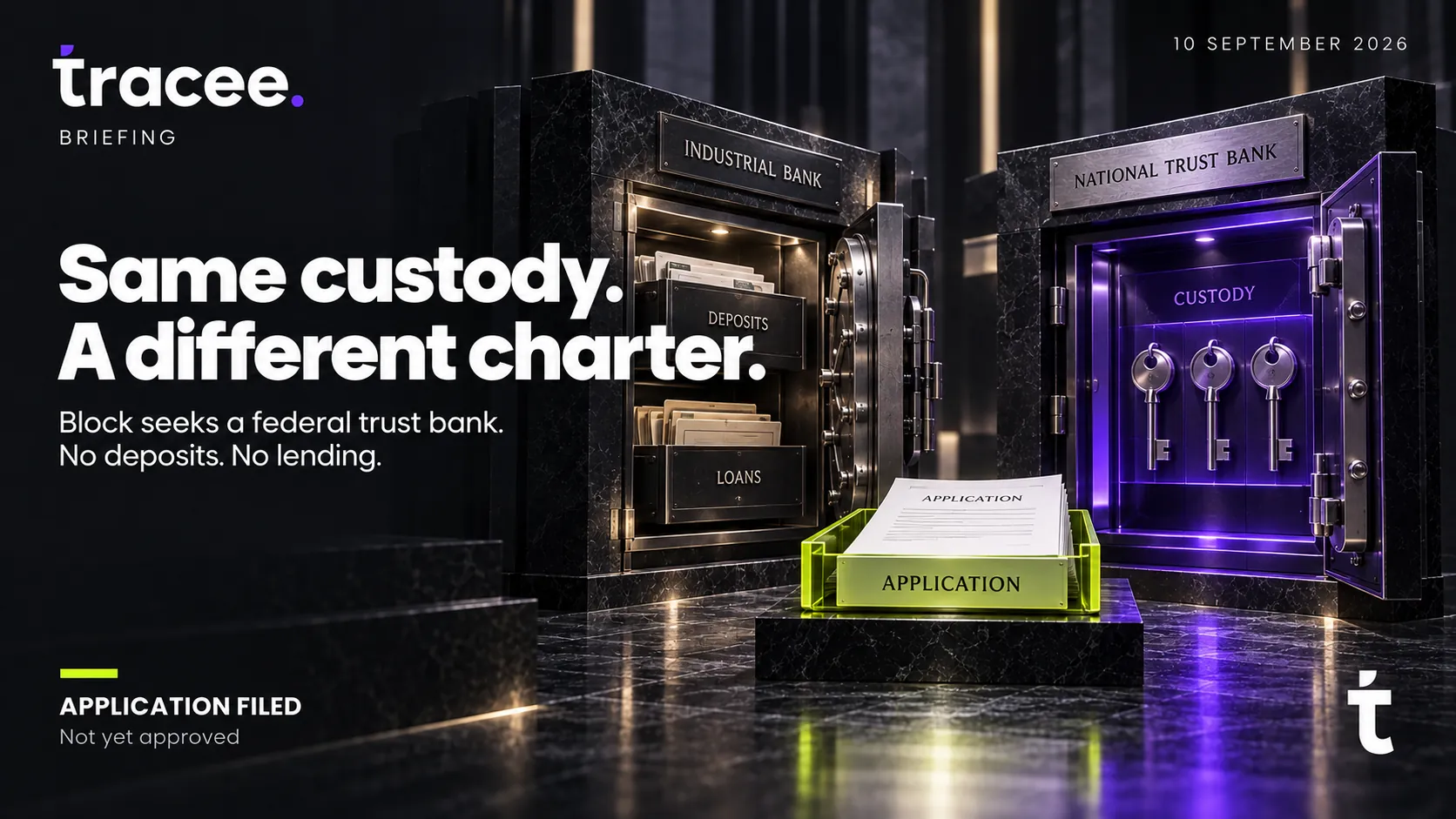
One sentence from the incoming CEO, and a second bank charter hiding behind it.
Note the reference to a bank Block already runs. This filing is for a second one, built to do the opposite of the first.
The filing bundles an entity, a limit, a hire, and a reason, and only one of them is new capability.
Four elements sit inside "Block seeks a national trust charter." Rated separately:
| Move | Status | Verdict |
|---|---|---|
| Application filed with the OCC to charter Builders Bank & Trust, N.A. | Confirmed | Real, but procedural. Dated 4 September 2026, filed under 12 CFR 5.8 and 5.10, subject to public notice and comment before any vote. |
| Bank would be uninsured and non-depository: custody only, no deposits, no loans | Confirmed | Narrower than a bank. A trust charter, not a banking license. It cannot fund itself with deposits or extend credit. |
| Lee Woolley named proposed President and CEO | Confirmed | A hire, not a launch. Ex-Treasury Department Federal Credit Union, Northern Trust, BNY Mellon: a career trust banker, not a product lead. |
| Stated rationale: consolidate 50-plus state money transmitter licenses under one federal charter | Stated | The actual ask. Preemption, not new capability. Block already self-custodies bitcoin today under the state patchwork. |
Zero of the four rows adds something Block cannot already do. All four move where it does it from.
Block already has a chartered bank. This filing is for its structural opposite, and for a seat in a specific queue.
One parent company, two charters built for opposite jobs, and a six-member cohort Builders Bank is applying to join.
- Two charters, opposite purposes. Square Financial Services proves Block already knows how to run a chartered, examined bank. Builders Bank asks for a second one that cannot touch a customer deposit, built for one job.
- The queue is the story, not the applicant. Builders Bank would be the seventh OCC-chartered crypto custody trust bank, arriving nine months after the OCC restarted approvals in December 2025 following a four-year pause since Anchorage.
This is a preemption filing dressed as a custody launch.
Block does not need Builders Bank to custody bitcoin. It already does, today, under state money transmitter licenses in more than 50 jurisdictions. The OCC filing does not add a capability. It moves an existing one onto a single federal charter, trading a fragmented state-by-state compliance surface for one supervisor as the business scales.
That timing puts Builders Bank directly inside a question tracee flagged on 31 August: what counts as a "qualified custodian" under the SEC's pending custody rule. That rule, "Amendments to the Custody Rules," sits with the White House and targets an October 2026 Commission vote. If its final text treats OCC-chartered trust banks as automatic qualified custodians, an approved Builders Bank would sit on the winning side before a single registered adviser has to pick a custodian for institutional bitcoin or stablecoin reserves.
The Woolley hire reads as intent to operate, not to shelve a charter. A career trust banker who ran a federal credit union and held senior roles at Northern Trust and BNY Mellon is a signal Block wants an examined institution on day one, not a name reserved against a future SEC ruling.
A filing is not a bank. Five reasons to read this as a queue position, not a charter.
- No approval timetable exists. The OCC gave no target date, and the December 2025 cohort took roughly a year from initial filing to conditional approval.
- Public comment is still open. Filed under 12 CFR 5.8 and 5.10, the application faces a standard notice-and-comment window, typically 30 days from publication, before the OCC can act.
- Conditional approval is not a finish line. Every 2025 crypto trust charter the OCC granted was conditional. Builders Bank, if it gets that far, would still need to satisfy operating conditions before a final, unconditional charter.
- Uninsured and non-depository by design caps what it can ever do. No FDIC insurance, no lending, no deposits: this narrows Builders Bank to custody and fiduciary services alone, a fraction of what Square Financial Services already does.
- The rule that decides the payoff still isn't public. The SEC's "Amendments to the Custody Rules" targets an October 2026 vote, but the operative text, including whether it names OCC trust banks outright, remains unreleased.
The OCC spent 2026 reopening a queue it had frozen for four years.
Anchorage Digital Bank held the OCC's only crypto national trust charter alone from 2021 until December 2025, when the agency conditionally approved five more in a single month: de novo charters for First National Digital Currency Bank and Ripple National Trust Bank, and conversions for BitGo, Fidelity Digital Assets, and Paxos. Builders Bank, filed nine months later, is the first new applicant into that reopened queue, and tracee's 31 August briefing on the SEC's custody rule already named that six-member cohort as the group positioned to benefit if the rule breaks their way.
The OCC has spent the year answering the supply side of institutional crypto custody: who is allowed to be a chartered bank for it. The SEC's still-unpublished rule answers the demand side: who is allowed to hire one. Builders Bank does not change that division of labor. It just adds a seventh name to the side of the ledger the OCC already controls.
A real filing, a real signal, and a payoff that still belongs to the SEC.
Builders Bank moves Block from custodying bitcoin under scattered state money transmitter licenses to seeking a single federal supervisor, timed to land inside whatever the SEC's custody rule says in October, if it says anything about OCC charters at all. It is not a new business. It is not yet an approval. And it does not, on its own, prove the SEC will treat an OCC trust charter as the structural edge tracee's 31 August briefing flagged as the open question. Until that text is public, Builders Bank is a queue position, well staffed and clearly timed, not a settled outcome.
Watch three things:
- Whether the OCC opens public comment and on what timeline, the first read on whether this moves faster than the year-long December 2025 cohort.
- Whether the SEC's October custody rule names OCC-chartered trust banks outright, the actual payoff Builders Bank is filed ahead of.
- Whether Woolley's team hires beyond the C-suite, the tell for whether Block is building an operating bank or parking a defensive charter.
Common questions about Block's Builders Bank charter filing.
What did Block file with the OCC on 4 September 2026?
What is Builders Bank & Trust, N.A. and what can't it do?
How is this different from Square Financial Services, Block's existing bank?
Which other companies hold OCC crypto-custody trust charters?
Where can I read the original source?
Related briefings on the same rails.
The SEC sent "Amendments to the Custody Rules" to the White House on 25 August, reviving a crypto custody rewrite that died under Gensler in 2025.
Read briefing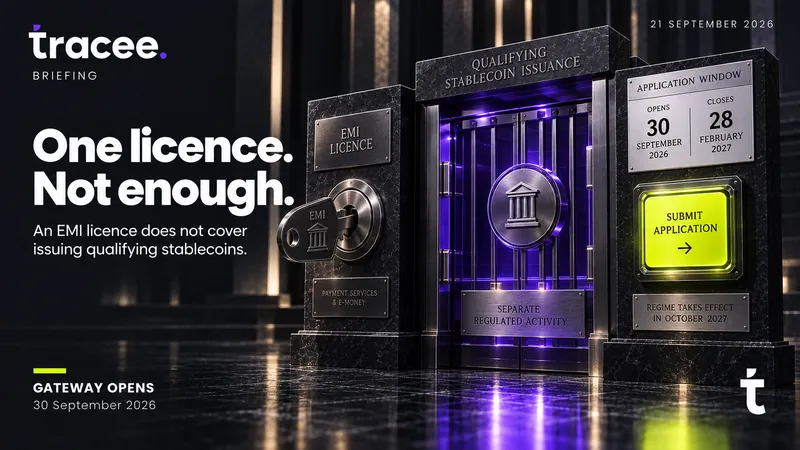
PS26/18 clarifies which of five newly regulated activities, issuing qualifying stablecoins included, an EMI licence does not cover.
Read briefing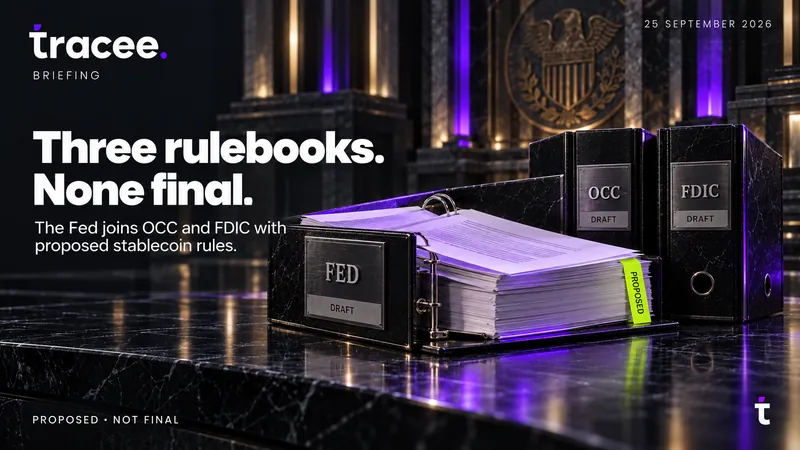
The Fed proposed GENIUS Act reserve, capital and application rules seven months after the OCC and five after the FDIC. None of the three is final yet.
Read briefing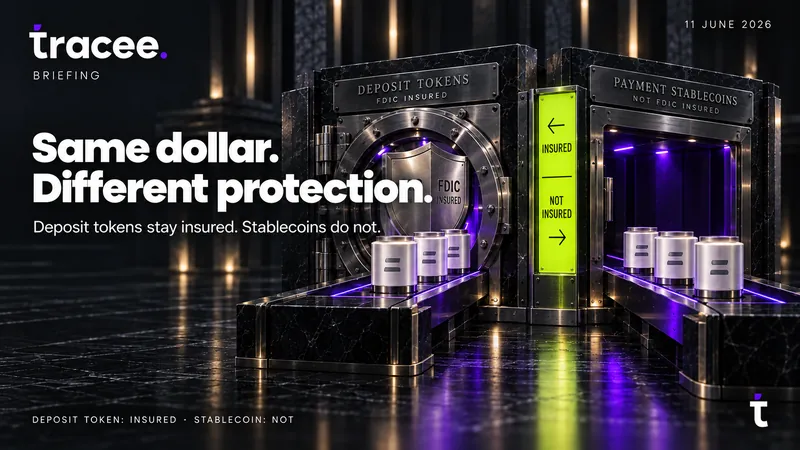
The FDIC's comment period on its GENIUS Act proposed rule closed June 9 with 338 submissions.
Read briefing
GENIUS (signed July 2025) handled the stablecoin layer. CLARITY now draws the perimeter around everything it settles against: digital commodities to the CFTC…
Read briefing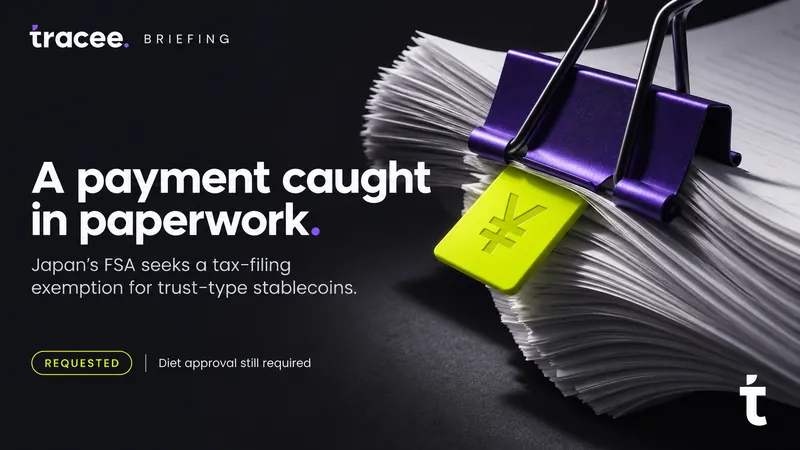
Japan's FSA filed a formal tax reform request to exempt trust-type stablecoins from filing a tax report every time a beneficiary changes, a rule built for family…
Read briefingSuggest a news item or request a private briefing.
Public briefings publish on no fixed cadence. Private briefings, written for one institution and one decision, are part of the consulting engagement formats.
Discuss your projectBook a discovery call