
SEBI tokenizes India's first corporate bond: the settlement runs on central bank digital money, and the secondary market does not exist yet.
One pilot, three bonds, and a central bank doing the settling.
Three issuers is not a market. The mechanism underneath them is the part worth taking apart.
Three bonds settled for real. The market to trade them still doesn't exist.
SEBI and RBI compressed a regulatory pilot, a new settlement mechanism and an unresolved timeline into one launch. Rated on their own merits:
| Move | Status | Verdict |
|---|---|---|
| Demat 2.0 pilot launch | Shipped | Real regulatory first. The first time an Indian corporate bond settled against RBI's wholesale digital rupee, under SEBI's Regulatory Sandbox. |
| Three bond issuances, ₹1,025 crore | Shipped | Real money, small scale. REC, L&T and IIFL raised a combined $107M from 23 investors between 7 and 9 September. |
| Atomic settlement via RBI's Unified Market Interface | Shipped | The actual new plumbing. Bond and cash legs move in the same event instead of separate systems reconciling afterward. |
| Same-day pay-in, allotment and listing | Shipped | Efficiency gain. REC had its funds the morning of bidding instead of two to three days later. |
| Secondary market and retail access | Pending | Not started. Phase two has no announced date, so none of these bonds can currently change hands. |
Four rows are working infrastructure moving real money today. The fifth is the reason a tokenized bond and a tradeable one are not yet the same thing.
Two legs, one ledger event, and a depository holding the keys.
Here is the Demat 2.0 stack end to end, from the bidding investor down to the bond terms that never changed.
- The cash leg is central bank money, not a bank or a stablecoin. RBI's wholesale digital rupee settles the payment side directly, the exact wiring the BIS and the ECB spent 2026 arguing central banks should build.
- Investors never touch a key. NSDL and CDSL hold and manage the cryptographic keys on their behalf, the same custody relationship as a conventional demat account, running on a different ledger underneath.
This is the mechanism, not the theory BIS spent 2026 asking for.
India just built the plumbing the BIS and the ECB spent the second half of 2026 telling everyone to build. BIS General Manager Pablo Hernandez de Cos told Jackson Hole that tokenized deposits and central bank money, not stablecoins, should carry serious settlement. ECB Executive Board member Isabel Schnabel argued days later that central bank money has to move on-chain or lose its anchoring role. Demat 2.0 answers both with a transaction rather than a speech: a security tokenized, a cash leg in wholesale central bank digital currency, both settling in the same event.
Most of 2026's stablecoin headlines have been about payment rails: PayPal's PYUSDx, Coinbase's community-bank rail, the 21-bank dollar consortium. India picked the opposite lane. It tokenized the security side, settled in central bank money, and skipped stablecoins entirely.
It is also the first pilot of this kind at regulator level outside the G7. Europe's equivalent bridge and Korea's tokenized-securities roadmap are both G7-adjacent, wholesale exercises. India ran the transaction in a $620B corporate bond market most of that infrastructure was never built for.
Three bonds and twenty-three investors is a pilot. Treat every number as early, not proof.
- Scale is a rounding error. ₹1,025 crore ($107M) against a $620B corporate bond market is roughly 0.02%. The plumbing works; the market has not moved onto it.
- No secondary market exists. An interim peer-to-peer transfer may be arranged through the depositories on request, but public trading and retail access are phase two, with no announced date.
- Investors don't hold their own keys. NSDL and CDSL do, on their behalf. That continues how demat accounts already work; it is not the self-custody norm crypto markets are used to, and SEBI has been explicit about the tradeoff.
- Nothing about the bond itself changed. Same ISIN, coupon, maturity, rating and covenants as a conventional issue. Tokenization moved the settlement technology, not the asset class.
- It is a sandbox, not a rule. SEBI's relaxations apply for a defined scope and period under its Regulatory Sandbox Framework. Nothing here is a standing legal change yet.
Everyone else is still arguing the theory. India already ran the transaction.
The comparison writes itself. The ECB's Project Pontes goes into production ten days after this launch, connecting market platforms to TARGET in central bank euros, a wholesale bridge among institutions that already share a currency. South Korea's FSC roadmap put a date on tokenized-securities legal recognition but pushed its own settlement layer into a won stablecoin law Seoul has not passed. India skipped the stablecoin debate entirely and wired the central bank in directly, and it went live before either of them.
The scale question is the one to watch. Broadridge's tokenized repo platform already moves $351B a day using conventional cash on the payment side. Demat 2.0 is tiny by comparison, but it is the only one of the three settling both legs, security and cash, as central bank digital currency on the same ledger.
The mechanism is proven. The market on top of it is not.
Demat 2.0 is the first working proof that a major economy outside the G7 can tokenize a security and settle it in the central bank's own digital money, atomically, without a stablecoin anywhere in the chain. Twenty-three investors and ₹1,025 crore are not a market yet, but the plumbing that the BIS and the ECB spent 2026 describing in speeches just moved real bonds in India.
Watch three things over the next two quarters:
- Whether SEBI names a date for phase two. Secondary trading and retail access are the difference between a pilot and a market.
- Whether issuance moves past three names. REC, L&T and IIFL are large, well-rated borrowers. A mid-tier or first-time issuer testing the rail would say more about the ceiling.
- Whether depository-held keys become the template other regulators copy. It is the opposite of crypto's self-custody norm, and it may be the version institutional regulators actually want.
Common questions about Demat 2.0 and India's tokenized bond pilot.
What is Demat 2.0?
How does the settlement actually work?
Which bonds have used Demat 2.0 so far?
Can investors trade these tokenized bonds?
Who holds custody of the tokenized bonds?
Related briefings on the same rails.
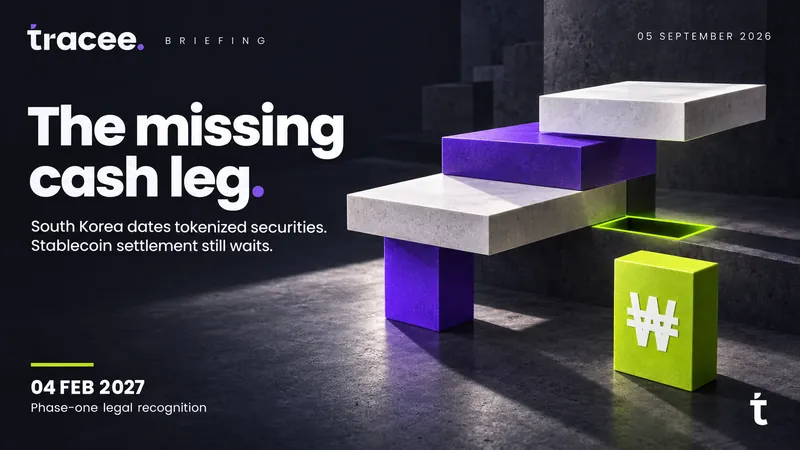
South Korea's FSC unveiled a three-phase roadmap for tokenized securities, with legal recognition for institutional funds, bonds and unlisted shares effective 4…
Read briefingKfW issued its third eWpG blockchain bond on June 9, EUR 100M, with three experiments scheduled during the bond term: a chain migration from Polygon to SWIAT/RL1…
Read briefingECB Executive Board member Isabel Schnabel drew a direct structural parallel between stablecoins and money market funds at the 2026 Bank of Korea International…
Read briefingJapan's dominant tokenized securities platform exits R3 Corda and lands on Avalanche L1 in June 2026, making ¥439.6B in tokenized real estate and corporate bonds…
Read briefing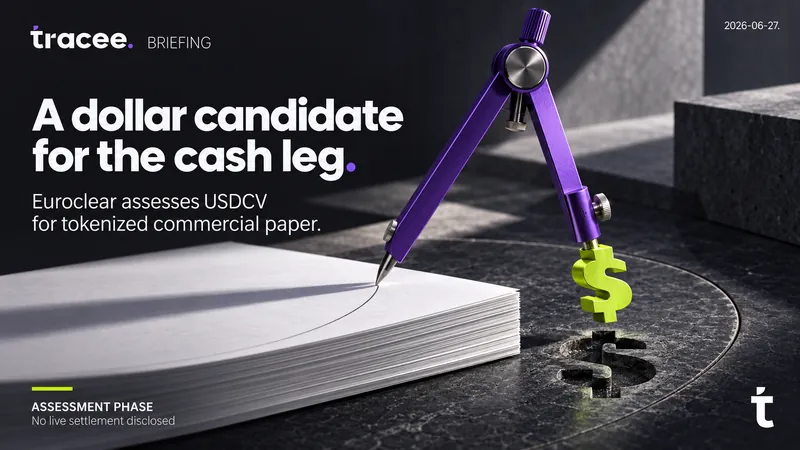
Euroclear, which settles more than $37 trillion in securities annually across 90+ markets, has designated SG-FORGE's USDCV as the candidate cash leg for…
Read briefing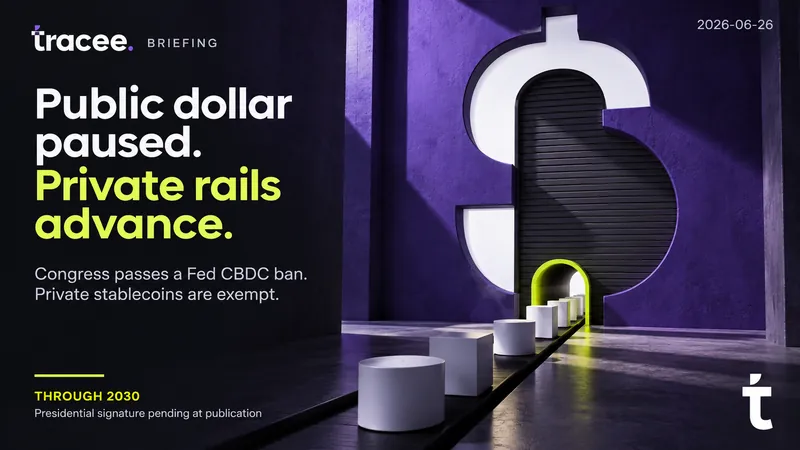
On June 22, 2026, the US Senate passed the 21st Century ROAD to Housing Act 85-5, with the House having cleared it 358-32. Buried in Section 1001: a four-year…
Read briefingSuggest a news item or request a private briefing.
Public briefings publish on no fixed cadence. Private briefings, written for one institution and one decision, are part of the consulting engagement formats.
Book a discovery call