
LayerZero and Keeta put tokenized bank deposits on four chains at once, and the bank behind them is an unnamed partner network behind a money transmitter.
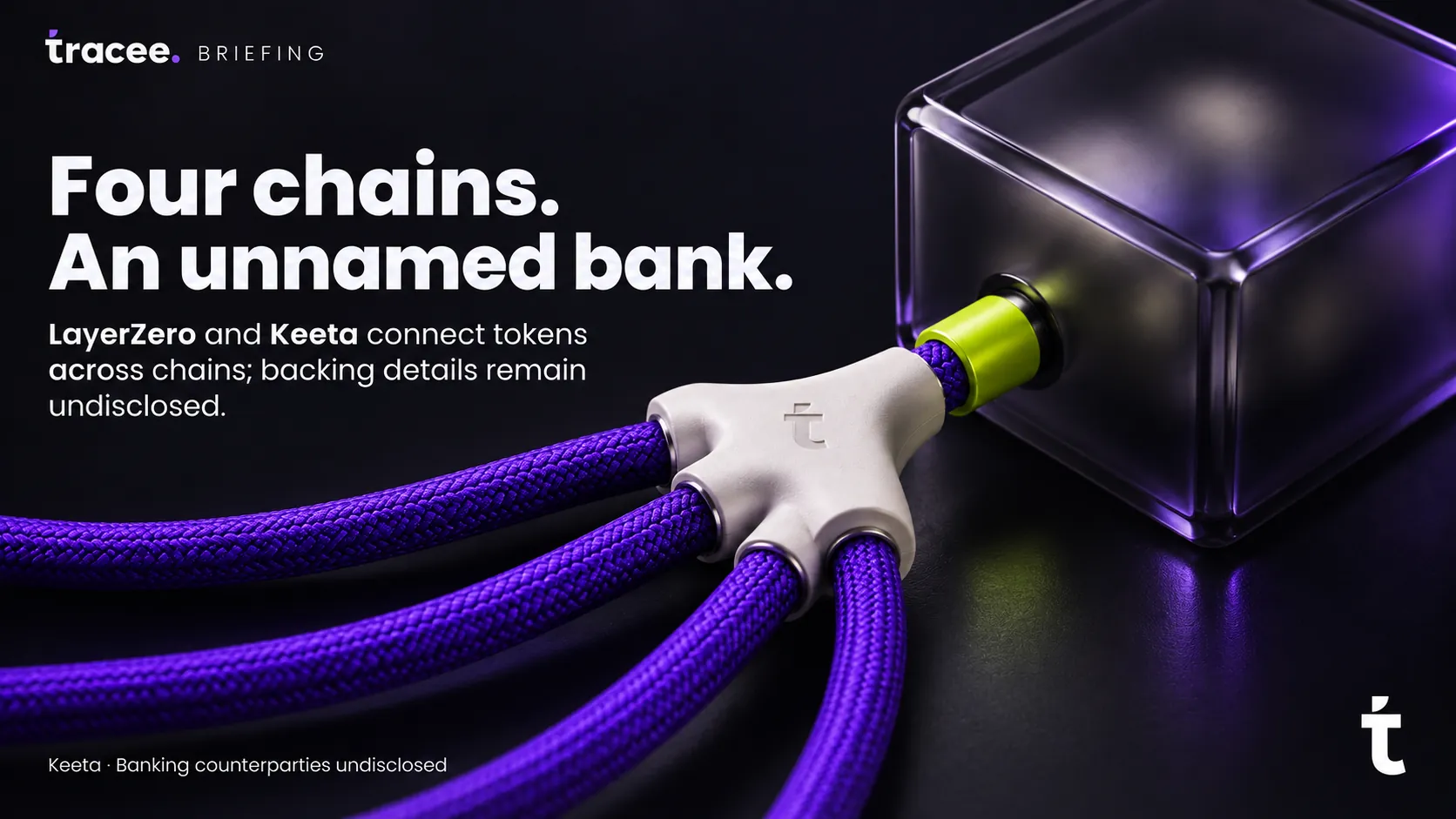
The announcement doesn't call this a stablecoin, it calls it a bank deposit, and leans on that word to do the trust work.
The sentence draws a straight line from the token to "commercial bank deposits." The word doing the least work in it is "commercial bank."
Four claims sit inside the launch, and half of them are disclosure, not delivery.
Rated against what the announcement actually discloses:
| Move | Status | Verdict |
|---|---|---|
| Multichain issuance via LayerZero OFT | Shipped | Live at announcement. Keeta Stablecoins move natively across Keeta Network, Ethereum, Solana and Base on LayerZero's Omnichain Fungible Token standard: burn on the source chain, mint on the destination, one global supply. |
| Nine-currency rollout (USD, EUR, JPY, CNY, GBP, CAD, MXN, AED, HKD) | Partial | One of nine live. Only the dollar token is confirmed at launch. The other eight are dated "later in July 2026," a roadmap line, not shipped inventory. |
| "Commercial bank deposit" backing | Undisclosed | Bivo is a money transmitter, not a bank. No partner bank is named, no deposit insurance status is disclosed, no redemption terms are published. |
| Issuer-side freeze and rate-limit control | Shipped | Confirmed in the contract design. The issuing entity keeps the ability to freeze, restrict or rate-limit any transfer, standard for an institutional compliance posture. |
Two of four rows are live and verifiable. Two are the announcement's word choice carrying weight its disclosure does not yet support.
Four layers sit between a deposit and a wallet, and only the top two are on a blockchain.
The path from fiat deposit to on-chain token runs through a licensing layer before it ever touches a chain.
- The token is one hop from the deposit, not zero. A licensed money transmitter sits between the bank account and the mint function, the same structural position a stablecoin issuer occupies.
- The compliance layer travels with the token. Freeze and rate-limit authority live in the OFT contract itself, so every chain the token reaches inherits the same issuer control.
Two banking coalitions bet on one closed rail each. Keeta bet on every open chain at once.
LayerZero's OFT standard turns the tokenized-deposit question from single-rail into every-rail on day one. The Clearing House's bank consortium is building one permissioned network for 18 banks, live H1 2027. Ripple ships RLUSD across 40-plus chains but keeps a single issuer and a single reserve. Keeta skips both patterns: a non-bank issuer, no permissioned network, four public chains simultaneously, with more to follow as LayerZero adds destinations.
This is the gap tracee's own coverage has been tracking from two sides. The Clearing House network keeps deposits FDIC-insured inside originating banks but confines them to a closed rail until 2027. Ripple's RLUSD-on-Wormhole move proved a single issuer can reach 40 chains without fragmenting its reserve. Keeta combines the reach of the second model with the "deposit" language of the first, without yet backing either claim with the disclosure both require.
Bivo is not a name a treasury desk already trusts the way it trusts JPMorgan or Standard Chartered. The pitch has to win on reach across four chains and nine currencies, not on credit standing, which is exactly why the announcement leads with distribution and leaves backing details for later.
A launch announcement is not a disclosure document. Four questions it leaves for the reader to chase down.
- No bank is named. "Partner-bank network" describes a structure, not a counterparty. Every other 2026 tokenized-deposit launch, JPMD, Citi Token Services, the SoFiUSD national-bank token, names its chartered issuer or custodian directly.
- No deposit insurance is disclosed. FDIC's June 2026 ruling drew a clean line: chartered-bank deposit tokens keep pass-through insurance, stablecoin holders do not. Keeta Stablecoins have not been placed on either side of that line.
- No redemption terms are published. No fee schedule, no redemption window, no statement of what happens to a holder's claim if Bivo's money-transmitter license or a partner bank relationship changes.
- Eight of nine currencies are still a roadmap line. "Later in July 2026" is a date range, not a commitment, and the announcement sets no fallback if it slips.
Three tokenized-deposit models are now running in parallel, and only one of them sits outside every existing regulatory perimeter.
By mid-2026, US tokenized deposits split into two tracks: bank-chartered tokens on closed or permissioned rails (JPMD, TCH's 18-bank network, SoFiUSD), and non-bank payment stablecoins seeking OCC licensing as Permitted Payment Stablecoin Issuers under the GENIUS Act (Circle, Paxos, Ripple, BitGo). Keeta fits neither. It is not a chartered bank issuing its own token, and Bivo's money-transmitter license is not a PPSI charter, so the entity behind "Keeta Stablecoins" is not the entity the GENIUS Act framework was built to supervise.
That gap matters more because the framework meant to close it is still open. Tracee's 20 July briefing covered the GENIUS Act's missed one-year rulemaking deadline: five federal regulators still hold proposals, not final rules, on exactly the reserve, custody and disclosure questions a launch like this one raises.
A non-bank issuer borrowing "bank deposit" language while final federal rules on payment-stablecoin disclosure remain unwritten is the labeling arbitrage those rules exist to close, whenever they land.
The interoperability is real and shipped. The deposit claim is a promise with no counterparty attached yet.
LayerZero's OFT standard genuinely puts one fungible token across four chains with a single global supply, and that piece of the announcement is verifiable today. The "commercial bank deposit" framing is not: it rests on an unnamed partner-bank network behind a state money-transmitter license, with no insurance status and no redemption terms on the page. Treat this as a real multichain distribution product wearing deposit-grade language it has not yet earned.
Watch three things:
- Whether Keeta or Bivo name the partner banks and state a deposit-insurance position for token holders.
- Whether the remaining eight currencies ship on the stated July 2026 timeline or slip into August.
- Whether OCC's overdue GENIUS Act final rules address non-bank, money-transmitter-backed "deposit" labeling directly, or leave the gap Keeta is currently occupying open.
Common questions about LayerZero and Keeta's tokenized bank deposits.
What did LayerZero and Keeta actually announce?
Are Keeta Stablecoins backed by an actual bank?
How is this different from JPMorgan's JPMD or The Clearing House network?
What is LayerZero's OFT standard?
Where can I read the original source?
Related briefings on the same rails.

Pontes went live with 13 banks and four DLT operators settling wholesale tokenised assets in central bank money.
Read briefing
Quant was named vendor for the tokenized deposit network 25 US banks are building, closing the watchpoint tracee flagged in June. No blockchain has been named yet.
Read briefing
Standard Chartered announced it is the first bank distributor of HKDAP, Hong Kong's first regulated HKD stablecoin.
Read briefing
ECB Executive Board member Isabel Schnabel told Jackson Hole that central banks must put their own money on-chain or lose the settlement layer to dollar stablecoins.
Read briefing
Neither grant buys a live payment. Both fund the governance and reconciliation systems behind pilots that were already running on Stellar.
Read briefing
Fiserv's platform is live with Roughrider Coin, a permissioned Solana token for 90+ North Dakota banks. No volume, supply or reserve figure is published.
Read briefingSuggest a news item or request a private briefing.
Public briefings publish on no fixed cadence. Private briefings, written for one institution and one decision, are part of the consulting engagement formats.
Discuss your projectBook a discovery call