
Broadridge just added G7 government debt to its tokenized repo rail: the platform moving $351 billion a day did not need the announcement to already be real.

Broadridge's own line is a rebuttal to every headline still calling tokenization a pilot.
Broadridge picked the same week to widen what its platform can actually hold. The scale claim was already earned; the collateral list is what changed.
Four claims in one release, rated against what DLR could already do before 2 September.
The wording claims a lot at once. Rating each piece against what DLR already ran narrows it to one real change.
| Claim | Status | Verdict |
|---|---|---|
| DLR now accepts G7 government securities as repo collateral, not only US Treasuries | Shipped | The actual news. Broadridge's global expansion adds sovereign debt from Group of Seven governments to a collateral list that had been Treasury-only since DLR's 2021 launch. |
| DLR is proven infrastructure, not a pilot | Shipped | True, and not new this week. DLR processed $7.4 trillion across August 2026 alone, five years after its first live transaction. |
| Firms can execute cross-border repo, intraday repo, and collateral moves across G7 markets via atomic settlement | Shipped | Broadens reach, per the release. Broadridge does not disclose which G7 countries' securities are live at launch versus phased in later. |
| New bank clients are using the G7 collateral capability | Undisclosed | Unconfirmed. The only participants Broadridge names, UBS and Societe Generale, were already active on the platform before this announcement. |
One collateral category joined the list. Everything else the release describes was already how DLR worked.
One rail, a longer collateral list, and a participant roster that predates the announcement.
Strip the "global expansion" framing and the change is narrow: one platform, one new category of eligible collateral, no new mechanism.
- The G7 label is the only new input. Atomic settlement, cross-border repo, and intraday collateral moves were already how DLR handled Treasuries.
- Canton is the thread that connects this to the rest of tracee's repo coverage. The network is the same one HIFI, DRW, and Marex used for a very different kind of repo trade.
The scale was never the open question. What DLR can hold as collateral is.
DLR's scale stopped being a question years ago. Tokenized repo passed the pilot stage on this platform specifically: DLR moved $365 billion a day in January 2026, a 508 percent jump from January 2025, and averaged $351 billion a day across August. What Broadridge announced this week is not that the rail works. It is that the rail now accepts a second class of collateral.
Widening that list matters more than the release states plainly. A desk can only tokenize what Broadridge has approved. Restricting DLR to US Treasuries limited its use outside dollar markets: a European or Japanese desk financing its own government's debt had no reason to route the trade through a Treasury-only rail. G7 eligibility turns DLR into infrastructure a non-US desk can use for its own book, not just a venue for parking Treasuries.
The contrast with tracee's other repo coverage is the real story. HIFI, DRW, and Marex proved a stablecoin can settle the cash leg of a repo trade on Canton. Broadridge proves the opposite path was never necessary: five years of production volume on the same network, settled in ordinary cash, with no stablecoin anywhere in the mechanism.
A collateral list is not a client list. Five things the release does not say.
- No country breakdown. Broadridge names "G7 securities" without specifying which of the seven governments' debt is live at launch versus phased in later.
- No new client for the new capability. UBS and Societe Generale are confirmed DLR participants, but neither is cited using G7 collateral specifically; the roster predates this announcement.
- The volume figures are platform-wide. The $351 billion daily average and $7.4 trillion August total describe all of DLR, not the new collateral type; there is no separate figure for G7-collateralized trades.
- It is a vendor press release. No regulator, exchange, or independent auditor has confirmed the scope or volume claims; Broadridge (NYSE: BR) is reporting on its own product.
- It says nothing about stablecoins. DLR settles the cash leg in ordinary money, so this does not bear on GENIUS Act compliance or the settlement-risk questions tracee's stablecoin-settled repo pieces engage with.
Three infrastructure bets are running in parallel on tokenized repo, and only one skips the stablecoin.
tracee's HIFI, DRW, and Marex briefing covered the first competitive onchain repo trade on Canton, US Treasuries settled against a stablecoin, USDCx, in June 2026. Broadridge runs on the same network and settles the same asset class, without a stablecoin anywhere in the chain. The two are not competing claims about which technology works; they are different answers to who holds the cash leg.
Progmat's JGB repo took a third route inside Japan: it moved the country's tokenized securities platform off Corda and onto Avalanche, then assembled 40 institutions to settle $1.6 trillion in JGB repo using stablecoins. The Clearing House's tokenized deposit network, 18 US banks committed to an H1 2027 launch, has not picked a vendor yet. Broadridge's pitch to that cohort is straightforward: DLR already runs in production, on real participant volume, without anyone needing to build new deposit-token infrastructure first.
Whether tokenized repo works was settled years ago. Whether this rail reaches past Treasuries is the open question now.
Broadridge's G7 expansion is a real, incremental move: genuinely new collateral eligibility, delivered by a platform that did not need to prove anything about scale. $7.4 trillion in monthly volume and a fifth year in production settle the question of whether tokenized repo works. The G7 announcement answers a narrower one: whether the rail can hold more than US Treasuries. On paper, it can. Broadridge has not yet shown who is actually using it that way.
Watch three things:
- Whether Broadridge discloses a country-by-country breakdown or a volume figure specific to G7 collateral in its next growth update, the only way to tell the expansion from a scope announcement.
- Whether the participant roster grows past UBS and Societe Generale toward the double-digit count Broadridge has said it expects this year.
- Whether The Clearing House's 18-bank deposit network picks Canton, or any DLR-adjacent infrastructure, once it selects a vendor ahead of its H1 2027 launch.
Common questions about Broadridge's Distributed Ledger Repo and the G7 collateral expansion.
What did Broadridge announce about its tokenized repo platform?
Is Broadridge's Distributed Ledger Repo really live, or is this a pilot?
How does the G7 securities expansion actually work?
What are the limits of this announcement?
Where can I read the original source?
Related briefings on the same rails.
Quant was named vendor for the tokenized deposit network 25 US banks are building, closing the watchpoint tracee flagged in June. No blockchain has been named yet.
Read briefing
KPMG issued an unqualified opinion on Tether International's FY2025 financial statements, its first full audit after two years of quarterly attestations, confirming…
Read briefing
PayPal, M0 and MoonPay took PYUSDx public: an infrastructure platform that wraps PYUSD into branded, company-issued stablecoins.
Read briefing
DBS and Citi settled a live USD payment via tokenized deposits on Swift's Digital Ledger in minutes on a Saturday.
Read briefing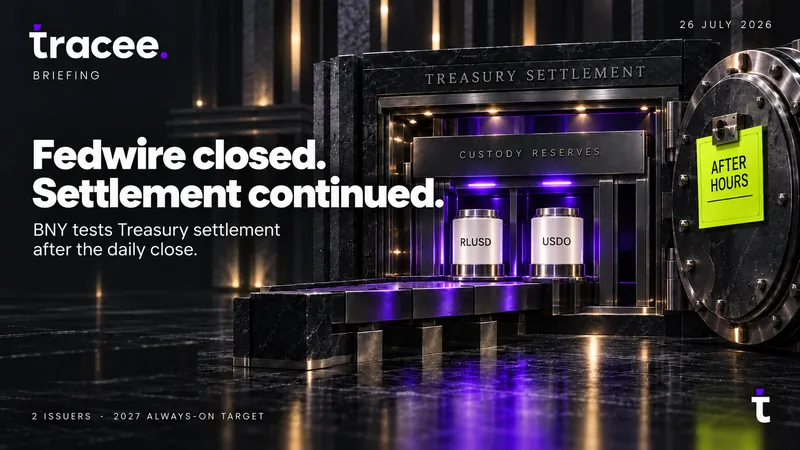
BNY moved Treasury-backed reserves tied to Ripple's RLUSD and OpenEden's USDO after Fedwire Securities Service's daily close.
Read briefing
Fiserv's platform is live with Roughrider Coin, a permissioned Solana token for 90+ North Dakota banks. No volume, supply or reserve figure is published.
Read briefingSuggest a news item or request a private briefing.
Public briefings publish on no fixed cadence. Private briefings, written for one institution and one decision, are part of the consulting engagement formats.
Book a discovery call