
Standard Chartered becomes the first bank distributor of HKDAP: Hong Kong licensed two stablecoin issuers, and Standard Chartered already owned one of them.
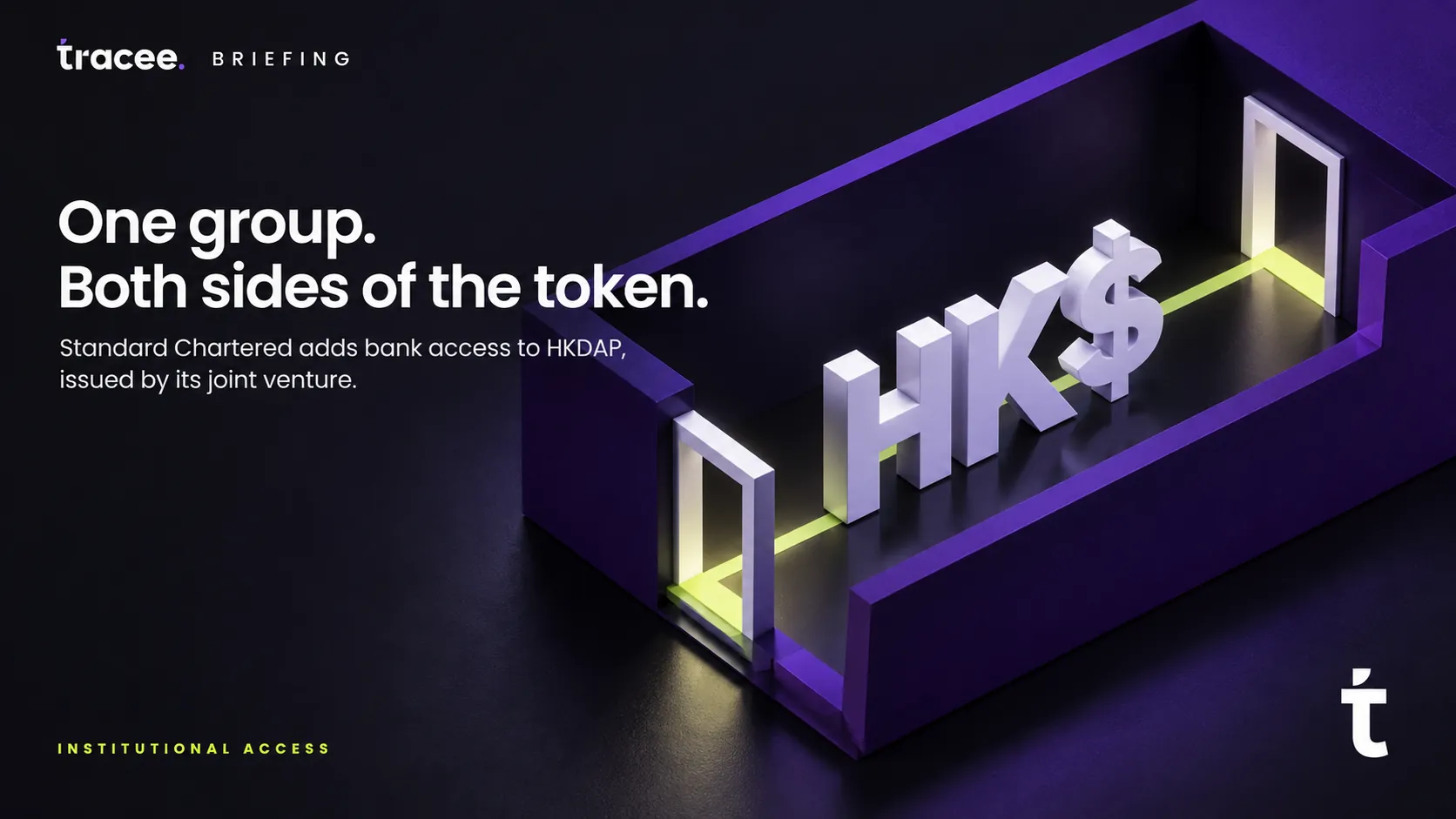
One sentence names a first. It doesn't name who owns what.
That sentence names a stablecoin and a first. It does not name the two ownership facts that decide whether the first is a competitive win or a formality. Both facts sit one layer below the press release.
A licensing decision, a product launch, and a distribution memo, folded into one release.
Standard Chartered's announcement compresses events from two different months into one story. Separated out:
| Move | Status | Verdict |
|---|---|---|
| HKMA grants Hong Kong's first stablecoin issuer licences, effective 10 April 2026 | Shipped | Two winners, from 36. Anchorpoint Financial and HSBC Hong Kong were approved out of 36 applications, a deliberately narrow regime. |
| Anchorpoint launches HKDAP in Beta Access, 12 August 2026 | Shipped | Hong Kong's first regulated HKD stablecoin. Institutional and professional investors only, distributed via HashKey Exchange and OSL Group. |
| Standard Chartered becomes first bank distributor of HKDAP, 24 August 2026 | Shipped | Its own subsidiary's product. Standard Chartered is Anchorpoint's parent and largest shareholder. |
| Tokenized money market fund settlement via HKDAP, targeted Q4 2026 | Pending | Named for the quarter, not for a partner. No asset manager has been disclosed yet. |
| Retail access to HKDAP | Pending | Not before late 2026. The current phase stays inside the Stablecoins Ordinance's institutional carve-out. |
One genuinely scarce regulatory event, one real product launch, and one distribution announcement that reads closer to an internal memo than a market win.
Trace the ownership chain, and "first bank distributor" stops being a surprise.
Here is who actually sits on each side of the HKDAP transaction.
- The distributor and the issuer share a parent. Standard Chartered is not competing for a mandate. It is opening a second door into a stablecoin its own Hong Kong entity already controls at the ownership level.
- HSBC is the only entity that could contest the claim, and hasn't. With two licensees in the market, Standard Chartered was racing against one competitor that has not announced an equivalent bank-channel program.
The scarce event happened in April. August just confirmed who moved first.
The licence, not the launch, is the scarce resource. Hong Kong received 36 stablecoin issuer applications and approved two. That decision, taken by the HKMA in April, fixed the competitive set months before Standard Chartered's August press release. Once only two entities can legally issue a regulated HKD stablecoin, one of them announcing that it distributes its own token through its own bank branch is a systems milestone, not a market outcome.
Vertical integration is the actual structure. Standard Chartered sits on every side of this transaction: as Anchorpoint's largest shareholder it controls issuance, as a licensed Hong Kong bank it now controls a distribution channel, and its own institutional clients are the intended counterparty. A client using HKDAP through Standard Chartered transacts inside one banking group, not across a competitive field of stablecoins the way a USDC or USDT holder would.
The fourth-quarter plan is where this could stop being self-referential. Standard Chartered says it will use HKDAP for tokenized money market fund subscription and settlement with international and local asset managers before year end, alongside treasury operations and cross-border payments across its own network. That is the same wedge tracee flagged when Schroders tokenised a fund on J.P. Morgan's Kinexys rails in August: a bank turning a settlement asset into fund infrastructure. Whether that plan lands with a named asset manager is the fact that will separate this from a licensing formality.
"First bank distributor" leaves out five facts. All five are worth naming.
- There was only one other bank that could have been first. HSBC holds Hong Kong's other stablecoin licence and has not announced a comparable bank-channel distribution program, so the claim rests on a field of one possible competitor.
- Institutional and professional investors only. HKDAP stays inside the Stablecoins Ordinance's initial phase; retail access is not expected before late 2026, so the payment-rail utility that makes stablecoins interesting at scale does not exist for HKDAP yet.
- The tokenized fund settlement plan has no named counterparty. Standard Chartered has stated an intention to work with international and local asset managers in the fourth quarter. No manager, fund, or signed mandate has been disclosed.
- The Hong Kong dollar is not the US dollar. The cross-border and emerging-market settlement demand that drives US dollar stablecoin volume does not transfer automatically to an HKD-denominated instrument with a far smaller base of international trade and reserve use.
- A vertically integrated issuer and distributor is a concentration, not just a convenience. Standard Chartered's roles as shareholder, issuer's parent, and distributor sit inside one banking group, a structure coverage of the announcement did not treat as a caveat worth naming.
This is Standard Chartered's second "first bank" stablecoin story in two months, in two different jurisdictions.
In July, Standard Chartered announced integrated USDC minting and redemption through Circle out of its Dubai International Financial Centre operations, covered in tracee's briefing on that launch. Between the two announcements, the bank has built the same embedded-distributor position in two jurisdictions that regulate stablecoins differently: a US dollar stablecoin it does not own in the UAE, and a Hong Kong dollar stablecoin it does own, through Anchorpoint, in Hong Kong.
Hong Kong's 2-of-36 approval rate is a narrower gate than the European Union's, where Circle and Paxos both hold MiCA licences alongside a wider issuer field, a contrast tracee covered in its MiCA equivalence briefing. The tokenized fund settlement plan Standard Chartered is targeting for the fourth quarter follows the pattern JPMorgan's Kinexys used to win Schroders' tokenized money market fund business in August: a bank rail competing to become the settlement layer for fund subscriptions, not the fund itself.
A positioning move, dressed as a competitive one.
Standard Chartered's HKDAP announcement is a positioning move dressed as a competitive one. The HKMA created a two-issuer market in April; Standard Chartered controls one of the two issuers and just opened a second, bank-branded door into that issuer's own token. None of that is disqualifying, banks are allowed to distribute what they own, but it is a smaller claim than "first" implies when only one other entity could have contested it. The plan worth tracking sits in the fourth quarter, not in this week's press release.
Watch three things:
- Whether an asset manager gets named for the fourth-quarter tokenized money market fund settlement program, the first evidence the plan has a real counterparty.
- Whether HSBC launches a competing bank-channel distribution program for its own Hong Kong stablecoin licence, turning a field of one into an actual contest.
- Whether the HKMA opens HKDAP to retail before year end, the move that would give the stablecoin an addressable market beyond institutional treasury desks.
Common questions about Standard Chartered's HKDAP distribution.
What did Standard Chartered announce on 24 August 2026?
What is HKDAP and who issues it?
Why did the Hong Kong Monetary Authority license only two stablecoin issuers?
Is Standard Chartered's "first bank distributor" claim as competitive as it sounds?
Where can I read the original source?
Related briefings on the same rails.
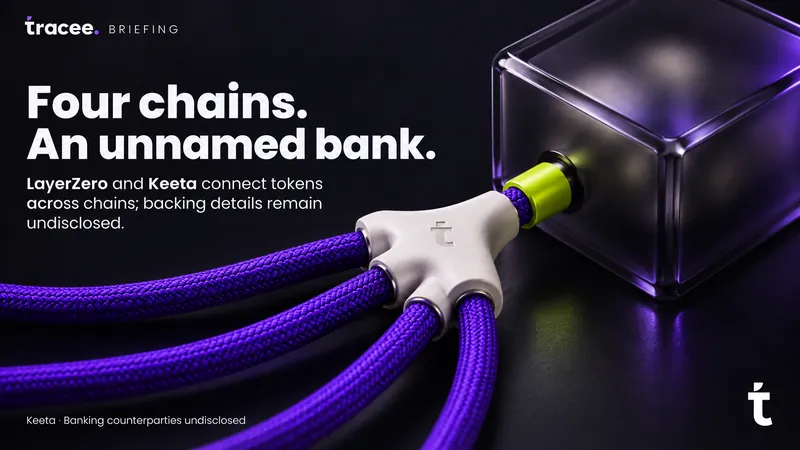
Keeta Stablecoins move natively across Keeta Network, Ethereum, Solana and Base via LayerZero's Omnichain Fungible Token standard.
Read briefingBNY moved Treasury-backed reserves tied to Ripple's RLUSD and OpenEden's USDO after Fedwire Securities Service's daily close.
Read briefing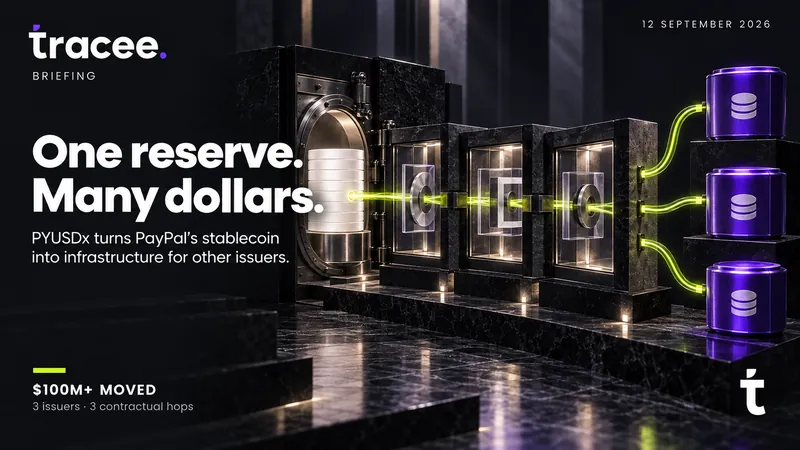
PayPal, M0 and MoonPay took PYUSDx public: an infrastructure platform that wraps PYUSD into branded, company-issued stablecoins.
Read briefing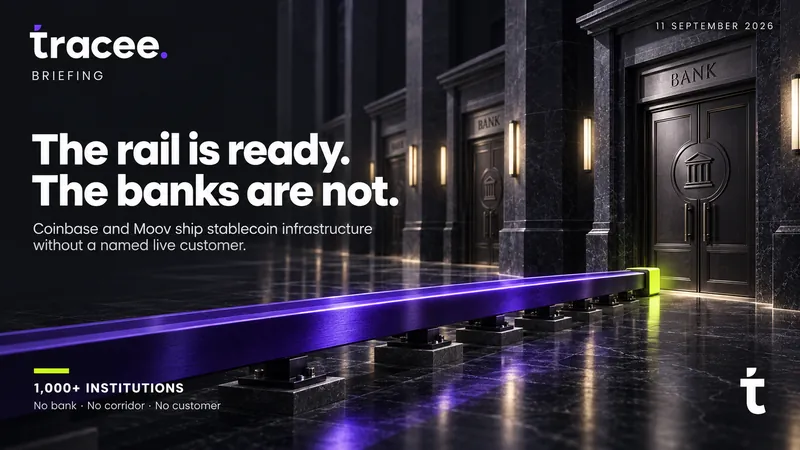
Coinbase and Moov gave 1,000-plus community banks and credit unions stablecoin payment infrastructure five days before the Senate's Clarity Act cloture vote.
Read briefing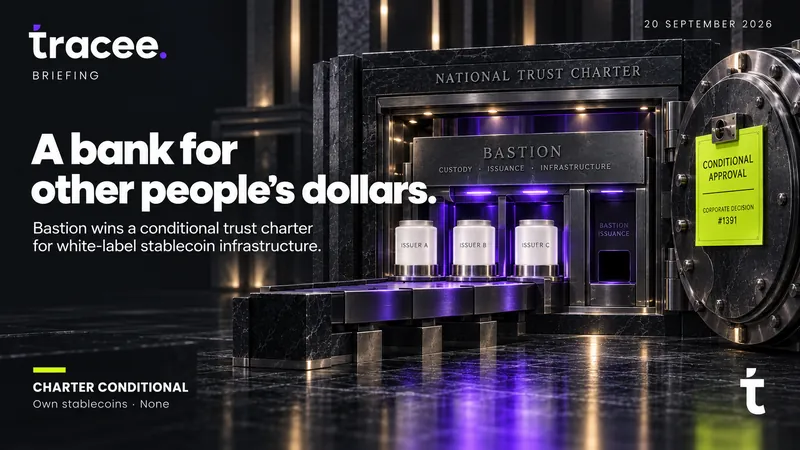
The OCC conditionally approved Bastion's national trust charter on 18 September, Corporate Decision #1391.
Read briefingQuant was named vendor for the tokenized deposit network 25 US banks are building, closing the watchpoint tracee flagged in June. No blockchain has been named yet.
Read briefingSuggest a news item or request a private briefing.
Public briefings publish on no fixed cadence. Private briefings, written for one institution and one decision, are part of the consulting engagement formats.
Book a discovery call