
Canada's Big Six banks answer stablecoins with a joint deposit token: OSFI cleared the legal question twelve days earlier, and nobody has named who builds it.
Six competitors, one statement, and a verb doing a lot of work.
Six banks that compete for the same deposits just agreed to share a rail instead. The statement names the ambition. It does not name the plumbing.
One joint statement, and most of what it settles is who signed, not what gets built.
Rate each element of the announcement on its own merits, not the headline's framing.
| Move | Status | Verdict |
|---|---|---|
| Six banks sign a joint statement | Shipped | Real commitment. BMO, CIBC, National Bank, RBC, Scotiabank and TD are on record together, not one bank running a pilot alone. |
| Phase one: interbank CAD tokenized-deposit transfers | Explore | Scoped narrow. Limited to moving balances among the six signatories, no customer-facing product named. |
| Connect to "other emerging digital asset initiatives" | Vague by design | A direction, not a plan. No named counterpart network, no interoperability standard, no timeline. |
| Blockchain platform or technology vendor | Not named | The load-bearing gap. No public disclosure of what the six banks would actually build the rail on. |
| Additional deposit-taking institutions joining | Open door | Invitation, not a roster. "Could join at an appropriate time" names no one and sets no criteria. |
One row is a hard fact. The other four are directions the six banks have agreed to point in, together, without agreeing yet on how to get there.
The legal predicate came first, the technical one is still blank.
Here is what the joint statement actually wires together, and what it leaves for later.
- The regulator moved first, on purpose. OSFI's technology-neutral ruling removed the one objection a bank's legal team could raise before agreeing to a pilot.
- Competitors, not a vendor consortium, hold the pen. The six banks committed to each other before committing to a technology stack, the opposite build order from most tokenized-deposit projects to date.
Six rivals cooperating is the actual signal, not the token.
Canada's Big Six compete hard for the same deposit base, current accounts, mortgages, commercial lending, the works. Getting all six to co-sign a joint statement on shared digital-money infrastructure, rather than each bank quietly building its own, is the notable fact here, not the underlying technology, which does not exist publicly yet. Press coverage of the announcement, from Coindesk to Ledger Insights to the Globe and Mail, converges on the same read: this is a defensive move against non-bank, dollar-denominated stablecoins that could otherwise pull Canadian-dollar balances out of the regulated banking system entirely.
The sequencing sharpens the read. OSFI's 10 September statement, which tracee covered the same week, removed the recurring legal objection compliance teams raise before recommending a tokenized-deposit pilot to their board: that the token might need its own legal wrapper. Twelve days later, six banks moved together. That is not proof the ruling caused the pact, but the timing is the kind large regulated institutions rarely leave to coincidence.
A joint statement is not a shared ledger, and this one has real gaps.
- No technology named. No blockchain platform, distributed-ledger vendor or interoperability standard is disclosed publicly, so there is nothing yet to evaluate for security, uptime or interoperability.
- No date. No completion target for phase one, no pilot-transaction date, nothing comparable to DBS and Citi's already-live Swift-ledger weekend payment.
- "Explore," not "launch." The verb in the joint statement is deliberately soft. This is a statement of intent among six banks, not a live interbank rail.
- No named spokesperson. The quotes are attributed to the joint statement collectively, not to a named executive at any one of the six banks, which is typical for a multi-party press release but limits accountability for the timeline.
- The invitation to other institutions is undefined. "Could join at an appropriate time" sets no criteria for which deposit-taking institutions qualify, or when that time arrives.
The US bank wave chose a shared stablecoin. Canada's Big Six chose the opposite instrument.
The contrast with tracee's own catalogue is sharp. In September, 21 US and international banks, Bank of America, Citi and Goldman Sachs among them, committed to a jointly owned dollar stablecoin venture, choosing to build a stablecoin rather than the tokenized deposits the BIS had just told Jackson Hole to prioritize. Canada's Big Six moved the other direction: a shared tokenized deposit, the instrument that keeps the balance a bank liability, not a stablecoin, which typically is not. Two G7 banking systems answered the same competitive pressure with two different instruments inside the same month.
Canada's federally regulated banking system is small and concentrated relative to the US, which is precisely why six banks reaching a joint statement is plausible here in a way a comparable US consortium of similar breadth has struggled to match quickly. The Clearing House's own US bank consortium, building toward a shared tokenized deposit network, is targeting the first half of 2027 and has not announced this kind of unified, all-major-bank joint statement. Canada's six just did, on ambition if not yet on infrastructure.
The deposit franchise was worth cooperating over. The rail underneath it still has no name.
Six competing Canadian banks agreeing to a joint statement on tokenized deposits, twelve days after their regulator cleared the legal path, is evidence the deposit franchise is worth more to them than the usual competitive instinct to build alone. It is not evidence of a working system. No platform, vendor, date or pilot transaction has been named, which puts this well behind the DBS and Citi Swift-ledger transfer already live, and roughly level with, not ahead of, the US consortium still building toward 2027.
Watch three things over the next two quarters:
- Whether a named platform or vendor is announced for phase one. That is the point this stops being a statement and starts being a build.
- Whether a completion date or first live transaction is announced. The gap between six banks agreeing and six banks settling one payment is the whole story.
- Whether other Canadian deposit-taking institutions, credit unions and smaller banks, are named as joining. That would turn an open invitation into an actual roster.
Common questions about Canada's Big Six tokenized deposit pact.
What did Canada's Big Six banks announce?
Is this a live product or just an announcement?
How does this relate to OSFI's tokenized deposit ruling?
Why are six competing banks cooperating on this?
Is a tokenized deposit the same as a stablecoin?
Related briefings on the same rails.

21 banks, from Bank of America to MUFG, committed to build a jointly owned dollar stablecoin company, three days after the BIS told Jackson Hole that tokenized…
Read briefingCiti's Tokenization 2030 report projects a $17B-to-$5.5T market by 2030, with DTCC (October 2026), Nasdaq, and ICE named as the infrastructure carriers.
Read briefing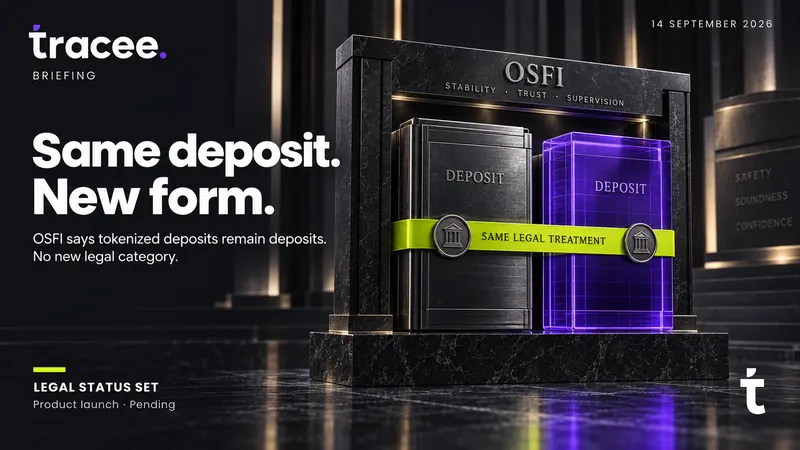
Canada's OSFI ruled tokenized deposits aren't legally distinct from ordinary ones, no new license, no new legal wrapper, while the FDIC still relies on a proposed…
Read briefingThe SEC releases a conditional exemption for crypto-native platforms to offer tokenized US equities outside full broker-dealer registration.
Read briefingDTCC named Stellar as the first public, permissionless blockchain for DTC-custodied securities on 27 May 2026, with availability targeted for H1 2027.
Read briefing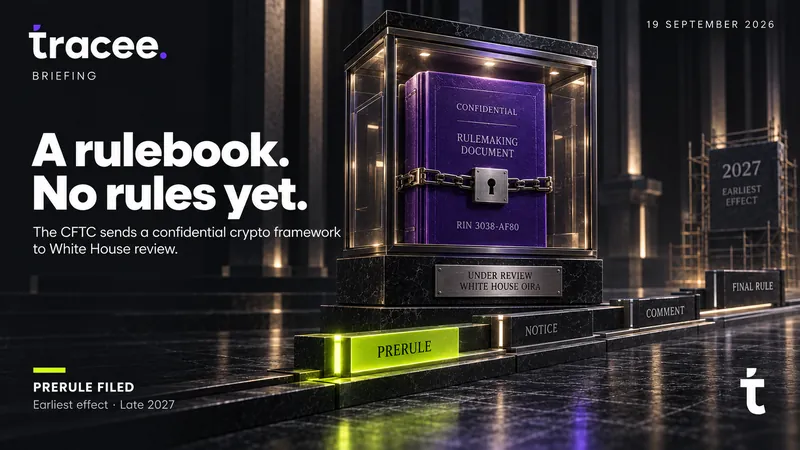
The CFTC submitted RIN 3038-AF80 to the White House OIRA on 17 September, two days after the Senate's Clarity Act cloture vote failed 49-50. The rule text is…
Read briefingSuggest a news item or request a private briefing.
Public briefings publish on no fixed cadence. Private briefings, written for one institution and one decision, are part of the consulting engagement formats.
Book a discovery call