
The CFTC just filed its own crypto rulebook with the White House. It's confidential, it bypasses Congress, and nothing in it binds anyone before 2027.
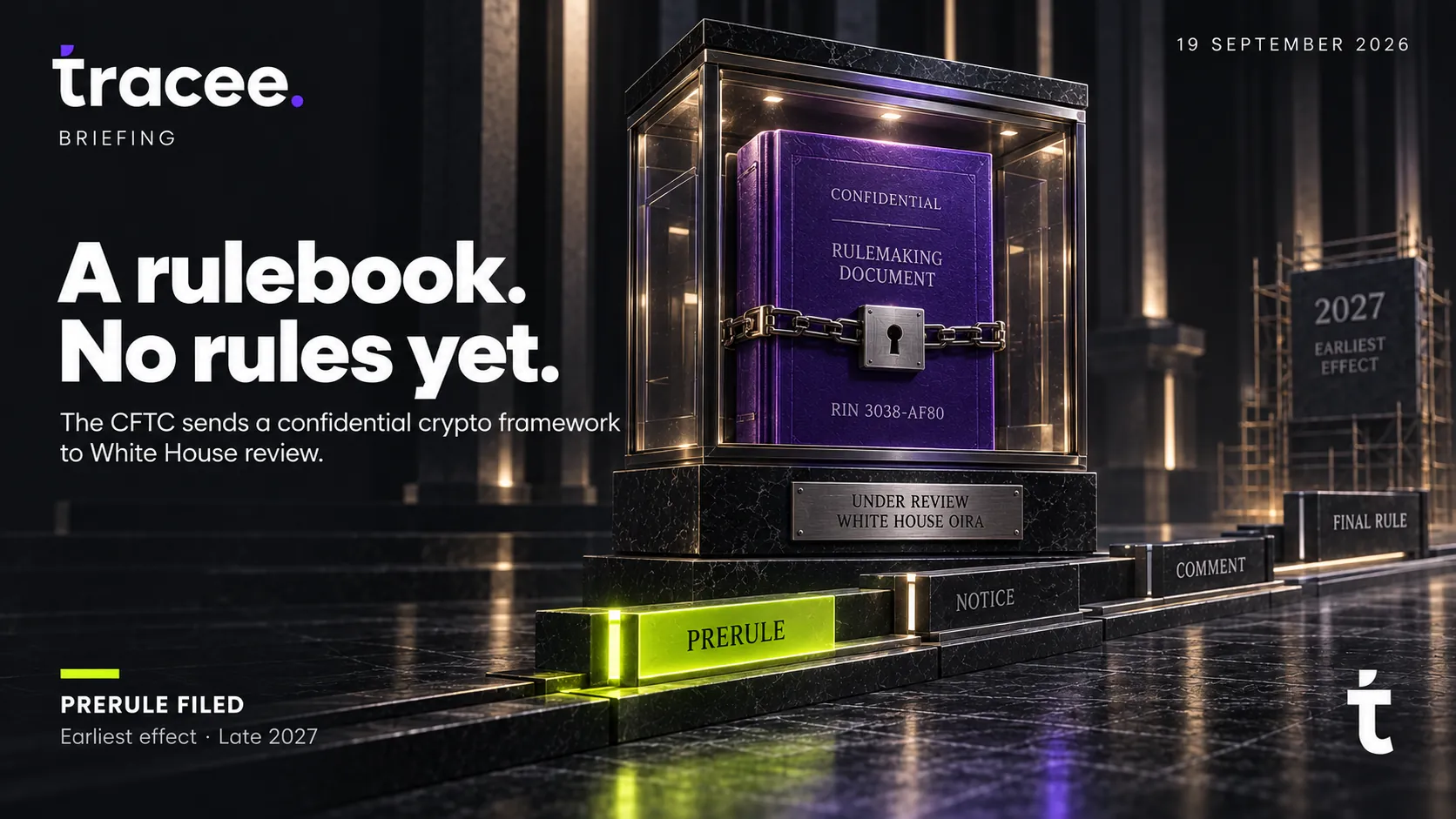
The entire public record fits in five lines. Everything else is reconstructed from a speech.
That is the complete public record as of publication. The substance behind it comes from what the Chairman already told the industry to expect, five weeks earlier.
Five steps sit between this filing and a rule anyone can be held to.
Strip the filing down to what actually exists today, versus what still has to happen before it means anything.
| Move | Status | Verdict |
|---|---|---|
| Filing submitted to OIRA | Filed | Real, procedurally. The CFTC submitted RIN 3038-AF80 on 17 September, the same day the SEC's separate exemption took effect. |
| Rule text | Confidential | Sealed, not summarized. Nothing beyond the title, RIN and stage is public while OIRA reviews it. |
| New "crypto asset market" DCM category | Previewed | Described, not confirmed. Chairman Selig outlined the concept in an August speech; whether the filed text still matches it is unverifiable. |
| Proposed rule in the Federal Register | Pending | Earliest case, November or December 2026, if OIRA clears its review in 60 of the 99 days it is allowed. |
| Binding final rule | Pending | Two comment rounds and a second OIRA review away. Not expected before late 2027 at the earliest. |
One row is done. Four are still ahead, and the one carrying the actual policy content is the one nobody outside government has read.
One filing, two clocks: a 99-day review, then a pipeline that runs into 2027.
Here is the sequence the filing has to survive before it regulates anything.
- The DCM category is the real payload. A "crypto asset market" designation would let currently unregistered spot exchanges apply for CFTC oversight without Congress ever amending the Commodity Exchange Act.
- OIRA is the only near-term checkpoint that matters. Nothing about this rule is public or binding until OIRA finishes a review it can legally stretch past year-end.
Two agencies filled the same gap the same week, with two different tools.
The Clarity Act needed 60 votes to break a Senate filibuster on 15 September and got 49. Two days later, on 17 September, the SEC issued a live exemptive order for tokenized stock trading. The same day, the CFTC quietly filed a rulemaking that changes nothing yet. Same trigger, same week, opposite instruments.
The DCM category Selig previewed is a bigger structural claim than the SEC's move. The SEC's exemption only reaches tokenized versions of stock already listed on NYSE or Nasdaq. A "crypto asset market" designation would let currently unregistered spot crypto exchanges, the kind Congress spent two years arguing over, apply directly for CFTC oversight, without a statute ever changing.
None of it is enforceable yet. A filed rulemaking is a procedural signal, not a market fact, and CFTC proposals built on "existing authority" have historically been narrowed once industry comment and legal review get at them. What survives contact with a published Federal Register text, not what Selig described in August, is the version that will actually govern anyone.
The filing is real. Almost everything it might contain is not yet verifiable.
- The text is secret. Beyond the RIN, title and stage, nothing about the substance is public; this briefing reconstructs the likely content from a speech given a month before the filing, not from the filing itself.
- Prerule is the earliest of five formal stages. It signals intent to draft, carries no legal weight, and can be withdrawn without a public trace if priorities change.
- "Not economically significant" cuts both ways. The classification means lighter White House scrutiny, but it also means the CFTC itself is not billing this internally as the market-structure overhaul it is described as elsewhere.
- CFTC jurisdiction over spot crypto markets remains legally contested. No statute clearly gives the CFTC authority over spot digital-commodity exchanges; building a DCM category on "existing authority" assumes a reading of the Commodity Exchange Act that has not been tested in court.
- Late 2027 is a floor, not a ceiling. Two OIRA reviews and two 60-day comment periods are the minimum path; a change in Commission priorities or personnel resets the clock further out.
tracee already covered the SEC's half of this week. This is the CFTC's, filed hours apart on the same clock's other track.
tracee's previous briefing covered the SEC's Innovation Exemption, issued 17 September for tokenized National Market System stock. This filing is the CFTC's parallel move, submitted the same day, and it completes the picture: the Clarity Act would have split jurisdiction between the SEC's securities perimeter and the CFTC's commodities perimeter. With the bill dead in the Senate, both agencies are now drawing that same perimeter administratively, on their own separate authorities and their own separate timetables.
Selig previewed the plan on 20 August at the CFTC's first Innovation Advisory Committee meeting, framing it explicitly as a fallback if the Clarity Act stalled. It stalled five days later. The filing that followed is the first hard evidence that the fallback plan is now operative, even though the operative text remains unseen.
Congress lost the pen. Two agencies picked it up, on different clocks.
The Clarity Act's failure did not stop the market-structure perimeter from being drawn, it just moved the drawing from the Capitol to two independent agencies. The SEC chose speed: an exemptive order, live today, revocable by the next Commission. The CFTC chose durability: a formal rulemaking that produces nothing enforceable for at least another year, but that could survive a change in administration if it clears two rounds of public comment. Both bets assume Congress stays stuck. Neither bet is safe if it doesn't.
Watch three things:
- The OIRA clearance date. A fast review signals White House priority; a full 99 days signals routine handling.
- Whether the published text matches Selig's August preview. The gap between a chairman's speech and a filed rule is where the real surprises live.
- A revived Clarity Act. Sixty votes in the Senate before late 2027 could pre-empt or reshape whatever the CFTC has built by then.
Common questions about the CFTC's OIRA filing.
What did the CFTC file with the White House?
What is a "crypto asset market" under this plan?
Why did this land two days after the Clarity Act vote failed?
When would a CFTC crypto rule actually take effect?
How does this compare to the SEC's Innovation Exemption?
Related briefings on the same rails.
GENIUS (signed July 2025) handled the stablecoin layer. CLARITY now draws the perimeter around everything it settles against: digital commodities to the CFTC…
Read briefing
The SEC's Innovation Exemption lets Tokenized Securities Venues trade tokenized NMS stock on permissioned AMMs for five years, two days after the Senate's Clarity…
Read briefing
Coinbase and Moov gave 1,000-plus community banks and credit unions stablecoin payment infrastructure five days before the Senate's Clarity Act cloture vote.
Read briefing
21 banks, from Bank of America to MUFG, committed to build a jointly owned dollar stablecoin company, three days after the BIS told Jackson Hole that tokenized…
Read briefing
The SEC sent "Amendments to the Custody Rules" to the White House on 25 August, reviving a crypto custody rewrite that died under Gensler in 2025.
Read briefingThe SEC releases a conditional exemption for crypto-native platforms to offer tokenized US equities outside full broker-dealer registration.
Read briefingSuggest a news item or request a private briefing.
Public briefings publish on no fixed cadence. Private briefings, written for one institution and one decision, are part of the consulting engagement formats.
Book a discovery call